Page 77 of 325
Make sure the rear window is clear
and you have good visibility bef ore
starting to drive.
The def ogger and antenna wires on
the inside of the rear window can be
accidentally damaged. When
cleaning the glass, always wipe side
to side.
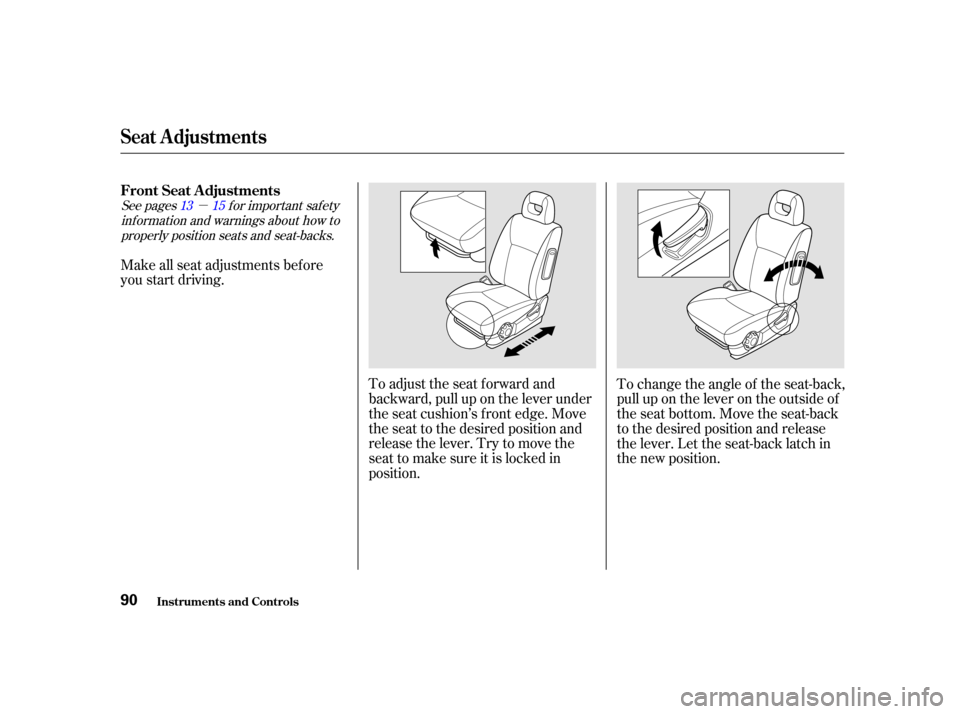
Push the button between the center
vents to turn on the hazard warning
lights (f our-way f lashers). This
causes all f our outside turn signals
and both indicators in the instrument
panel to f lash. Use the hazard
warning lights if you need to park in
a dangerous area near heavy traffic,
or if your car is disabled. The rear window def ogger will clear
fog, frost, and thin ice from the
window. Push the def ogger button to
turn it on and of f . The light in the
button lights to show the def ogger is
on. If you do not turn it of f , the
def ogger will shut itself of f af ter
about15minutes.Italsoshutsoff
when you turn of f the ignition. You
have to turn it on again when you
restart the car.
Controls Near the Steering Wheel
Inst rument s and Cont rols
Rear Window Def ogger
Hazard Warning
74
Page 93 of 325
�µ
See pages f or important saf ety
inf ormation and warnings about how toproperly position seats and seat-backs. 13 15
Make all seat adjustments bef ore
you start driving.
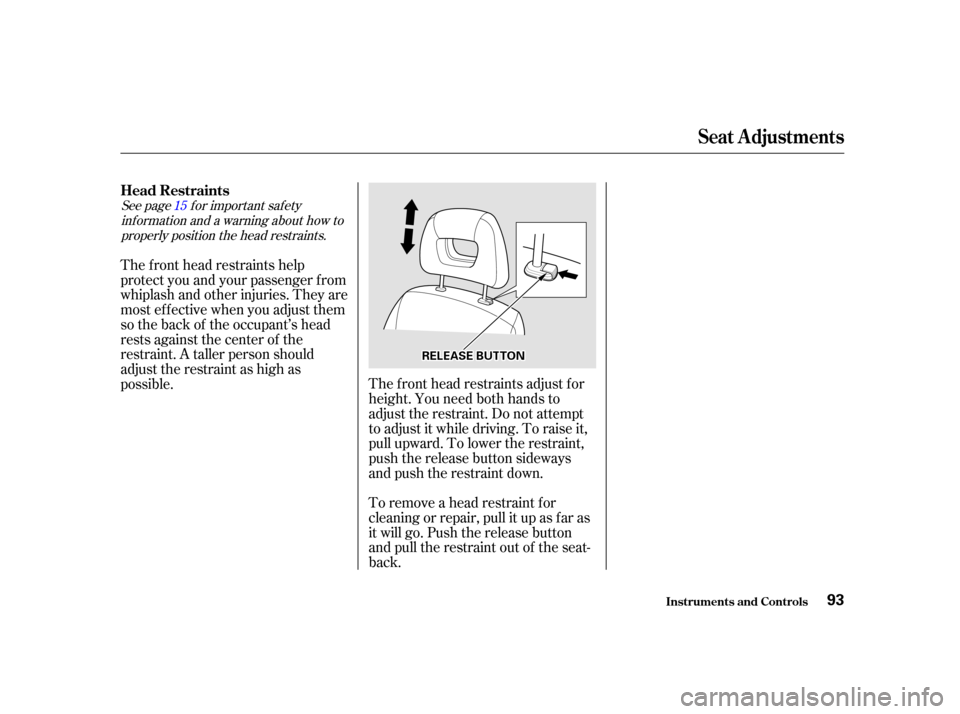
To adjust the seat forward and
backward, pull up on the lever under
the seat cushion’s f ront edge. Move
the seat to the desired position and
releasethelever.Trytomovethe
seat to make sure it is locked in
position.To change the angle of the seat-back,
pull up on the lever on the outside of
the seat bottom. Move the seat-back
to the desired position and release
the lever. Let the seat-back latch in
the new position.
FrontSeatAdjustments
Seat A djustments
Inst rument s and Cont rols90
Page 96 of 325
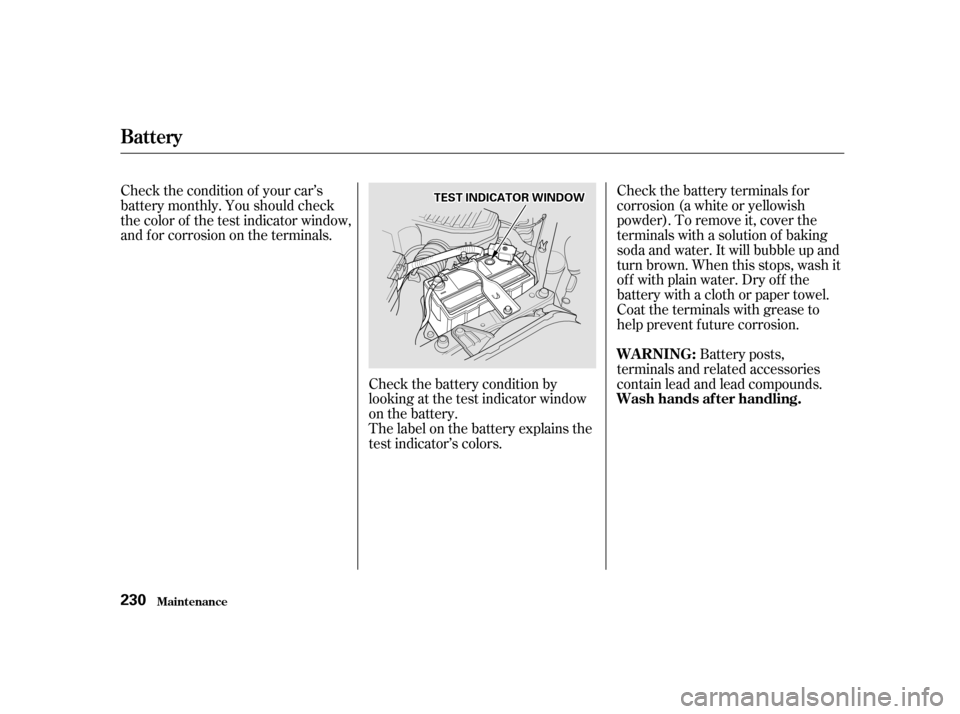
To remove a head restraint f or
cleaning or repair, pull it up as f ar as
it will go. Push the release button
and pull the restraint out of the seat-
back. The f ront head restraints adjust f or
height. You need both hands to
adjust the restraint. Do not attempt
to adjust it while driving. To raise it,
pull upward. To lower the restraint,
push the release button sideways
and push the restraint down.
The f ront head restraints help
protect you and your passenger f rom
whiplash and other injuries. They are
most ef f ective when you adjust them
so the back of the occupant’s head
rests against the center of the
restraint. A taller person should
adjust the restraint as high as
possible.
See page f or important saf ety
inf ormation and a warning about how toproperly position the head restraints. 15
Seat A djustments
Inst rument s and Cont rols
Head Restraints
93
R RE
EL
LEE A
A S
SEE B
BUUT TT
TO
ON N
Page 197 of 325
�µCheck your tires
f requently f or wear and proper
pressure. Both are important in
preventing ‘‘hydroplaning’’ (loss of
traction on a wet surface). In the
winter, mount snow tires on all f our
wheels f or the best handling.
Watch road conditions caref ully,
they can change f rom moment to
moment. Wet leaves can be as slip-
pery as ice. ‘‘Clear’’ roads can have
patches of ice. Driving conditions
can be very hazardous when the
outside temperature is near f reezing.
The road surf ace can become
covered with areas of water puddles
mixed with areas of ice, so your
traction can change without warning.
Be caref ul when downshif ting. If
traction is low, you can lock up the
drive wheels f or a moment and cause
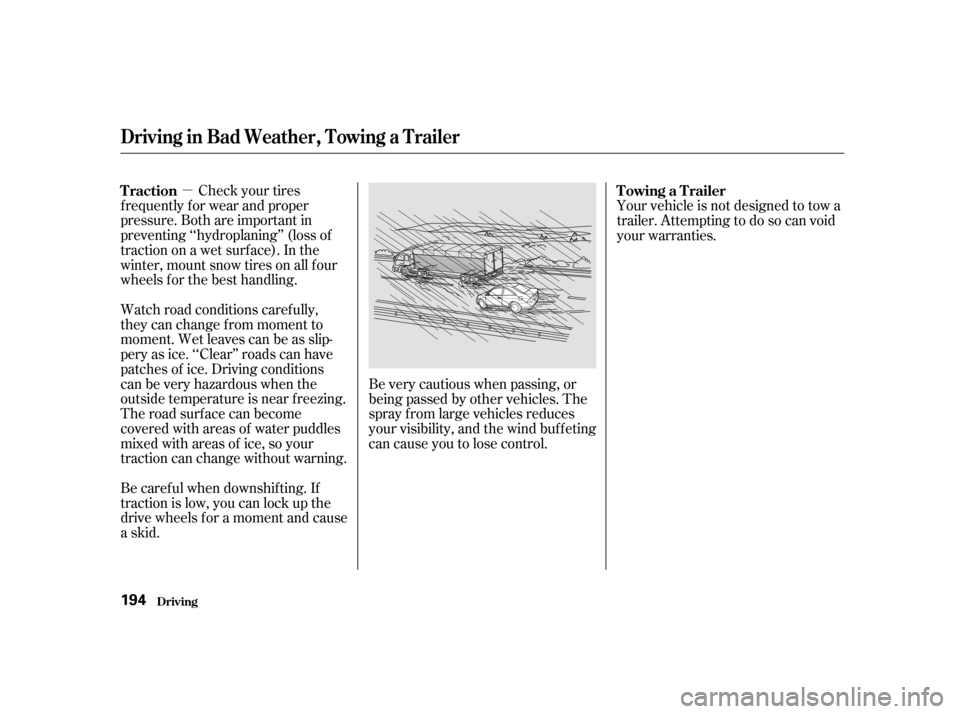
askid. Be very cautious when passing, or
beingpassedbyothervehicles.The
spray f rom large vehicles reduces
your visibility, and the wind buf f eting
can cause you to lose control.Your vehicle is not designed to tow a
trailer. Attempting to do so can void
your warranties. Towing a Trailer
Traction
Driving in Bad Weather, Towing a Trailer
Driving194
Page 219 of 325
�µ
�´ �´
�µ
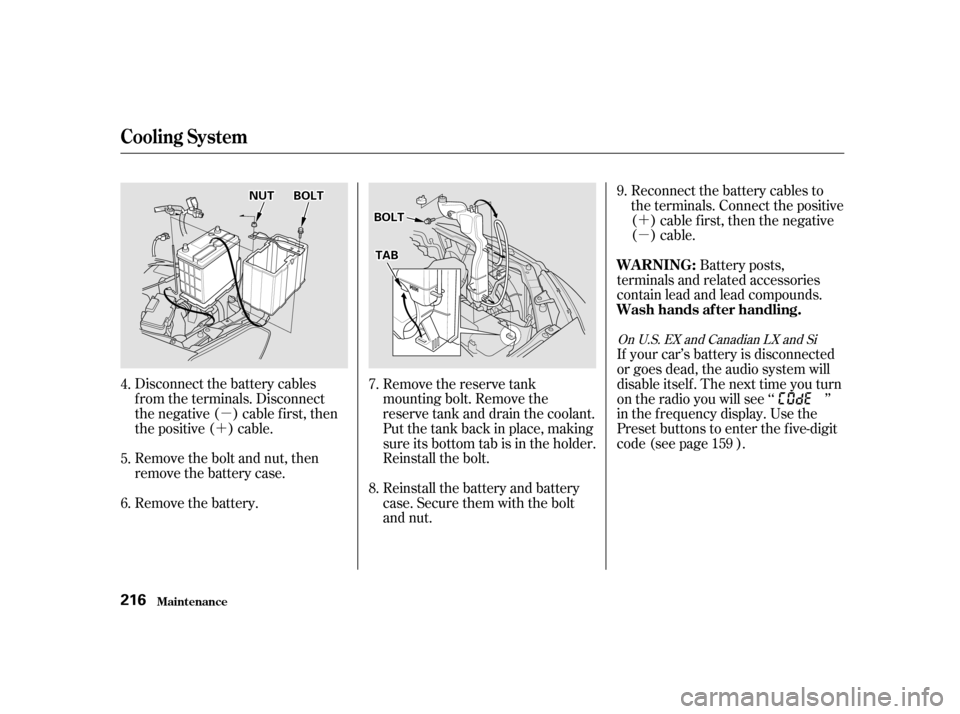
Disconnect the battery cables
f rom the terminals. Disconnect
the negative ( ) cable first, then
the positive ( ) cable.
Remove the bolt and nut, then
remove the battery case. Remove the reserve tank
mounting bolt. Remove the
reserve tank and drain the coolant.
Put the tank back in place, making
sure its bottom tab is in the holder.
Reinstall the bolt.
Reinstall the battery and battery
case. Secure them with the bolt
and nut.Reconnect the battery cables to
the terminals. Connect the positive
( ) cable f irst, then the negative
()cable.
Battery posts,
terminals and related accessories
contain lead and lead compounds.
Remove the battery. If your car’s battery is disconnected
or goes dead, the audio system will
disableitself.Thenexttimeyouturn
on the radio you will see ‘‘ ’’
in the f requency display. Use the
Preset buttons to enter the five-digit
code (see page ).
4.
6. 7.
5. 8.9.
159
On U.S. EX and Canadian LX and Si
Cooling Syst em
Maint enance
WARNING:
Wash hands af ter handling.
216
N NUUTT B
BOOL LTT
B
BOOL LTT
T
T A
A B
B
Page 233 of 325
Check the battery terminals for
corrosion (a white or yellowish
powder). To remove it, cover the
terminals with a solution of baking
soda and water. It will bubble up and
turn brown. When this stops, wash it
of f with plain water. Dry of f the
battery with a cloth or paper towel.
Coat the terminals with grease to
help prevent f uture corrosion.
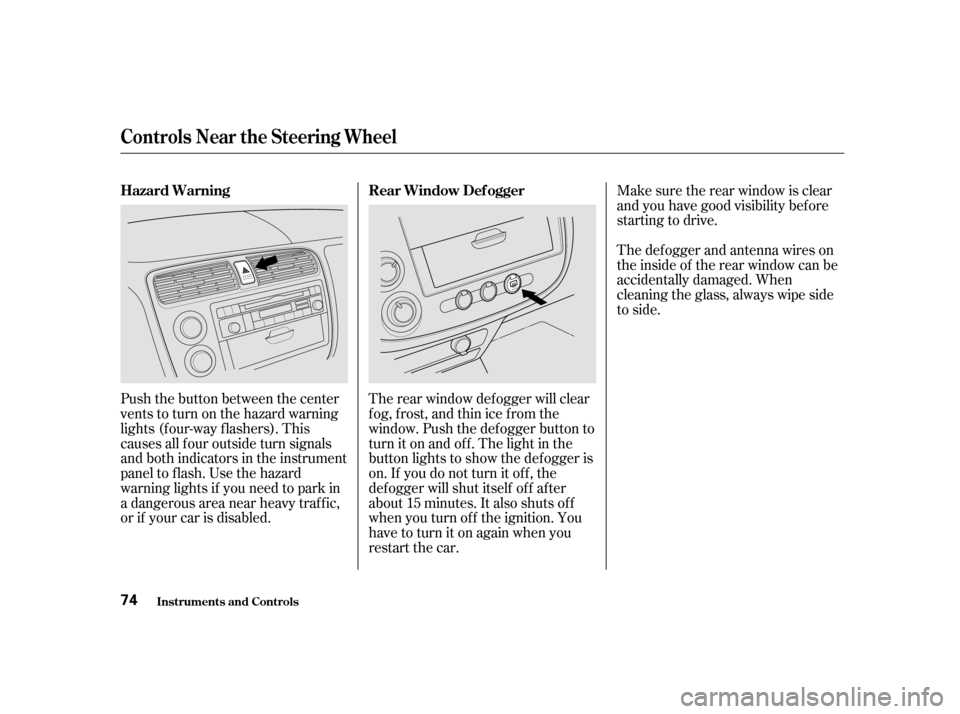
Check the battery condition by
looking at the test indicator window
on the battery.
The label on the battery explains the
test indicator’s colors.
Check the condition of your car’s
battery monthly. You should check
the color of the test indicator window,
and f or corrosion on the terminals.
Battery posts,
terminals and related accessories
contain lead and lead compounds.
Battery
Maint enance
WARNING:
Wash hands af ter handling.
230
T T E
ES
ST T I
INND DI
ICCA A T
TO
OR R W
WI INND DO
OW W
Page 268 of 325
If you have a f lat tire while driving,
stop in a saf e place to change it.
Stopping in traf f ic or on the shoulder
of a busy road is dangerous. Drive
slowly along the shoulder until you
gettoanexitoranareatostopthat
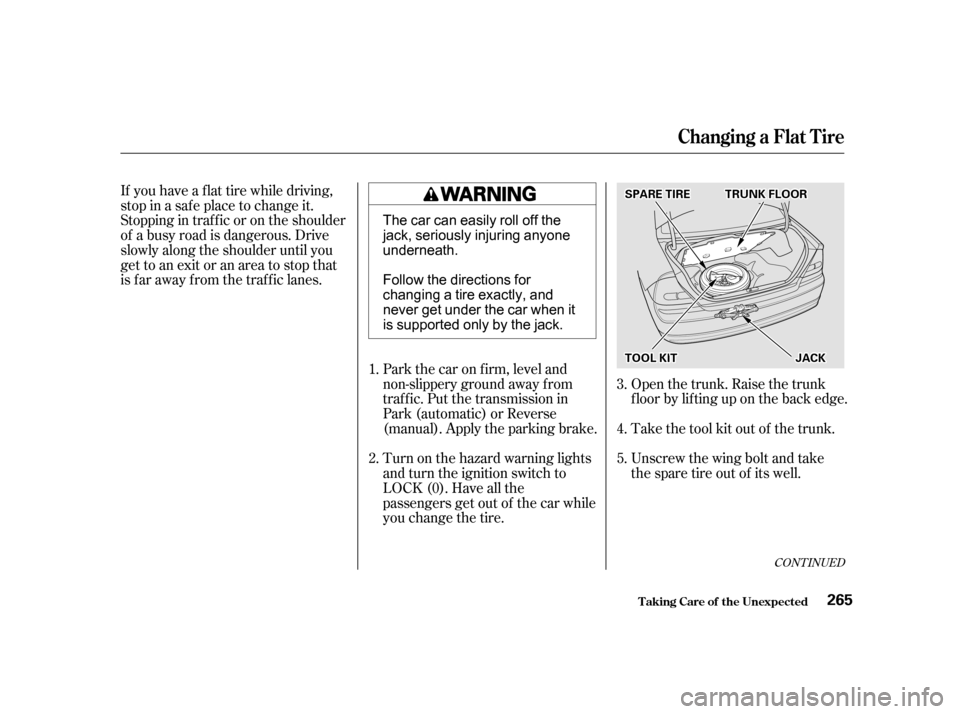
is far away from the traffic lanes.Open the trunk. Raise the trunk
f loor by lif ting up on the back edge.
Take the tool kit out of the trunk.
Unscrew the wing bolt and take
the spare tire out of its well.
Park the car on f irm, level and
non-slippery ground away f rom
traf f ic. Put the transmission in
Park (automatic) or Reverse
(manual). Apply the parking brake.
Turn on the hazard warning lights
and turn the ignition switch to
LOCK (0). Have all the
passengers get out of the car while
you change the tire.
5. 4. 3.
2. 1.
CONT INUED
Changing a Flat T ire
T aking Care of t he Unexpect ed265
S SP PA
A R
REE T
TI
IRRE E T
TR
RU UN NKK F
FLLOOO ORR
T
T O
OO OLL K
KIITT J
JAA C
CKK
The car can easily roll off the
jack, seriously injuring anyone
underneath.
Follow the directions for
changing a tire exactly, and
never get under the car when it
is supported only by the jack.
Page 275 of 325

If youfindnothingwrong,youwill
need a qualif ied technician to f ind
the problem. Seeon page .
In this case, the starter motor’s
speed sounds normal, or even f aster
than normal, when you turn the
ignition switch to START (III), but
the engine does not run.
Your car has the Immobilizer
System. You should use a
properly-coded master or valet key
to start the engine (see page ).
A key that is not properly coded
will cause the immobilizer system
indicator in the dash panel to blink
rapidly.
Are you using the proper starting
procedure? Ref er to on page . Do you have f uel? Turn the
ignition switch to ON (II) for a
minute and watch the f uel gauge.
The low f uel level warning light
may not be working, so you were
not reminded to f ill the tank.
There may be an electrical
problem, such as no power to the
f uel pump. Check all the f uses
(see page ).
80
177 285
289
Emergency
Towing
T he Starter Operates Normally
Starting the
Engine
If Your Engine Won’t Start
T aking Care of t he Unexpect ed272