Page 302 of 419

5-35 Rocking Your Vehicle To Get It Out
First, turn your steering wheel left and right. That will
clear the area around your front wheels. If you have a
four
-wheel drive vehicle, shift into 4HI or 4LO. If your
vehicle has the Traction Assist System, you should turn
it off by pressing the TAS on/off button. Then shift back
and forth between REVERSE (R) and a forward gear,
spinning the wheels as little as possible. Release the
accelerator pedal while you shift, and press lightly on
the accelerator pedal when the transmission is in gear.
By slowly spinning your wheels in the forward and
reverse directions, you will cause a rocking motion that
may free your vehicle. If that doesn't get you out after
a few tries, you may need to be towed out. Or, you can
use your recovery hooks if your vehicle has them. If you
do need to be towed out, see ªTowing Your Vehicleº in
the Index.
Using the Recovery Hooks
Your vehicle may be equipped with recovery hooks.
The recovery hooks are provided at the front of your
vehicle. You may need to use them if you're stuck
off
-road and need to be pulled to some place where
you can continue driving.
Page 304 of 419

6-
6-1
Section 6 Service and Appearance Care
Here you will find information about the care of your vehicle. This section begins with service and fuel information,
and then it shows how to check important fluid and lubricant levels. There is also technical information about your
vehicle, and a part devoted to its appearance care.
6
-2 Service
6
-3 Fuel
6
-5 Fuels in Foreign Countries
6
-5 Filling Your Tank
6
-8 Filling a Portable Fuel Container
6
-8 Checking Things Under the Hood
6
-13 Noise Control System
6
-14 Engine Oil
6
-18 Engine Air Cleaner/Filter
6
-20 Passenger Compartment Air Filter
(If Equipped)
6
-21 Automatic Transmission Fluid
6
-25 Rear Axle
6
-25 Four-Wheel Drive
6
-27 Engine Coolant
6
-30 Coolant Surge Tank Pressure Cap
6
-30 Power Steering Fluid6
-32 Windshield Washer Fluid
6
-33 Brakes
6
-37 Battery
6
-37 Bulb Replacement
6
-43 Windshield Wiper Blade Replacement
6
-44 Tires
6
-53 Appearance Care
6
-53 Cleaning the Inside of Your Vehicle
6
-57 Cleaning the Outside of Your Vehicle
6
-61 GM Vehicle Care/Appearance Materials
6
-62 Vehicle Identification Number (VIN)
6
-63 Electrical System
6
-71 Replacement Bulbs
6
-72 Capacities and Specifications
6
-74 Normal Maintenance Replacement Parts
Page 328 of 419
6-25
Rear Axle
When to Check Lubricant
Refer to the Maintenance Schedule to determine how
often to check the lubricant. Additional rear axle
scheduled maintenance is required when trailer towing.
See ªScheduled Maintenance Servicesº in the Index.
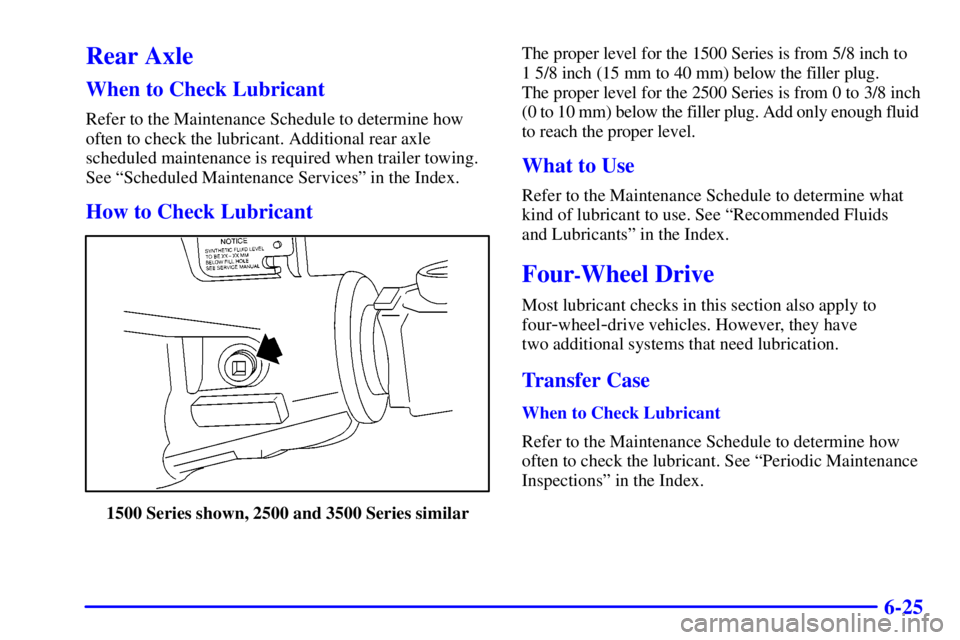
How to Check Lubricant
1500 Series shown, 2500 and 3500 Series similarThe proper level for the 1500 Series is from 5/8 inch to
1 5/8 inch (15 mm to 40 mm) below the filler plug.
The proper level for the 2500 Series is from 0 to 3/8 inch
(0 to 10 mm) below the filler plug. Add only enough fluid
to reach the proper level.
What to Use
Refer to the Maintenance Schedule to determine what
kind of lubricant to use. See ªRecommended Fluids
and Lubricantsº in the Index.
Four-Wheel Drive
Most lubricant checks in this section also apply to
four
-wheel-drive vehicles. However, they have
two additional systems that need lubrication.
Transfer Case
When to Check Lubricant
Refer to the Maintenance Schedule to determine how
often to check the lubricant. See ªPeriodic Maintenance
Inspectionsº in the Index.
Page 368 of 419
6-65
NAME Usage
CRUISE Cruise Control, Instrument Cluster
IGN 3 Ignition, Power Seats
4WD Four
-Wheel Drive System,
Auxiliary Battery
CRANK Starting System
INT PRK Parking Lamps, Sidemarker
Lamps, Interior Lamps
L DOOR Power Door Lock Relay
BRAKE Anti
-Lock Brake System
RR WIPER Rear Window Wiper
ILLUM Interior Lamps
SEAT Power Seat Circuit Breaker
TURN Exterior Lamps, Turn Signals,
Hazard Lamps
UNLOCK Power Door Locks
HTR A/C Climate Control System
WS WPR Windshield WipersNAME Usage
IGN 1 Ignition, Instrument Panel
AIR BAG Air Bag
MIR/LOCK Power Mirrors, Power Door Locks
DR LOCK Power Door Locks
PWR WDO Power Window Circuit Breaker
UNLOCK Power Door Lock Relay
IGN 0 PRND321 Display,
Odometer, PCM
SEO IGN Special Equipment
Option, Ignition, Onstar
�
SEO ACCY Special Equipment Option
Accessory, Cellular Telephone
RAP #1 Retained Accessory Power Relay
RDO I Audio System, Onstar
�
RAP #2 Rear Power Windows,
Sunroof, Radio, Onstar�
Page 382 of 419

7-4
Part A: Scheduled
Maintenance Services
Using Your Maintenance Schedule
We at General Motors want to help you keep your
vehicle in good working condition. But we don't know
exactly how you'll drive it. You may drive very short
distances only a few times a week. Or you may drive
long distances all the time in very hot, dusty weather.
You may use your vehicle in making deliveries.
Or you may drive it to work, to do errands or in
many other ways.
Because of all the different ways people use their
vehicles, maintenance needs vary. You may need more
frequent checks and replacements. So please read the
following and note how you drive. If you have any
questions on how to keep your vehicle in good
condition, see your dealer.
This part tells you the maintenance services you should
have done and when you should schedule them. If you
go to your dealer for your service needs, you'll know
that GM
-trained and supported service people will
perform the work using genuine GM parts.The proper fluids and lubricants to use are listed in Part D.
Make sure whoever services your vehicle uses these. All
parts should be replaced and all necessary repairs done
before you or anyone else drives the vehicle.
This schedule is for vehicles that:
�carry passengers and cargo within recommended
limits. You will find these limits on your vehicle's
Certification/Tire label. See ªLoading Your Vehicleº
in the Index.
�are driven on reasonable road surfaces within legal
driving limits.
�are driven off
-road in the recommended manner. See
ªOff
-Road Driving With Your Four-Wheel-Drive
Vehicleº in the Index.
�use the recommended fuel. See ªFuelº in the Index.
Page 401 of 419

7-23 Throttle System Inspection
Inspect the throttle system for interference or binding,
and for damaged or missing parts. Replace parts as
needed. Replace any components that have high effort
or excessive wear. Do not lubricate accelerator and
cruise control cables.
Transfer Case and Front Axle
(Four-Wheel Drive) Inspection
Every 12 months or at engine oil change intervals, check
front axle and transfer case and add lubricant when
necessary. A fluid loss could indicate a problem; check
and have it repaired, if needed. On manual shift transfer
case, oil the control lever pivot point. Check vent hose
at transfer case for kinks and proper installation. More
frequent lubrication may be required on off
-road use.
Brake System Inspection
Inspect the complete system. Inspect brake lines and
hoses for proper hook
-up, binding, leaks, cracks,
chafing, etc. Inspect disc brake pads for wear and
rotors for surface condition. Inspect other brake parts,
including calipers, parking brake, etc. You may need
to have your brakes inspected more often if your
driving habits or conditions result in frequent braking.
Page:
< prev 1-8 9-16 17-24
