Page 233 of 407
4-55 When You Are Ready to Leave After
Parking on a Hill
1. Apply your regular brakes and hold the pedal down
while you:
�Start your engine;
�Shift into a gear; and
�Release the parking brake.
2. Let up on the brake pedal.
3. Drive slowly until the trailer is clear of the chocks.
4. Stop and have someone pick up and store the chocks.
Maintenance When Trailer Towing
Your vehicle will need service more often when you're
pulling a trailer. See the Maintenance Schedule for more
on this. Things that are especially important in trailer
operation are automatic transmission fluid (don't
overfill), engine oil, axle lubricant, belt, cooling system
and brake system. Each of these is covered in this
manual, and the Index will help you find them quickly.
If you're trailering, it's a good idea to review these
sections before you start your trip.
Check periodically to see that all hitch nuts and bolts
are tight.
Page 243 of 407
5-10
Cooling System
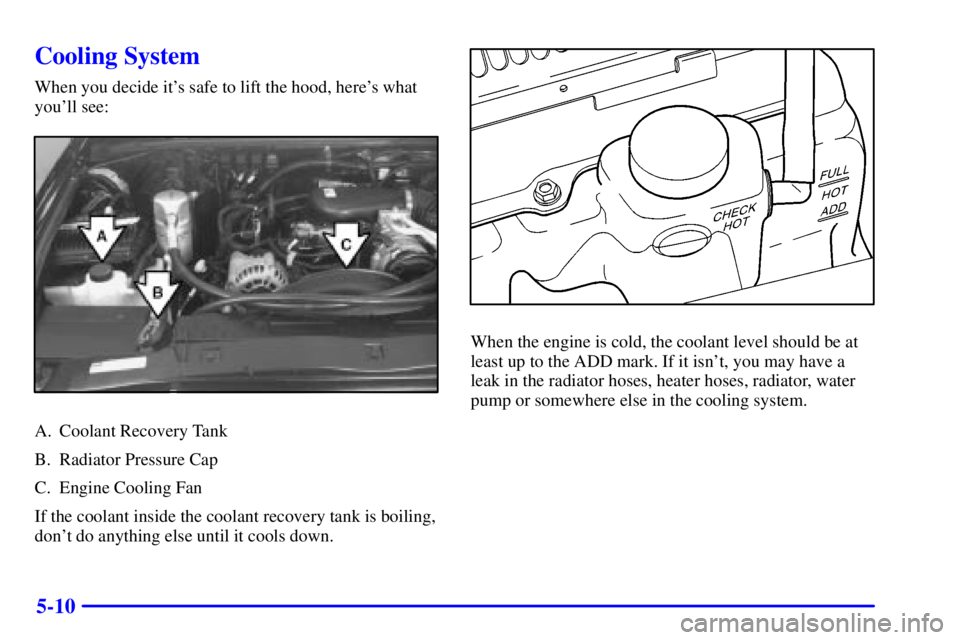
When you decide it's safe to lift the hood, here's what
you'll see:
A. Coolant Recovery Tank
B. Radiator Pressure Cap
C. Engine Cooling Fan
If the coolant inside the coolant recovery tank is boiling,
don't do anything else until it cools down.
When the engine is cold, the coolant level should be at
least up to the ADD mark. If it isn't, you may have a
leak in the radiator hoses, heater hoses, radiator, water
pump or somewhere else in the cooling system.
Page 245 of 407
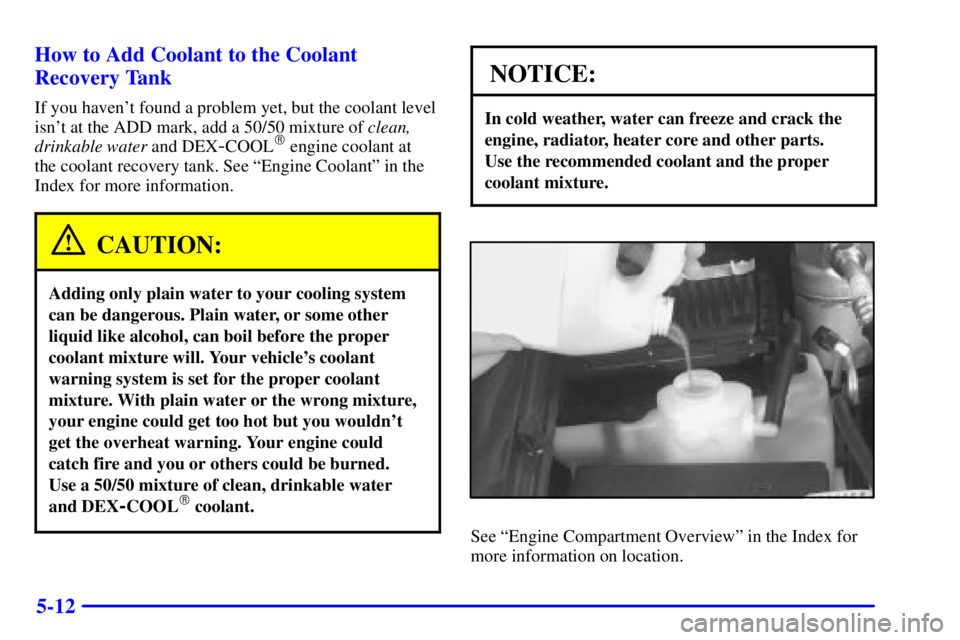
5-12 How to Add Coolant to the Coolant
Recovery Tank
If you haven't found a problem yet, but the coolant level
isn't at the ADD mark, add a 50/50 mixture of clean,
drinkable water and DEX
-COOL� engine coolant at
the coolant recovery tank. See ªEngine Coolantº in the
Index for more information.
CAUTION:
Adding only plain water to your cooling system
can be dangerous. Plain water, or some other
liquid like alcohol, can boil before the proper
coolant mixture will. Your vehicle's coolant
warning system is set for the proper coolant
mixture. With plain water or the wrong mixture,
your engine could get too hot but you wouldn't
get the overheat warning. Your engine could
catch fire and you or others could be burned.
Use a 50/50 mixture of clean, drinkable water
and DEX
-COOL� coolant.
NOTICE:
In cold weather, water can freeze and crack the
engine, radiator, heater core and other parts.
Use the recommended coolant and the proper
coolant mixture.
See ªEngine Compartment Overviewº in the Index for
more information on location.
Page 257 of 407
5-24
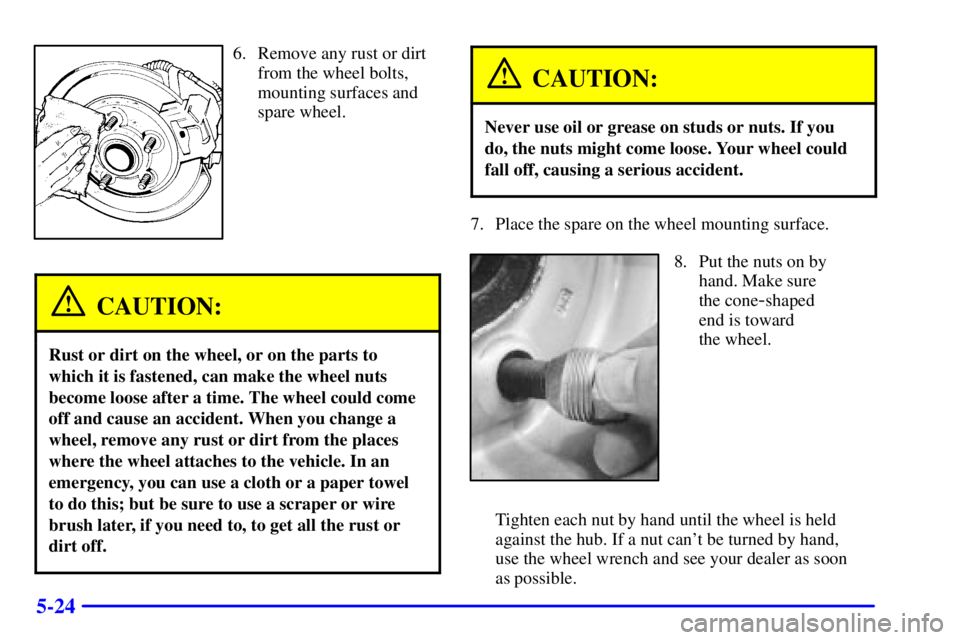
6. Remove any rust or dirt
from the wheel bolts,
mounting surfaces and
spare wheel.
CAUTION:
Rust or dirt on the wheel, or on the parts to
which it is fastened, can make the wheel nuts
become loose after a time. The wheel could come
off and cause an accident. When you change a
wheel, remove any rust or dirt from the places
where the wheel attaches to the vehicle. In an
emergency, you can use a cloth or a paper towel
to do this; but be sure to use a scraper or wire
brush later, if you need to, to get all the rust or
dirt off.
CAUTION:
Never use oil or grease on studs or nuts. If you
do, the nuts might come loose. Your wheel could
fall off, causing a serious accident.
7. Place the spare on the wheel mounting surface.
8. Put the nuts on by
hand. Make sure
the cone
-shaped
end is toward
the wheel.
Tighten each nut by hand until the wheel is held
against the hub. If a nut can't be turned by hand,
use the wheel wrench and see your dealer as soon
as possible.
Page 266 of 407

6-
6-1
Section 6 Service and Appearance Care
Here you will find information about the care of your vehicle. This section begins with service and fuel information,
and then it shows how to check important fluid and lubricant levels. There is also technical information about your
vehicle, and a part devoted to its appearance care.
6
-2 Service
6
-3 Fuel (Gasoline)
6
-5 Fuel E-85 (85% Ethanol)
6
-7 Fuels in Foreign Countries
6
-7 Filling Your Tank
6
-9 Filling a Portable Fuel Container
6
-10 Checking Things Under the Hood
6
-13 Engine Oil
6
-18 Engine Air Cleaner/Filter
6
-19 Automatic Transmission Fluid
6
-23 Manual Transmission Fluid
6
-24 Hydraulic Clutch
6
-25 Rear Axle
6
-26 Four-Wheel Drive
6
-27 Engine Coolant
6
-31 Radiator Pressure Cap
6
-31 Power Steering Fluid6
-32 Windshield Washer Fluid
6
-33 Brakes
6
-37 Battery
6
-38 Bulb Replacement
6
-44 Windshield Wiper Blade Replacement
6
-46 Tires
6
-55 Appearance Care
6
-55 Cleaning the Inside of Your Vehicle
6
-57 Care of Safety Belts
6
-58 Cleaning the Outside of Your Vehicle
6
-62 GM Vehicle Care/Appearance Materials Chart
6
-63 Vehicle Identification Number (VIN)
6
-63 Service Parts Identification Label
6
-64 Electrical System
6
-69 Replacement Bulbs
6
-70 Capacities and Specifications
6
-72 Normal Maintenance Replacement Parts
Page 272 of 407
6-7
Fuels in Foreign Countries
If you plan on driving in another country outside the
United States or Canada, the proper fuel may be hard
to find. Never use leaded gasoline or any other fuel not
recommended in the previous text on fuel. Costly repairs
caused by use of improper fuel wouldn't be covered by
your warranty.
To check on fuel availability, ask an auto club, or
contact a major oil company that does business in the
country where you'll be driving.
Filling Your Tank
CAUTION:
Fuel vapor is highly flammable. It burns
violently, and that can cause very bad injuries.
Don't smoke if you're near fuel or refueling
your vehicle. Keep sparks, flames and smoking
materials away from fuel.
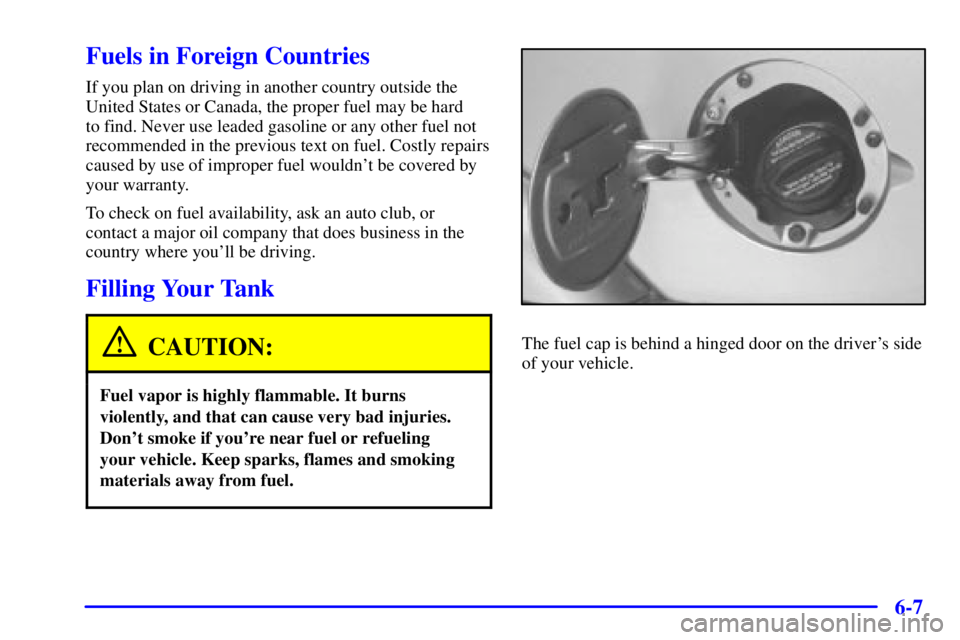
The fuel cap is behind a hinged door on the driver's side
of your vehicle.
Page 275 of 407
6-10
Checking Things Under the Hood
CAUTION:
Things that burn can get on hot engine parts and
start a fire. These include liquids like fuel, oil,
coolant, brake fluid, windshield washer and other
fluids, and plastic or rubber. You or others could
be burned. Be careful not to drop or spill things
that will burn onto a hot engine.
Hood Release
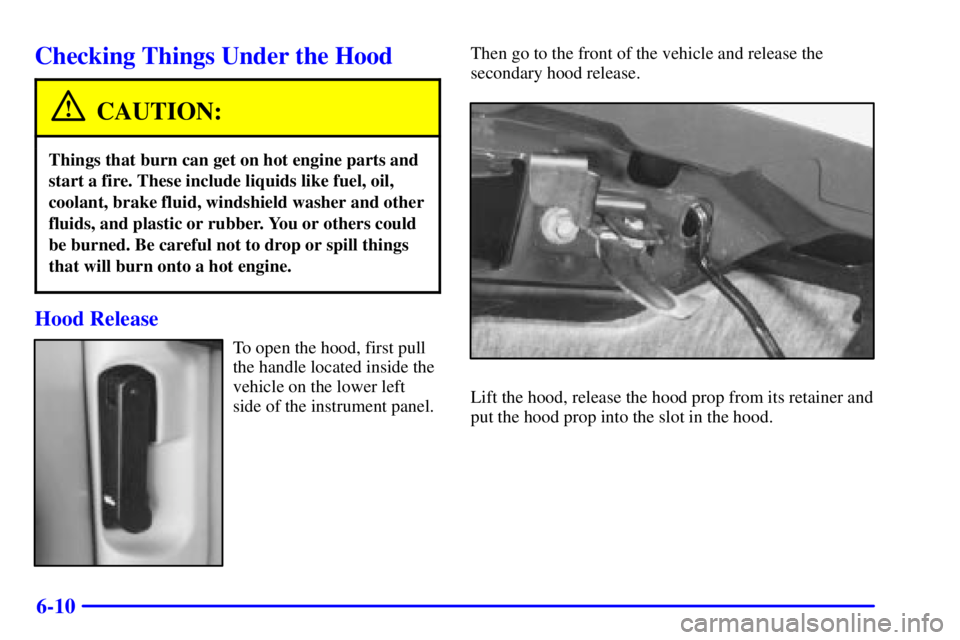
To open the hood, first pull
the handle located inside the
vehicle on the lower left
side of the instrument panel.Then go to the front of the vehicle and release the
secondary hood release.
Lift the hood, release the hood prop from its retainer and
put the hood prop into the slot in the hood.
Page 276 of 407
6-11 Engine Compartment Overview
When you open the hood on the ªVORTECº 2200 L4 engine, you'll see:
A. Battery
B. Coolant Recovery Tank
C. Automatic Transmission Dipstick
D. Engine Oil Fill Cap and DipstickE. Power Steering Reservoir
F. Brake Master Cylinder
G. Engine Air Cleaner/FilterH. Engine Compartment
Fuse Block
I. Windshield Washer
Fluid Reservoir