Page 47 of 468

1-34 Servicing Your Air Bag-Equipped Vehicle
Air bags affect how your vehicle should be serviced.
There are parts of the air bag system in several places
around your vehicle. You don't want the system to
inflate while someone is working on your vehicle.
Your dealer and the service manual have information
about servicing your vehicle and the air bag system.
To purchase a service manual, see ªService and Owner
Publicationsº in the Index.
CAUTION:
For up to 10 minutes after the ignition key is
turned off and the battery is disconnected, an air
bag can still inflate during improper service. You
can be injured if you are close to an air bag when
it inflates. Avoid wires wrapped with yellow tape
or yellow connectors. They are probably part of
the air bag system. Be sure to follow proper
service procedures, and make sure the person
performing work for you is qualified to do so.
The air bag system does not need regular maintenance.
Adding Equipment to Your Air
Bag-Equipped Vehicle
Q:If I add a push bumper or a bicycle rack to
the front of my vehicle, will it keep the air bags
from working properly?
A:As long as the push bumper or bicycle rack is
attached to your vehicle so that the vehicle's basic
structure isn't changed, it's not likely to keep the
air bags from working properly in a crash.
Q:Is there anything I might add to the front of
the vehicle that could keep the air bags from
working properly?
A:Yes. If you add things that change your vehicle's
frame, bumper system, front end sheet metal or
height, they may keep the air bag system from
working properly. Also, the air bag system may not
work properly if you relocate any of the air bag
sensors. If you have any questions about this,
you should contact Customer Assistance before
you modify your vehicle. The phone numbers and
addresses for Customer Assistance are in Step Two of
the Customer Satisfaction Procedure in this manual.
See ªCustomer Satisfaction Procedureº in the Index.
Page 48 of 468
1-35
Q:What if I add a snow plow? Will it keep the
air bags from working properly?
A:We've designed our air bag systems to work
properly under a wide range of conditions,
including snow plowing with vehicles equipped
with the optional Snow Plow Prep Package
(RPO VYU). But don't change or defeat the
snow plow's ªtripping mechanism.º If you do,
it can damage your snow plow and your vehicle,
and it may cause an air bag inflation.
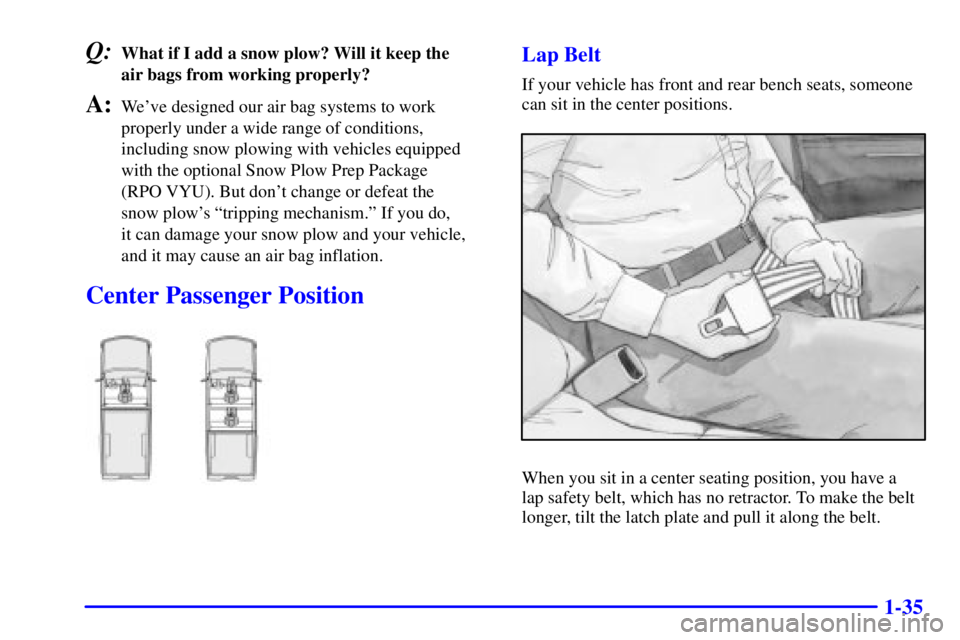
Center Passenger Position
Lap Belt
If your vehicle has front and rear bench seats, someone
can sit in the center positions.
When you sit in a center seating position, you have a
lap safety belt, which has no retractor. To make the belt
longer, tilt the latch plate and pull it along the belt.
Page 57 of 468

1-44
CAUTION:
Children who are up against, or very close to, any
air bag when it inflates can be seriously injured
or killed. Air bags plus lap
-shoulder belts offer
outstanding protection for adults and older
children, but not for young children and infants.
Neither the vehicle's safety belt system nor its
air bag system is designed for them. Young
children and infants need the protection that
a child restraint system can provide.
Q:What are the different types of add-on
child restraints?
A:Add-on child restraints, which are purchased
by the vehicle's owner, are available in four basic
types. Selection of a particular restraint should
take into consideration not only the child's weight,
height and age but also whether or not the restraint
will be compatible with the motor vehicle in which
it will be used.
For most basic types of child restraints, there are
many different models available. When purchasing
a child restraint, be sure it is designed to be used
in a motor vehicle. If it is, the restraint will have a
label saying that it meets federal motor vehicle
safety standards.
The restraint manufacturer's instructions that
come with the restraint state the weight and
height limitations for a particular child restraint.
In addition, there are many kinds of restraints
available for children with special needs.
Page 59 of 468
1-46
Restraint Systems for Children
An infant car bed (A), a special bed made for use in a
motor vehicle, is an infant restraint system designed to
restrain or position a child on a continuous flat surface.
Make sure that the infant's head rests toward the center
of the vehicle.
A rear-facing infant seat (B) provides restraint with
the seating surface against the back of the infant.
The harness system holds the infant in place and, in a
crash, acts to keep the infant positioned in the restraint.
Page 60 of 468
1-47
A forward-facing child seat (C-E) provides restraint
for the child's body with the harness and also sometimes
with surfaces such as T
-shaped or shelf-like shields.
A booster seat (F-G) is a child restraint designed to
improve the fit of the vehicle's safety belt system.
Some booster seats have a shoulder belt positioner,
and some high
-back booster seats have a five-point
harness. A booster seat can also help a child to see out
the window.
Page 61 of 468

1-48
Q:How do child restraints work?
A:A child restraint system is any device designed for
use in a motor vehicle to restrain, seat, or position
children. A built
-in child restraint system is a
permanent part of the motor vehicle. An add
-on
child restraint system is a portable one, which is
purchased by the vehicle's owner.
For many years, add
-on child restraints have
used the adult belt system in the vehicle. To help
reduce the chance of injury, the child also has to
be secured within the restraint. The vehicle's belt
system secures the add
-on child restraint in the
vehicle, and the add
-on child restraint's harness
system holds the child in place within the restraint.
One system, the three
-point harness, has straps
that come down over each of the infant's shoulders
and buckle together at the crotch. The five
-point
harness system has two shoulder straps, two hip
straps and a crotch strap. A shield may take the
place of hip straps. A T
-shaped shield has shoulder straps that are
attached to a flat pad which rests low against the
child's body. A shelf
- or armrest-type shield has
straps that are attached to a wide, shelf
-like shield
that swings up or to the side.
When choosing a child restraint, be sure the child
restraint is designed to be used in a vehicle. If it is,
it will have a label saying that it meets federal motor
vehicle safety standards.
Then follow the instructions for the restraint. You may
find these instructions on the restraint itself or in a
booklet, or both. These restraints use the belt system in
your vehicle, but the child also has to be secured within
the restraint to help reduce the chance of personal injury.
When securing an add
-on child restraint, refer to the
instructions that come with the restraint which may be
on the restraint itself or in a booklet, or both, and to this
manual. The child restraint instructions are important, so
if they are not available, obtain a replacement copy from
the manufacturer.
Page 68 of 468
1-55
There are also anchorage points at the rear base of the
front passenger's seat.
Anchor the top strap to one of these anchor points.
Be sure to use an anchor point located on the same
side of the vehicle as the seating position where the
child restraint will be placed. Raise the head restraint
and route the top strap under it.
Once you have the top strap anchored, you'll be ready
to secure the child restraint itself. Tighten the top
strap when and as the child restraint manufacturer's
instructions say.Lower Anchorages and Top Tethers for
Children (LATCH System)
Your vehicle may have the LATCH system. If it does,
you'll find anchors in the rear of the seat cushion.
For front passenger seat positions, there is an anchor
behind and to the bottom of the seat to secure the top
strap. For rear center seat positions, there is an anchor
near the driver's side rear seat head restraint.
Page 69 of 468
1-56
In order to use the system, you need either a forward-facing
child restraint that has attaching points (A) at its base and
a top tether anchor (B), or a rear
-facing child restraint that
has attaching points (A), as shown here.
With this system, use the LATCH system instead of the
vehicle's safety belts to secure a child restraint.
CAUTION:
If a LATCH-type child restraint isn't attached
to its anchorage points, the restraint won't be
able to protect a child sitting there. In a crash,
the child could be seriously injured or killed.
Make sure that a LATCH
-type child restraint is
properly installed using the anchorage points,
or use the vehicle's safety belts to secure the
restraint. See ªSecuring a Child Restraint in the
Center Rear Seat Position (Extended Cab) and
(Crew Cab)º or ªSecuring a Child Restraint in
the Right Front Seat Positionº in the Index for
information on how to secure a child restraint in
your vehicle using the vehicle's safety belts.