Page 46 of 448
1-34
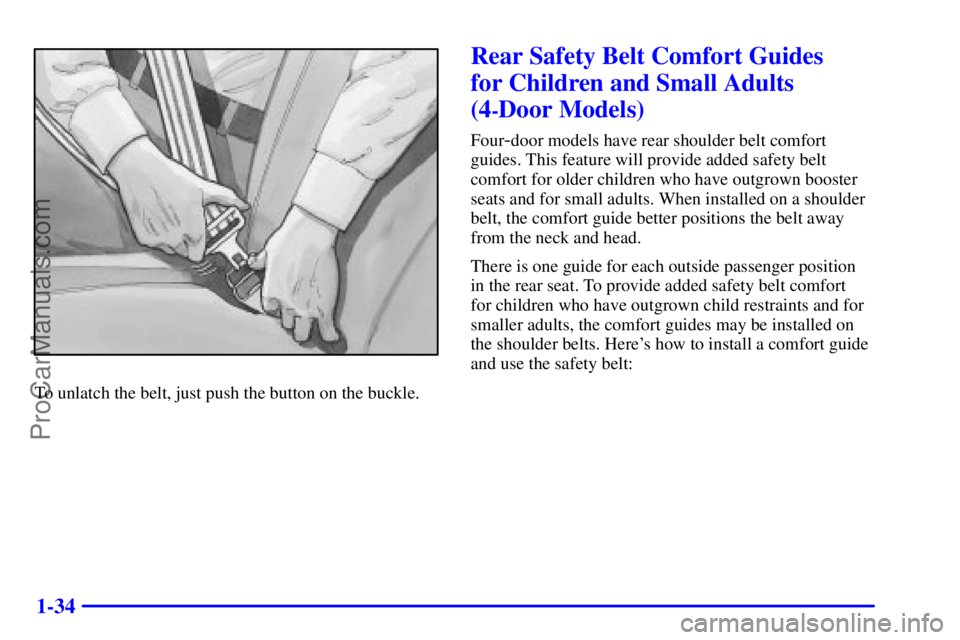
To unlatch the belt, just push the button on the buckle.
Rear Safety Belt Comfort Guides
for Children and Small Adults
(4
-Door Models)
Four-door models have rear shoulder belt comfort
guides. This feature will provide added safety belt
comfort for older children who have outgrown booster
seats and for small adults. When installed on a shoulder
belt, the comfort guide better positions the belt away
from the neck and head.
There is one guide for each outside passenger position
in the rear seat. To provide added safety belt comfort
for children who have outgrown child restraints and for
smaller adults, the comfort guides may be installed on
the shoulder belts. Here's how to install a comfort guide
and use the safety belt:
ProCarManuals.com
Page 55 of 448
1-43
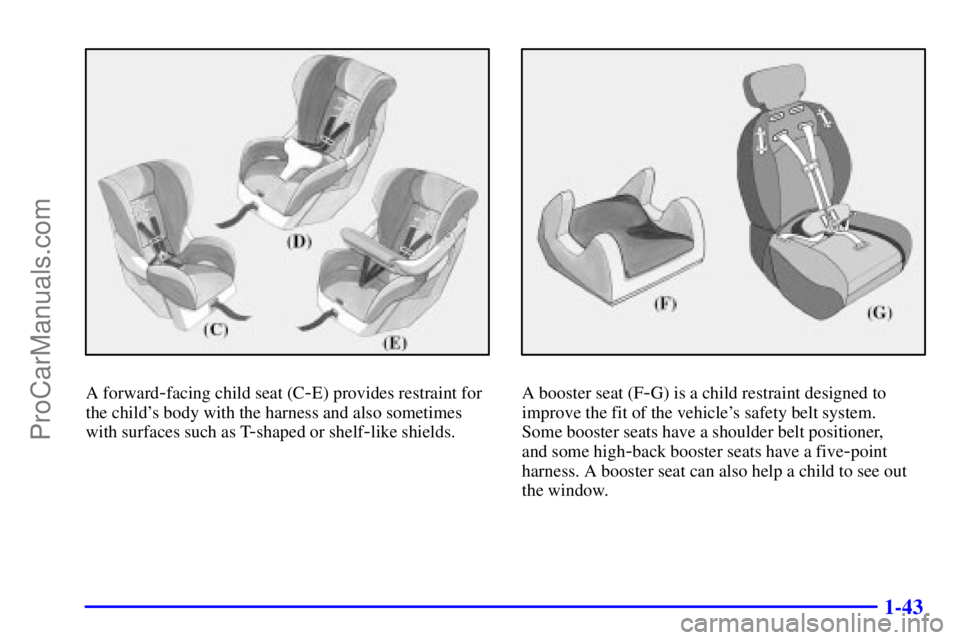
A forward-facing child seat (C-E) provides restraint for
the child's body with the harness and also sometimes
with surfaces such as T
-shaped or shelf-like shields.
A booster seat (F-G) is a child restraint designed to
improve the fit of the vehicle's safety belt system.
Some booster seats have a shoulder belt positioner,
and some high
-back booster seats have a five-point
harness. A booster seat can also help a child to see out
the window.
ProCarManuals.com
Page 59 of 448
1-47
If your vehicle is equipped with the rear convenience
system, there will be plugs covering the anchor brackets.To remove the plugs, grasp the edges of the plugs and
pull them out. See ªRear Convenience Systemº in the
Index for more information. Don't use the rear set of
tie
-down brackets near the liftgate/endgate or the center
tie
-down bracket near the rear seats.
Anchor the top strap to one of these anchor points.
Be sure to use an anchor point located on the same
side of the vehicle as the seating position where the
child restraint will be placed.
Once you have the top strap anchored, you'll be ready
to secure the child restraint itself. Tighten the top
strap when and as the child restraint manufacturer's
instructions say.
ProCarManuals.com
Page 63 of 448
1-51
Although a rear seat is a safer place, you can secure a
forward
-facing child restraint in the right front seat.
You'll be using the lap
-shoulder belt. See the earlier
part about the top strap if the child restraint has one.
Be sure to follow the instructions that came with the
child restraint. Secure the child in the child restraint
when and as the instructions say.
1. Because your vehicle has a right front passenger air
bag, always move the seat as far back as it will go
before securing a forward
-facing child restraint.
See ªSeatsº in the Index.
2. Put the restraint on the seat.
3. Pick up the latch plate, and run the lap and shoulder
portions of the vehicle's safety belt through or
around the restraint. The child restraint instructions
will show you how.
If the shoulder belt goes in front of the child's face
or neck, put it behind the child restraint.
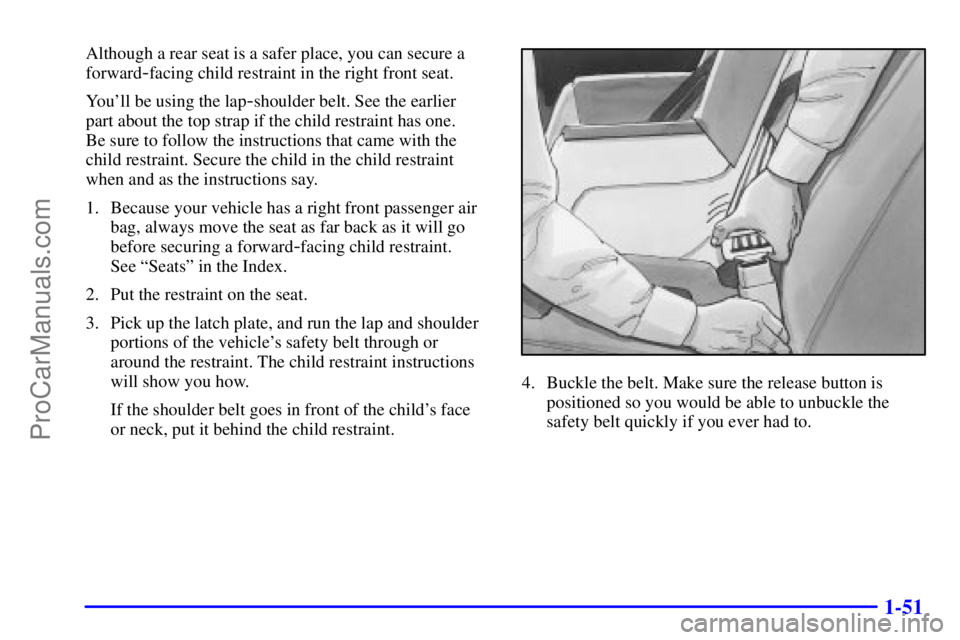
4. Buckle the belt. Make sure the release button is
positioned so you would be able to unbuckle the
safety belt quickly if you ever had to.
ProCarManuals.com
Page 65 of 448
1-53
Older Children
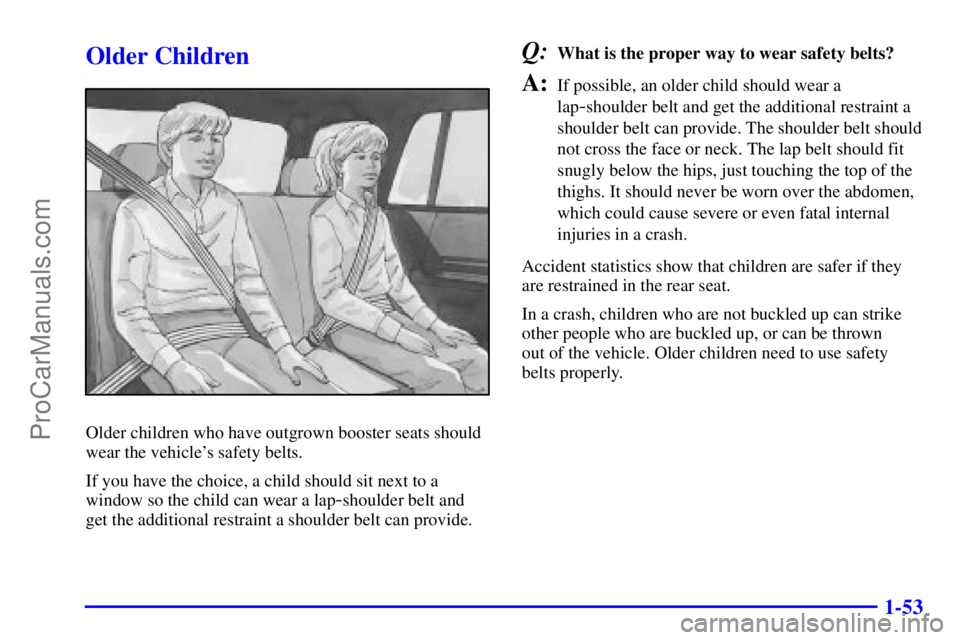
Older children who have outgrown booster seats should
wear the vehicle's safety belts.
If you have the choice, a child should sit next to a
window so the child can wear a lap
-shoulder belt and
get the additional restraint a shoulder belt can provide.
Q:What is the proper way to wear safety belts?
A:If possible, an older child should wear a
lap
-shoulder belt and get the additional restraint a
shoulder belt can provide. The shoulder belt should
not cross the face or neck. The lap belt should fit
snugly below the hips, just touching the top of the
thighs. It should never be worn over the abdomen,
which could cause severe or even fatal internal
injuries in a crash.
Accident statistics show that children are safer if they
are restrained in the rear seat.
In a crash, children who are not buckled up can strike
other people who are buckled up, or can be thrown
out of the vehicle. Older children need to use safety
belts properly.
ProCarManuals.com
Page 94 of 448
2-26
Automatic Transmission Operation
Your automatic transmission may have a shift lever
located on the console between the seats or on the
steering column.
There are several different positions for your shift lever.
If your vehicle is equipped with a column shift lever,
it features an electronic shift position indicator within
the instrument panel cluster. This display must be
powered anytime the shift lever is capable of being
moved out of PARK (P). This means that if your key
is in OFF, but not locked, there will be a small current
drain on your battery which could discharge your battery
over a period of time. If you need to leave your key
in the ignition in OFF for an extended period, it is
recommended that you disconnect the battery cable
from the battery to prevent discharging your battery.
PARK (P): This position locks your rear wheels. It's the
best position to use when you start your engine because
your vehicle can't move easily.CAUTION:
It is dangerous to get out of your vehicle if the
shift lever is not fully in PARK (P) with the
parking brake firmly set. Your vehicle can roll.
Don't leave your vehicle when the engine is
running unless you have to. If you have left the
engine running, the vehicle can move suddenly.
You or others could be injured. To be sure your
vehicle won't move, even when you're on fairly
level ground, always set your parking brake and
move the shift lever to PARK (P).
See ªShifting Into PARK (P)º in the Index. If you
have four
-wheel drive, your vehicle will be free to
roll
-- even if your shift lever is in PARK (P) -- if
your transfer case is in NEUTRAL. So, be sure
the transfer case is in a drive gear
-- not in
NEUTRAL. See ªFour
-Wheel Drive (Automatic
Transfer Case)º in the Index. If you're pulling a
trailer, see ªTowing a Trailerº in the Index.
ProCarManuals.com
Page 177 of 448
3-9 Ventilation System
For mild outside temperatures when little heating or
cooling is needed, use PANEL or VENT to direct
outside air through your vehicle. Airflow is through the
instrument panel outlets.
Your vehicle's ventilation system supplies outside air to
the inside of your vehicle when it is moving. When the
vehicle is not moving, you can get outside air to flow
through by selecting any mode and any fan speed.
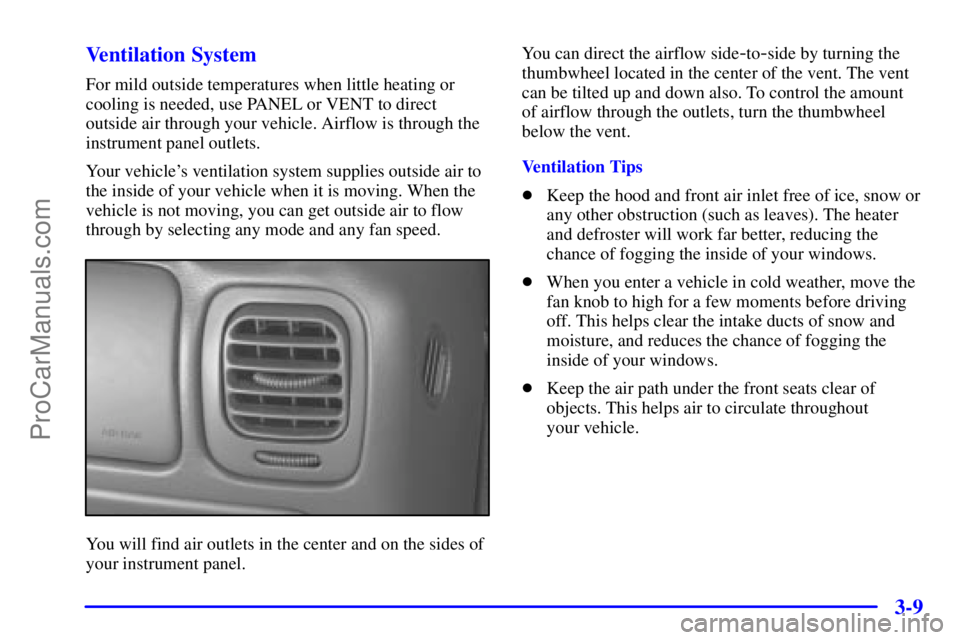
You will find air outlets in the center and on the sides of
your instrument panel.You can direct the airflow side
-to-side by turning the
thumbwheel located in the center of the vent. The vent
can be tilted up and down also. To control the amount
of airflow through the outlets, turn the thumbwheel
below the vent.
Ventilation Tips
�Keep the hood and front air inlet free of ice, snow or
any other obstruction (such as leaves). The heater
and defroster will work far better, reducing the
chance of fogging the inside of your windows.
�When you enter a vehicle in cold weather, move the
fan knob to high for a few moments before driving
off. This helps clear the intake ducts of snow and
moisture, and reduces the chance of fogging the
inside of your windows.
�Keep the air path under the front seats clear of
objects. This helps air to circulate throughout
your vehicle.
ProCarManuals.com
Page 261 of 448
4-45
CAUTION:
Things you put inside your vehicle can strike
and injure people in a sudden stop or turn,
or in a crash.
�Put things in the cargo area of your vehicle.
Try to spread the weight evenly.
�Never stack heavier things, like suitcases,
inside the vehicle so that some of them are
above the tops of the seats.
�Don't leave an unsecured child restraint
in your vehicle.
�When you carry something inside the
vehicle, secure it whenever you can.
�Don't leave a seat folded down unless
you need to.
There's also important loading information for off-road
driving in this manual. See ªLoading Your Vehicle for
Off
-Road Drivingº in the Index.
Payload
The payload capacity is shown on the Certification/Tire
label. This is the maximum load capacity that your
vehicle can carry. Be sure to include the weight of the
occupants as part of your load. If you added any
accessories or equipment after your vehicle left the
factory, remember to subtract the weight of these things
from the payload. Your dealer can help you with this.
Electronic Level Control (If Equipped)
If your vehicle is equipped with the electronic level
control the rear of the vehicle is automatically kept
level as you load or unload your vehicle. However,
you should still not exceed the GVWR or the GAWR.
The ignition has to be on for the level control to work.
The system includes a small electric air compressor and
air
-adjustable rear shock absorbers.
You may hear the compressor operating when you load
or unload your vehicle, and periodically as the system
self
-adjusts. This is normal.
ProCarManuals.com