Page 18 of 448
1-6 Reclining Front Seatbacks
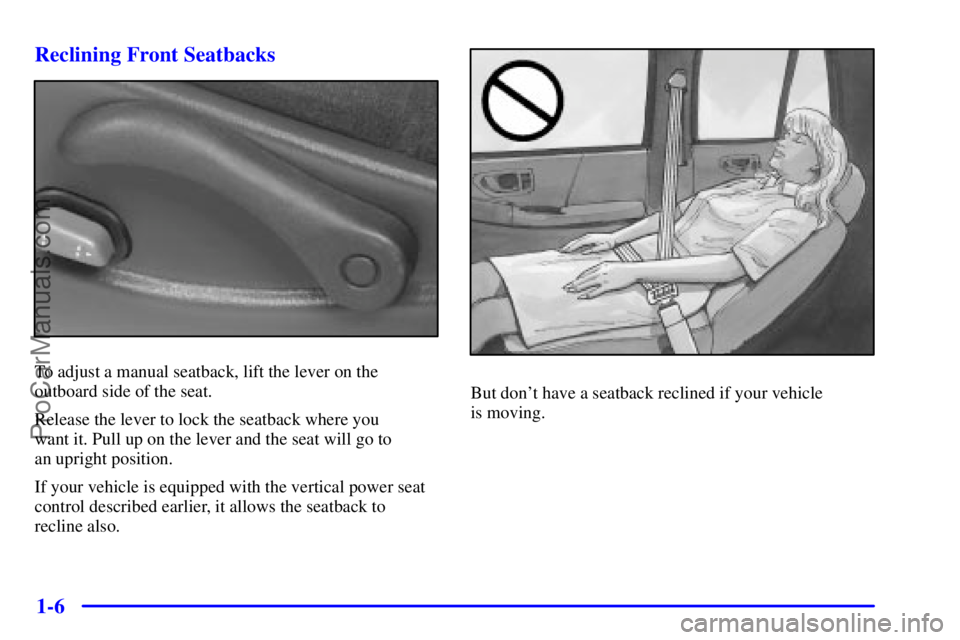
To adjust a manual seatback, lift the lever on the
outboard side of the seat.
Release the lever to lock the seatback where you
want it. Pull up on the lever and the seat will go to
an upright position.
If your vehicle is equipped with the vertical power seat
control described earlier, it allows the seatback to
recline also.
But don't have a seatback reclined if your vehicle
is moving.
ProCarManuals.com
Page 20 of 448
1-8 Seatback Latches
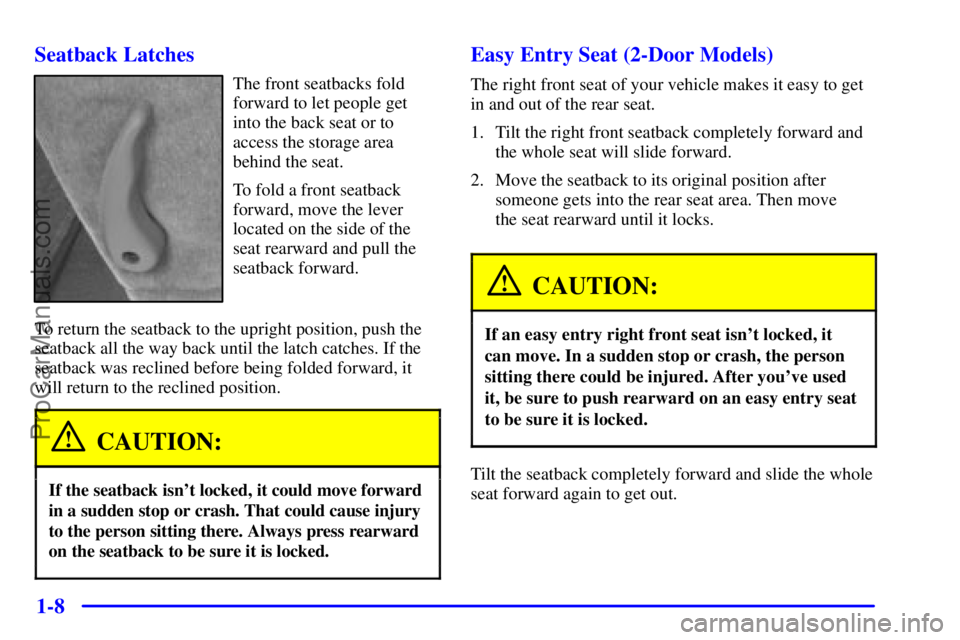
The front seatbacks fold
forward to let people get
into the back seat or to
access the storage area
behind the seat.
To fold a front seatback
forward, move the lever
located on the side of the
seat rearward and pull the
seatback forward.
To return the seatback to the upright position, push the
seatback all the way back until the latch catches. If the
seatback was reclined before being folded forward, it
will return to the reclined position.
CAUTION:
If the seatback isn't locked, it could move forward
in a sudden stop or crash. That could cause injury
to the person sitting there. Always press rearward
on the seatback to be sure it is locked.
Easy Entry Seat (2-Door Models)
The right front seat of your vehicle makes it easy to get
in and out of the rear seat.
1. Tilt the right front seatback completely forward and
the whole seat will slide forward.
2. Move the seatback to its original position after
someone gets into the rear seat area. Then move
the seat rearward until it locks.
CAUTION:
If an easy entry right front seat isn't locked, it
can move. In a sudden stop or crash, the person
sitting there could be injured. After you've used
it, be sure to push rearward on an easy entry seat
to be sure it is locked.
Tilt the seatback completely forward and slide the whole
seat forward again to get out.
ProCarManuals.com
Page 21 of 448
1-9 Rear Seats
Your vehicle has a folding rear seat which lets you fold
the seatbacks down for more cargo space.
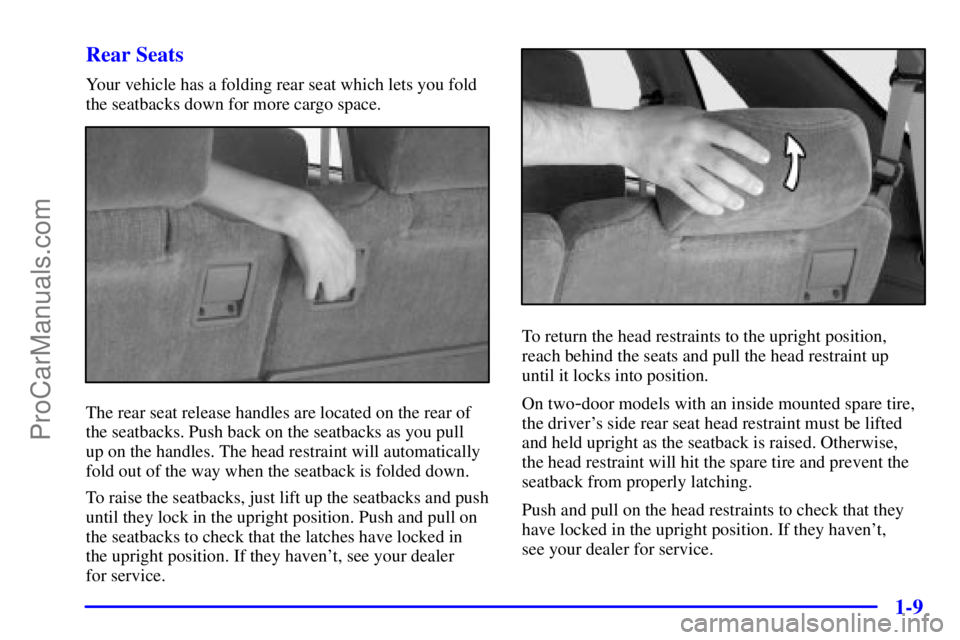
The rear seat release handles are located on the rear of
the seatbacks. Push back on the seatbacks as you pull
up on the handles. The head restraint will automatically
fold out of the way when the seatback is folded down.
To raise the seatbacks, just lift up the seatbacks and push
until they lock in the upright position. Push and pull on
the seatbacks to check that the latches have locked in
the upright position. If they haven't, see your dealer
for service.
To return the head restraints to the upright position,
reach behind the seats and pull the head restraint up
until it locks into position.
On two
-door models with an inside mounted spare tire,
the driver's side rear seat head restraint must be lifted
and held upright as the seatback is raised. Otherwise,
the head restraint will hit the spare tire and prevent the
seatback from properly latching.
Push and pull on the head restraints to check that they
have locked in the upright position. If they haven't,
see your dealer for service.
ProCarManuals.com
Page 28 of 448
1-16
Driver Position
This part describes the driver's restraint system.
Lap-Shoulder Belt
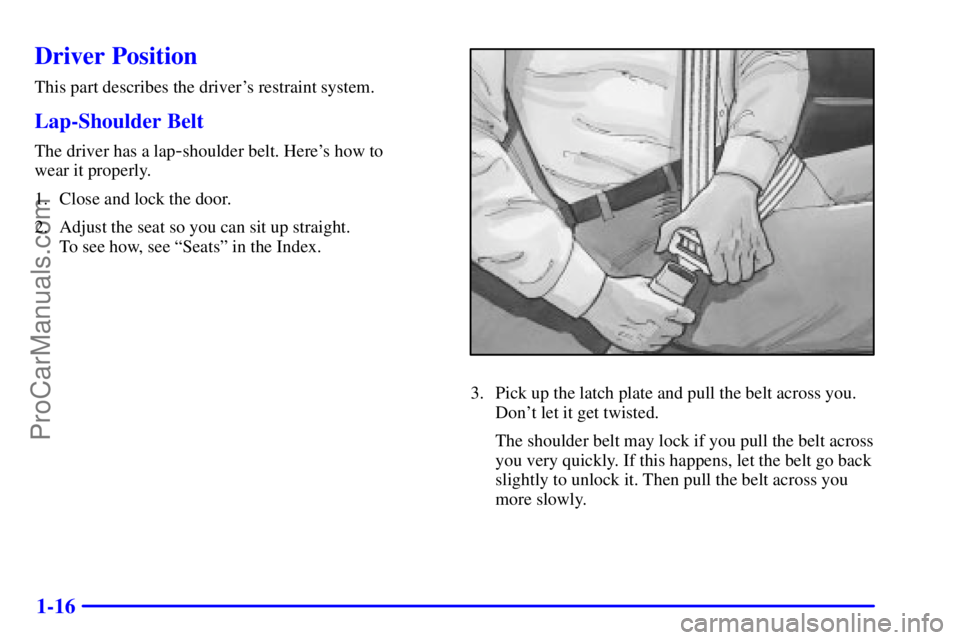
The driver has a lap-shoulder belt. Here's how to
wear it properly.
1. Close and lock the door.
2. Adjust the seat so you can sit up straight.
To see how, see ªSeatsº in the Index.
3. Pick up the latch plate and pull the belt across you.
Don't let it get twisted.
The shoulder belt may lock if you pull the belt across
you very quickly. If this happens, let the belt go back
slightly to unlock it. Then pull the belt across you
more slowly.
ProCarManuals.com
Page 29 of 448
1-17
4. Push the latch plate into the buckle until it clicks.
Pull up on the latch plate to make sure it is secure.
If the belt isn't long enough, see ªSafety Belt
Extenderº at the end of this section.
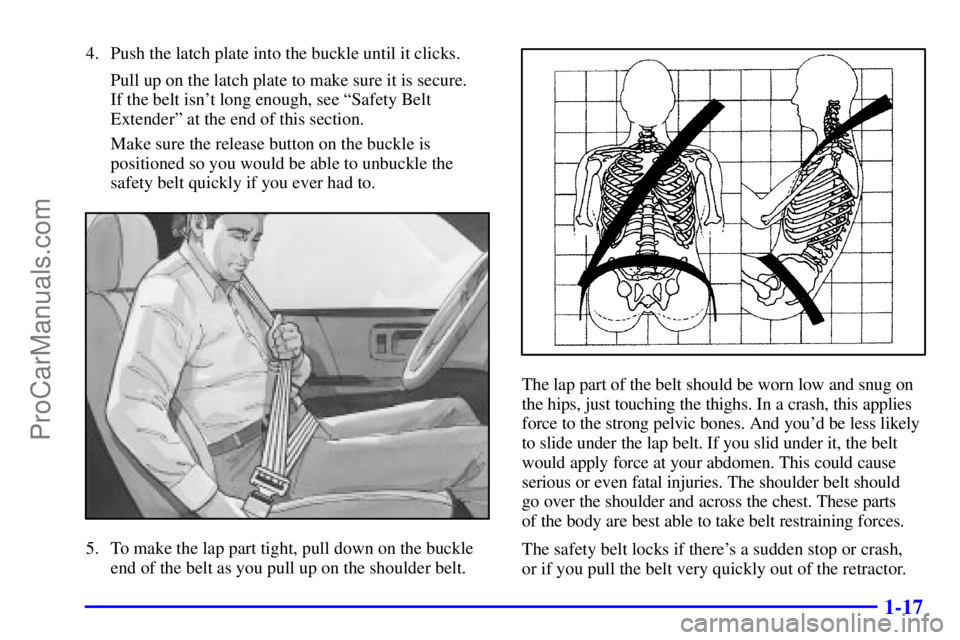
Make sure the release button on the buckle is
positioned so you would be able to unbuckle the
safety belt quickly if you ever had to.
5. To make the lap part tight, pull down on the buckle
end of the belt as you pull up on the shoulder belt.
The lap part of the belt should be worn low and snug on
the hips, just touching the thighs. In a crash, this applies
force to the strong pelvic bones. And you'd be less likely
to slide under the lap belt. If you slid under it, the belt
would apply force at your abdomen. This could cause
serious or even fatal injuries. The shoulder belt should
go over the shoulder and across the chest. These parts
of the body are best able to take belt restraining forces.
The safety belt locks if there's a sudden stop or crash,
or if you pull the belt very quickly out of the retractor.
ProCarManuals.com
Page 35 of 448
1-23
The best way to protect the fetus is to protect the
mother. When a safety belt is worn properly, it's
more likely that the fetus won't be hurt in a crash.
For pregnant women, as for anyone, the key to
making safety belts effective is wearing them properly.
Right Front Passenger Position
To learn how to wear the right front passenger's safety belt
properly, see ªDriver Positionº earlier in this section.
The right front passenger's safety belt works the same
way as the driver's safety belt
-- except for one thing.
If you ever pull the shoulder portion of the belt out
all the way, you will engage the child restraint locking
feature. If this happens, just let the belt go back all the
way and start again.
Air Bag System
This part explains the air bag system.
Your vehicle has air bags
-- one air bag for the driver
and another air bag for the right front passenger.
Frontal air bags are designed to help reduce the risk of
injury from the force of an inflating air bag. But these
air bags must inflate very quickly to do their job and
comply with federal regulations.Here are the most important things to know about the
air bag system:
CAUTION:
You can be severely injured or killed in a crash if
you aren't wearing your safety belt
-- even if you
have air bags. Wearing your safety belt during
a crash helps reduce your chance of hitting
things inside the vehicle or being ejected from it.
Air bags are ªsupplemental restraintsº to the
safety belts. All air bags are designed to work
with safety belts, but don't replace them. Air
bags are designed to work only in moderate to
severe crashes where the front of your vehicle
hits something. They aren't designed to inflate
at all in rollover, rear, side or low
-speed frontal
crashes. And, for unrestrained occupants,
air bags may provide less protection in frontal
crashes than more forceful air bags have
provided in the past. Everyone in your vehicle
should wear a safety belt properly
-- whether or
not there's an air bag for that person.
ProCarManuals.com
Page 43 of 448
1-31
Rear Seat Passengers
It's very important for rear seat passengers to buckle up!
Accident statistics show that unbelted people in the rear
seat are hurt more often in crashes than those who are
wearing safety belts.
Rear passengers who aren't safety belted can be thrown
out of the vehicle in a crash. And they can strike others
in the vehicle who are wearing safety belts.
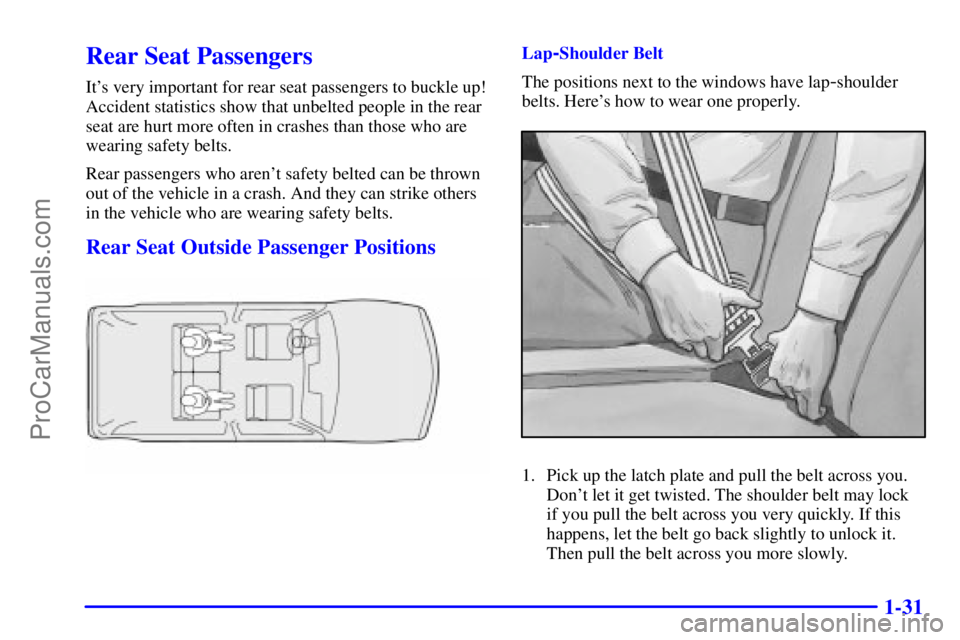
Rear Seat Outside Passenger Positions
Lap-Shoulder Belt
The positions next to the windows have lap
-shoulder
belts. Here's how to wear one properly.
1. Pick up the latch plate and pull the belt across you.
Don't let it get twisted. The shoulder belt may lock
if you pull the belt across you very quickly. If this
happens, let the belt go back slightly to unlock it.
Then pull the belt across you more slowly.
ProCarManuals.com
Page 44 of 448
1-32
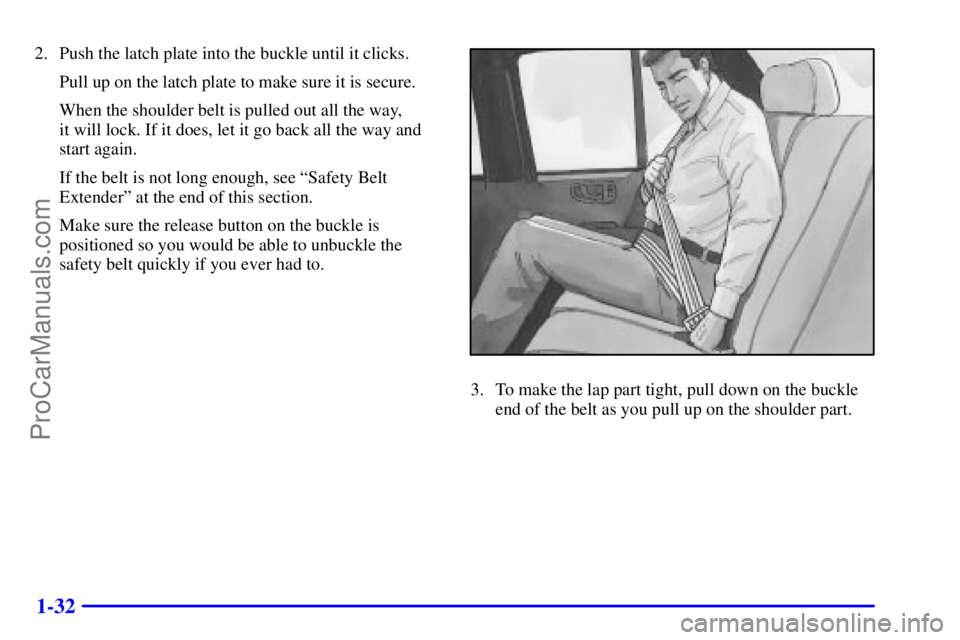
2. Push the latch plate into the buckle until it clicks.
Pull up on the latch plate to make sure it is secure.
When the shoulder belt is pulled out all the way,
it will lock. If it does, let it go back all the way and
start again.
If the belt is not long enough, see ªSafety Belt
Extenderº at the end of this section.
Make sure the release button on the buckle is
positioned so you would be able to unbuckle the
safety belt quickly if you ever had to.
3. To make the lap part tight, pull down on the buckle
end of the belt as you pull up on the shoulder part.
ProCarManuals.com