Page 245 of 288

Readiness for Inspection/Maintenance (I/M) testing
In some localities, it may be a legal requirement to pass an I/M test of
the on-board diagnostics system. If your ªCheck Engine/Service Engine
Soonº light is on, refer to the description in theWarning Lights and
Chimessection of theInstrumentationchapter. Your vehicle may not
pass the I/M test with the ªCheck Engine/Service Engine Soonº light on.
If the vehicle's powertrain system or its battery has just been serviced,
the on-board diagnostics system is reset to a ªnot ready for I/M testº
condition. To ready the on-board diagnostics system for I/M testing, a
minimum of 30 minutes of city and highway driving is necessary as
described below:
²First, at least 10 minutes of driving on an expressway or highway.
²Next, at least 20 minutes driving in stop-and-go, city-type traffic with
at least four idle periods.
Allow the vehicle to sit for at least eight hours without starting the
engine. Then, start the engine and complete the above driving cycle. The
engine must warm up to its normal operating temperature. Once started,
do not turn off the engine until the above driving cycle is complete.
BULBS
Replacing exterior bulbs
It is a good idea to check the operation of the following lights frequently:
²Headlamps
²Turn signals
²Cornering lamps (if equipped)
²Auxiliary parking lamps (if equipped)
²High-mount brakelamp
²Tail lamps
²Brakelamps
²Backup lamps
²License plate lamps
Do not remove lamp bulbs unless they will be replaced immediately. If a
bulb is removed for an extended period of time, contaminants may enter
the lamp housings and affect performance.
Maintenance and care
245
Page 254 of 288

Cleaning mirrors
Do not clean your mirrors with a dry cloth or abrasive materials. Use a
soft cloth and mild detergent and water. Be careful when removing ice
from outside mirrors because you may damage the reflective surface.
Cleaning the exterior lamps
Wash with the same detergent as the exterior of your vehicle. If
necessary, use a tar remover such as Ford Extra Strength Tar and Road
Oil Remover (B7A-19520±AA).
To avoid scratching the lamps, do not use a dry paper towel, chemical
solvents or abrasive cleaners.
Cleaning the wiper blades, windshield and rear window
If the wiper blades do not wipe properly, clean the wiper blade rubber
element with undiluted windshield washer solution or a mild detergent.
To avoid damaging the blades, do not use fuel, kerosene, paint thinner or
other solvents.
If the wiper still does not wipe properly, this could be caused by
substances on the windshield or rear window such as tree sap and some
hot wax treatments used by commercial car washes. Clean the outside of
the windshield or rear window with a non-abrasive cleaner such as Ford
Ultra-Clear Spray Glass Cleaner, (E4AZ-19C507±AA), available from your
Ford Dealer.Do notuse abrasive cleansers on glass as they may cause
scratches. The windshield or rear window is clean if beads do not form
when you rinse it with water. The windshield, rear window and wiper
blades should be cleaned on a regular basis, and blades or rubber
elements replaced when worn.
Cleaning the engine
Engines are more efficient when they are clean because grease and dirt
buildup keep the engine warmer than normal. When washing:
²Take care when using a power washer to clean the engine. The high
pressure fluid could penetrate the sealed parts and cause damage.
²Do not spray with cold water to avoid cracking the engine block or
other engine components.
²Never apply anything to the drive belt (including belt dressing).
Maintenance and care
254
Page 255 of 288
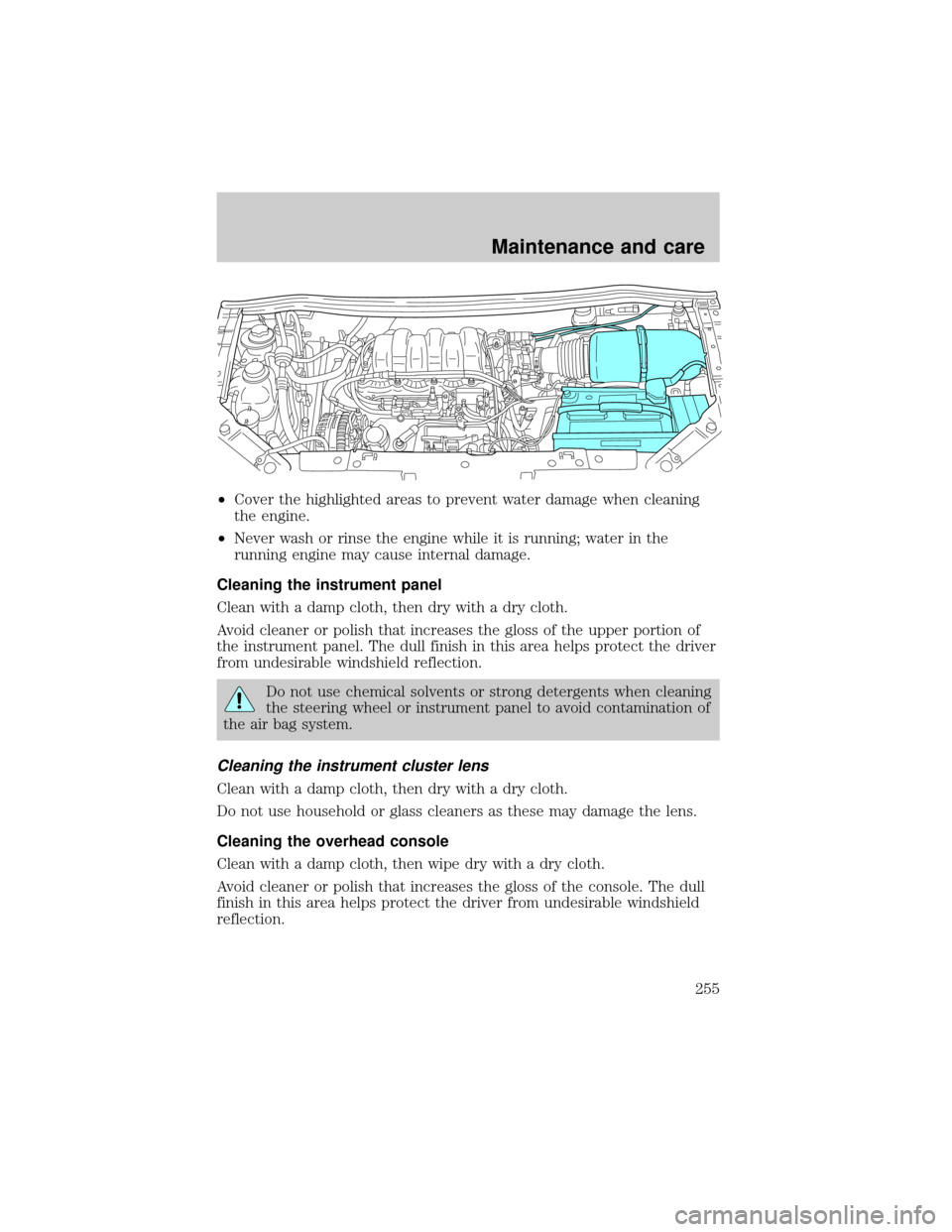
²Cover the highlighted areas to prevent water damage when cleaning
the engine.
²Never wash or rinse the engine while it is running; water in the
running engine may cause internal damage.
Cleaning the instrument panel
Clean with a damp cloth, then dry with a dry cloth.
Avoid cleaner or polish that increases the gloss of the upper portion of
the instrument panel. The dull finish in this area helps protect the driver
from undesirable windshield reflection.
Do not use chemical solvents or strong detergents when cleaning
the steering wheel or instrument panel to avoid contamination of
the air bag system.
Cleaning the instrument cluster lens
Clean with a damp cloth, then dry with a dry cloth.
Do not use household or glass cleaners as these may damage the lens.
Cleaning the overhead console
Clean with a damp cloth, then wipe dry with a dry cloth.
Avoid cleaner or polish that increases the gloss of the console. The dull
finish in this area helps protect the driver from undesirable windshield
reflection.
Maintenance and care
255
Page 257 of 288

Cleaning leather seats (if equipped)
To clean, simply use a soft cloth dampened with water and a mild soap.
Wipe the leather again with a damp cloth to remove soap residue. Dry
with a soft cloth. For tougher soiling concerns, Ford recommends using
the Deluxe Leather Care Kit F8AZ-19G253±AA, which is available from
your Ford Dealer. This mild cleaner and special pad, cleans the leather
and maintains its natural beauty. Follow the instructions on the cleaner
label. Regular cleaning of your leather upholstery helps maintain its
resiliency and color.
Do not use household cleaning products, alcohol solutions,
solvents or cleaners intended for rubber, vinyl or plastics.
Cleaning the interior fabric
Remove dust and loose dirt with a whisk broom or a vacuum cleaner.
Remove fresh spots immediately. Do not use household or glass cleaners.
These agents can stain and discolor the fabric. Use a mild soap and
water solution if necessary.
MOTORCRAFT PART NUMBERS
Component 3.8L OHV V6 engine
Air filter element FA-1616
Fuel filter FG-986B
Battery (standard) BXT-65-650
Battery (optional) BXT-65-750
Oil filter FL-400S
PCV valve EV-152
Spark plugs* AWSF-42EE***
* Refer to Vehicle Emissions Control Information (VECI) decal for spark
plug gap information.
*** If a spark plug is removed for inspection, it must be reinstalled in the
same cylinder. Cylinders No. 1, 2, and 3 have a ªEGº suffix. Cylinders No.
4, 5, and 6 have a ªEº suffix. If a spark plug needs to be replaced, use
only spark plugs with the service part number suffix letter ªEEº as
shown on the engine decal.
Capacities and specifications
257
Page 258 of 288
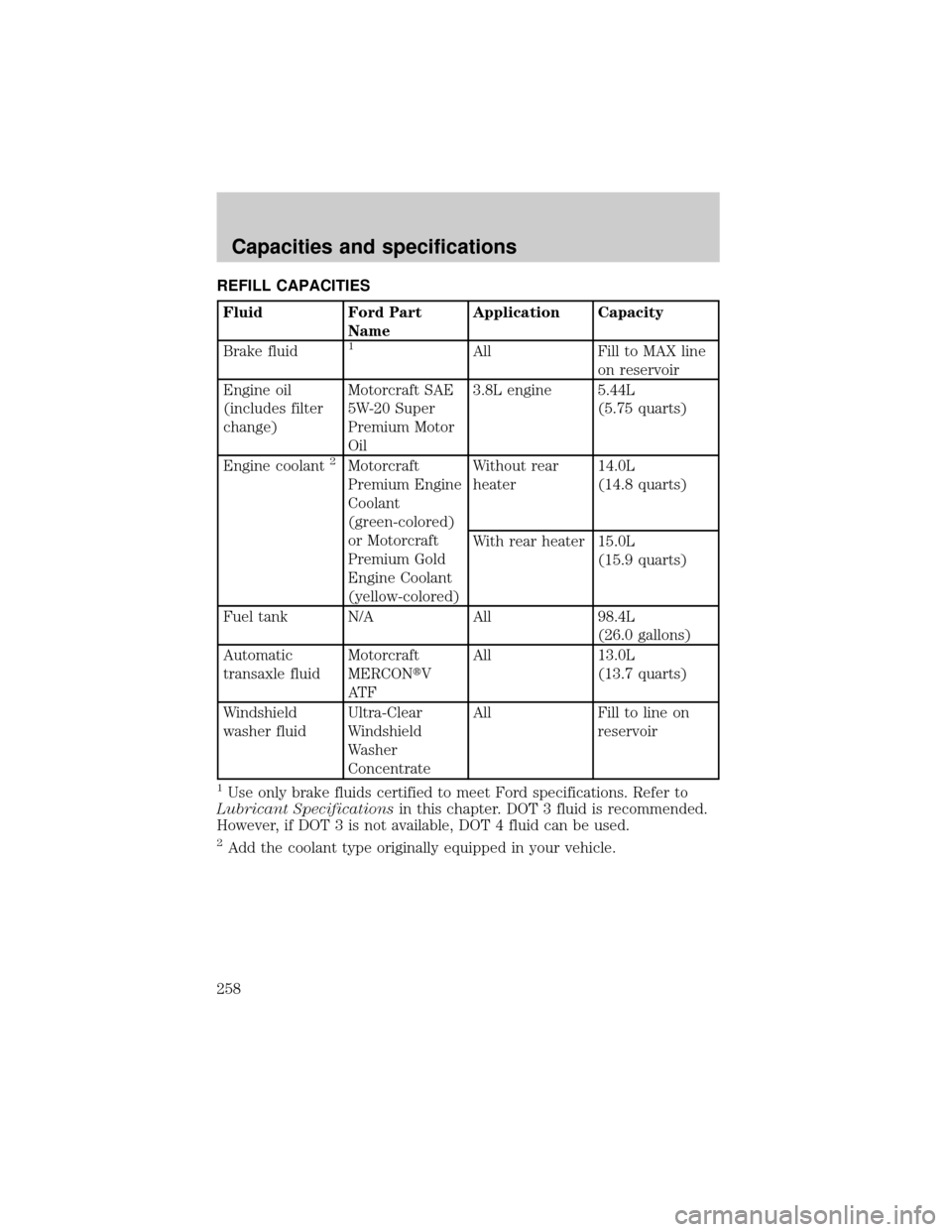
REFILL CAPACITIES
Fluid Ford Part
NameApplication Capacity
Brake fluid
1All Fill to MAX line
on reservoir
Engine oil
(includes filter
change)Motorcraft SAE
5W-20 Super
Premium Motor
Oil3.8L engine 5.44L
(5.75 quarts)
Engine coolant
2Motorcraft
Premium Engine
Coolant
(green-colored)
or Motorcraft
Premium Gold
Engine Coolant
(yellow-colored)Without rear
heater14.0L
(14.8 quarts)
With rear heater 15.0L
(15.9 quarts)
Fuel tank N/A All 98.4L
(26.0 gallons)
Automatic
transaxle fluidMotorcraft
MERCONtV
AT FAll 13.0L
(13.7 quarts)
Windshield
washer fluidUltra-Clear
Windshield
Washer
ConcentrateAll Fill to line on
reservoir
1Use only brake fluids certified to meet Ford specifications. Refer to
Lubricant Specificationsin this chapter. DOT 3 fluid is recommended.
However, if DOT 3 is not available, DOT 4 fluid can be used.
2Add the coolant type originally equipped in your vehicle.
Capacities and specifications
258
Page 259 of 288
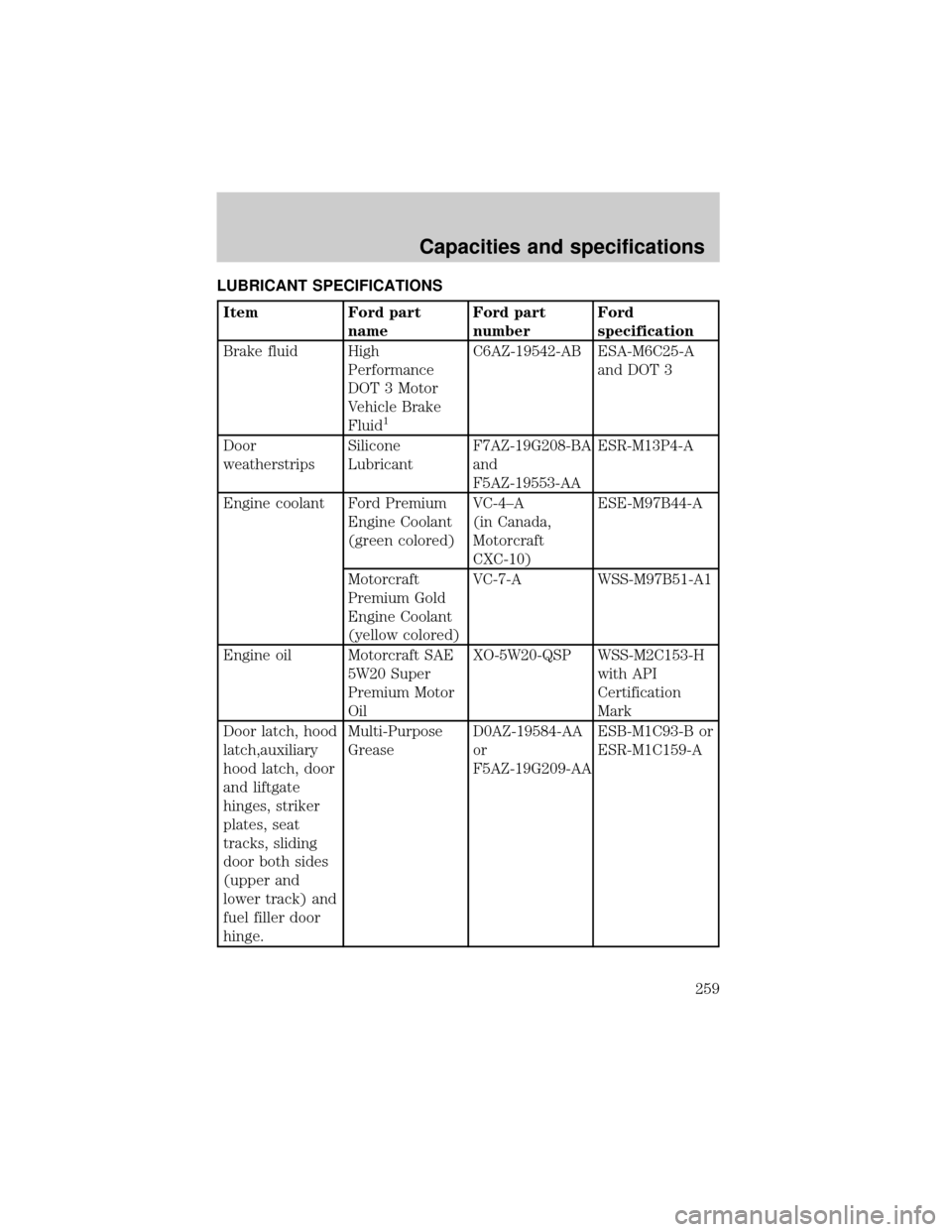
LUBRICANT SPECIFICATIONS
Item Ford part
nameFord part
numberFord
specification
Brake fluid High
Performance
DOT 3 Motor
Vehicle Brake
Fluid
1
C6AZ-19542-AB ESA-M6C25-A
and DOT 3
Door
weatherstripsSilicone
LubricantF7AZ-19G208-BA
and
F5AZ-19553-AAESR-M13P4-A
Engine coolant Ford Premium
Engine Coolant
(green colored)VC-4±A
(in Canada,
Motorcraft
CXC-10)ESE-M97B44-A
Motorcraft
Premium Gold
Engine Coolant
(yellow colored)VC-7-A WSS-M97B51-A1
Engine oil Motorcraft SAE
5W20 Super
Premium Motor
OilXO-5W20-QSP WSS-M2C153-H
with API
Certification
Mark
Door latch, hood
latch,auxiliary
hood latch, door
and liftgate
hinges, striker
plates, seat
tracks, sliding
door both sides
(upper and
lower track) and
fuel filler door
hinge.Multi-Purpose
GreaseD0AZ-19584-AA
or
F5AZ-19G209-AAESB-M1C93-B or
ESR-M1C159-A
Capacities and specifications
259
Page 261 of 288
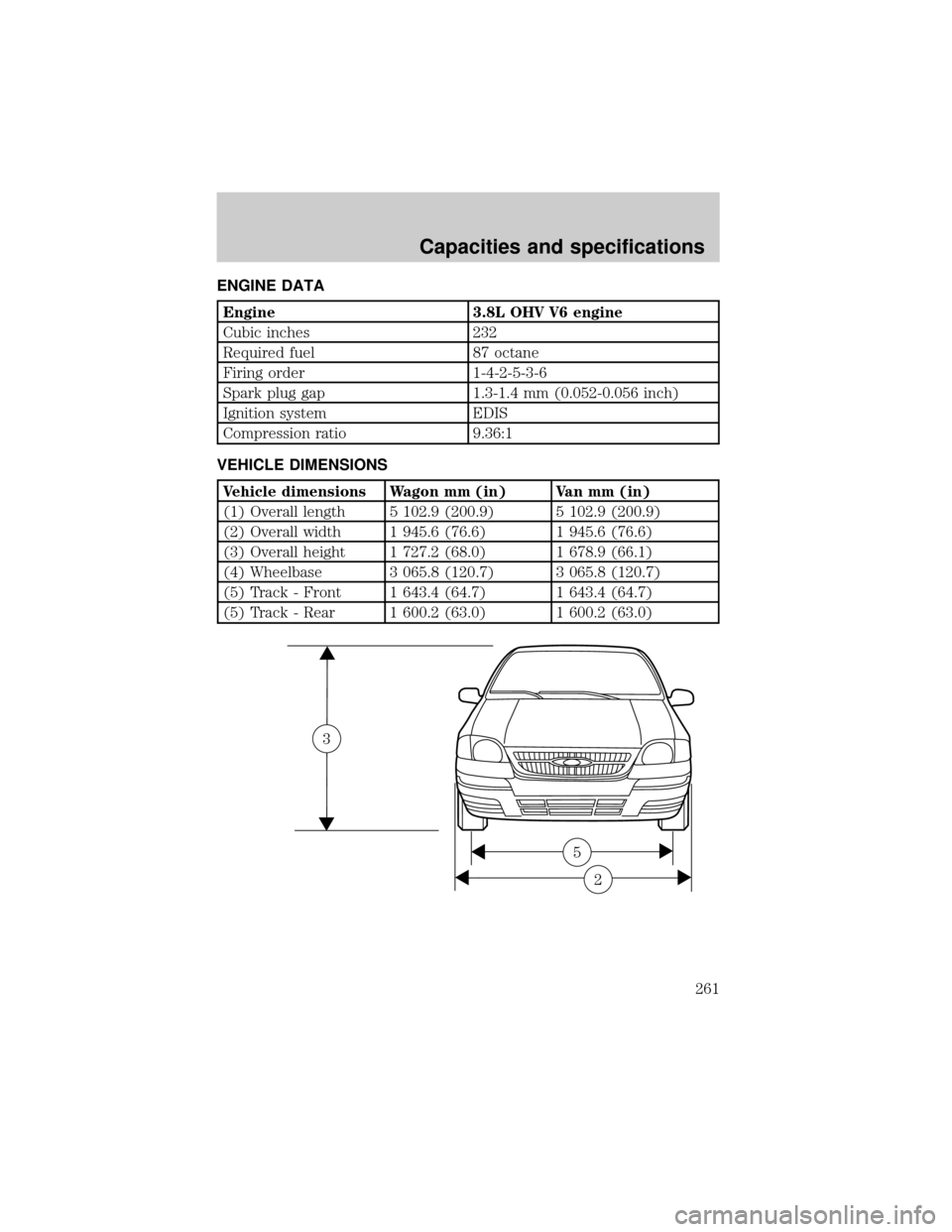
ENGINE DATA
Engine 3.8L OHV V6 engine
Cubic inches 232
Required fuel 87 octane
Firing order 1-4-2-5-3-6
Spark plug gap 1.3-1.4 mm (0.052-0.056 inch)
Ignition system EDIS
Compression ratio 9.36:1
VEHICLE DIMENSIONS
Vehicle dimensions Wagon mm (in) Van mm (in)
(1) Overall length 5 102.9 (200.9) 5 102.9 (200.9)
(2) Overall width 1 945.6 (76.6) 1 945.6 (76.6)
(3) Overall height 1 727.2 (68.0) 1 678.9 (66.1)
(4) Wheelbase 3 065.8 (120.7) 3 065.8 (120.7)
(5) Track - Front 1 643.4 (64.7) 1 643.4 (64.7)
(5) Track - Rear 1 600.2 (63.0) 1 600.2 (63.0)
2
5
3
Capacities and specifications
261
Page 263 of 288
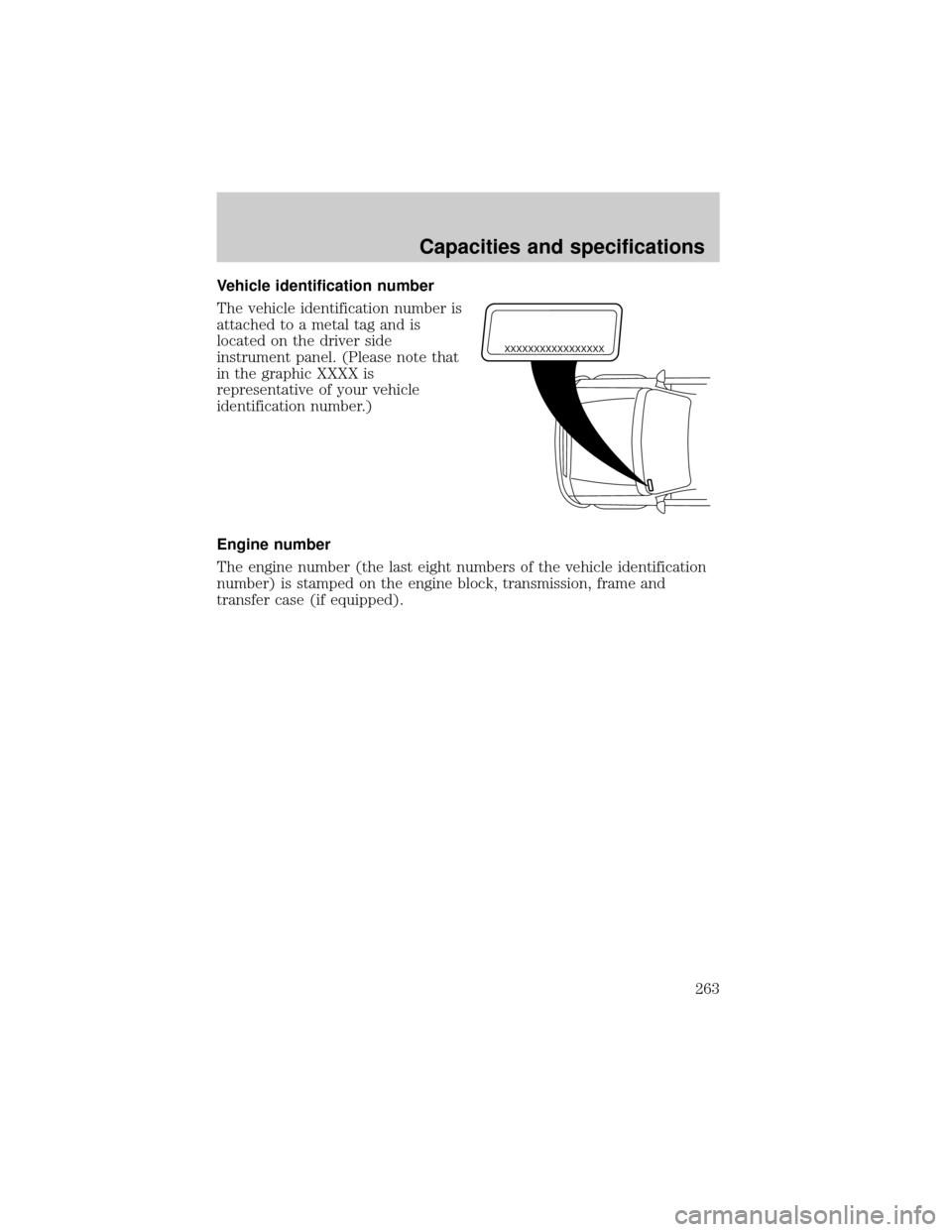
Vehicle identification number
The vehicle identification number is
attached to a metal tag and is
located on the driver side
instrument panel. (Please note that
in the graphic XXXX is
representative of your vehicle
identification number.)
Engine number
The engine number (the last eight numbers of the vehicle identification
number) is stamped on the engine block, transmission, frame and
transfer case (if equipped).
XXXXXXXXXXXXXXXXX
Capacities and specifications
263