Page 185 of 272
3. Turn off the engine and remove the key.
4. Block the wheels to prevent the vehicle from moving unexpectedly.
Working with the engine on
²Automatic transmission:
1. Set the parking brake and ensure the gearshift is securely latched in P
(Park).
2. Block the wheels to prevent the vehicle from moving unexpectedly.
Note:Do not start your engine with the air cleaner removed and do not
remove it while the engine is running.
²Manual transmission:
1. Set the parking brake, depress the clutch and place the gearshift in
neutral.
2. Block the wheels to prevent the vehicle from moving unexpectedly.
Note:Do not start your engine with the air cleaner removed and do not
remove it while the engine is running.
The cooling fan is automatic and may come on at any time.
Always disconnect the negative terminal of the battery before
working near the fan.
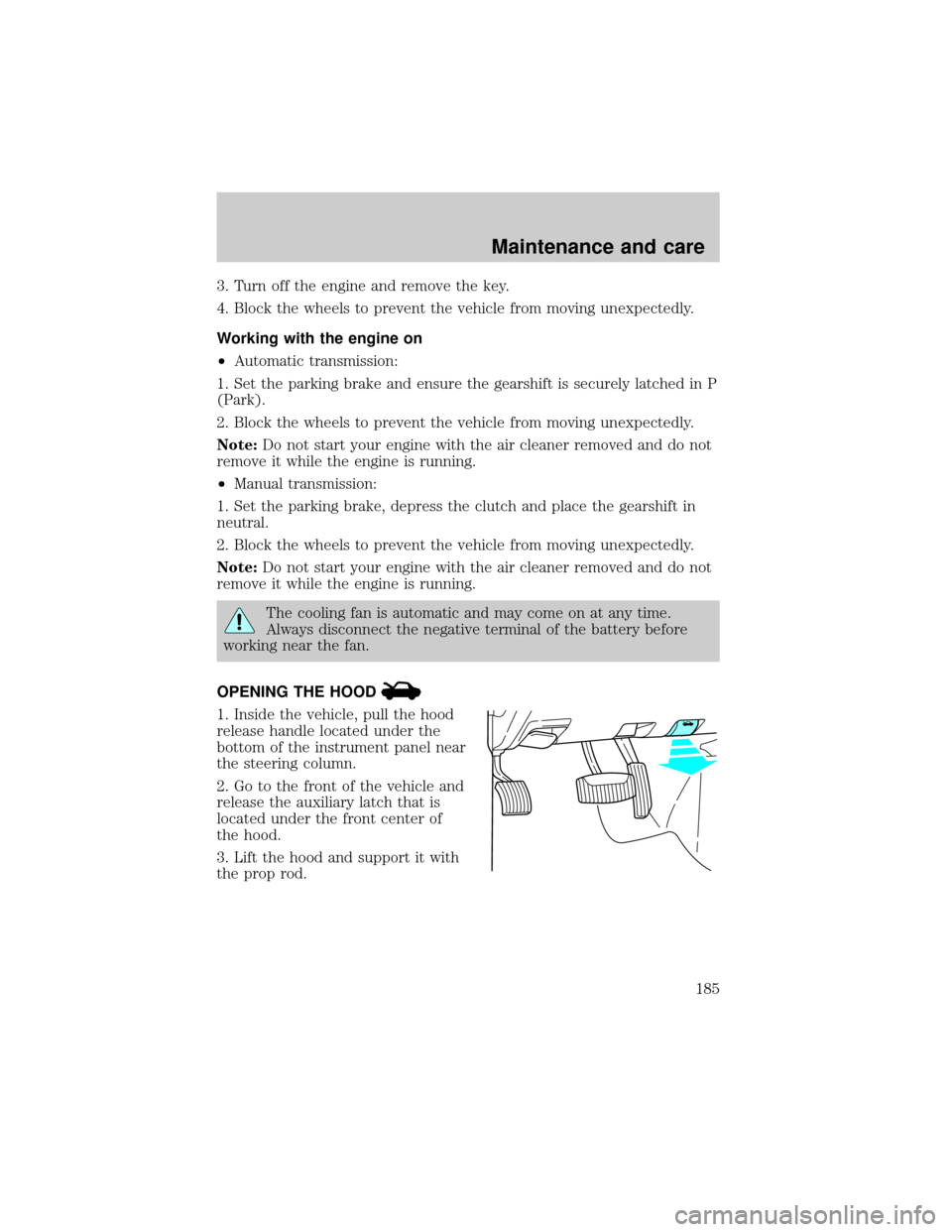
OPENING THE HOOD
1. Inside the vehicle, pull the hood
release handle located under the
bottom of the instrument panel near
the steering column.
2. Go to the front of the vehicle and
release the auxiliary latch that is
located under the front center of
the hood.
3. Lift the hood and support it with
the prop rod.
Maintenance and care
185
Page 202 of 272

If you drive in extremely hot climates:
²It is still necessary to maintain the coolant concentration
above 40%.
²NEVER decrease the coolant concentration below 40%.
²Decreased engine coolant concentrations below 40% will
decrease the corrosion protection characteristics of the engine
coolant and may cause engine damage.
²Decreased engine coolant concentrations below 40% will
decrease the freeze protection characteristics of the engine
coolant and may cause engine damage.
²Refer to the chart on the coolant container to ensure the
coolant concentration in your vehicle will provide adequate
protection at the temperatures in which you drive.
Vehicles driven year-round in non-extreme climates should use a 50/50
mixture of engine coolant and distilled water for optimum cooling system
and engine protection.
CHECKING AND ADDING POWER STEERING FLUID
Check the power steering fluid.
Refer to the scheduled maintenance
guide for the service interval
schedules. If adding fluid is
necessary, use only MERCONtAT F.
1. Start the engine and let it run until it reaches normal operating
temperature (the engine coolant temperature gauge indicator will be
near the center of the normal area between H and C).
2. While the engine idles, turn the steering wheel left and right several
times.
Maintenance and care
202
Page 238 of 272
Cleaning the exterior lamps
Wash with the same detergent as the exterior of your vehicle. If
necessary, use a tar remover such as Ford Extra Strength Tar and Road
Oil Remover (B7A-19520±AA).
To avoid scratching the lamps, do not use a dry paper towel, chemical
solvents or abrasive cleaners.
Cleaning the windshield, wiper blades and rear window
If the wiper blades do not wipe properly, clean the wiper blade rubber
element with undiluted windshield washer solution or a mild detergent.
To avoid damaging the blades, do not use fuel, kerosene, paint thinner or
other solvents.
If the wiper still does not wipe properly, this could be caused by
substances on the windshield or rear window such as tree sap and some
hot wax treatments used by commercial car washes. Clean the outside of
the windshield or rear window with a non-abrasive cleaner such as Ford
Ultra-Clear Spray Glass Cleaner, (E4AZ-19C507±AA), available from your
Ford Dealer.Do notuse abrasive cleansers on glass as they may cause
scratches. The windshield or rear window is clean if beads do not form
when you rinse it with water. The windshield, rear window and wiper
blades should be cleaned on a regular basis, and blades or rubber
elements replaced when worn.
Cleaning the instrument panel
Clean with a damp cloth, then dry with a dry cloth.
Avoid cleaner or polish that increases the gloss of the upper portion of
the instrument panel. The dull finish in this area helps protect the driver
from undesirable windshield reflection.
Do not use chemical solvents or strong detergents when cleaning
the steering wheel or instrument panel to avoid contamination of
the air bag system.
Cleaning the instrument cluster lens
Clean with a damp cloth, then dry with a dry cloth.
Do not use household or glass cleaners as these may damage the lens.
Maintenance and care
238
Page 268 of 272

Servicing your vehicle ..............184
Snowplowing .................................4
Spark plugs,
specifications .............240, 245±246
Special notice ................................4
ambulance conversions ..............5
utility-type vehicles ....................4
Specification chart,
lubricants ...........................243, 245
Speed control ..............................65
Speedometer ...............................18
Starting your vehicle ........123, 126
jump starting ..........................178
Steering wheel
tilting .........................................70
T
Tachometer .................................17
Tires ...........................171, 210±212
changing ..................171±172, 175
checking the pressure ............212
replacing ..................................213
rotating ....................................212
snow tires and chains ............214
tire grades ...............................211
treadwear ................................211
Tonneau cover .............................76
Towing .......................................147
recreational towing .................156
trailer towing ..........................147
wrecker ....................................183
Traction-lok rear axle ...............144
Transfer case
fluid checking .........................206Transmission
automatic operation ...............132
fluid, checking and adding
(automatic) .............................203
fluid, checking and adding
(manual) .................................205
fluid, refill capacities ..............240
lubricant specifications ..243, 245
manual operation ....................136
Trip odometer .............................18
Trunk ...........................................80
Turn signal ............................13, 64
V
Vehicle dimensions ...................246
Vehicle Identification Number
(VIN) ..........................................248
Vehicle loading ..........................144
camper bodies ........................157
Ventilating your vehicle ...........127
W
Warning chimes ...........................15
Warning lights (see Lights) .......10
Washer fluid ..............................196
Water, Driving through .............144
Windows
power .........................................72
Windshield washer fluid and
wipers
checking and adding fluid .....196
checking and cleaning ............209
operation ...................................71
replacing wiper blades ...........210
Wrecker towing .........................183
Index
268