2001 FORD POSTAL EXPLORER lock
[x] Cancel search: lockPage 60 of 88
²NEVER decrease the coolant concentration below 40%.
²Engine coolant concentrations above 60% or below 40% will
decrease the freeze protection characteristics of the engine
coolant and may cause engine damage.
Plain water may be added in an emergency, but youmustreplace it with
a 50/50 mixture of engine coolant and distilled water as soon as possible.
Check the coolant level in the reservoir before you drive your vehicle the
next few times (with the engine cool). If necessary, add a50/50
mixtureof engine coolant and distilled water to the engine coolant
reservoir until the coolant level is at the ªcold fill levelº or within the
ªcold fill rangeº as listed on the reservoir (depending upon application).
Have your dealer check the engine cooling system for leaks if you have
to add more than 1.0 liter (1.0 quart) of engine coolant per month.
To avoid scalding hot steam or coolant from being released from
the engine cooling system, never remove the reservoir cap while
the engine is running or hot. Failure to follow this warning may result
in damage to the engine's cooling system and possible severe personal
injury.
If you must remove the coolant cap, follow these steps to avoid personal
injury:
1. Before you remove the cap, turn the engine off and let it cool.
2. When the engine is cool, wrap a thick cloth around the cap. Slowly
turn cap counterclockwise until pressure begins to release.
3. Step back while the pressure releases.
4. When you are sure that all the pressure has been released, use the
cloth to turn it counterclockwise and remove the cap.
Recycled engine coolant
Ford Motor Company recommends the use of a recycled engine coolant
produced by Ford-approved processes.
Not all coolant recycling processes produce coolant which meets Ford
specification WSS-M97B51±A1. Use of a recycled engine coolant which
does not meet the Ford G05 specification may harm engine and cooling
system components.
Maintenance and care
60
Page 67 of 88
²The vehicle may need to be driven to relearn the idle and fuel trim
strategy.
²If you do not allow the engine to relearn its idle trim, the idle
quality of your vehicle may be adversely affected until the idle
trim is eventually relearned.
When the battery is disconnected or a new battery installed, the
transmission must relearn its adaptive strategy. As a result of this, the
transmission may shift firmly. This operation is considered normal and
will not affect function or durability of the transmission. Over time the
adaptive learning process will fully update transmission operation to its
optimum shift feel.
If the battery has been disconnected or a new battery has been installed,
the clock and the preset radio stations must be reset once the battery is
reconnected.
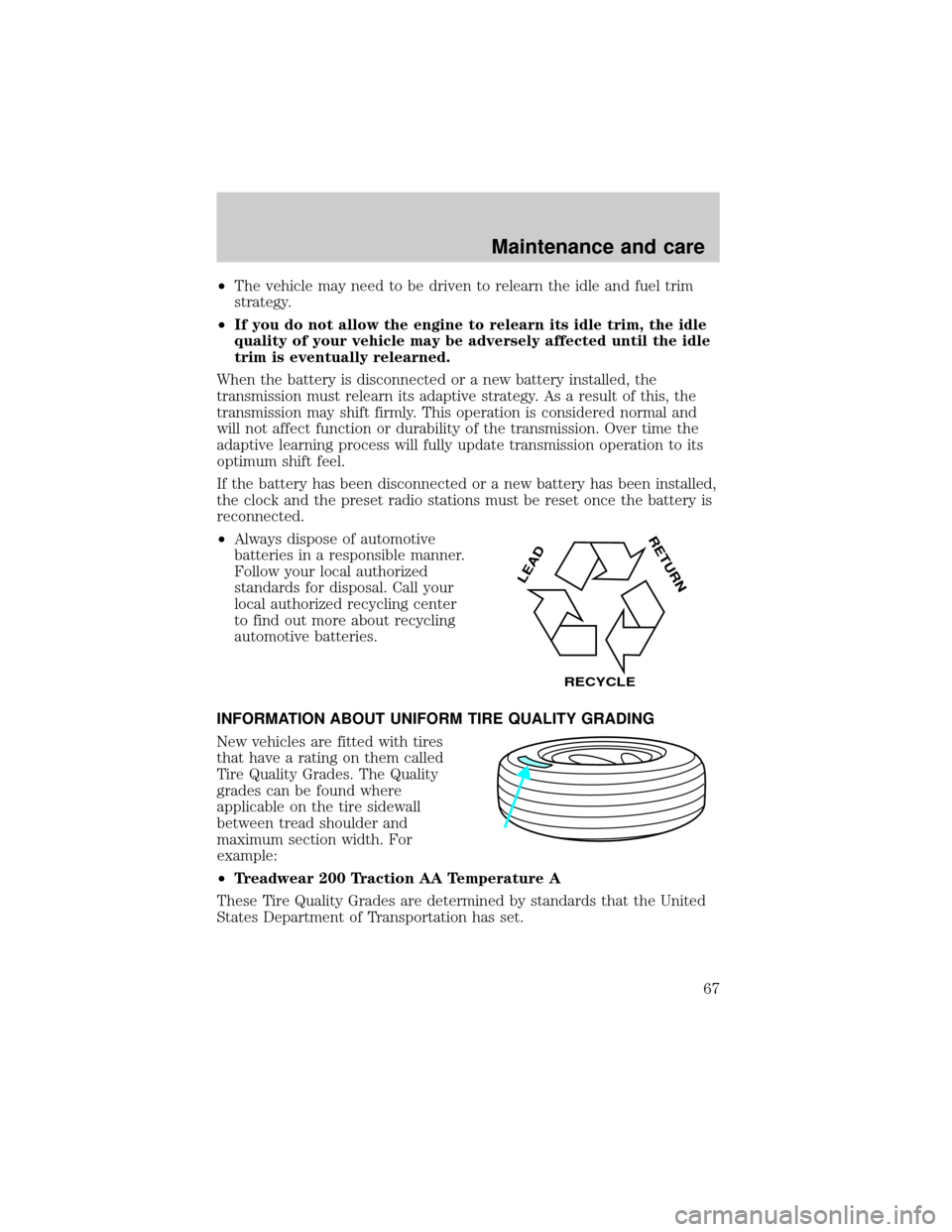
²Always dispose of automotive
batteries in a responsible manner.
Follow your local authorized
standards for disposal. Call your
local authorized recycling center
to find out more about recycling
automotive batteries.
INFORMATION ABOUT UNIFORM TIRE QUALITY GRADING
New vehicles are fitted with tires
that have a rating on them called
Tire Quality Grades. The Quality
grades can be found where
applicable on the tire sidewall
between tread shoulder and
maximum section width. For
example:
²Treadwear 200 Traction AA Temperature A
These Tire Quality Grades are determined by standards that the United
States Department of Transportation has set.
LEAD
RETURN
RECYCLE
Maintenance and care
67
Page 77 of 88
If you have run out of fuel:
²You may need to cycle the ignition from OFF to ON several times after
refueling, to allow the fuel system to pump the fuel from the tank to
the engine.
²Your ªCheck Engineº indicator may come on. For more information on
the ªCheck Engineº indicator, refer to theInstrumentationchapter.
Fuel Filler Cap
Your fuel tank filler cap has an indexed design with a 1/8 turn on/off feature.
When fueling your vehicle:
1. Turn the engine off.
2. Carefully turn the filler cap counterclockwise 1/8 of a turn until it
stops.
3. Pull to remove the cap from the fuel filler pipe.
4. To install the cap, align the tabs on the cap with the notches on the
filler pipe.
5. Turn the filler cap clockwise 1/8 of a turn until it stops.
If the ªService Engine Soon/Check Engineº indicator comes on and stays
on after you start the engine, the fuel filler cap may not be properly
installed. Turn off the engine, remove the fuel filler cap, align the cap
properly and reinstall it.
If you must replace the fuel filler cap, replace it with a fuel filler
cap that is designed for your vehicle. The customer warranty may
be void for any damage to the fuel tank or fuel system if the
correct genuine Ford or Motorcraft fuel filler cap is not used.
The fuel system may be under pressure. If the fuel filler cap is
venting vapor or if you hear a hissing sound, wait until it stops
before completely removing the fuel filler cap. Otherwise, fuel may
spray out and injure you or others.
If you do not use the proper fuel filler cap, excessive pressure or
vacuum in the fuel tank may damage the fuel system or cause
the fuel cap to disengage in a collision, which may result in possible
personal injury.
Maintenance and care
77
Page 84 of 88

A
Air cleaner filter .........................80
Antifreeze
(see Engine coolant) ..................57
Anti-lock brake system
(see Brakes) ..........................23±24
Automatic transmission
driving an automatic
overdrive ...................................27
fluid, adding ..............................62
fluid, checking ..........................62
fluid, refill capacities ................80
fluid, specification ....................82
Axle
lubricant specifications ......81±82
refill capacities ..........................80
B
Battery .........................................65
acid, treating emergencies .......65
charging system warning light ..9
jumping a disabled battery ......43
maintenance-free ......................65
replacement, specifications .....80
servicing ....................................65
voltage gauge ............................11
Brakes ..........................................23
anti-lock ...............................23±24
anti-lock brake system
(ABS) warning light .............8, 24
brake warning light ....................7
fluid, checking and adding ......56
fluid, refill capacities ................80
fluid, specifications .............81±82
lubricant specifications ......81±82
shift interlock ............................26
Break-in period .............................3C
Capacities for refilling fluids ......80
Coolant
checking and adding ................57
refill capacities ....................61, 80
specifications ......................81±82
D
Dipstick
automatic transmission fluid ...62
engine oil ...................................54
Doors
lubricant specifications ............81
Driveline universal
joint and slip yoke ......................64
Driving under special
conditions ....................................32
mud ......................................31±32
sand ...........................................32
snow and ice .......................31, 33
through water ...........................32
E
Emergencies, roadside
jump-starting ............................43
Emission control system ............78
Engine ..........................................82
check engine/
service engine soon light ...........6
coolant .......................................57
idle speed control .....................65
lubrication specifications ...81±82
refill capacities ..........................80
service points ............................53
starting after a collision ...........34
Engine oil ....................................54
Index
84
Page 86 of 88

headlamps, flash to pass ..........14
instrument panel, dimming .....13
Lane change indicator
(see Turn signal) ........................16
Lights, warning and indicator ......6
anti-lock brakes (ABS) ........8, 24
brake ............................................7
charging system ..........................9
high beam ...................................8
overdrive off ................................8
safety belt ...................................7
service engine soon ....................6
turn signal indicator ...................8
Lubricant specifications .......81±82
M
Manual transmission
fluid capacities ..........................80
lubricant specifications ............82
Motorcraft parts ....................78, 80
O
Octane rating ..............................75
Odometer .....................................10
Oil (see Engine oil) ....................54
Overdrive .....................................16
P
Parking brake ..............................24
Parts (see Motorcraft parts) ......80
Power distribution box
(see Fuses) .................................37Power steering ............................25
fluid, checking and adding ......62
fluid, refill capacity ..................80
fluid, specifications .............81±82
R
Relays ....................................34, 39
S
Safety defects, reporting ............83
Safety restraints
warning light and chime ........7, 9
Servicing your vehicle ................52
Spark plugs, specifications ...80, 82
Special notice ................................3
utility-type vehicles ....................3
Specification chart,
lubricants ...............................81±82
Speedometer .................................9
Starting your vehicle ............18±21
jump starting ............................43
Steering wheel
tilting .........................................15
T
Tires .................................40, 67±69
changing ....................................40
checking the pressure ..............69
replacing ....................................70
rotating ......................................69
snow tires and chains ..............71
tire grades .................................68
treadwear ..................................68
Towing .........................................69
wrecker ......................................49
Index
86