2001 FORD POSTAL EXPLORER transmission
[x] Cancel search: transmissionPage 63 of 88
working properly, i.e., if the transmission slips or shifts slowly or if you
notice some sign of fluid leakage.
Automatic transmission fluid expands when warmed. To obtain an
accurate fluid check, drive the vehicle until it is warmed up
(approximately 30 km [20 miles]). If your vehicle has been operated for
an extended period at high speeds, in city traffic during hot weather or
pulling a trailer, the vehicle should be turned off for about 30 minutes to
allow fluid to cool before checking.
1. Drive the vehicle 30 km (20 miles) or until it reaches normal operating
temperature.
2. Park the vehicle on a level surface and engage the parking brake.
3. With the parking brake engaged and your foot on the brake pedal,
start the engine and move the gearshift lever through all of the gear
ranges. Allow sufficient time for each gear to engage.
4. Latch the gearshift lever in P (Park) and leave the engine running.
5. Remove the dipstick, wiping it clean with a clean, dry lint free rag. If
necessary, refer toIdentifying components in the engine compartment
in this chapter for the location of the dipstick.
6. Install the dipstick making sure it is fully seated in the filler tube.
7. Remove the dipstick and inspect the fluid level. The fluid should be in
the designated area for normal operating temperature or ambient
temperature.
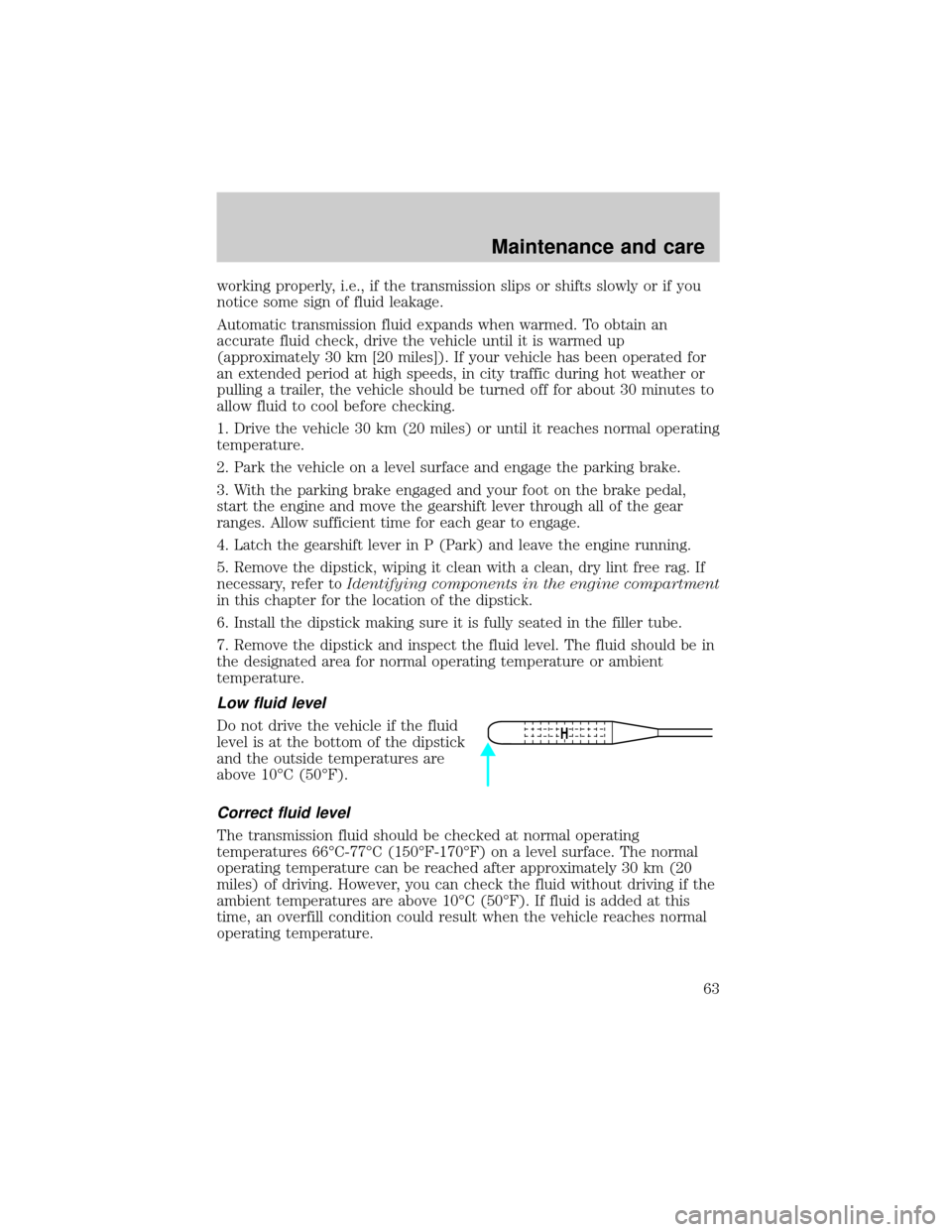
Low fluid level
Do not drive the vehicle if the fluid
level is at the bottom of the dipstick
and the outside temperatures are
above 10ÉC (50ÉF).
Correct fluid level
The transmission fluid should be checked at normal operating
temperatures 66ÉC-77ÉC (150ÉF-170ÉF) on a level surface. The normal
operating temperature can be reached after approximately 30 km (20
miles) of driving. However, you can check the fluid without driving if the
ambient temperatures are above 10ÉC (50ÉF). If fluid is added at this
time, an overfill condition could result when the vehicle reaches normal
operating temperature.
H
Maintenance and care
63
Page 64 of 88
![FORD POSTAL EXPLORER 2001 2.G Owners Manual The transmission fluid should be in
this range if at normal operating
temperature (66ÉC-77ÉC
[150ÉF-170ÉF]).
High fluid level
Fluid levels above the safe range
may result in transmission failure.](/manual-img/11/5323/w960_5323-63.png "FORD POSTAL EXPLORER 2001 2.G Owners Manual The transmission fluid should be in
this range if at normal operating
temperature (66ÉC-77ÉC
[150ÉF-170ÉF]).
High fluid level
Fluid levels above the safe range
may result in transmission failure.")
The transmission fluid should be in
this range if at normal operating
temperature (66ÉC-77ÉC
[150ÉF-170ÉF]).
High fluid level
Fluid levels above the safe range
may result in transmission failure.
An overfill condition of transmission
fluid may cause shift and/or
engagement concerns and/or
possible damage.
High fluid levels can be caused by an overheating condition.
Adjusting automatic transmission fluid levels
Before adding any fluid, make sure the correct type is used. The type of
fluid used is normally indicated on the dipstick and also in the
Lubricant specificationssection in theCapacities and specifications
chapter.
Use of a non-approved automatic transmission fluid may cause
internal transmission component damage.
If necessary, add fluid in 250 mL (1/2 pint) increments through the filler
tube until the level is correct.
If an overfill occurs, excess fluid
should be removed by a qualified
technician.
An overfill condition of
transmission fluid may cause
shift and/or engagement concerns and/or possible damage.
DRIVELINE UNIVERSAL JOINT AND SLIP YOKE
Your vehicle may be equipped with universal joints that require
lubrication. Refer to the scheduled maintenance guide for maintenance
intervals. If the original universal joints are replaced with universal joints
equipped with grease fittings, lubrication will also be necessary.
H
H
H
Maintenance and care
64
Page 65 of 88
BATTERY
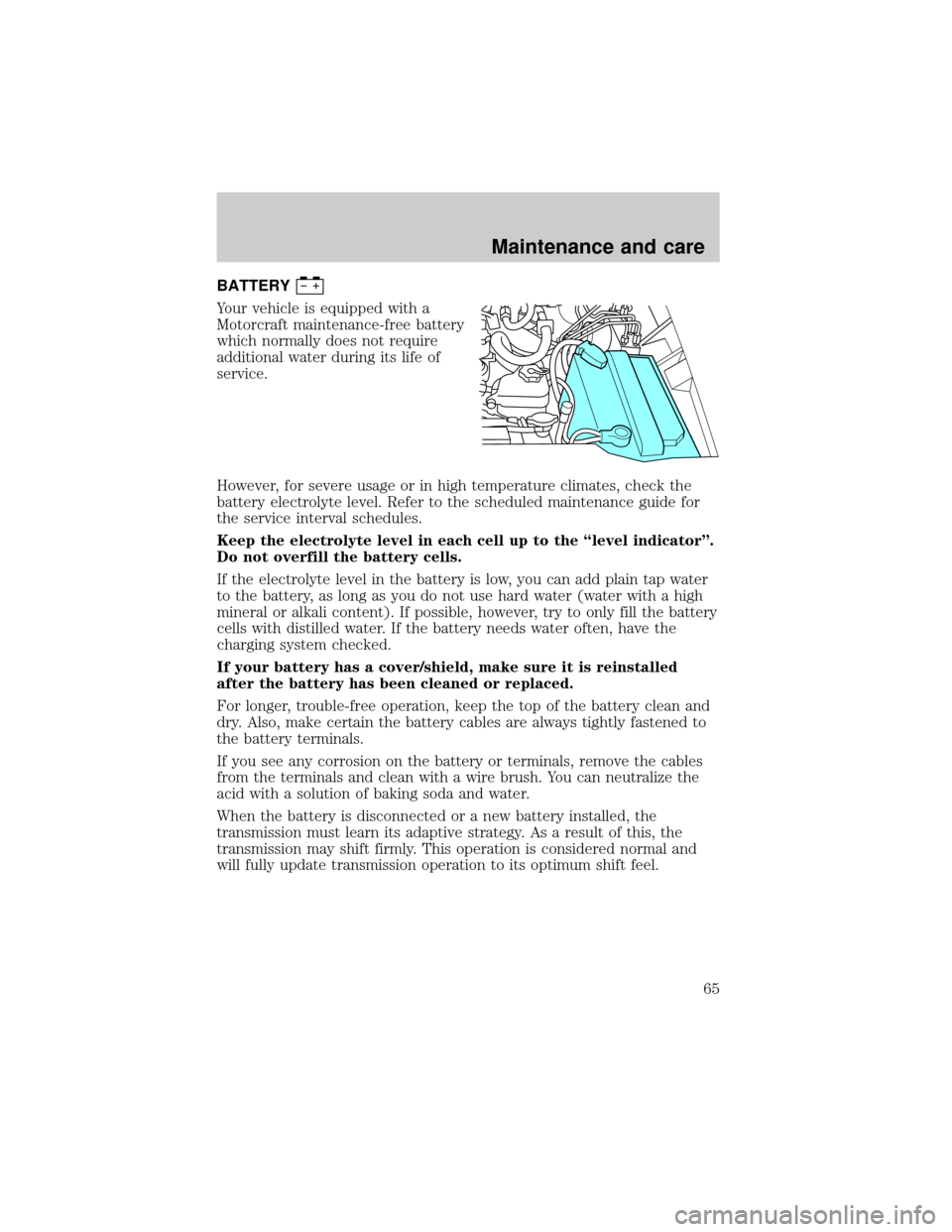
Your vehicle is equipped with a
Motorcraft maintenance-free battery
which normally does not require
additional water during its life of
service.
However, for severe usage or in high temperature climates, check the
battery electrolyte level. Refer to the scheduled maintenance guide for
the service interval schedules.
Keep the electrolyte level in each cell up to the ªlevel indicatorº.
Do not overfill the battery cells.
If the electrolyte level in the battery is low, you can add plain tap water
to the battery, as long as you do not use hard water (water with a high
mineral or alkali content). If possible, however, try to only fill the battery
cells with distilled water. If the battery needs water often, have the
charging system checked.
If your battery has a cover/shield, make sure it is reinstalled
after the battery has been cleaned or replaced.
For longer, trouble-free operation, keep the top of the battery clean and
dry. Also, make certain the battery cables are always tightly fastened to
the battery terminals.
If you see any corrosion on the battery or terminals, remove the cables
from the terminals and clean with a wire brush. You can neutralize the
acid with a solution of baking soda and water.
When the battery is disconnected or a new battery installed, the
transmission must learn its adaptive strategy. As a result of this, the
transmission may shift firmly. This operation is considered normal and
will fully update transmission operation to its optimum shift feel.
Maintenance and care
65
Page 67 of 88
²The vehicle may need to be driven to relearn the idle and fuel trim
strategy.
²If you do not allow the engine to relearn its idle trim, the idle
quality of your vehicle may be adversely affected until the idle
trim is eventually relearned.
When the battery is disconnected or a new battery installed, the
transmission must relearn its adaptive strategy. As a result of this, the
transmission may shift firmly. This operation is considered normal and
will not affect function or durability of the transmission. Over time the
adaptive learning process will fully update transmission operation to its
optimum shift feel.
If the battery has been disconnected or a new battery has been installed,
the clock and the preset radio stations must be reset once the battery is
reconnected.
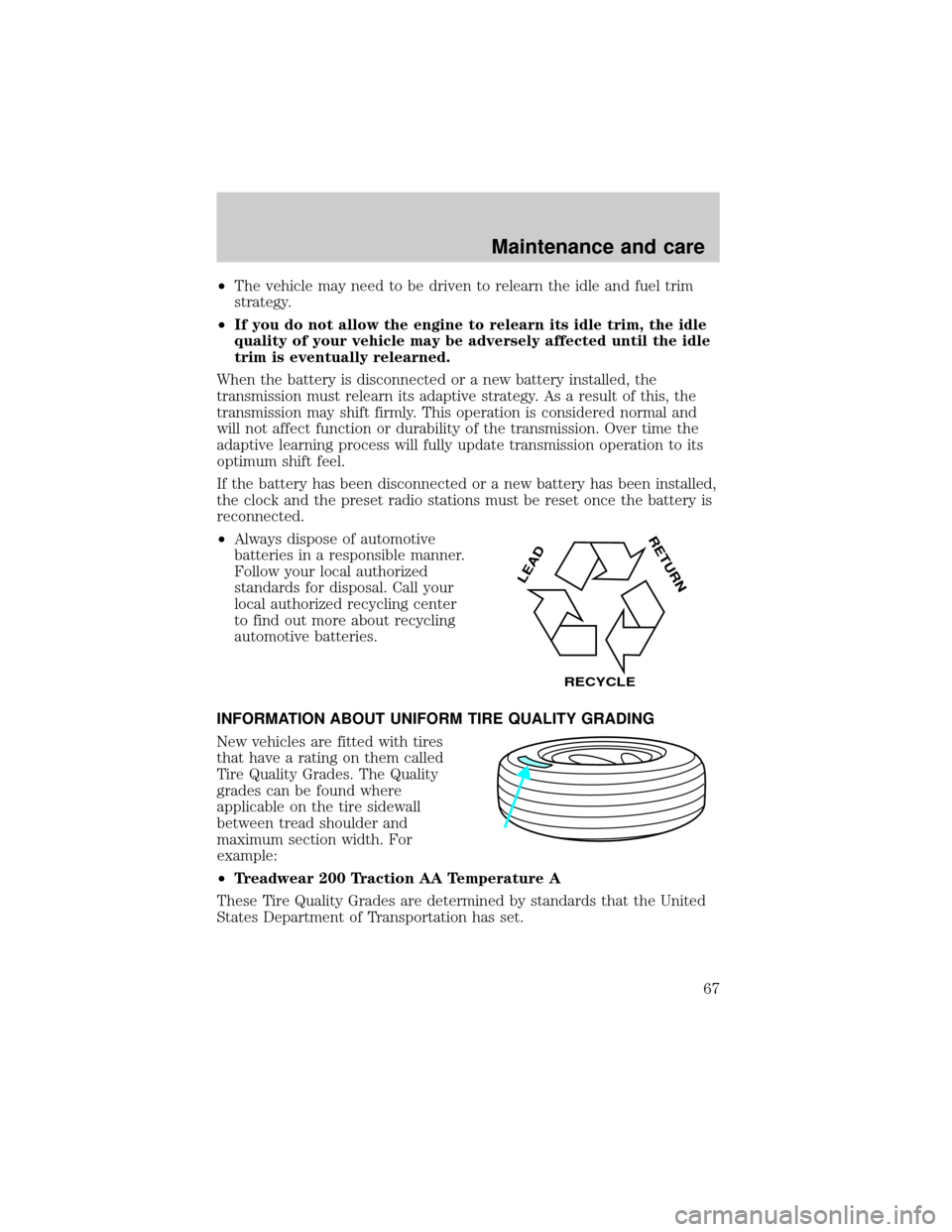
²Always dispose of automotive
batteries in a responsible manner.
Follow your local authorized
standards for disposal. Call your
local authorized recycling center
to find out more about recycling
automotive batteries.
INFORMATION ABOUT UNIFORM TIRE QUALITY GRADING
New vehicles are fitted with tires
that have a rating on them called
Tire Quality Grades. The Quality
grades can be found where
applicable on the tire sidewall
between tread shoulder and
maximum section width. For
example:
²Treadwear 200 Traction AA Temperature A
These Tire Quality Grades are determined by standards that the United
States Department of Transportation has set.
LEAD
RETURN
RECYCLE
Maintenance and care
67
Page 80 of 88
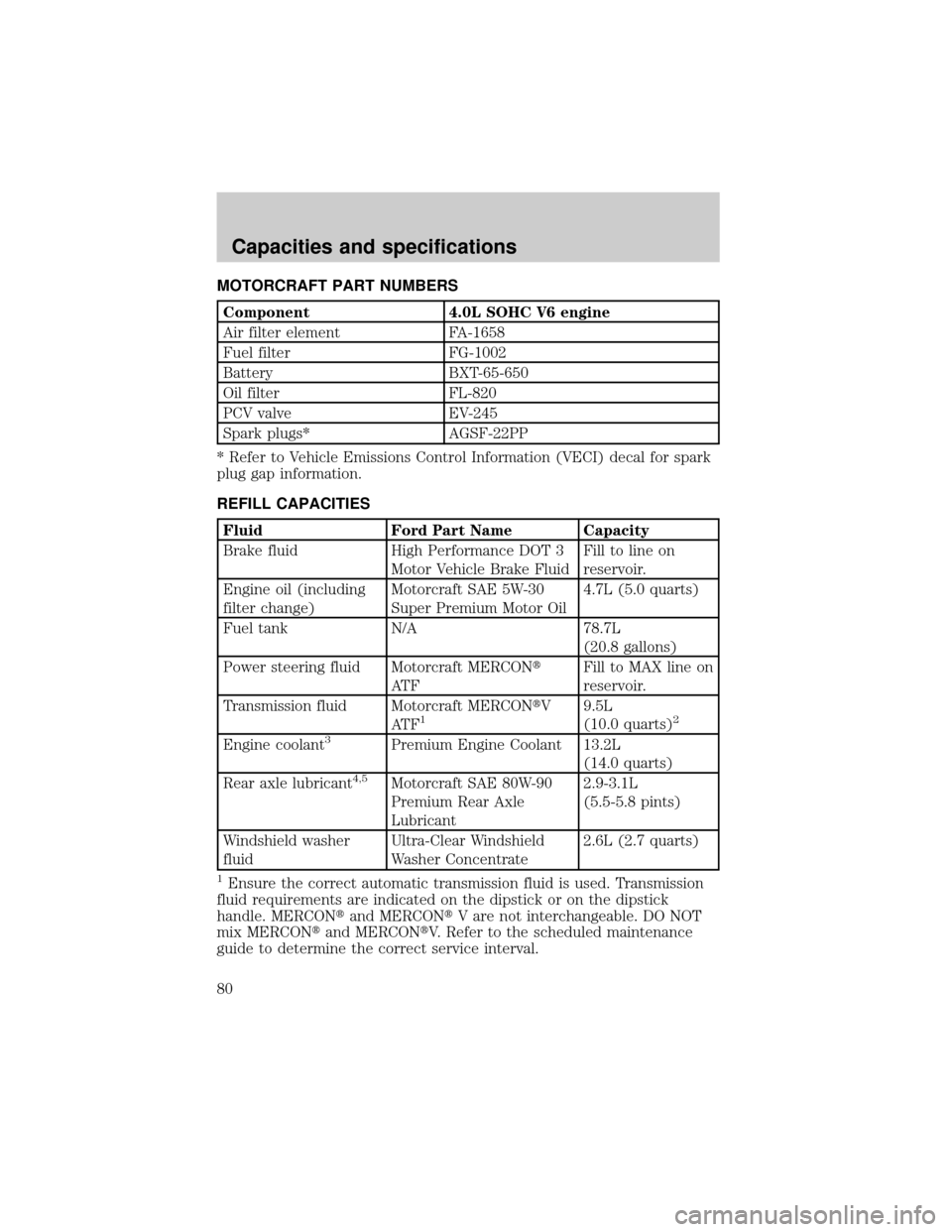
MOTORCRAFT PART NUMBERS
Component 4.0L SOHC V6 engine
Air filter element FA-1658
Fuel filter FG-1002
Battery BXT-65-650
Oil filter FL-820
PCV valve EV-245
Spark plugs* AGSF-22PP
* Refer to Vehicle Emissions Control Information (VECI) decal for spark
plug gap information.
REFILL CAPACITIES
Fluid Ford Part Name Capacity
Brake fluid High Performance DOT 3
Motor Vehicle Brake FluidFill to line on
reservoir.
Engine oil (including
filter change)Motorcraft SAE 5W-30
Super Premium Motor Oil4.7L (5.0 quarts)
Fuel tank N/A 78.7L
(20.8 gallons)
Power steering fluid Motorcraft MERCONt
AT FFill to MAX line on
reservoir.
Transmission fluid Motorcraft MERCONtV
AT F
19.5L
(10.0 quarts)2
Engine coolant3Premium Engine Coolant 13.2L
(14.0 quarts)
Rear axle lubricant
4,5Motorcraft SAE 80W-90
Premium Rear Axle
Lubricant2.9-3.1L
(5.5-5.8 pints)
Windshield washer
fluidUltra-Clear Windshield
Washer Concentrate2.6L (2.7 quarts)
1Ensure the correct automatic transmission fluid is used. Transmission
fluid requirements are indicated on the dipstick or on the dipstick
handle. MERCONtand MERCONtV are not interchangeable. DO NOT
mix MERCONtand MERCONtV. Refer to the scheduled maintenance
guide to determine the correct service interval.
Capacities and specifications
80
Page 81 of 88
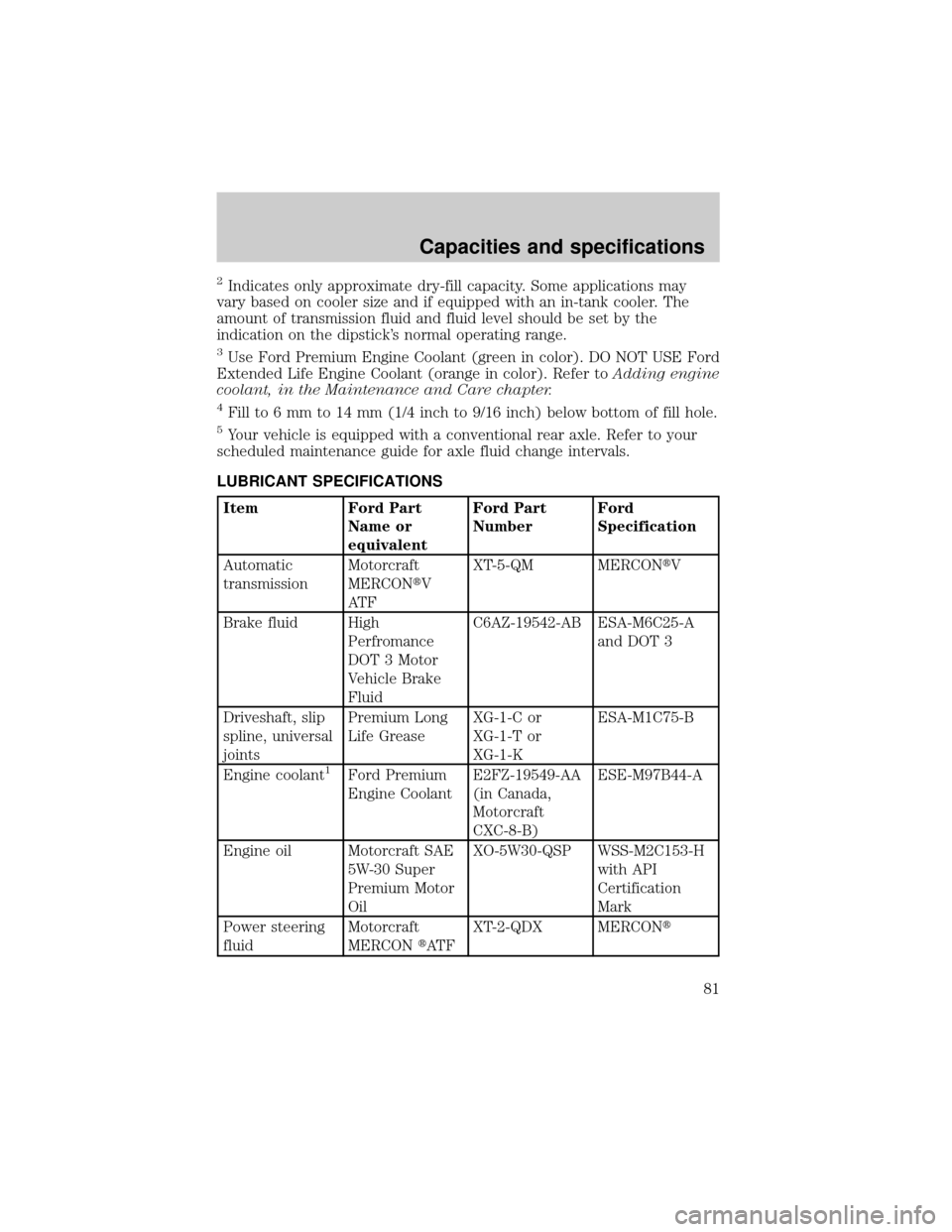
2Indicates only approximate dry-fill capacity. Some applications may
vary based on cooler size and if equipped with an in-tank cooler. The
amount of transmission fluid and fluid level should be set by the
indication on the dipstick's normal operating range.
3Use Ford Premium Engine Coolant (green in color). DO NOT USE Ford
Extended Life Engine Coolant (orange in color). Refer toAdding engine
coolant, in the Maintenance and Care chapter.
4Fill to 6 mm to 14 mm (1/4 inch to 9/16 inch) below bottom of fill hole.
5Your vehicle is equipped with a conventional rear axle. Refer to your
scheduled maintenance guide for axle fluid change intervals.
LUBRICANT SPECIFICATIONS
Item Ford Part
Name or
equivalentFord Part
NumberFord
Specification
Automatic
transmissionMotorcraft
MERCONtV
AT FXT-5-QM MERCONtV
Brake fluid High
Perfromance
DOT 3 Motor
Vehicle Brake
FluidC6AZ-19542-AB ESA-M6C25-A
and DOT 3
Driveshaft, slip
spline, universal
jointsPremium Long
Life GreaseXG-1-C or
XG-1-T or
XG-1-KESA-M1C75-B
Engine coolant
1Ford Premium
Engine CoolantE2FZ-19549-AA
(in Canada,
Motorcraft
CXC-8-B)ESE-M97B44-A
Engine oil Motorcraft SAE
5W-30 Super
Premium Motor
OilXO-5W30-QSP WSS-M2C153-H
with API
Certification
Mark
Power steering
fluidMotorcraft
MERCONtAT FXT-2-QDX MERCONt
Capacities and specifications
81
Page 84 of 88

A
Air cleaner filter .........................80
Antifreeze
(see Engine coolant) ..................57
Anti-lock brake system
(see Brakes) ..........................23±24
Automatic transmission
driving an automatic
overdrive ...................................27
fluid, adding ..............................62
fluid, checking ..........................62
fluid, refill capacities ................80
fluid, specification ....................82
Axle
lubricant specifications ......81±82
refill capacities ..........................80
B
Battery .........................................65
acid, treating emergencies .......65
charging system warning light ..9
jumping a disabled battery ......43
maintenance-free ......................65
replacement, specifications .....80
servicing ....................................65
voltage gauge ............................11
Brakes ..........................................23
anti-lock ...............................23±24
anti-lock brake system
(ABS) warning light .............8, 24
brake warning light ....................7
fluid, checking and adding ......56
fluid, refill capacities ................80
fluid, specifications .............81±82
lubricant specifications ......81±82
shift interlock ............................26
Break-in period .............................3C
Capacities for refilling fluids ......80
Coolant
checking and adding ................57
refill capacities ....................61, 80
specifications ......................81±82
D
Dipstick
automatic transmission fluid ...62
engine oil ...................................54
Doors
lubricant specifications ............81
Driveline universal
joint and slip yoke ......................64
Driving under special
conditions ....................................32
mud ......................................31±32
sand ...........................................32
snow and ice .......................31, 33
through water ...........................32
E
Emergencies, roadside
jump-starting ............................43
Emission control system ............78
Engine ..........................................82
check engine/
service engine soon light ...........6
coolant .......................................57
idle speed control .....................65
lubrication specifications ...81±82
refill capacities ..........................80
service points ............................53
starting after a collision ...........34
Engine oil ....................................54
Index
84
Page 86 of 88

headlamps, flash to pass ..........14
instrument panel, dimming .....13
Lane change indicator
(see Turn signal) ........................16
Lights, warning and indicator ......6
anti-lock brakes (ABS) ........8, 24
brake ............................................7
charging system ..........................9
high beam ...................................8
overdrive off ................................8
safety belt ...................................7
service engine soon ....................6
turn signal indicator ...................8
Lubricant specifications .......81±82
M
Manual transmission
fluid capacities ..........................80
lubricant specifications ............82
Motorcraft parts ....................78, 80
O
Octane rating ..............................75
Odometer .....................................10
Oil (see Engine oil) ....................54
Overdrive .....................................16
P
Parking brake ..............................24
Parts (see Motorcraft parts) ......80
Power distribution box
(see Fuses) .................................37Power steering ............................25
fluid, checking and adding ......62
fluid, refill capacity ..................80
fluid, specifications .............81±82
R
Relays ....................................34, 39
S
Safety defects, reporting ............83
Safety restraints
warning light and chime ........7, 9
Servicing your vehicle ................52
Spark plugs, specifications ...80, 82
Special notice ................................3
utility-type vehicles ....................3
Specification chart,
lubricants ...............................81±82
Speedometer .................................9
Starting your vehicle ............18±21
jump starting ............................43
Steering wheel
tilting .........................................15
T
Tires .................................40, 67±69
changing ....................................40
checking the pressure ..............69
replacing ....................................70
rotating ......................................69
snow tires and chains ..............71
tire grades .................................68
treadwear ..................................68
Towing .........................................69
wrecker ......................................49
Index
86