Page 45 of 240
When in this mode, traffic announcements will
interrupt radio and CD play.
²Press the MENU control until TRAFFIC is
displayed.
²Press the SEL control to engage the feature. The
display will read TRAFFIC ON.
This feature also allows you to control the volume of
traffic announcements. With the display reading
TRAFFIC ON, adjust the volume using the volume
control to the desired level. The volume level will
show at the bottom of the display. Interrupting traffic
announcements will be at the selected volume level.
To disengage the feature, press the MENU control
until TRAFFIC ON displays. Press the SEL control.
The display will read TRAFFIC OFF.
Traffic announcements not available in most
U.S. markets.
Program type
This feature allows you to search for RDS stations
selectively by their program type.
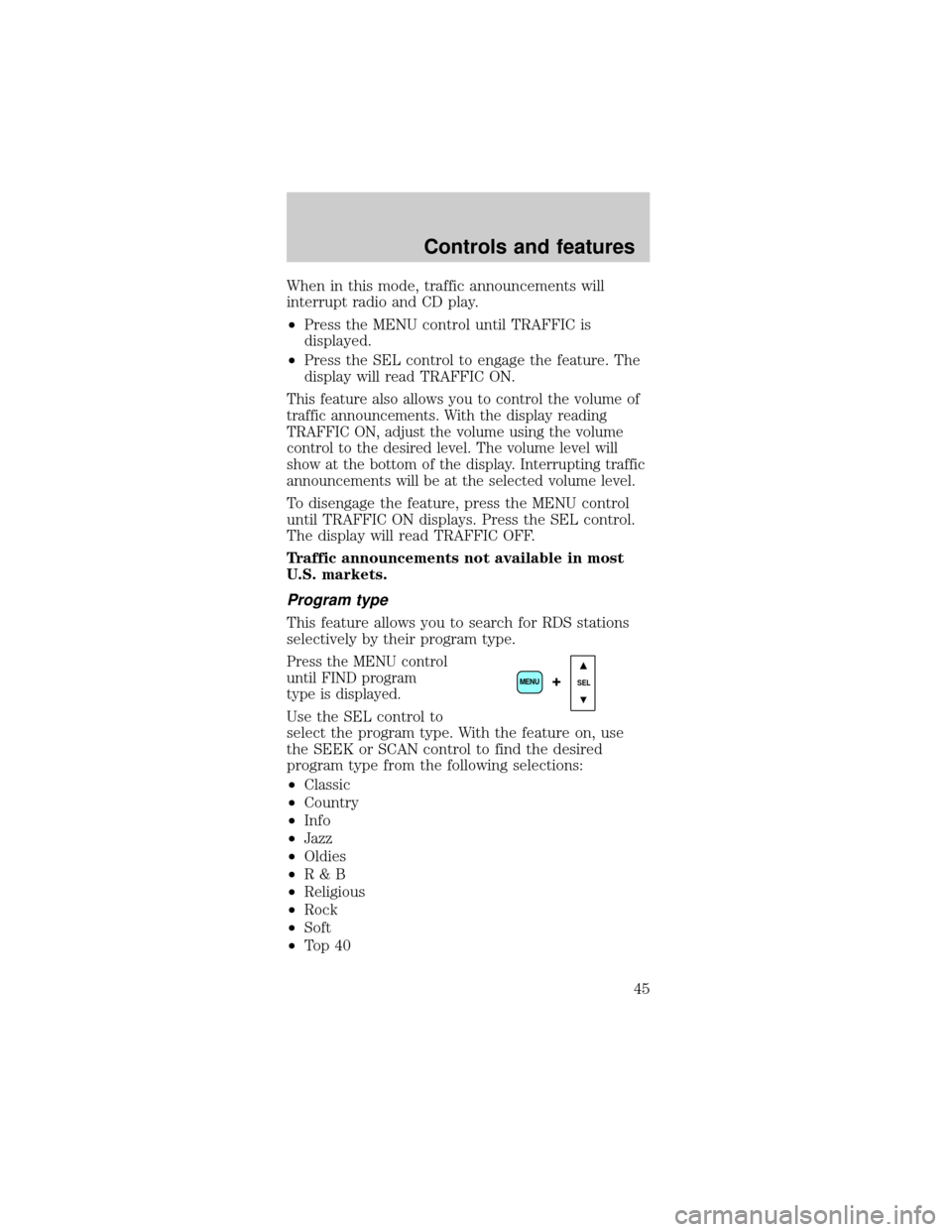
Press the MENU control
until FIND program
type is displayed.
Use the SEL control to
select the program type. With the feature on, use
the SEEK or SCAN control to find the desired
program type from the following selections:
²Classic
²Country
²Info
²Jazz
²Oldies
²R&B
²Religious
²Rock
²Soft
²To p 4 0
SEL+MENU
Controls and features
45
Page 46 of 240
Show
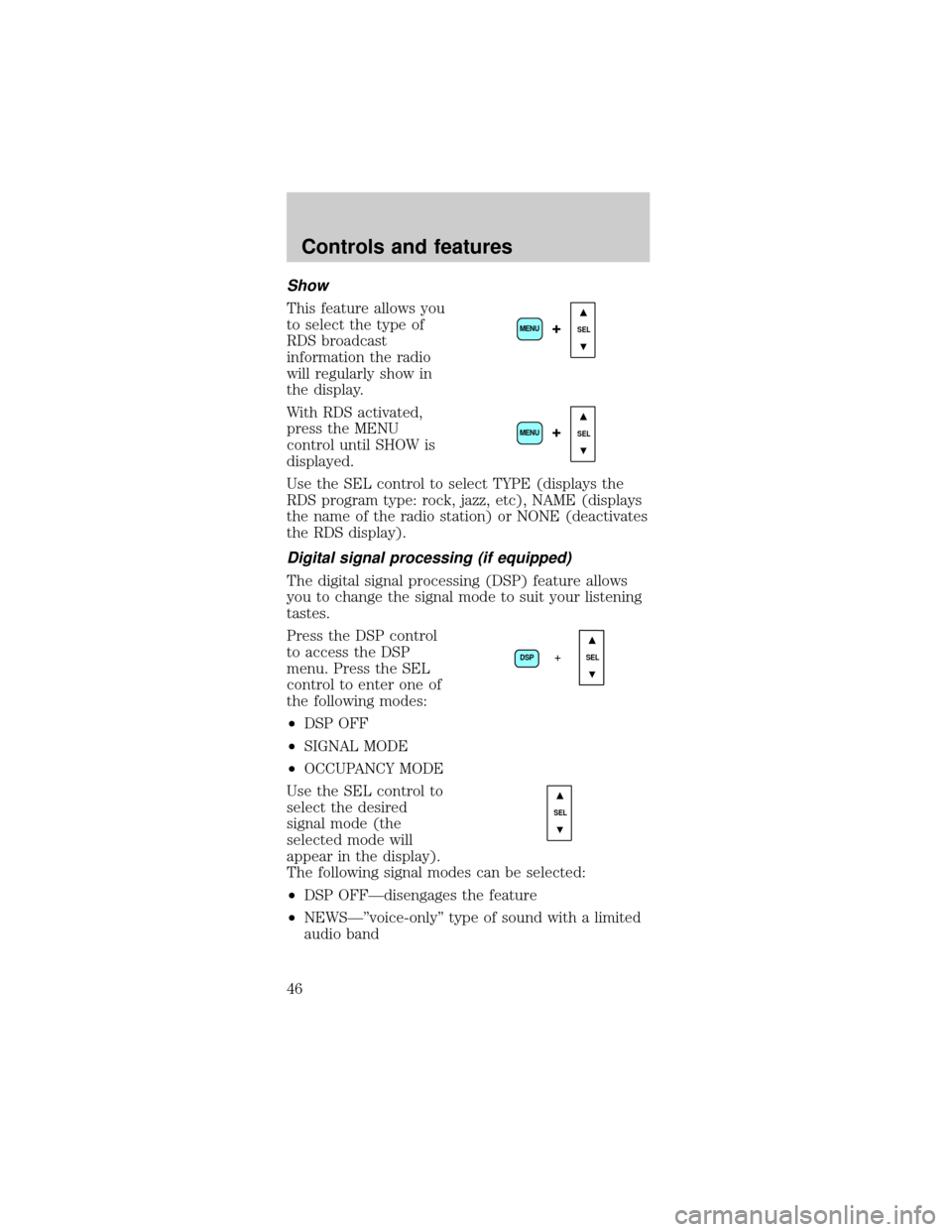
This feature allows you
to select the type of
RDS broadcast
information the radio
will regularly show in
the display.
With RDS activated,
press the MENU
control until SHOW is
displayed.
Use the SEL control to select TYPE (displays the
RDS program type: rock, jazz, etc), NAME (displays
the name of the radio station) or NONE (deactivates
the RDS display).
Digital signal processing (if equipped)
The digital signal processing (DSP) feature allows
you to change the signal mode to suit your listening
tastes.
Press the DSP control
to access the DSP
menu. Press the SEL
control to enter one of
the following modes:
²DSP OFF
²SIGNAL MODE
²OCCUPANCY MODE
Use the SEL control to
select the desired
signal mode (the
selected mode will
appear in the display).
The following signal modes can be selected:
²DSP OFFÐdisengages the feature
²NEWSкvoice-onlyº type of sound with a limited
audio band
SEL+MENU
SEL
+MENU
DSP
SEL+
SEL
Controls and features
46
Page 49 of 240

Do not insert any promotional (odd shaped or
sized) discs, or discs with removable labels into
the CD player as jamming may occur.
Cleaning cassette player (if equipped)
Clean the tape player head with a cassette cleaning
cartridge after 10 to 12 hours of play in order to
maintain the best sound and operation.
Cassette and cassette player care
²
Use only cassettes that are 90 minutes long or less.
²Do not expose tapes to direct sunlight, high
humidity, extreme heat or extreme cold. Allow
tapes that may have been exposed to extreme
temperatures to reach a moderate temperature
before playing.
²Tighten very loose tapes by inserting a finger or
pencil into the hole and turning the hub.
²Remove loose labels before inserting tapes.
²Do not leave tapes in the cassette player for a
long time when not being played.
Radio frequency information
The Federal Communications Commission (FCC) and
the Canadian Radio and Telecommunications
Commission(CRTC) establish the frequencies AM and
FM stations may use for their broadcasts. Allowable
frequencies are:
AM 530, 540±1600, 1610 kHz
FM 87.7, 87.9±107.7, 107.9 MHz
Not all frequencies are used in a given area.
Radio reception factors
Three factors can affect radio reception:
²Distance/strength.The further an FM signal
travels, the weaker it is. The listenable range of
the average FM station is approximately 40 km
(24 miles). This range can be affected by ªsignal
modulation.º Signal modulation is a process radio
stations use to increase their strength/volume
relative to other stations.
Controls and features
49
Page 50 of 240

²Terrain.Hills, mountains and tall buildings
between your vehicle's antenna and the radio
station signal can cause FM reception problems.
Static can be caused on AM stations by power
lines, electric fences, traffic lights and
thunderstorms. Moving away from an interfering
structure (out of its ªshadowº) returns your
reception to normal.
²Station overload.Weak signals are sometimes
captured by stronger signals when you pass a
broadcast tower. A stronger signal may
temporarily overtake a weaker signal and play
while the weak station frequency is displayed.
The audio system automatically switches to single
channel reception if it will improve the reception of
a station normally received in stereo.
Audio system warranties and service
Refer to theWarranty Guidefor audio system
warranty information.
If service is necessary, see your dealer or a qualified
technician.
TRACTION CONTROLY
This control can be
used to turn the
Traction Controlyon
or off. Refer to the
Traction Controly
section of theDrivingchapter for more information.
TRUNK REMOTE CONTROL
The remote trunk release control is located in the
glove compartment. Press to open trunk.
Controls and features
50
Page 52 of 240
POSITIONS OF THE IGNITION
1. ACCESSORY, allows
the electrical
accessories such as the
radio to operate while
the engine is not
running. For manual
transmission, you must
depress the ignition
release lever.
2. LOCK, locks the steering wheel, automatic
transmission gearshift lever and allows key removal.
For manual transmission, you must depress the
ignition release lever.
3. OFF, shuts off the engine and all accessories
without locking the steering wheel.
4. ON, all electrical circuits operational. Warning
lights illuminated. Key position when driving.
5. START, cranks the engine. Release the key as
soon as the engine starts.
TILT STEERING WHEEL (IF EQUIPPED)
Pull the tilt steering
control toward you to
move the steering
wheel up or down.
Hold the control while
adjusting the wheel to
the desired position,
then release the
control to lock the
steering wheel in
position.
Never adjust the steering wheel when the
vehicle is moving.
3
1
2
5
4
Controls and features
52
Page 67 of 240

Replacing the batteries
The transmitter is powered by two coin type
three-volt lithium batteries. Typical operating range
will allow you to be up to 10 meters (33 feet) away
from your vehicle. A decrease in operating range can
be caused by:
²weather conditions
²nearby radio towers
²structures around the vehicle
²other vehicles parked next to the vehicle
To replace the
batteries:
1. Twist a thin coin
between the two halves
of the transmitter near
the key ring. DO NOT
TAKE THE FRONT
PART OF THE
TRANSMITTER
APART.
2. Place the positive
(+) side of new batteries down. Refer to the diagram
inside the transmitter unit.
3. Snap the two halves back together.
Replacement of the battery willnotcause the
remote transmitter to become deprogrammed from
your vehicle. The remote transmitter should operate
normally after battery replacement.
SECURILOCKYPASSIVE ANTI-THEFT SYSTEM
SecuriLockypassive anti-theft system is an engine
immobilization system. This system prevents the
engine from being started unless acoded key
programmed to your vehicleis used.
The SecuriLockypassive anti-theft system is not
compatible with non-Ford aftermarket remote start
systems. Use of these systems may result in vehicle
starting problems and a loss of security protection.
Controls and features
67
Page:
< prev 1-8 9-16 17-24