2001 FORD F650 jump
[x] Cancel search: jumpPage 142 of 240

GETTING ROADSIDE ASSISTANCE
To fully assist you should you have a vehicle concern, Ford offers a
complimentary roadside assistance program. This program is separate
from the New Vehicle Limited Warranty. The service is available:
²24±hours, seven days a week
²for the New Vehicle Limited Warranty period (U.S.) of two years
(unlimited miles)
Roadside assistance will cover:
²jump-starts
²lock-out assistance
²towing to the nearest Ford Motor Company dealership, or towing to
your selling dealership if within 56 km (35 miles). Even non-warranty
related tows, like accidents or getting stuck in the mud or snow, are
covered (some exclusions apply, such as impound towing or
repossession).
Using roadside assistance
Complete the roadside assistance identification card and place it in your
wallet for quick reference. This card is found in the Owner Guide
portfolio in the glove compartment.
To receive roadside assistance in the United States, call 1-800-241-3673.
In Canada call 1±800±665±2006.
Should you need to arrange roadside assistance for yourself, Ford will
reimburse a reasonable amount. To obtain information about
reimbursement, call 1-800-241-3673.
Roadside emergencies
142
Page 154 of 240
JUMP STARTING YOUR VEHICLE
The gases around the battery can explode if exposed to flames,
sparks, or lit cigarettes. An explosion could result in injury or
vehicle damage.
Do not push start your vehicle. You could damage the catalytic
converter.
Batteries contain sulfuric acid which burns skin, eyes, and
clothing.
Preparing your vehicle
Also see the label on the battery.
1. Use only a 12±volt supply to start your vehicle. If you connect your
battery to a 24±volt power supply you can damage your starter, ignition
system and other electrical components. Do not attach the jumper cables
to the glow plug relay as this could severely damage the glow plugs,
injector driver module and PCM.
2. Do not disconnect the battery of the disabled vehicle as this could
damage the vehicle's electrical system.
3. Park the booster vehicle close to the disabled vehicle making sure
theydo nottouch. Set the parking brake on both vehicles and stay clear
of the engine cooling fan and other moving parts.
4. Check all battery terminals and remove any excessive corrosion before
you attach the battery cables.
5. Turn the heater fan on in both vehicles to protect any electrical
surges. Turn all other accessories off.
Roadside emergencies
154
Page 155 of 240
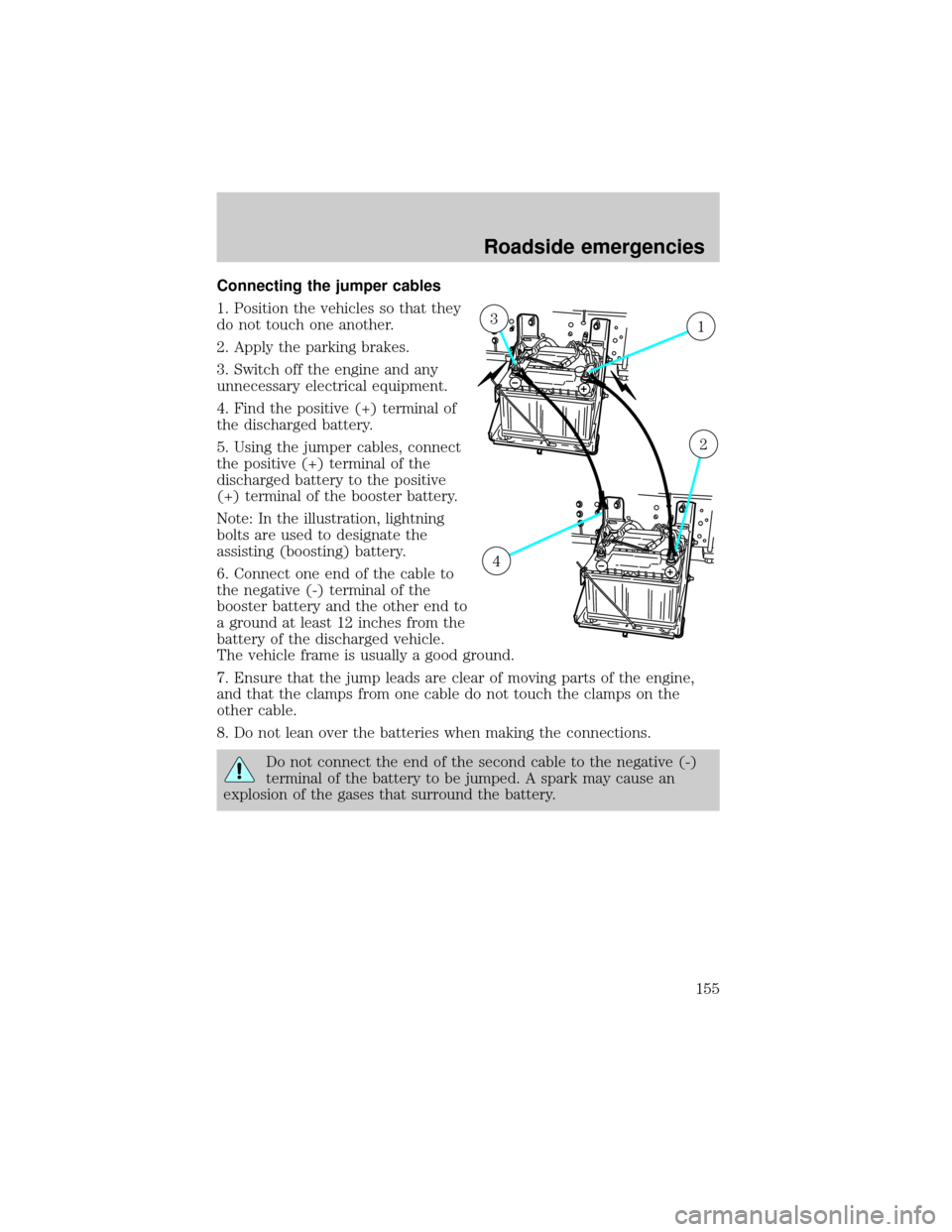
Connecting the jumper cables
1. Position the vehicles so that they
do not touch one another.
2. Apply the parking brakes.
3. Switch off the engine and any
unnecessary electrical equipment.
4. Find the positive (+) terminal of
the discharged battery.
5. Using the jumper cables, connect
the positive (+) terminal of the
discharged battery to the positive
(+) terminal of the booster battery.
Note: In the illustration, lightning
bolts are used to designate the
assisting (boosting) battery.
6. Connect one end of the cable to
the negative (-) terminal of the
booster battery and the other end to
a ground at least 12 inches from the
battery of the discharged vehicle.
The vehicle frame is usually a good ground.
7. Ensure that the jump leads are clear of moving parts of the engine,
and that the clamps from one cable do not touch the clamps on the
other cable.
8. Do not lean over the batteries when making the connections.
Do not connect the end of the second cable to the negative (-)
terminal of the battery to be jumped. A spark may cause an
explosion of the gases that surround the battery.
13
2
4
Roadside emergencies
155
Page 156 of 240
Jump starting
1. Start the booster vehicle and run the engine at moderately increased
speed.
2. After a few minutes, start the engine of the vehicle with the
discharged battery.
3. After starting, run the engine at about 1,000 RPM for 3±5 minutes.
Do not operate the starter longer than 30 seconds. Wait at least
two minutes between starting attempts to allow the starter to
cool. If the engine does not start after several attempts, call for
road service.
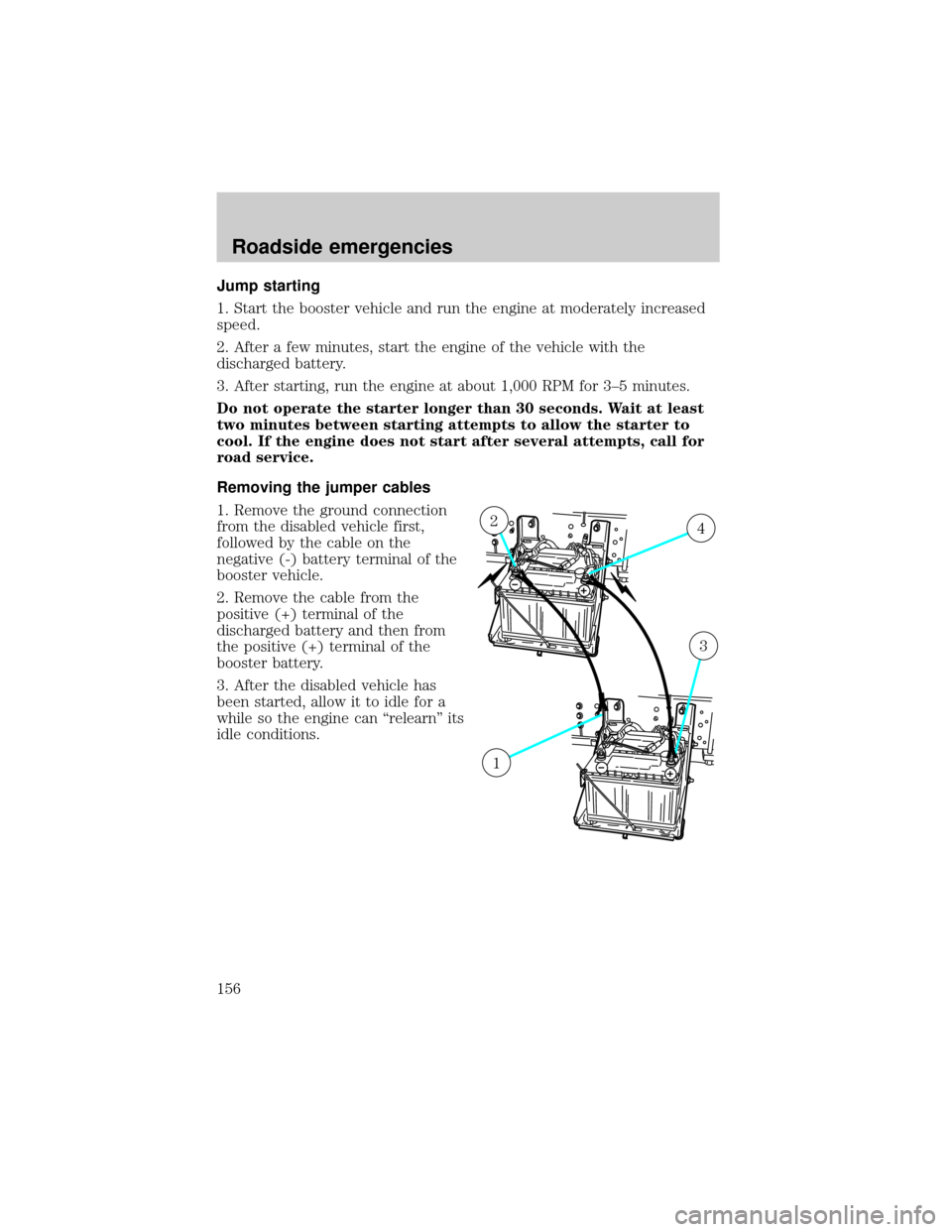
Removing the jumper cables
1. Remove the ground connection
from the disabled vehicle first,
followed by the cable on the
negative (-) battery terminal of the
booster vehicle.
2. Remove the cable from the
positive (+) terminal of the
discharged battery and then from
the positive (+) terminal of the
booster battery.
3. After the disabled vehicle has
been started, allow it to idle for a
while so the engine can ªrelearnº its
idle conditions.
42
3
1
Roadside emergencies
156
Page 157 of 240

WRECKER TOWING
Always unload your vehicle before towing it. The recommended method
of towing is with the drive wheels off the ground.
Before towing, make sure:
²the parking brake is released.
²if air pressure has been lost, to release the brakes manually.
Improper towing of the vehicle will not allow sufficient lubrication of the
transmission which may cause serious damage to internal transmission
components. Always follow the outlined towing procedures.
²To tow a vehicle on the front wheels,the steering wheel must be
in the straight ahead position. Secure the steering wheel with a
holding device (such as provided by a towing company).
²To tow a vehicle on the rear wheels,it will be necessary to remove
the drive axles or disconnect the driveshaft. If the drive axles are
removed, the ends of the axle housing must be sealed to prevent the
loss of axle lubricant during towing.
²To tow a vehicle with an inoperative rear axle,the rear wheels
must be raised onto a dolly or tow the vehicle on the front wheels.
²If your vehicle is equipped with tow hooks,chains must be
fastened directly to the tow hooks on the vehicle.
²If your vehicle is not equipped with tow hooks,chains must be
routed under the bottom edge of the bumper with a protection bar to
protect the bumper, and attached to the vehicle chassis. Under no
circumstances is the vehicle to be lifted or towed by attaching chains
directly to the bumper.
RAISING THE VEHICLE
Never lift the vehicle by the bumper. When raising the vehicle, attach
chains to or place the jack(s) directly beneath the main structural
members of the vehicle.
PUSH-STARTING YOUR VEHICLE
Avoid attempting to start a vehicle by pushing. Instead, use jumper
cables as described underJump starting your vehiclein theRoadside
emergencieschapter. Vehicles with an automatic transmission cannot be
started by pushing.
Roadside emergencies
157
Page 237 of 240

A
Air cleaner filter .......................174
Air conditioning ..........................22
Audio system (see Radio) .........28
Automatic transmission ............131
Auxiliary power point .................22
B
Battery .......................................172
jumping a disabled battery ....157
voltage gauge ............................19
Belt minder .................................92
Brakes ........................107, 109, 113
anti-lock ...................107±108, 116
anti-lock brake system
(ABS) warning light .........13, 108
brake warning light ............10±11
fluid, checking and adding ....163
parking ....................110, 113, 116
trailer .......................................118
C
Cassette tape player .............49±50
Child safety restraints ................96
child safety belts ......................96
Child safety seats ........................97
attaching with tether straps ..100
in front seat ..............................99
in rear seat ................................99
tether anchorage hardware ...101
Cleaning your vehicle ...............196
engine compartment ..............198
exterior ....................................197
exterior lamps .........................198
instrument cluster lens ..........199instrument panel ....................199
interior .....................................199
plastic parts ............................198
safety belts ..............................199
washing ....................................196
waxing .....................................197
wheels ......................................198
wiper blades ............................198
Climate control (see Air
conditioning or Heating) ............22
Clock ..........................32, 39, 48, 62
Clutch ........................................164
fluid ..........................................164
Compass, electronic ....................71
calibration .................................73
set zone adjustment .................72
Console
overhead ....................................71
Controls
power seat .................................84
Coolant ......................................166
checking and adding ..............166
Cruise control (see Speed
control) ........................................66
Customer Assistance ................142
Ford accessories for your
vehicle .....................................233
Ford Extended Service
Plan ..........................................226
Getting assistance outside
the U.S. and Canada ..............232
Getting roadside assistance ...142
Getting the service you
need .........................................226
Ordering additional owner's
literature .................................235
The Dispute Settlement
Board .......................................229
Index
237
Page 238 of 240

Utilizing the
Mediation/Arbitration
Program ...................................232
D
Daytime running lamps
(see Lamps) ................................21
Driving under special
conditions
through water .........................140
E
Emergencies, roadside
jump-starting ..........................157
Emission control system ..........208
Engine
check engine/service engine
soon light ..................................15
cleaning ...................................198
coolant .....................................166
Engine block heater .................105
Engine fan .................................168
Engine oil ..................................159
checking and adding ..............159
oil pressure gauge ....................20
recommendations ...................161
Exhaust fumes ..........................106
F
Foglamps .....................................22
Fuel ............................................183
calculating fuel
economy ..........................141, 189
choosing the right fuel ...........185
filling your vehicle with fuel ..183
filter, specifications ........186±187gauge .........................................17
improving fuel
economy ..........................141, 189
safety information relating to
automotive fuels .....................183
Fuses ..................................143, 145
G
Gas mileage (see Fuel
economy) ...........................141, 189
Gauges .........................................17
battery voltage gauge ...............19
engine coolant temperature
gauge .........................................17
engine oil pressure gauge ........20
fuel gauge ..................................17
odometer ...................................18
speedometer .............................18
tachometer ................................19
trip odometer ............................19
H
Hazard flashers .........................143
Headlamps ...................................21
aiming ......................................195
daytime running lights .............21
flash to pass ..............................66
high beam ...........................13, 66
turning on and off ....................21
warning chime ..........................16
Heating ........................................22
heater only system ...................22
heating and air conditioning
system .......................................24
Hood ..........................................158
Index
238
Page 239 of 240

I
Ignition
removing the key ....................130
Infant seats (see Safety seats) ..97
Instrument panel
cleaning ...................................199
cluster ......................................199
lighting up panel and
interior .......................................21
location of components ............10
J
Jump-starting your vehicle ......157
K
Keys
key in ignition chime ...............16
removing from the ignition ....130
L
Lamps ..........................................74
bulb replacement
specifications chart ................195
cargo lamps ...............................21
daytime running light ...............21
fog lamps ...................................22
headlamps .................................21
headlamps, flash to pass ..........66
instrument panel, dimming .....21
interior lamps ...........................74
replacing bulbs ...............192±194
Lane change indicator (see
Turn signal) .................................65
Lights, warning and indicator ....10
anti-lock brakes (ABS) ....13, 108
brake ....................................10±11charging system ........................11
check coolant ......................14, 16
high beam .................................13
safety belt .................................15
service engine soon ..................15
turn signal indicator .................12
Lubricant specifications ...........201
M
Maintenance and Care ..............211
Manual transmission .................126
Mirrors .........................................77
heated ........................................74
O
Odometer .....................................18
P
Panic alarm feature, remote
entry system ................................79
Parking brake ............110, 113, 116
Power distribution box
(see Fuses) ...............................148
Power door locks ........................76
Power steering ..................124±125
fluid, checking and adding ....168
R
Radio ............................................28
Refill capacities for fluids ........200
Relays ................................143, 152
Remote entry system ...........78±79
illuminated entry ......................79
locking/unlocking doors ...........78
Index
239