Page 85 of 104
5. Follow one of the simple calculations in order to determine fuel
economy:
Multiply liters used by 100, then divide by total kilometers
traveled.
Divide total miles traveled by total gallons used.
Keep a record for at least one month and record the type of driving (city
or highway). This will provide an accurate estimate of the vehicle’s fuel
economy under current driving conditions. Additionally, keeping records
during summer and winter will show how temperature impacts fuel
economy. In general, lower temperatures give lower fuel economy.
Driving style — good driving and fuel economy habits
Give consideration to the lists that follow and you may be able to change
a number of variables and improve your fuel economy.
Habits
•Smooth, moderate operation can yield up to 10% savings in fuel.
•Steady speeds without stopping will usually give the best fuel
economy.
•Idling for long periods of time (greater than one minute) may waste
fuel.
•Anticipate stopping; slowing down may eliminate the need to stop.
•Sudden or hard accelerations may reduce fuel economy.
•Slow down gradually.
•Driving at reasonable speeds (traveling at 88 km/h [55 mph] uses 15%
less fuel than traveling at 105 km/h [65 mph]).
•Revving the engine before turning it off may reduce fuel economy.
•Using the air conditioner or defroster may reduce fuel economy.
•You may want to turn off the speed control in hilly terrain if
unnecessary shifting between third and fourth gear occurs.
Unnecessary shifting of this type could result in reduced fuel
economy.
•Warming up a vehicle on cold mornings is not required and may
reduce fuel economy.
•Resting your foot on the brake pedal while driving may reduce fuel
economy.
Maintenance and care
85
Page 87 of 104
FUEL FILTER REPLACEMENT
The fuel filter assembly is located inside the driver side frame rail, near
the transmission.
The fuel filter should be replaced every 24 000 km (15 000 miles).
Removal
If the fuel filter is being serviced with the rear of the vehicle
higher than the front, or if the fuel tank is pressurized, fuel
leakage or siphoning from the tank fuel tubes could occur. To prevent
this condition, maintain the vehicle front end at or above the level of
the rear of the vehicle.
Do not smoke or carry lighted tobacco or open flame of any type
when working on or near any fuel related component. Highly
flammable mixtures are always present and may be ignited, resulting in
possible personal injury.
Fuel in the fuel system remains under high pressure even when
the engine is not running. Before servicing or disconnecting any
of the fuel lines or fuel system components, the fuel system pressure
must be relieved in order to prevent accidental spraying of fuel,
causing personal injury or a fire hazard.
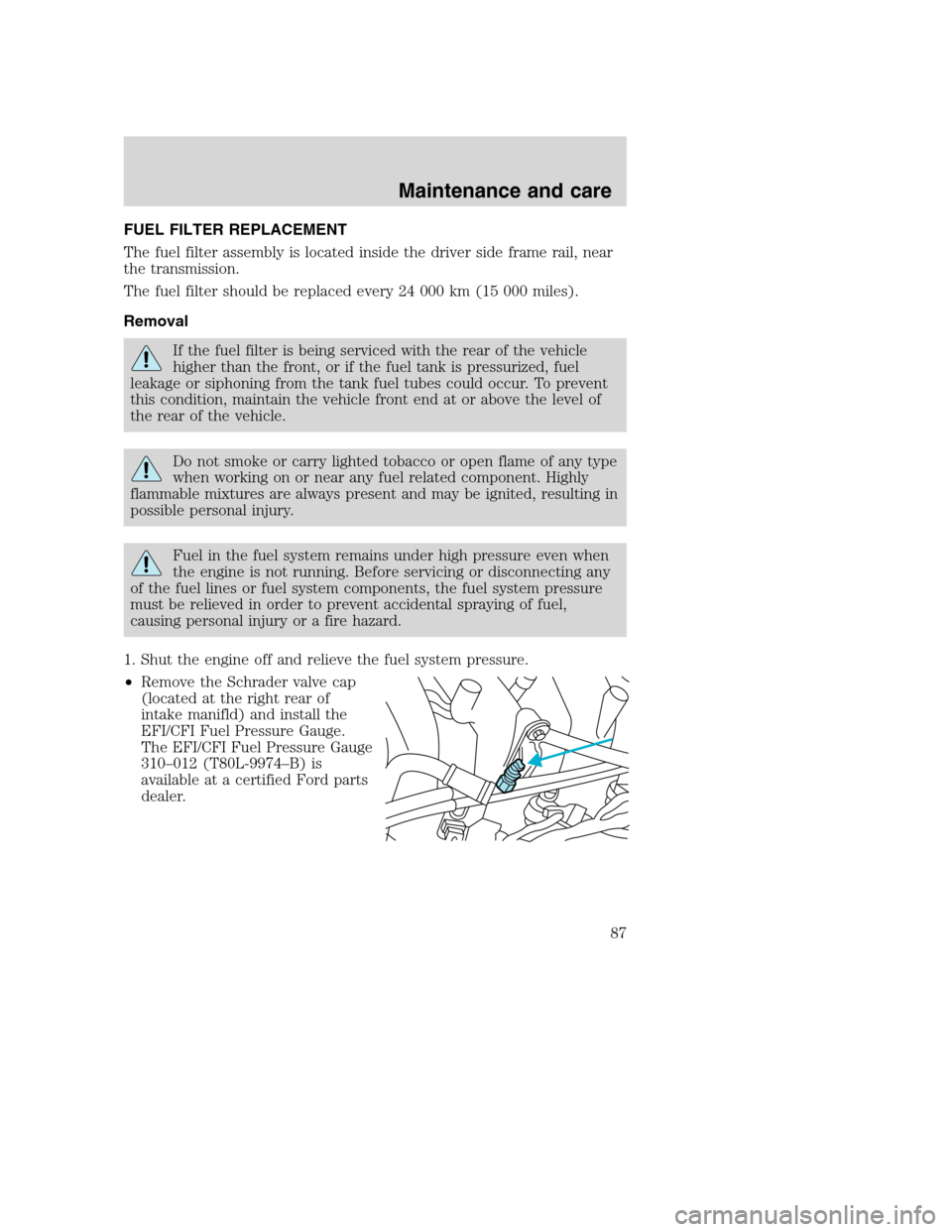
1. Shut the engine off and relieve the fuel system pressure.
•Remove the Schrader valve cap
(located at the right rear of
intake manifld) and install the
EFI/CFI Fuel Pressure Gauge.
The EFI/CFI Fuel Pressure Gauge
310–012 (T80L-9974–B) is
available at a certified Ford parts
dealer.
Maintenance and care
87
Page 91 of 104
•Next, at least 20 minutes driving in stop-and-go, city-type traffic with
at least four idle periods.
Allow the vehicle to sit for at least eight hours without starting the
engine. Then, start the engine and complete the above driving cycle. The
engine must warm up to its normal operating temperature. Once started,
do not turn off the engine until the above driving cycle is complete.
BULBS
Replacing exterior bulbs
Check the operation of the following lamps frequently:
•Headlamps
•Tail lamps
•Brakelamps
•Turn signals
•Backup lamps
•License plate lamp
Do not remove lamp bulbs unless they will be replaced immediately. If a
bulb is removed for an extended period of time, contaminants may enter
the lamp housings and affect performance.
CLEANING AND CARING FOR YOUR VEHICLE
Refer to the Customer Assistance chapter for a list of Ford-approved
cleaners, polishes and waxes.
Cleaning the wheels
Wash with the same detergent as the body of your vehicle. Do not use
acid-based or alcohol-based wheel cleaners, steel wool, fuel or strong
detergents. Never use abrasives that will damage the finish of special
wheel surfaces. Use a tar remover to remove grease and tar.
The brushes used in some automatic car washes may damage the finish
on your wheels. Before going to a car wash, find out if the brushes are
abrasive.
Maintenance and care
91
Page 96 of 104
Item Ford part
nameFord part
numberFord
specification
Parking brake
assemblyMotorcraft
MERCON�XT-2-QDX MERCON�
Dana Axle Motorcraft SAE
75W-140 High
Performance
Synthetic Rear
Axle LubricantF1TZ-19580-B WSL-M2C192-A
1Ensure the correct automatic transmission fluid is used. Transmission
fluid requirements are indicated on the dipstick or on the dipstick
handle. Check the container to verify the fluid being added is of the
correct type. Refer to your scheduled maintenance guide to determine
the correct service interval.
Some transmission fluids may be labeled as dual usage, such as
MERCON�and MERCON�V. These dual usage fluids are not to be used
in an automatic transmission that requires use of the MERCON�type
fluid. However, these dual usage fluids may be used in transmissions that
require the MERCON�V type fluid.
MERCON�and MERCON�V type fluids are not interchangeable.
DO NOT mix MERCON�and MERCON�V. Use of a transmission
fluid that indicates dual usage (MERCON�and MERCON�V) in
an automatic transmission application requiring MERCON�may
cause transmission damage. Use of any fluid other than the
recommended fluid may cause transmission damage.
ENGINE DATA
Engine 6.8L V10 engine
Cubic inches 415
Required fuel 87 octane
Firing order 1-6-5-10-2-7-3-8-4-9
Spark plug gap 1.3-1.4 mm (0.052-0.056 inch)
Ignition system Coil on plug
Compression ratio 9.0:1
Capacities and specifications
96
Page 104 of 104
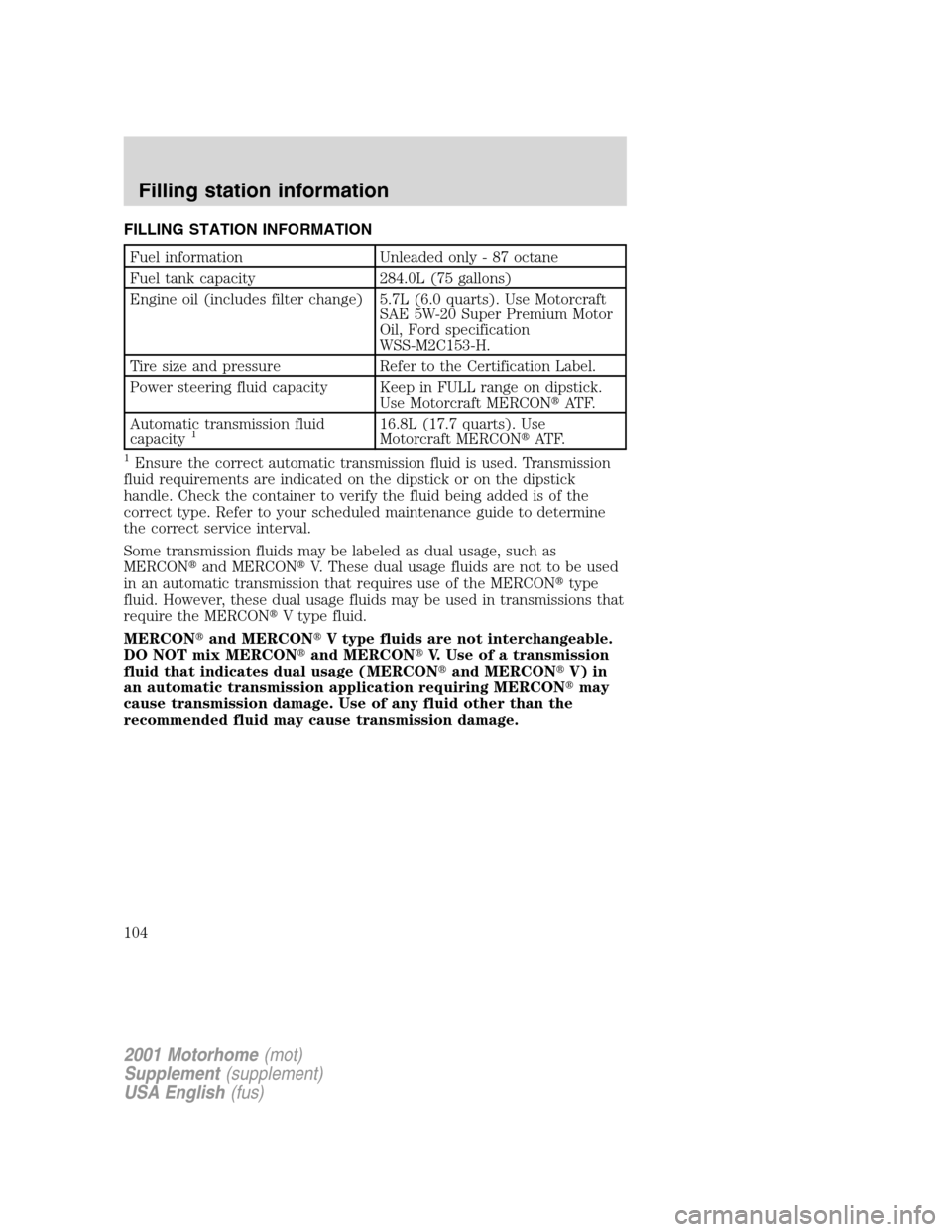
FILLING STATION INFORMATION
Fuel information Unleaded only - 87 octane
Fuel tank capacity 284.0L (75 gallons)
Engine oil (includes filter change) 5.7L (6.0 quarts). Use Motorcraft
SAE 5W-20 Super Premium Motor
Oil, Ford specification
WSS-M2C153-H.
Tire size and pressure Refer to the Certification Label.
Power steering fluid capacity Keep in FULL range on dipstick.
Use Motorcraft MERCON�AT F.
Automatic transmission fluid
capacity
116.8L (17.7 quarts). Use
Motorcraft MERCON�AT F.
1Ensure the correct automatic transmission fluid is used. Transmission
fluid requirements are indicated on the dipstick or on the dipstick
handle. Check the container to verify the fluid being added is of the
correct type. Refer to your scheduled maintenance guide to determine
the correct service interval.
Some transmission fluids may be labeled as dual usage, such as
MERCON�and MERCON�V. These dual usage fluids are not to be used
in an automatic transmission that requires use of the MERCON�type
fluid. However, these dual usage fluids may be used in transmissions that
require the MERCON�V type fluid.
MERCON�and MERCON�V type fluids are not interchangeable.
DO NOT mix MERCON�and MERCON�V. Use of a transmission
fluid that indicates dual usage (MERCON�and MERCON�V) in
an automatic transmission application requiring MERCON�may
cause transmission damage. Use of any fluid other than the
recommended fluid may cause transmission damage.
2001 Motorhome(mot)
Supplement(supplement)
USA English(fus)
Filling station information
104