Page 8 of 256
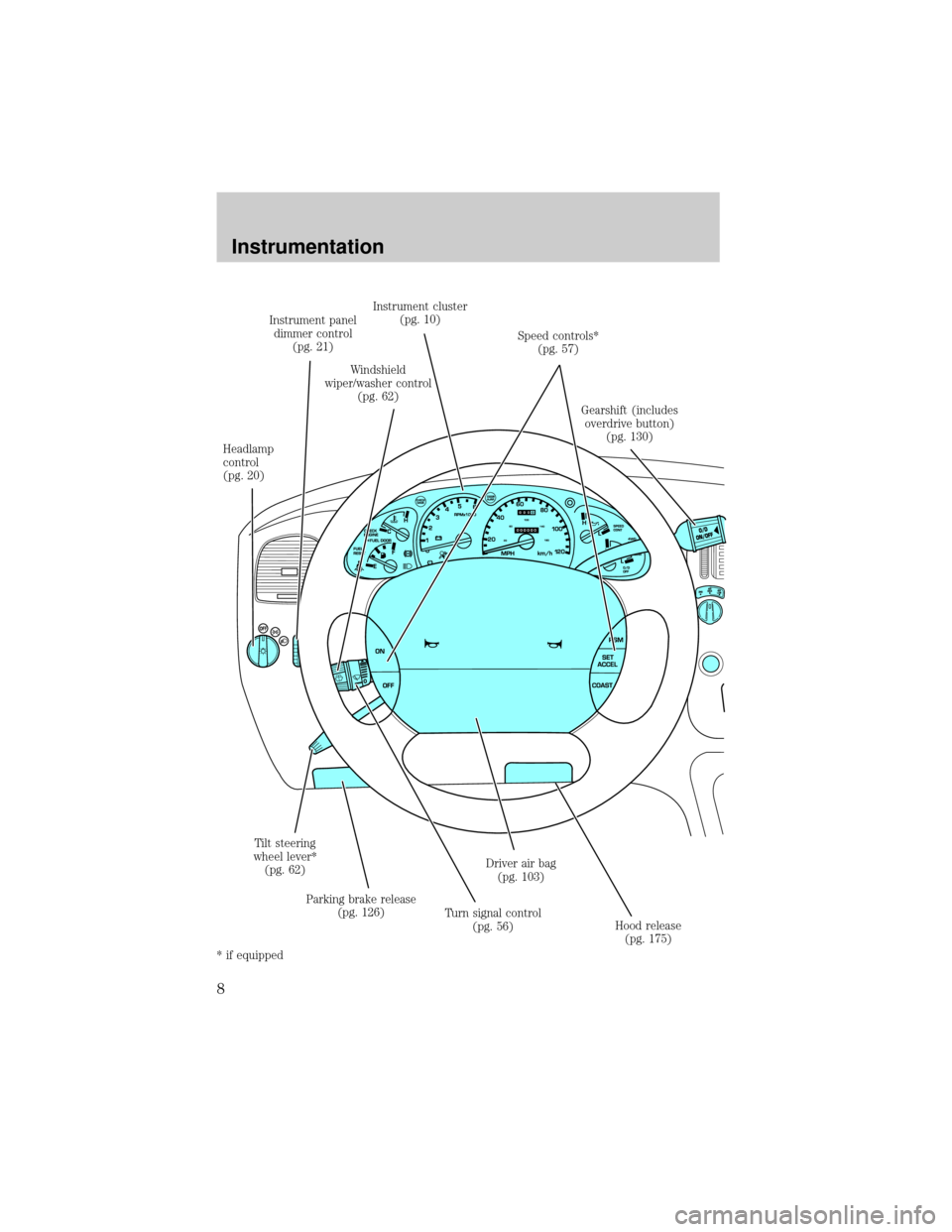
Headlamp
control
(pg. 20)Instrument panel
dimmer control
(pg. 21)
Windshield
wiper/washer control
(pg. 62)Instrument cluster
(pg. 10)
Speed controls*
(pg. 57)
Gearshift (includes
overdrive button)
(pg. 130)
Hood release
(pg. 175) Driver air bag
(pg. 103)
Turn signal control
(pg. 56) Parking brake release
(pg. 126) Tilt steering
wheel lever*
(pg. 62)
* if equipped
Instrumentation
8
Page 13 of 256
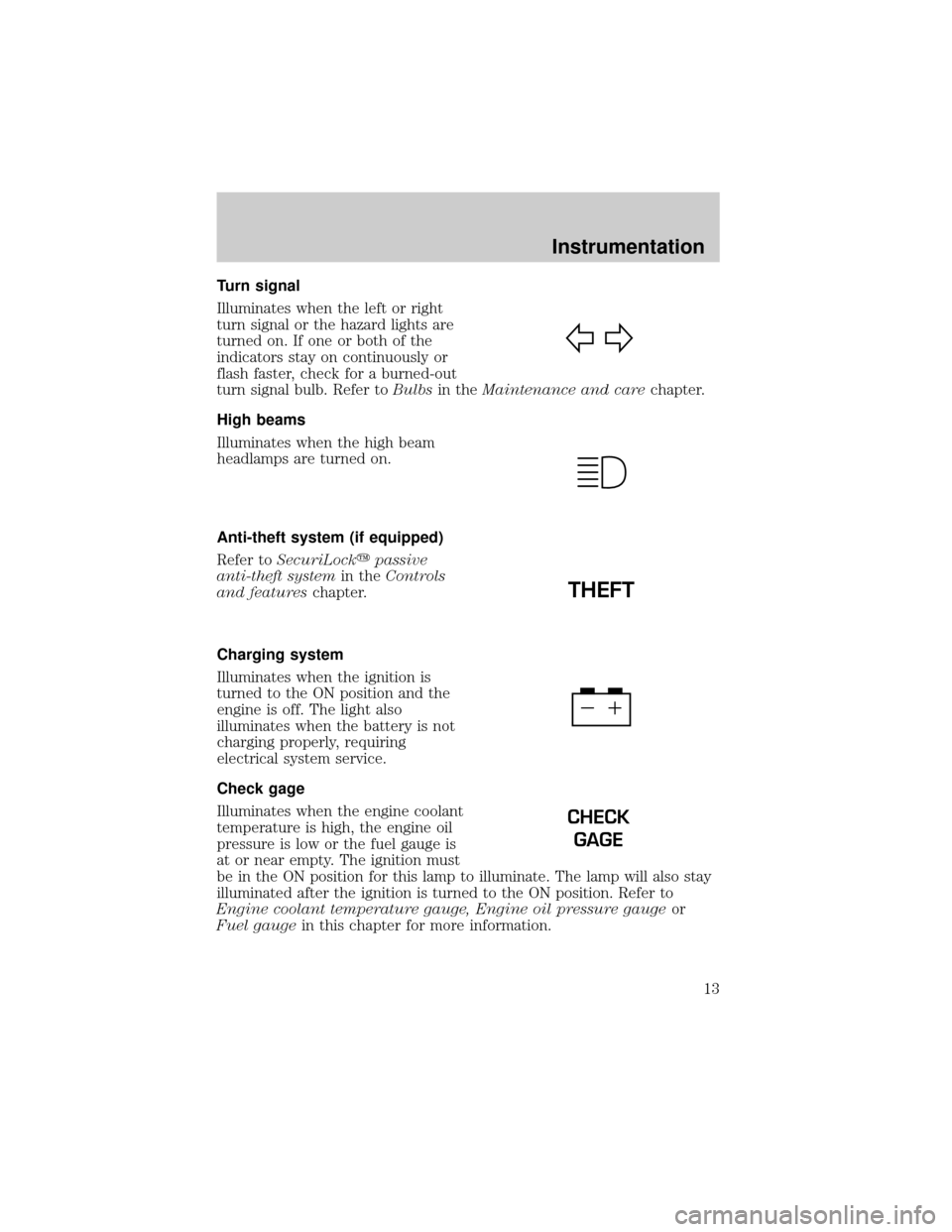
Turn signal
Illuminates when the left or right
turn signal or the hazard lights are
turned on. If one or both of the
indicators stay on continuously or
flash faster, check for a burned-out
turn signal bulb. Refer toBulbsin theMaintenance and carechapter.
High beams
Illuminates when the high beam
headlamps are turned on.
Anti-theft system (if equipped)
Refer toSecuriLockypassive
anti-theft systemin theControls
and featureschapter.
Charging system
Illuminates when the ignition is
turned to the ON position and the
engine is off. The light also
illuminates when the battery is not
charging properly, requiring
electrical system service.
Check gage
Illuminates when the engine coolant
temperature is high, the engine oil
pressure is low or the fuel gauge is
at or near empty. The ignition must
be in the ON position for this lamp to illuminate. The lamp will also stay
illuminated after the ignition is turned to the ON position. Refer to
Engine coolant temperature gauge, Engine oil pressure gaugeor
Fuel gaugein this chapter for more information.
THEFT
CHECK
GAGE
Instrumentation
13
Page 50 of 256
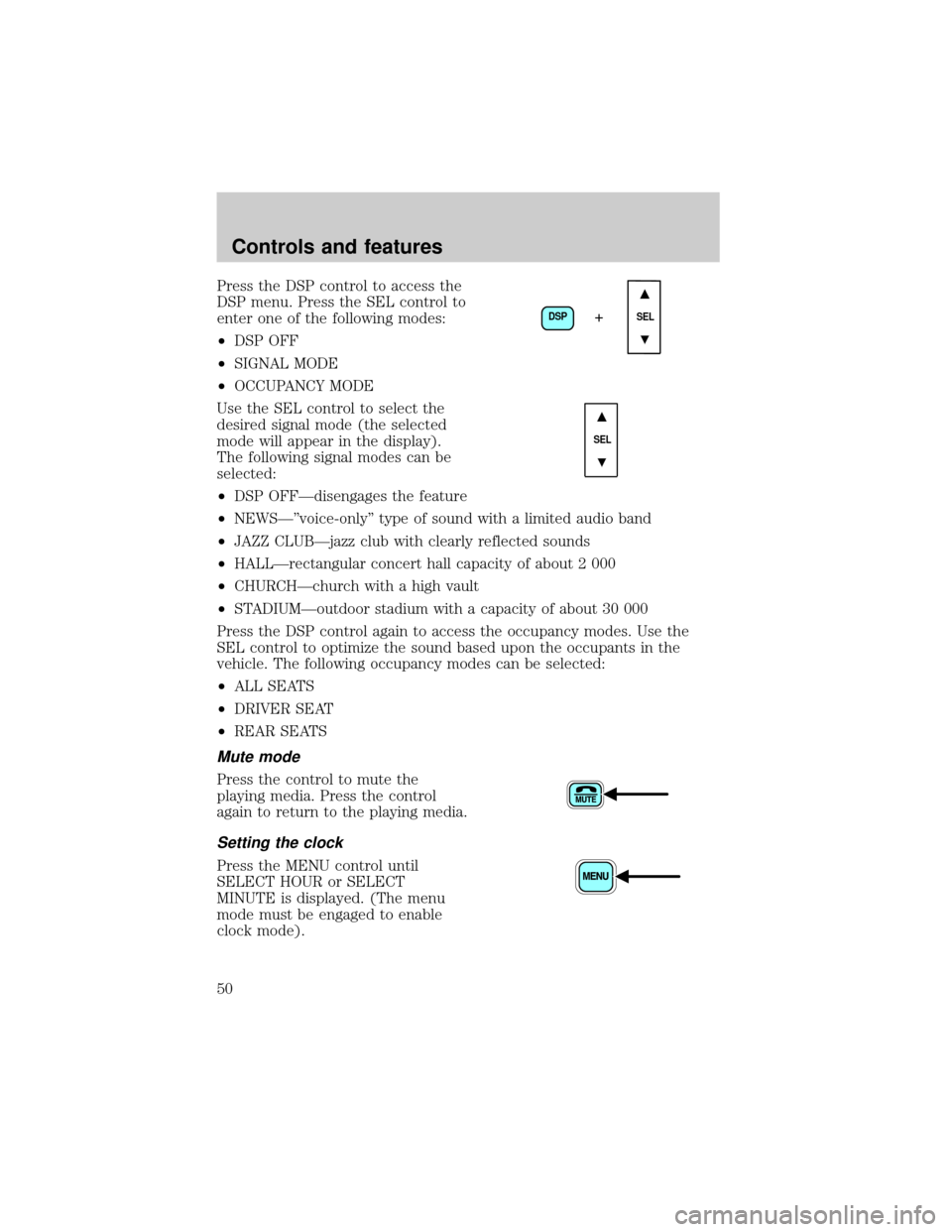
Press the DSP control to access the
DSP menu. Press the SEL control to
enter one of the following modes:
²DSP OFF
²SIGNAL MODE
²OCCUPANCY MODE
Use the SEL control to select the
desired signal mode (the selected
mode will appear in the display).
The following signal modes can be
selected:
²DSP OFFÐdisengages the feature
²NEWSкvoice-onlyº type of sound with a limited audio band
²JAZZ CLUBÐjazz club with clearly reflected sounds
²HALLÐrectangular concert hall capacity of about 2 000
²CHURCHÐchurch with a high vault
²STADIUMÐoutdoor stadium with a capacity of about 30 000
Press the DSP control again to access the occupancy modes. Use the
SEL control to optimize the sound based upon the occupants in the
vehicle. The following occupancy modes can be selected:
²ALL SEATS
²DRIVER SEAT
²REAR SEATS
Mute mode
Press the control to mute the
playing media. Press the control
again to return to the playing media.
Setting the clock
Press the MENU control until
SELECT HOUR or SELECT
MINUTE is displayed. (The menu
mode must be engaged to enable
clock mode).
DSP
SEL+
SEL
Controls and features
50
Page 55 of 256
Radio frequency information
The Federal Communications Commission (FCC) and the Canadian Radio
and Telecommunications Commission(CRTC) establish the frequencies
AM and FM stations may use for their broadcasts. Allowable frequencies
are:
AM 530, 540±1600, 1610 kHz
FM 87.7, 87.9±107.7, 107.9 MHz
Not all frequencies are used in a given area.
Radio reception factors
Three factors can affect radio reception:
²Distance/strength.The further an FM signal travels, the weaker it is.
The listenable range of the average FM station is approximately 40 km
(24 miles). This range can be affected by ªsignal modulation.º Signal
modulation is a process radio stations use to increase their
strength/volume relative to other stations.
²Terrain.Hills, mountains and tall buildings between your vehicle's
antenna and the radio station signal can cause FM reception problems.
Static can be caused on AM stations by power lines, electric fences,
traffic lights and thunderstorms. Moving away from an interfering
structure (out of its ªshadowº) returns your reception to normal.
²Station overload.Weak signals are sometimes captured by stronger
signals when you pass a broadcast tower. A stronger signal may
temporarily overtake a weaker signal and play while the weak station
frequency is displayed.
The audio system automatically switches to single channel reception if it
will improve the reception of a station normally received in stereo.
Audio system warranties and service
Refer to theWarranty Guidefor audio system warranty information.
If service is necessary, see your dealer or a qualified technician.
Controls and features
55
Page 56 of 256
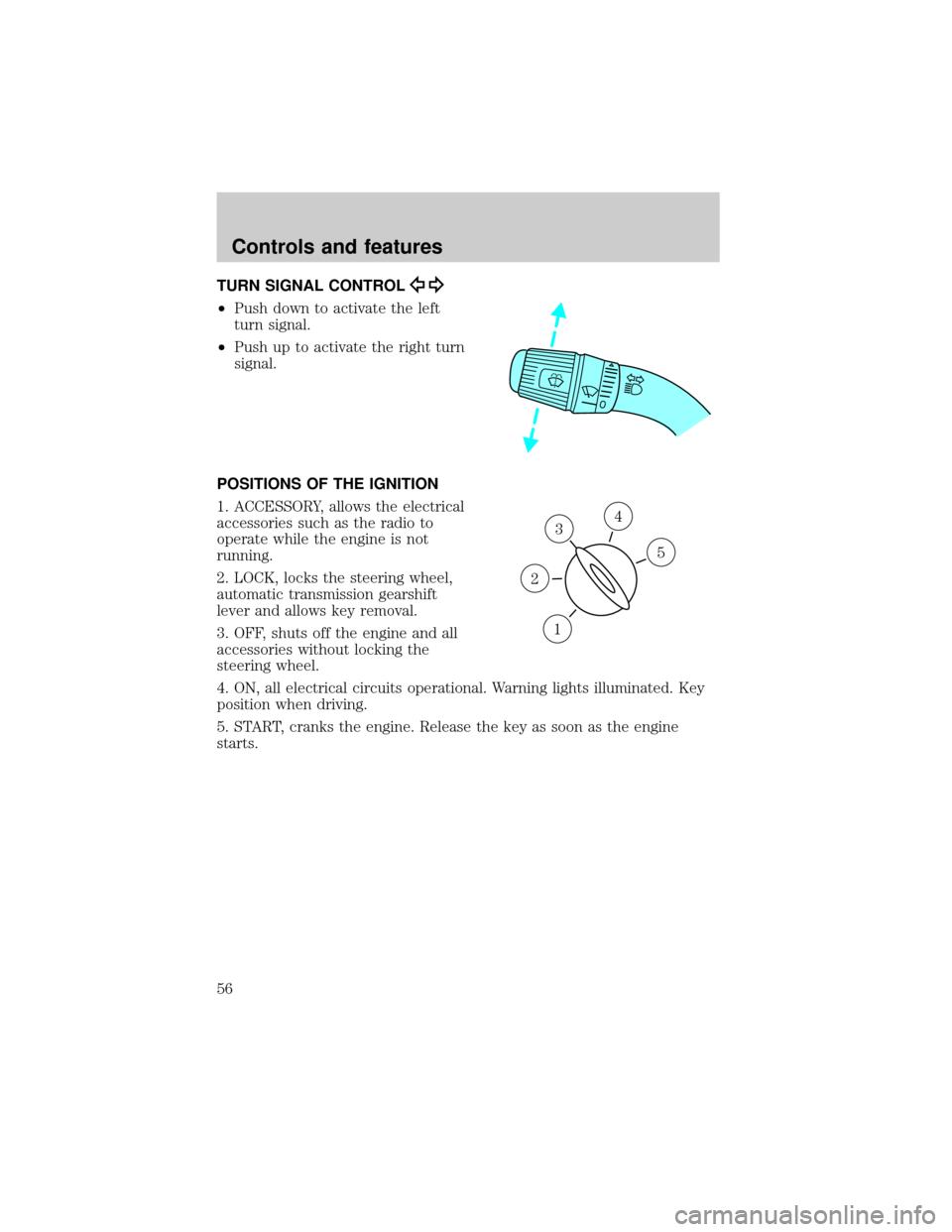
TURN SIGNAL CONTROL
²Push down to activate the left
turn signal.
²Push up to activate the right turn
signal.
POSITIONS OF THE IGNITION
1. ACCESSORY, allows the electrical
accessories such as the radio to
operate while the engine is not
running.
2. LOCK, locks the steering wheel,
automatic transmission gearshift
lever and allows key removal.
3. OFF, shuts off the engine and all
accessories without locking the
steering wheel.
4. ON, all electrical circuits operational. Warning lights illuminated. Key
position when driving.
5. START, cranks the engine. Release the key as soon as the engine
starts.
3
1
2
5
4
Controls and features
56
Page 212 of 256
²Turn signals
²License plate lamp
²Tail lamps
²Back-up lamps
Do not remove lamp bulbs unless they can be replaced immediately with
new ones. If a bulb is removed for an extended period of time,
contaminants may enter the lamp housings and affect lamp performance.
Replacing headlamp bulbs
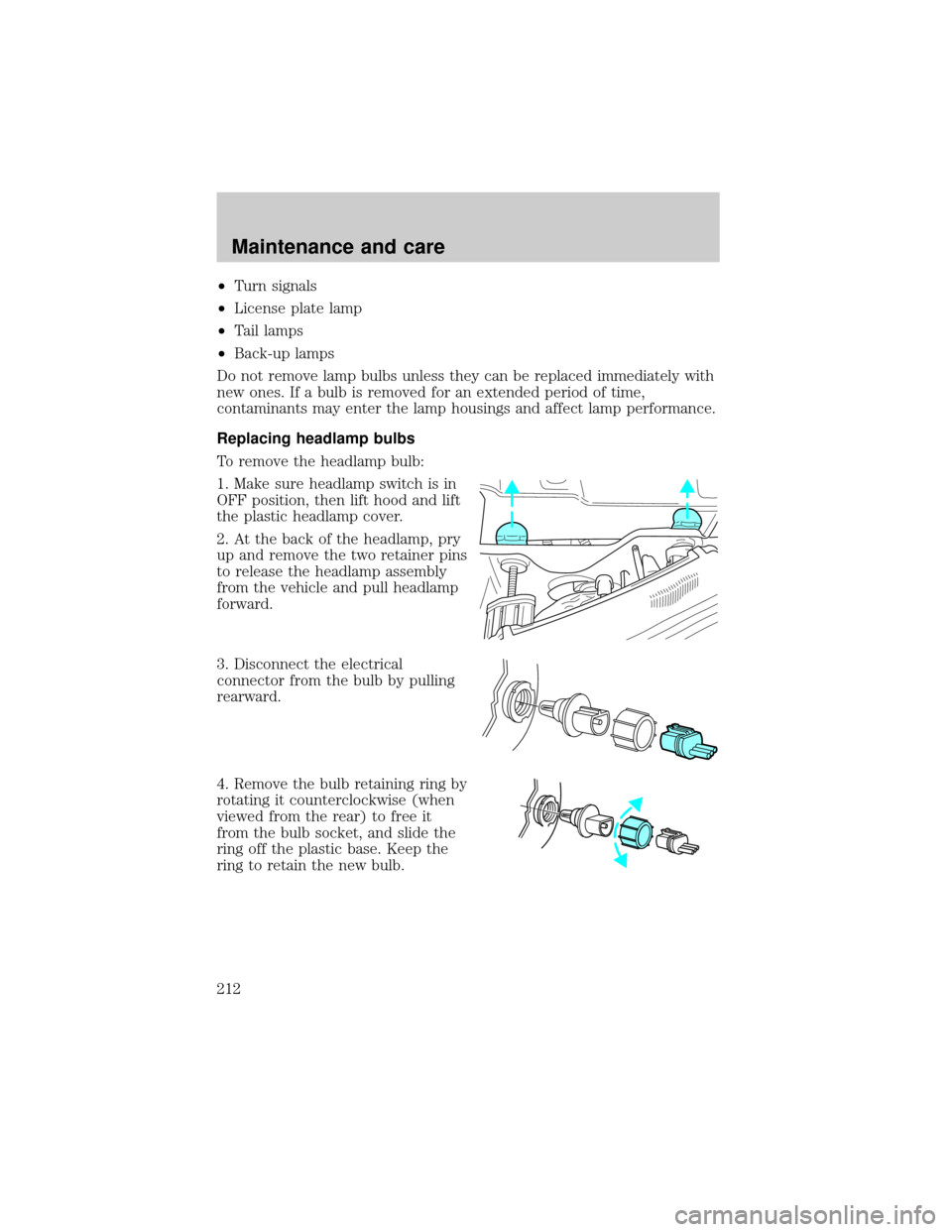
To remove the headlamp bulb:
1. Make sure headlamp switch is in
OFF position, then lift hood and lift
the plastic headlamp cover.
2. At the back of the headlamp, pry
up and remove the two retainer pins
to release the headlamp assembly
from the vehicle and pull headlamp
forward.
3. Disconnect the electrical
connector from the bulb by pulling
rearward.
4. Remove the bulb retaining ring by
rotating it counterclockwise (when
viewed from the rear) to free it
from the bulb socket, and slide the
ring off the plastic base. Keep the
ring to retain the new bulb.
Maintenance and care
212
Page 214 of 256
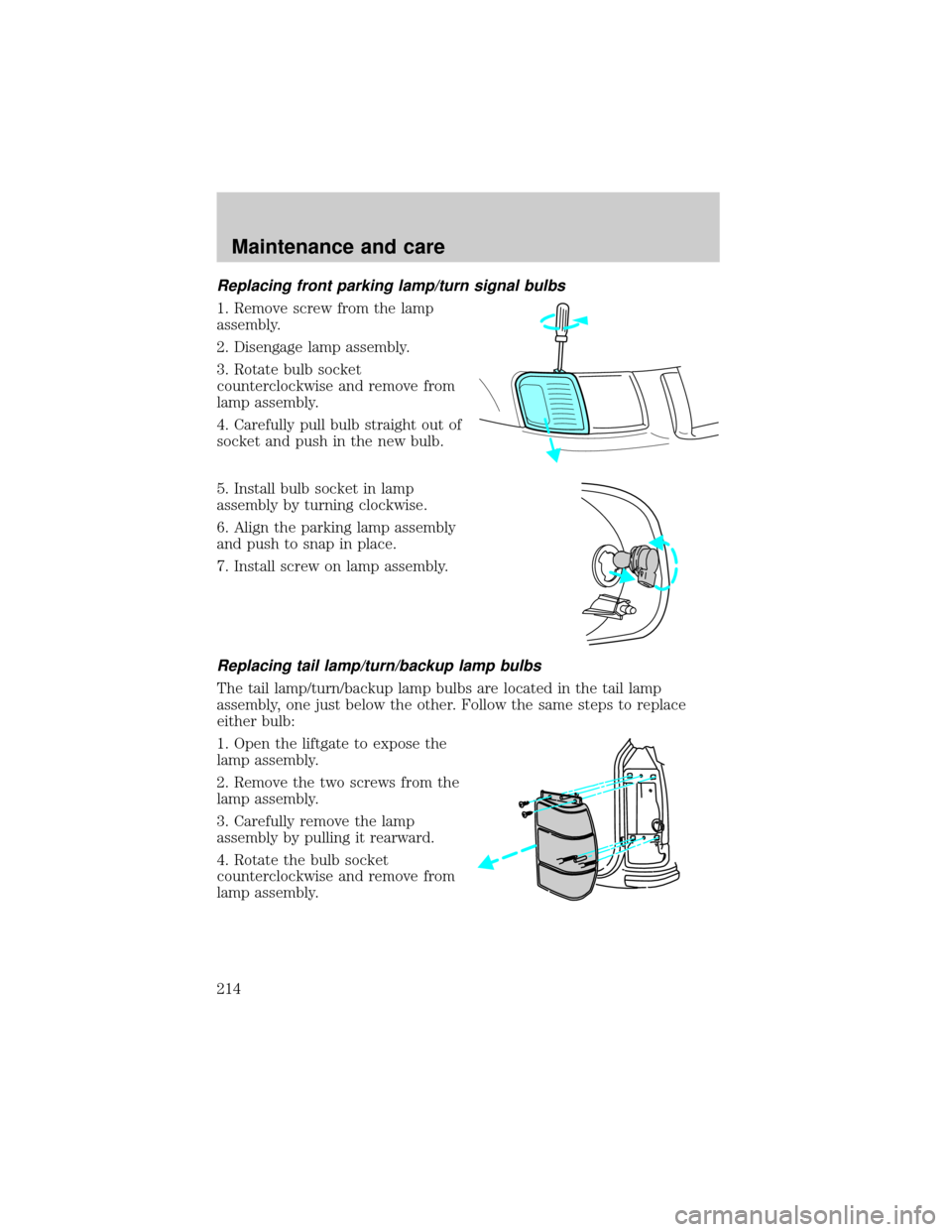
Replacing front parking lamp/turn signal bulbs
1. Remove screw from the lamp
assembly.
2. Disengage lamp assembly.
3. Rotate bulb socket
counterclockwise and remove from
lamp assembly.
4. Carefully pull bulb straight out of
socket and push in the new bulb.
5. Install bulb socket in lamp
assembly by turning clockwise.
6. Align the parking lamp assembly
and push to snap in place.
7. Install screw on lamp assembly.
Replacing tail lamp/turn/backup lamp bulbs
The tail lamp/turn/backup lamp bulbs are located in the tail lamp
assembly, one just below the other. Follow the same steps to replace
either bulb:
1. Open the liftgate to expose the
lamp assembly.
2. Remove the two screws from the
lamp assembly.
3. Carefully remove the lamp
assembly by pulling it rearward.
4. Rotate the bulb socket
counterclockwise and remove from
lamp assembly.
Maintenance and care
214
Page 248 of 256

GVWR (Gross Vehicle Weight
Rating) .......................................141
calculating .......................141, 143
definition .................................141
driving with a heavy load ......141
location ....................................141
H
Hazard flashers .........................152
Head restraints .....................87, 91
Headlamps ...................................20
aiming ..............................216±217
bulb specifications ..................216
daytime running lights .............20
flash to pass ..............................21
high beam ...........................13, 21
replacing bulbs .......................212
turning on and off ....................20
warning chime ..........................15
Heating ........................................22
heating and air conditioning
system .......................................22
Hood ..........................................175
I
Ignition .........................56, 228±229
Infant seats (see Safety seats) 113
Inspection/maintenance (I/M)
testing ........................................211
Instrument panel
cleaning ...................................221
cluster ................................10, 222
lighting up panel and
interior .......................................21
location of components ............10J
Jack ............................................161
positioning ...............................161
storage .....................................161
Jump-starting your vehicle ......166
K
Keyless entry system .................79
autolock .....................................82
keypad .......................................79
locking and unlocking doors ....81
programming entry code .........80
Keys .......................................83±85
key in ignition chime ...............15
positions of the ignition ...........56
L
Lamps
bulb replacement
specifications chart ................216
cargo lamps ...............................21
daytime running light ...............20
fog lamps ...................................20
headlamps .................................20
headlamps, flash to pass ..........21
instrument panel, dimming .....21
interior lamps ...................68, 216
replacing bulbs ..............211±212,
214±215
Lane change indicator (see
Turn signal) .................................56
Liftgate ........................................73
Lights, warning and indicator ....10
air bag ........................................12
anti-lock brakes (ABS) ....12, 126
anti-theft ...................................13
brake ..........................................12
Index
248