2001 FORD EXPLORER SPORT child lock
[x] Cancel search: child lockPage 117 of 256
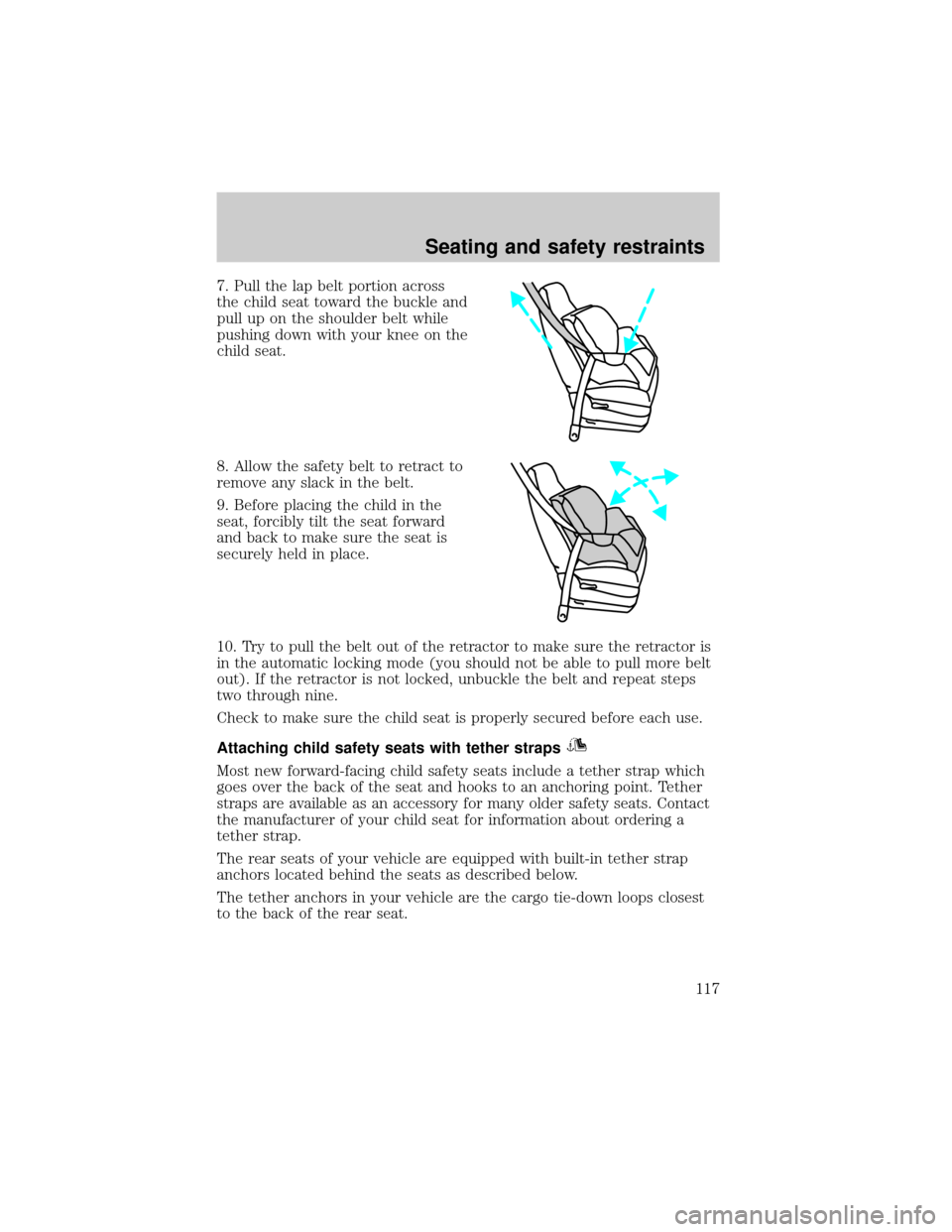
7. Pull the lap belt portion across
the child seat toward the buckle and
pull up on the shoulder belt while
pushing down with your knee on the
child seat.
8. Allow the safety belt to retract to
remove any slack in the belt.
9. Before placing the child in the
seat, forcibly tilt the seat forward
and back to make sure the seat is
securely held in place.
10. Try to pull the belt out of the retractor to make sure the retractor is
in the automatic locking mode (you should not be able to pull more belt
out). If the retractor is not locked, unbuckle the belt and repeat steps
two through nine.
Check to make sure the child seat is properly secured before each use.
Attaching child safety seats with tether straps
Most new forward-facing child safety seats include a tether strap which
goes over the back of the seat and hooks to an anchoring point. Tether
straps are available as an accessory for many older safety seats. Contact
the manufacturer of your child seat for information about ordering a
tether strap.
The rear seats of your vehicle are equipped with built-in tether strap
anchors located behind the seats as described below.
The tether anchors in your vehicle are the cargo tie-down loops closest
to the back of the rear seat.
Seating and safety restraints
117
Page 193 of 256
When lifting a plastic-cased battery, excessive pressure on the
end walls could cause acid to flow through the vent caps,
resulting in personal injury and/or damage to the vehicle or battery.
Lift the battery with a battery carrier or with your hands on opposite
corners.
Keep batteries out of reach of children. Batteries contain sulfuric
acid. Avoid contact with skin, eyes or clothing. Shield your eyes
when working near the battery to protect against possible splashing of
acid solution. In case of acid contact with skin or eyes, flush
immediately with water for a minimum of 15 minutes and get prompt
medical attention. If acid is swallowed, call a physician immediately.
Battery posts, terminals and related accessories contain lead and
lead compounds.Wash hands after handling.
Because your vehicle's engine is electronically controlled by a computer,
some control conditions are maintained by power from the battery. When
the battery is disconnected or a new battery is installed, the engine must
relearn its idle and fuel trim strategy for optimum driveability and
performance. To begin this process:
1. With the vehicle at a complete stop, set the parking brake.
2. Put the gearshift in P (Park), turn off all accessories and start the
engine.
3. Run the engine until it reaches normal operating temperature.
4. Allow the engine to idle for at least one minute.
5. Turn the A/C on and allow the engine to idle for at least one minute.
6. Drive the vehicle to complete the relearning process.
²The vehicle may need to be driven 16 km (10 miles) or more to
relearn the idle and fuel trim strategy.
²If you do not allow the engine to relearn its idle trim, the idle
quality of your vehicle may be adversely affected until the idle
trim is eventually relearned.
If the battery has been disconnected or a new battery has been installed,
the clock and the preset radio stations must be reset once the battery is
reconnected.
Maintenance and care
193
Page 213 of 256
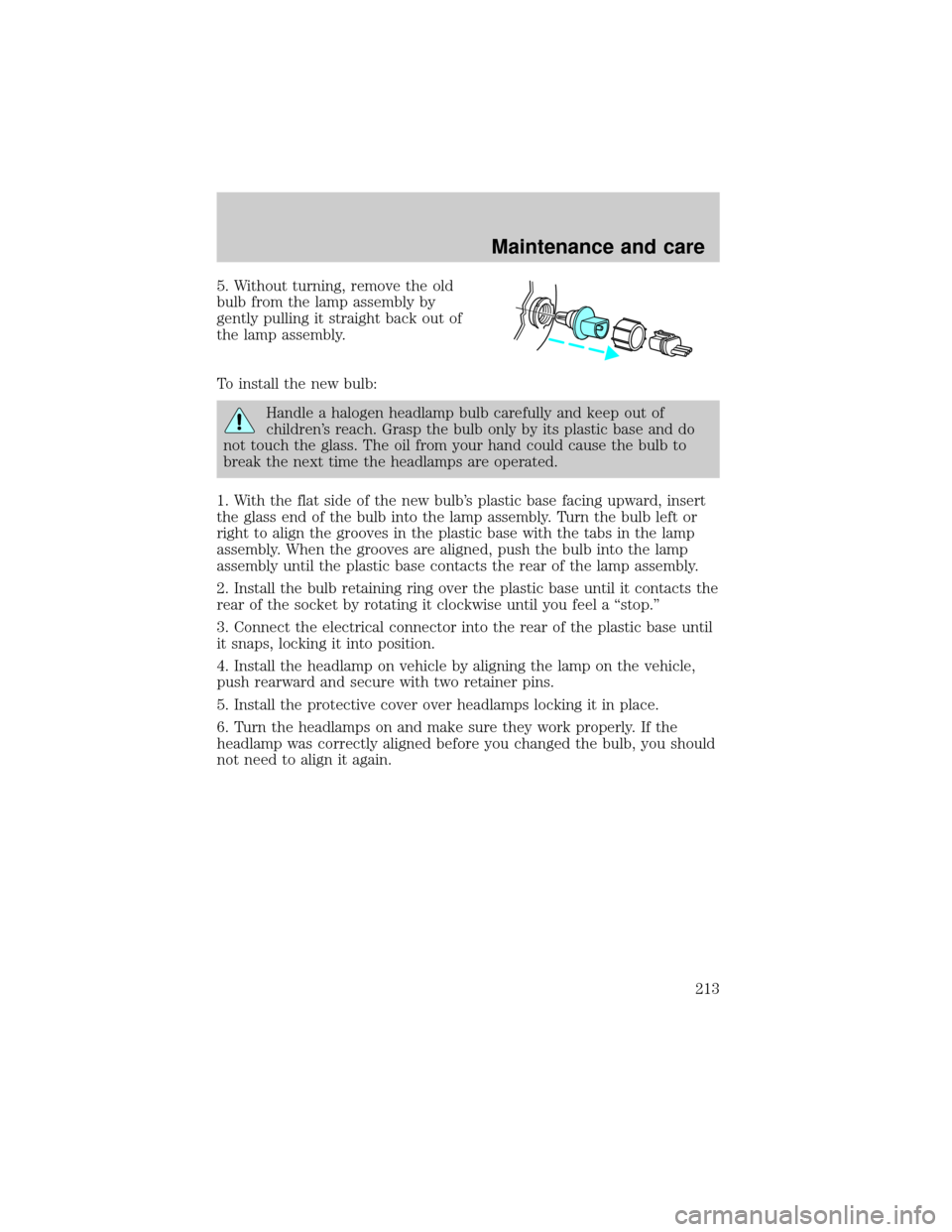
5. Without turning, remove the old
bulb from the lamp assembly by
gently pulling it straight back out of
the lamp assembly.
To install the new bulb:
Handle a halogen headlamp bulb carefully and keep out of
children's reach. Grasp the bulb only by its plastic base and do
not touch the glass. The oil from your hand could cause the bulb to
break the next time the headlamps are operated.
1. With the flat side of the new bulb's plastic base facing upward, insert
the glass end of the bulb into the lamp assembly. Turn the bulb left or
right to align the grooves in the plastic base with the tabs in the lamp
assembly. When the grooves are aligned, push the bulb into the lamp
assembly until the plastic base contacts the rear of the lamp assembly.
2. Install the bulb retaining ring over the plastic base until it contacts the
rear of the socket by rotating it clockwise until you feel a ªstop.º
3. Connect the electrical connector into the rear of the plastic base until
it snaps, locking it into position.
4. Install the headlamp on vehicle by aligning the lamp on the vehicle,
push rearward and secure with two retainer pins.
5. Install the protective cover over headlamps locking it in place.
6. Turn the headlamps on and make sure they work properly. If the
headlamp was correctly aligned before you changed the bulb, you should
not need to align it again.
Maintenance and care
213
Page 245 of 256

A
Air bag supplemental restraint
system ................................103, 109
and child safety seats ............105
description ......................103, 109
disposal ....................................112
driver air bag ..................106, 110
indicator light ...........12, 108, 111
operation .........................106, 110
passenger air bag ...........106, 110
side air bag ..............................109
Air cleaner filter ...............182, 224
Air conditioning ..........................22
rear seat controls .....................25
Ambulance packages ....................4
Antifreeze (see Engine
coolant) .....................................183
Anti-lock brake system (see
Brakes) ..............................125±126
Anti-theft system
warning light .............................13
Audio system (see Radio) .........28
Automatic transmission ............129
driving an automatic
overdrive .................................130
fluid, adding ............................188
fluid, checking ........................188
fluid, refill capacities ..............224
fluid, specification ..................228
Auxiliary power point .................72
Axle
lubricant specifications ..226, 228
refill capacities ........................224
traction lok ..............................128B
Battery .......................................192
acid, treating emergencies .....192
charging system warning
light ............................................13
jumping a disabled battery ....166
maintenance-free ....................192
replacement, specifications ...224
servicing ..................................192
voltage gauge ............................18
Belt minder .................................99
Brakes ........................................125
anti-lock ...........................125±126
anti-lock brake system (ABS)
warning light .....................12, 126
brake warning light ..................12
fluid, checking and adding ....180
fluid, refill capacities ..............224
fluid, specifications .........226, 228
lubricant specifications ..226, 228
parking ....................................126
shift interlock ..........................129
Break-in period .............................3
C
Capacities for refilling fluids ....224
Cargo area shade ........................74
Cargo cover .................................74
Cassette tape player ...................37
Certification Label ....................231
Child safety restraints ..............112
child safety belts ....................112
Child safety seats ......................113
attaching with tether straps ..117
in front seat ............................115
in rear seat ..............................115
Index
245
Page 250 of 256

Safety restraints ....................93±98
belt minder ...............................99
cleaning the safety belts .......102,
223
extension assembly ..................98
for adults .............................94±97
for children .............................112
warning light and chime ...12, 15,
98±99
Safety seats for children ..........113
Seat belts (see Safety
restraints) ....................................93
Seats
child safety seats ....................113
cleaning ...................................222
SecuriLock passive anti-theft
system ....................................83±85
Servicing your vehicle ..............174
Snowplowing .................................4
Spark plugs, specifications ......224,
228±229
Special notice ................................4
ambulance conversions ..............4
utility-type vehicles ....................5
Specification chart,
lubricants ...........................226, 228
Speed control ..............................57
Speedometer ...............................16
Starting your vehicle ........120, 122
jump starting ..........................166
Steering wheel
tilting .........................................62T
Tachometer .................................18
Tires ...........................161, 195±196
changing ..........................161, 163
checking the pressure ............196
replacing ..................................198
rotating ....................................197
snow tires and chains ............199
tire grades ...............................196
treadwear ................................195
Towing .......................................143
recreational towing .................149
trailer towing ..........................143
wrecker ....................................172
Traction-lok rear axle ...............128
Transfer case
fluid checking .........................191
Transmission
automatic operation ...............129
fluid, checking and adding
(automatic) .............................188
fluid, refill capacities ..............224
lubricant specifications ..226, 228
manual operation ....................133
Trip odometer .............................17
Turn signal ............................13, 56
V
Vehicle dimensions ...................229
Vehicle Identification Number
(VIN) ..........................................231
Vehicle loading ..........................141
Ventilating your vehicle ...........124
Index
250