2001 FORD EXPLORER check engine light
[x] Cancel search: check engine lightPage 200 of 288
Preparing your vehicle
When the battery is disconnected or a new battery is installed, the
transmission must relearn its adaptive strategy. As a result of this, the
transmission may shift firmly. This operation is considered normal and
will not effect function or durability of the transmission. Over time, the
adaptive learning process will fully update transmission operation to its
optimum shift feel.
1.Use only a 12±volt supply to start your vehicle.
2. Do not disconnect the battery of the disabled vehicle as this could
damage the vehicle's electrical system.
3.
Park the booster vehicle close to the hood of the disabled vehicle
making sure the two vehiclesdo nottouch. Set the parking brake on both
vehicles and stay clear of the engine cooling fan and other moving parts.
4. Check all battery terminals and remove any excessive corrosion before
you attach the battery cables. Ensure that vent caps are tight and level.
5. Turn the heater fan on in both vehicles to protect any electrical
surges. Turn all other accessories off.
Connecting the jumper cables
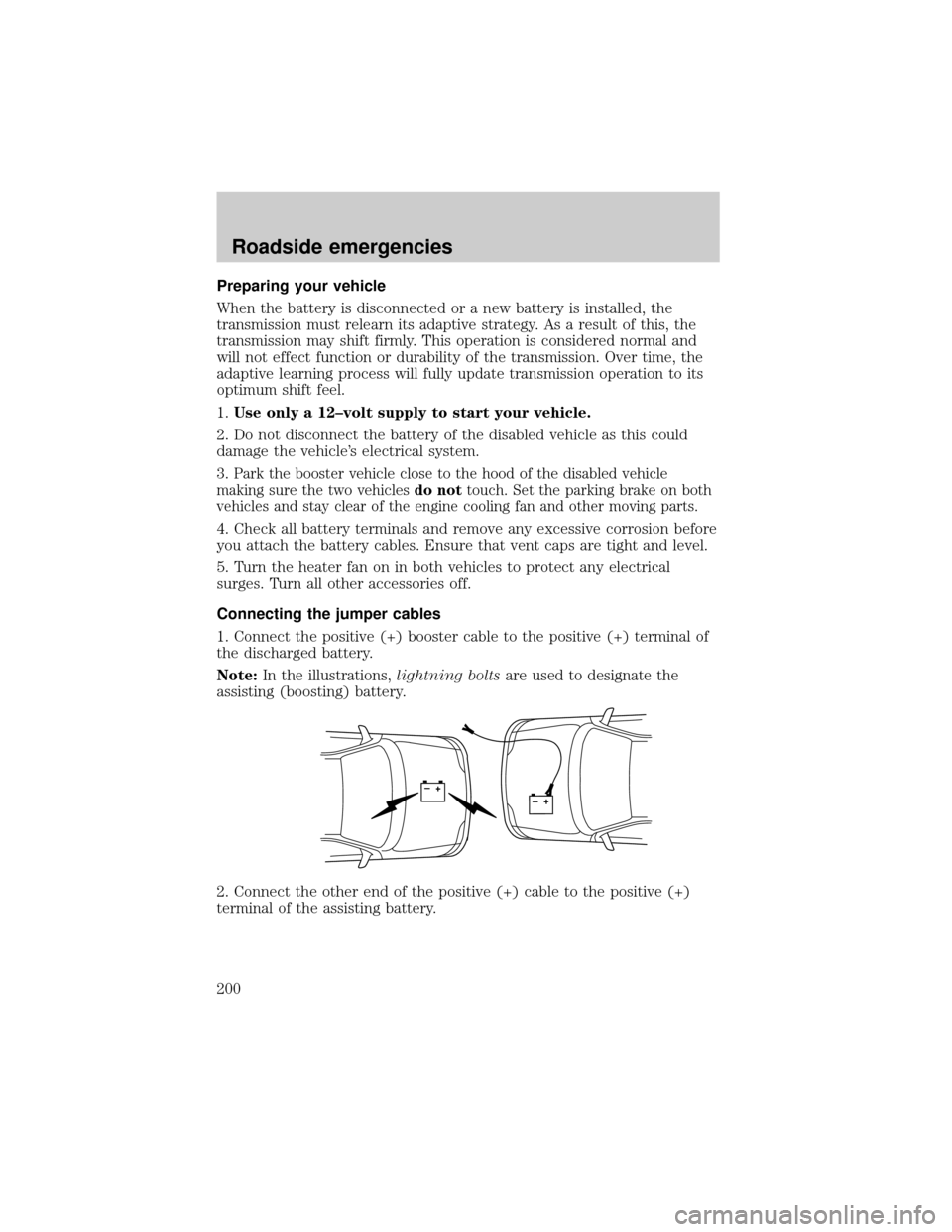
1. Connect the positive (+) booster cable to the positive (+) terminal of
the discharged battery.
Note:In the illustrations,lightning boltsare used to designate the
assisting (boosting) battery.
2. Connect the other end of the positive (+) cable to the positive (+)
terminal of the assisting battery.
+–+–
Roadside emergencies
200
Page 207 of 288

SERVICE RECOMMENDATIONS
To help you service your vehicle:
²We highlight do-it-yourself items in the engine compartment for easy
location.
²We provide a scheduled maintenance guide which makes tracking
routine service easy.
If your vehicle requires professional service, your dealership can provide
the necessary parts and service. Check your ªWarranty Guideº to find out
which parts and services are covered.
Use only recommended fuels, lubricants, fluids and service parts
conforming to specifications. Motorcraft parts are designed and built to
provide the best performance in your vehicle.
PRECAUTIONS WHEN SERVICING YOUR VEHICLE
Be especially careful when inspecting or servicing your vehicle.
²Do not work on a hot engine.
²When the engine is running, make sure that loose clothing, jewelry or
long hair does not get caught up in moving parts.
²Do not work on a vehicle with the engine running in an enclosed
space, unless you are sure you have enough ventilation.
²Keep all lit cigarettes, open flames and other lit material away from
the battery and all fuel related parts.
If you disconnect the battery, the engine must ªrelearnº its idle
conditions before your vehicle will drive properly, as explained inBattery
in this chapter.
Working with the engine off
1. Set the parking brake and ensure the gearshift is securely latched in P
(Park).
2. Turn off the engine and remove the key.
3. Block the wheels to prevent the vehicle from moving unexpectedly.
Working with the engine on
1. Set the parking brake and ensure the gearshift is securely latched in P
(Park).
2. Block the wheels to prevent the vehicle from moving unexpectedly.
Maintenance and care
207
Page 241 of 288

Maintenance
²Keep tires properly inflated and use only recommended size.
²Operating a vehicle with the wheels out of alignment will reduce fuel
economy.
²Use recommended engine oil. Refer toLubricant Specifications.
²Perform all regularly scheduled maintenance items. Follow the
recommended maintenance schedule and owner maintenance checks
found in your vehicle scheduled maintenance guide.
Conditions
²Heavily loading a vehicle or towing a trailer may reduce fuel economy
at any speed.
²Carrying unnecessary weight may reduce fuel economy (approximately
0.4 km/L [1 mpg] is lost for every 180 kg [400 lb] of weight carried).
²Adding certain accessories to your vehicle (for example bug
deflectors, rollbars/light bars, running boards, ski/luggage racks) may
reduce fuel economy.
²Using fuel blended with alcohol may lower fuel economy.
²Fuel economy may decrease with lower temperatures during the first
12±16 km (8±10 miles) of driving.
²Driving on flat terrain offers improved fuel economy as compared to
driving on hilly terrain.
²Transmissions give their best fuel economy when operated in the top
cruise gear and with steady pressure on the gas pedal.
²Four-wheel-drive operation (if equipped) is less fuel efficient than
two-wheel-drive operation.
²Close windows for high speed driving.
EPA window sticker
Every new vehicle should have the EPA window sticker. Contact your
dealer if the window sticker is not supplied with your vehicle. The EPA
window sticker should be your guide for the fuel economy comparisons
with other vehicles.
It is important to note the box in the lower left corner of the window
sticker. These numbers represent the Range of L/100 km (MPG)
expected on the vehicle under optimum conditions. Your fuel economy
may vary depending upon the method of operation and conditions.
Maintenance and care
241
Page 242 of 288
EMISSION CONTROL SYSTEM
Your vehicle is equipped with various emission control components and a
catalytic converter which will enable your vehicle to comply with applicable
exhaust emission standards. To make sure that the catalytic converter and
other emission control components continue to work properly:
²Use only the specified fuel listed.
²Avoid running out of fuel.
²Do not turn off the ignition while your vehicle is moving, especially at
high speeds.
²Have the items listed in your scheduled maintenance guide performed
according to the specified schedule.
The scheduled maintenance items listed in the scheduled maintenance
guide are essential to the life and performance of your vehicle and to its
emissions system.
If other than Ford, Motorcraft or Ford-authorized parts are used for
maintenance replacements or for service of components affecting
emission control, such non-Ford parts should be equivalent to genuine
Ford Motor Company parts in performance and durability.
Do not park, idle, or drive your vehicle in dry grass or other dry
ground cover. The emission system heats up the engine
compartment and exhaust system, which can start a fire.
Illumination of the ªCheck Engineº light, charging system warning light
or the temperature warning light, fluid leaks, strange odors, smoke or
loss of engine power, could indicate that the emission control system is
not working properly.
Exhaust leaks may result in entry of harmful and potentially
lethal fumes into the passenger compartment.
Do not make any unauthorized changes to your vehicle or engine. By
law, vehicle owners and anyone who manufactures, repairs, services,
sells, leases, trades vehicles, or supervises a fleet of vehicles are not
permitted to intentionally remove an emission control device or prevent
it from working. Information about your vehicle's emission system is on
the Vehicle Emission Control Information Decal located on or near the
engine. This decal identifies engine displacement and gives some tune up
specifications.
Maintenance and care
242
Page 243 of 288

Please consult your ªWarranty Guideº for complete emission warranty
information.
Readiness for Inspection/Maintenance (I/M) testing
In some localities, it may be a legal requirement to pass an I/M test of
the on-board diagnostics system. If your ªCheck Engine/Service Engine
Soonº light is on, refer to the description in theWarning Lights and
Chimessection of theInstrumentationchapter. Your vehicle may not
pass the I/M test with the ªCheck Engine/Service Engine Soonº light on.
If the vehicle's powertrain system or its battery has just been serviced,
the on-board diagnostics system is reset to a ªnot ready for I/M testº
condition. To ready the on-board diagnostics system for I/M testing, a
minimum of 30 minutes of city and highway driving is necessary as
described below:
²First, at least 10 minutes of driving on an expressway or highway.
²Next, at least 20 minutes driving in stop-and-go, city-type traffic with
at least four idle periods.
Allow the vehicle to sit for at least eight hours without starting the
engine. Then, start the engine and complete the above driving cycle. The
engine must warm up to its normal operating temperature. Once started,
do not turn off the engine until the above driving cycle is complete.
BULBS
Replacing exterior bulbs
Check the operation of the following lamps frequently:
²Headlamps
²Foglamps
²High-mount brakelamp
²Brakelamps
²Turn signals
²License plate lamp
²Tail lamps
²Back-up lamps
Do not remove lamp bulbs unless they can be replaced immediately with
new ones. If a bulb is removed for an extended period of time,
contaminants may enter the lamp housings and affect lamp performance.
Maintenance and care
243
Page 276 of 288

A
Air bag supplemental restraint
system ................................137, 141
and child safety seats ............139
description ......................137, 141
disposal ....................................144
driver air bag ..................139, 142
indicator light ...........10, 141, 143
operation .........................139, 142
passenger air bag ...........139, 142
side air bag ..............................141
Air cleaner filter .......................255
Air conditioning ..........................23
automatic temperature
control system ..........................27
rear seat controls .....................32
Air suspension ...........................160
description ..............................160
warning light .............................12
All Wheel Drive (AWD),
driving off road .........................173
Ambulance packages ....................3
Antifreeze (see Engine
coolant) .....................................216
Anti-lock brake system
(see Brakes) ......................157±158
Anti-theft system
warning light .............................11
Armrests ....................................107
Audio system (see Radio) .........36
Automatic transmission
driving an automatic
overdrive .........................162, 165
fluid, adding ............................222
fluid, checking ........................222
fluid, refill capacities ..............255fluid, specification ..................260
Auxiliary power point ...............106
Axle
lubricant specifications ..258, 260
refill capacities ........................255
traction lok ..............................175
B
Battery .......................................225
acid, treating emergencies .....225
charging system warning
light ............................................11
jumping a disabled battery ....199
maintenance-free ....................225
replacement, specifications ...255
servicing ..................................225
voltage gauge ............................16
Belt minder ...............................133
Brakes ........................................157
anti-lock ...........................157±158
anti-lock brake system (ABS)
warning light .....................10, 158
brake warning light ..................10
fluid, checking and adding ....214
fluid, refill capacities ..............255
fluid, specifications .........258, 260
lubricant specifications ..258, 260
parking ....................................158
shift interlock ..........................161
Break-in period .............................3
C
Capacities for refilling fluids ....255
Cargo area shade ......................108
Cargo cover ...............................108
CD changer .................................78
Index
276
Page 278 of 288

E
Emergencies, roadside
jump-starting ..........................199
Emission control system ..........242
Engine ........................................260
check engine/service engine
soon light ....................................8
cleaning ...................................250
coolant .....................................216
idle speed control ...................225
lubrication
specifications ..................258, 260
refill capacities ........................255
service points ..................209±210
starting after a collision .........186
Engine block heater .................154
Engine oil ..................................210
checking and adding ..............210
dipstick ....................................210
filter, specifications ........213, 255
recommendations ...................213
refill capacities ........................255
specifications ..................258, 260
Exhaust fumes ..........................155
F
Floor mats .................................107
Fluid capacities .........................255
Foglamps .....................................22
Four-Wheel Drive vehicles...12, 167
control trac .......................34, 168
description ......................168±169
driving off road ...............170, 173
electronic shift ..........................34
preparing to drive your
vehicle .....................................161Fuel ............................................234
calculating fuel economy...18, 238
cap .......................................9, 237
capacity ...................................255
choosing the right fuel ...........236
comparisons with EPA fuel
economy estimates .................241
detergent in fuel .....................237
filling your vehicle with
fuel ...........................234, 237, 239
filter, specifications ........238, 255
fuel pump shut-off switch .....186
gauge .........................................16
improving fuel economy ........238
octane rating ...................236, 260
quality ......................................236
running out of fuel .................237
safety information relating to
automotive fuels .....................234
Fuses ..................................187, 189
G
Garage door opener ..............92, 96
Gas cap (see Fuel cap) ........9, 237
Gas mileage (see Fuel
economy) ...................................238
Gauges .........................................13
battery voltage gauge ...............16
engine coolant temperature
gauge .........................................14
engine oil pressure gauge ........16
fuel gauge ..................................16
odometer ...................................15
speedometer .............................14
tachometer ................................15
trip odometer ............................15
GAWR (Gross Axle Weight
Rating) .......................................176
calculating ...............................178
Index
278
Page 280 of 288

air bag ........................................10
anti-lock brakes (ABS) ....10, 158
anti-theft ...................................11
brake ..........................................10
charging system ........................11
check coolant ............................11
check engine ...............................8
cruise indicator .........................13
door ajar ....................................12
fuel cap light ...............................9
high beam .................................11
overdrive off ..............................12
safety belt .................................10
speed control ............................88
turn signal indicator .................11
Load limits .................................176
GAWR ......................................176
GVWR ......................................176
trailer towing ..........................176
Loading instructions .................177
Locks
autolock ...................................116
childproof ................................104
Lubricant specifications ...258, 260
Lumbar support, seats .....124±125
M
Manual transmission
fluid capacities ........................255
lubricant specifications ..........260
Message center ...........................17
english/metric button ...............17
reset button ..............................19
system check button ................19
Mirrors
automatic dimming rearview
mirror ......................................102
cleaning ...................................254fold away .................................105
heated ......................................105
side view mirrors (power) .....104
Moon roof ....................................93
Motorcraft parts ................238, 255
O
Octane rating ............................236
Odometer .....................................15
Off-Road Driving .......................173
Oil (see Engine oil) ..................210
P
Panic alarm feature, remote
entry system ..............................110
Parking brake ............................158
Parts (see Motorcraft parts) ....255
Power distribution box (see
Fuses) ........................................192
Power door locks ......................103
Power steering ..........................159
fluid, checking and adding ....220
fluid, refill capacity ................255
fluid, specifications .........258, 260
Preparing to drive your
vehicle ........................................161
R
Radio ............................................36
Relays ........................................187
Remote entry system .......109±110
illuminated entry ....................113
locking/unlocking doors .........110
panic alarm .............................110
Index
280