2001 FORD EXPEDITION change wheel
[x] Cancel search: change wheelPage 156 of 280
Speed sensitive steering
The steering in your vehicle is speed sensitive. At high speeds, steering
assist will decrease to improve steering feel.
If the amount of effort required to steer your vehicle changes while
driving at a constant vehicle speed, have the power steering system
checked by your dealer or a qualified service technician.
AIR SUSPENSION SYSTEM (IF EQUIPPED)
The air suspension system is designed to improve ride, handling and
general vehicle performance for static, on and off-road driving conditions.
•The load leveling feature of the air suspension automatically keeps the
vehicle at a constant level if a load is added or removed from the
vehicle.
•The height adjustment feature automatically controls the vehicle
height over a range of approximately 5 cm (2 inches) based on vehicle
speed, ignition position and selection of two or four-wheel drive
modes.
•The air suspension automatically puts the vehicle at its lowest height
when ignition is OFF to provide easy entry and exit. When ever a door
is opened (including the liftgate) the system memorizes and maintains
the height of the vehicle until all doors are closed or until vehicle
exceeds 16km/h (10mph).
•The air suspension system raises the vehicle to its normal ride
position when the ignition is turned on, all doors are closed and the
transmission is shifted into gear.
•In 4WD Low the air suspension system will not move to its lowest
height. In 4WD Low, the air suspension system raises the vehicle
above the normal ride height at speeds below 40 km/h (25 mph) to
improve ground clearance. In 4WD Low, do not exceed 56 km/h
(35 mph).
•When the vehicle is in motion, the air suspension system will adjust
the vehicle’s height according to ground clearance and speed to
maximize ride comfort.
•It is normal to occasionally hear a buzz or clicking from the vehicle’s
air suspension system when the ignition is turned off. The system
stays energized for 40 minutes after the ignition is turned off to
compensate for any load changes made after the vehicle is parked.
Driving
156
Page 165 of 280
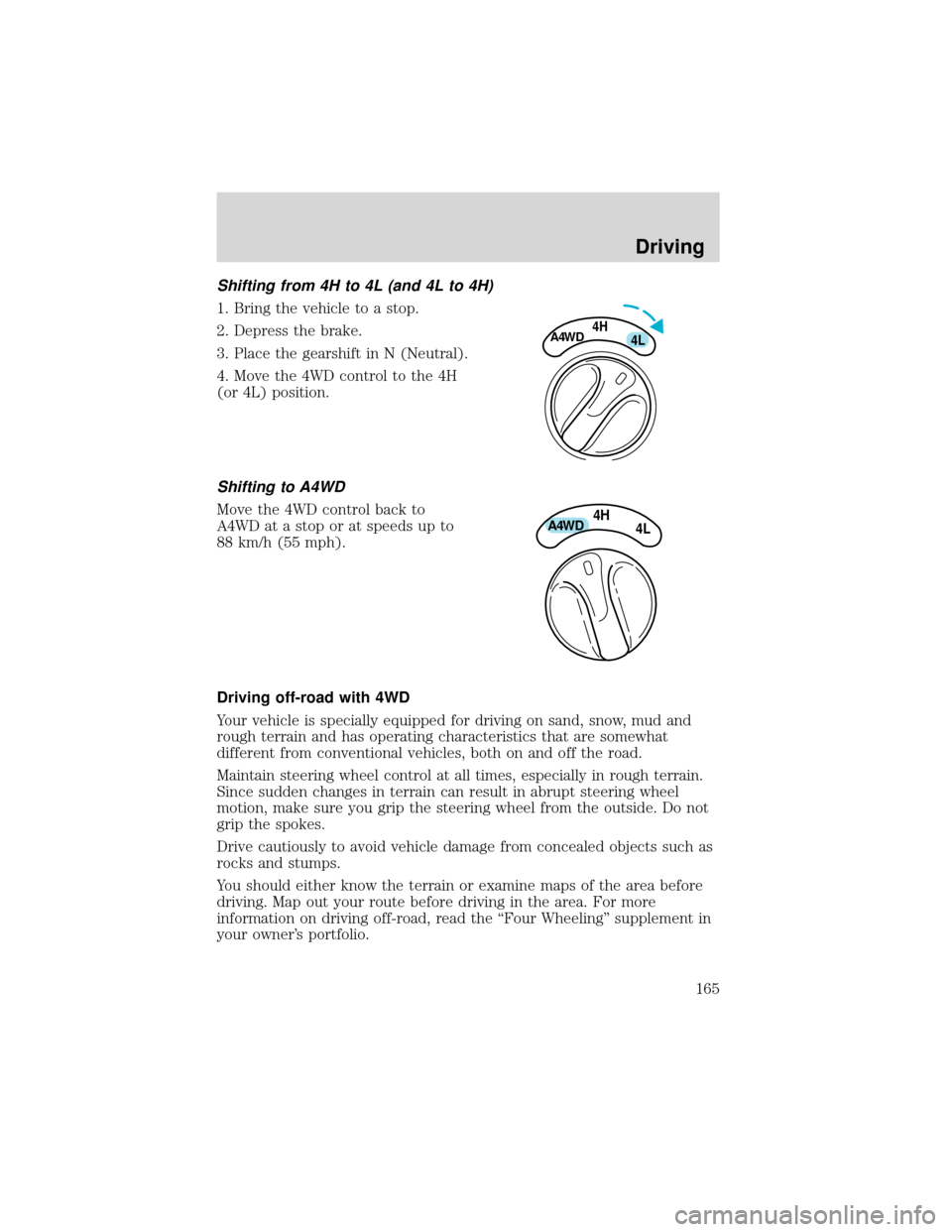
Shifting from 4H to 4L (and 4L to 4H)
1. Bring the vehicle to a stop.
2. Depress the brake.
3. Place the gearshift in N (Neutral).
4. Move the 4WD control to the 4H
(or 4L) position.
Shifting to A4WD
Move the 4WD control back to
A4WD at a stop or at speeds up to
88 km/h (55 mph).
Driving off-road with 4WD
Your vehicle is specially equipped for driving on sand, snow, mud and
rough terrain and has operating characteristics that are somewhat
different from conventional vehicles, both on and off the road.
Maintain steering wheel control at all times, especially in rough terrain.
Since sudden changes in terrain can result in abrupt steering wheel
motion, make sure you grip the steering wheel from the outside. Do not
grip the spokes.
Drive cautiously to avoid vehicle damage from concealed objects such as
rocks and stumps.
You should either know the terrain or examine maps of the area before
driving. Map out your route before driving in the area. For more
information on driving off-road, read the“Four Wheeling”supplement in
your owner’s portfolio.
4HA4WD4L
4HA4WD4L
Driving
165
Page 166 of 280
If your vehicle gets stuck
If the vehicle is stuck in mud or snow it may be rocked out by shifting
from forward and reverse gears, stopping between shifts, in a steady
pattern. Press lightly on the accelerator in each gear.
Do not rock the vehicle if the engine is not at normal operating
temperature or damage to the transmission may occur.
Do not rock the vehicle for more than a few minutes or damage
to the transmission and tires may occur or the engine may
overheat.
Do not spin the wheels at over 56 km/h (35 mph). The tires may
fail and injure a passenger or bystander.
Sand
When driving over sand, try to keep all four wheels on the most solid
area of the trail. Do not reduce the tire pressures but shift to a lower
gear and drive steadily through the terrain. Apply the accelerator slowly
and avoid spinning the wheels.
Mud and water
If you must drive through high water, drive slowly. Traction or brake
capability may be limited.
When driving through water, determine the depth; avoid water higher
than the bottom of the hubs (if possible) and proceed slowly. If the
ignition system gets wet, the vehicle may stall.
Once through water, always try the brakes. Wet brakes do not stop the
vehicle as effectively as dry brakes. Drying can be improved by moving
your vehicle slowly while applying light pressure on the brake pedal.
After driving through mud, clean off residue stuck to rotating driveshafts,
halfshafts and tires. Excess mud stuck on tires and rotating driveshafts
causes an imbalance that could damage drive components.
If the transmission, transfer case or front axle are submerged in water,
their fluids should be checked and changed, if necessary.
Water intrusion into the transmission may damage the
transmission.
If the rear axle is submerged in water, the rear axle lubricant should be
checked and changed, if necessary. The rear axle is filled with a
Driving
166
Page 176 of 280
4WD vehicles electronic shift transfer case (with automatic
transmissions)
4x4 vehicles with electronic shift on the fly cannot be towed with any
wheels on the ground.
Trailer towing tips
•Practice turning, stopping and backing up before starting on a trip to
get the feel of the vehicle trailer combination. When turning, make
wider turns so the trailer wheels will clear curbs and other obstacles.
•Allow more distance for stopping with a trailer attached.
•If you are driving down a long or steep hill, shift to a lower gear. Do
not apply the brakes continuously, as they may overheat and become
less effective.
•The trailer tongue weight should be 10% of the loaded trailer weight.
•After you have traveled 80 km (50 miles), thoroughly check your
hitch, electrical connections and trailer wheel lug nuts.
•When stopped in traffic for long periods of time in hot weather, place
the gearshift in P (Park) and increase idle speed. This aids engine
cooling and air conditioner efficiency.
•Vehicles with trailers should not be parked on a grade. If you must
park on a grade, place wheel chocks under the trailer’s wheels.
Launching or retrieving a boat
When backing down a ramp during boat launching or retrieval,
•Do not allow the static water level to rise above the bottom edge of
the rear bumper and
•Do not allow waves to break higher than 15 cm (6 inches) above the
bottom edge of the rear bumper.
Exceeding these limits may allow water to enter critical vehicle
components, adversely affecting driveability, emissions, reliability and
causing internal transmission damage.
Replace the rear axle lubricant anytime the axle has been submerged in
water. Rear axle lubricant quantities are not to be checked or changed
unless a leak is suspected or repair required.
Disconnect the wiring to the trailer before backing the trailer into the
water. Reconnect the wiring to the trailer after the trailer is removed
from the water.
Driving
176
Page 191 of 280
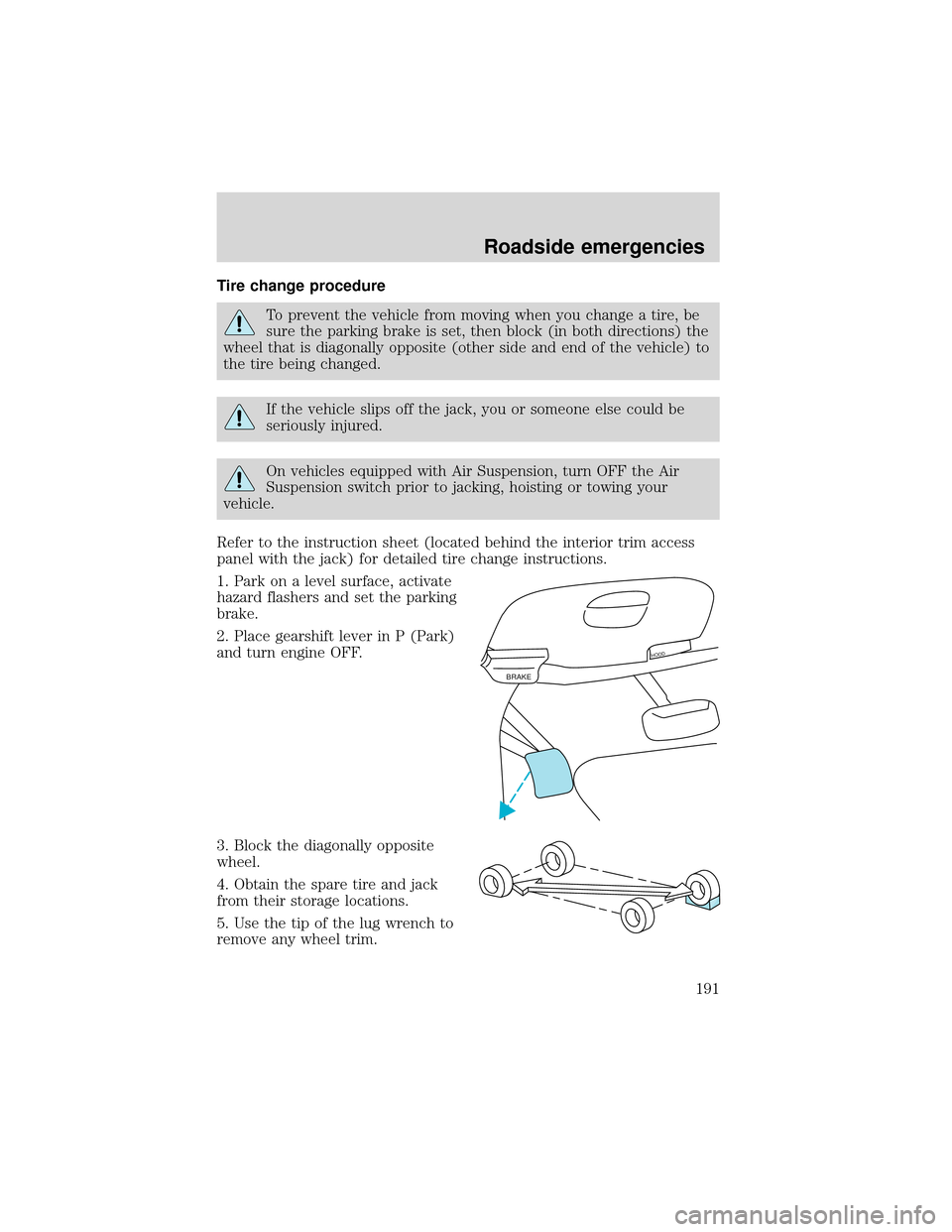
Tire change procedure
To prevent the vehicle from moving when you change a tire, be
sure the parking brake is set, then block (in both directions) the
wheel that is diagonally opposite (other side and end of the vehicle) to
the tire being changed.
If the vehicle slips off the jack, you or someone else could be
seriously injured.
On vehicles equipped with Air Suspension, turn OFF the Air
Suspension switch prior to jacking, hoisting or towing your
vehicle.
Refer to the instruction sheet (located behind the interior trim access
panel with the jack) for detailed tire change instructions.
1. Park on a level surface, activate
hazard flashers and set the parking
brake.
2. Place gearshift lever in P (Park)
and turn engine OFF.
3. Block the diagonally opposite
wheel.
4. Obtain the spare tire and jack
from their storage locations.
5. Use the tip of the lug wrench to
remove any wheel trim.
BRAKE
HOOD
Roadside emergencies
191
Page 192 of 280
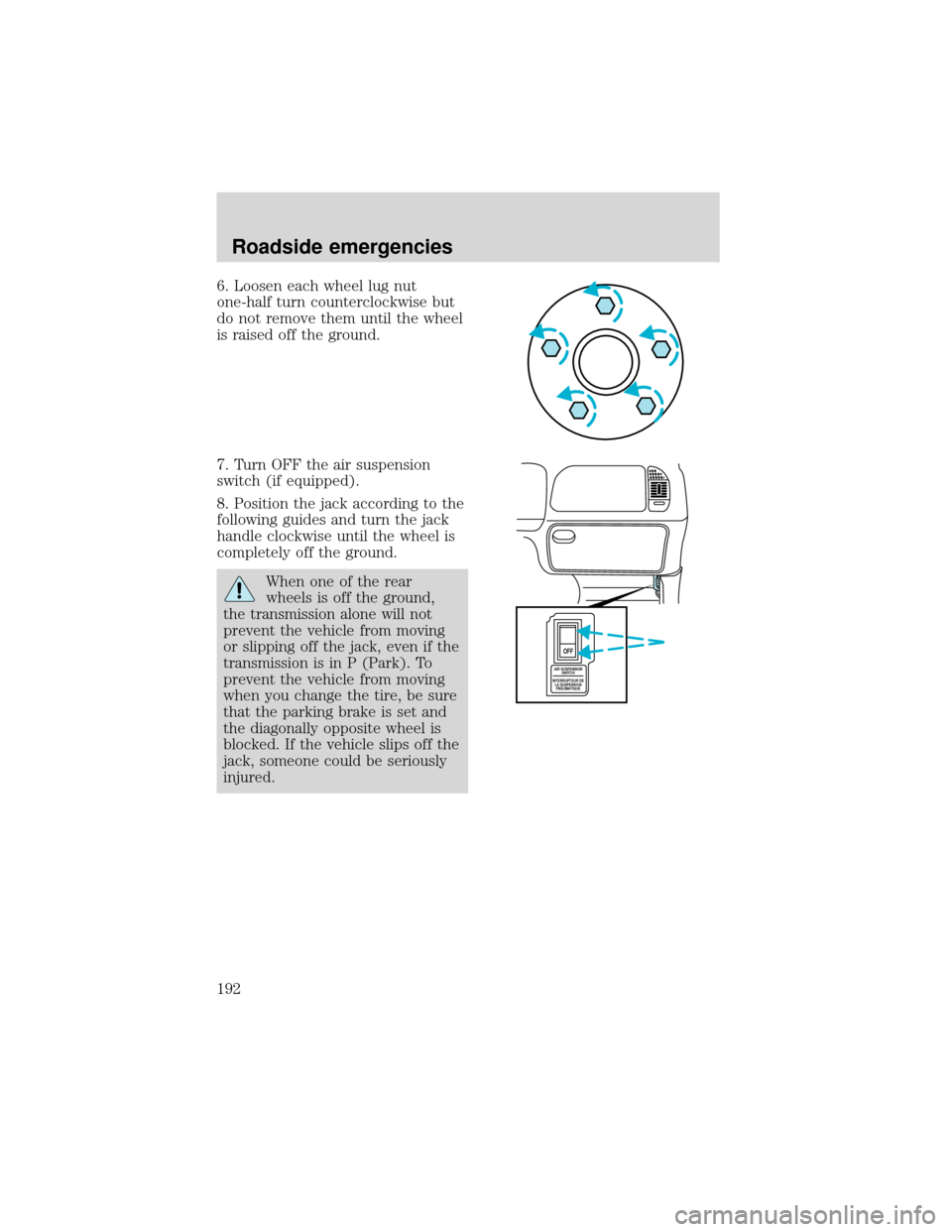
6. Loosen each wheel lug nut
one-half turn counterclockwise but
do not remove them until the wheel
is raised off the ground.
7. Turn OFF the air suspension
switch (if equipped).
8. Position the jack according to the
following guides and turn the jack
handle clockwise until the wheel is
completely off the ground.
When one of the rear
wheels is off the ground,
the transmission alone will not
prevent the vehicle from moving
or slipping off the jack, even if the
transmission is in P (Park). To
prevent the vehicle from moving
when you change the tire, be sure
that the parking brake is set and
the diagonally opposite wheel is
blocked. If the vehicle slips off the
jack, someone could be seriously
injured.
AIR SUSPENSION
SWITCH
INTERRUPTEUR DE
LA SUSPENSION
PNEUMATIQUE
OFF
Roadside emergencies
192
Page 272 of 280
Cassette tape player ...................28
CD changer .................................52
Certification Label ....................256
Child safety restraints ..............137
child safety belts ....................137
Child safety seats ......................138
attaching with tether
straps ...............................143–144
in front seat ............................140
in rear seat ..............140, 142–143
Cleaning your vehicle ...............242
engine compartment ..............244
exterior ............................243–244
exterior lamps .........................245
instrument cluster lens ..........246
instrument panel ....................246
interior .............................246–247
plastic parts ............................245
safety belts ..............................247
washing ....................................243
waxing .....................................243
wheels ......................................244
windows ..................................246
wiper blades ............................245
woodtone trim ........................247
Climate control (see Air
conditioning or Heating) ............56
Clock ......................................37, 49
Compass, electronic ....................78
calibration .................................80
set zone adjustment .................79
Console ........................................91
overhead ........................75–76, 81
rear ............................................91
Controls
power seat ...............................106Coolant
checking and adding ..............208
refill capacities ................212, 248
specifications ..................251, 254
Cruise control (see Speed
control) ........................................69
Customer Assistance ................178
Ford accessories for your
vehicle .....................................264
Ford Extended
Service Plan ............................257
Getting assistance outside the
U.S. and Canada .....................263
Getting roadside assistance ...178
Getting the service you
need .........................................257
Ordering additional owner’s
literature .................................268
The Dispute Settlement
Board .......................................260
Utilizing the
Mediation/Arbitration
Program ...................................263
D
Daytime running lamps
(see Lamps) ................................21
Defrost
rear window ..............................23
Dipstick
automatic transmission
fluid ..........................................215
engine oil .................................203
Doors
door ajar warning .....................14
lubricant specifications ..........251
Driveline universal joint and
slip yoke ....................................217
Index
272
Page 273 of 280
Driving under special
conditions ..................................167
mud ..........................................166
sand .........................................166
snow and ice ...........................167
through water .................166, 168
E
Emergencies, roadside
jump-starting ..........................194
Emission control system ..........235
Engine ........................................254
check engine/service engine
soon light ..................................10
cleaning ...................................244
coolant .....................................208
fail-safe coolant ......................213
idle speed control ...................217
lubrication specifications ......251,
254
refill capacities ........................248
service points ..........................203
starting after a collision .........179
Engine block heater .................150
Engine oil ..................................203
change oil soon warning,
message center .......................203
checking and adding ..............203
dipstick ....................................203
filter, specifications ........205, 248
recommendations ...................205
refill capacities ........................248
specifications ..................251, 254
Exhaust fumes ..........................150
F
Fail safe cooling ........................213Floor mats ...................................92
Fluid capacities .........................248
Foglamps .....................................22
Four-Wheel Drive
vehicles ................................14, 163
control trac .......................24, 163
description ..............................164
driving off road .......................165
electronic shift ..................24, 164
indicator light ...........................14
preparing to drive your
vehicle .....................................158
Fuel ............................................227
calculating fuel economy .......232
cap ...........................................231
capacity ...................................248
choosing the right fuel ...........229
comparisons with EPA fuel
economy estimates .................235
detergent in fuel .....................230
filling your vehicle with
fuel ...........................227, 231–232
filter, specifications ........231, 248
fuel pump shut-off switch .....179
gauge .........................................16
improving fuel economy ........232
low fuel warning light ..............10
octane rating ...................229, 254
quality ......................................230
running out of fuel .................230
safety information relating to
automotive fuels .....................227
Fuses ..................................181–182
G
Garage door opener ..............76, 84
Gas cap (see Fuel cap) ............231
Index
273