2001 FORD EXPEDITION Seat
[x] Cancel search: SeatPage 205 of 280
•Oil levels above the MAX mark may cause engine damage. Some oil
must be removed from the engine by a service technician.
7. Put the indicator back in and ensure it is fully seated.
Adding engine oil
1. Check the engine oil. For instructions, refer toChecking the engine
oilin this chapter.
2. If the engine oil level is not within the normal range, add only certified
engine oil of the recommended viscosity. Remove the engine oil filler cap
and use a funnel to pour the engine oil into the opening.
3. Recheck the engine oil level. Make sure the oil level is not above the
MAX mark on the engine oil level indicator (dipstick).
4. Install the indicator and ensure it is fully seated.
5. Fully install the engine oil filler cap by turning the filler cap clockwise
1/4 of a turn until three clicks are heard until it is latched.
To avoid possible oil loss, DO NOT operate the vehicle with the
engine oil level indicator and/or the engine oil filler cap removed.
Engine oil and filter recommendations
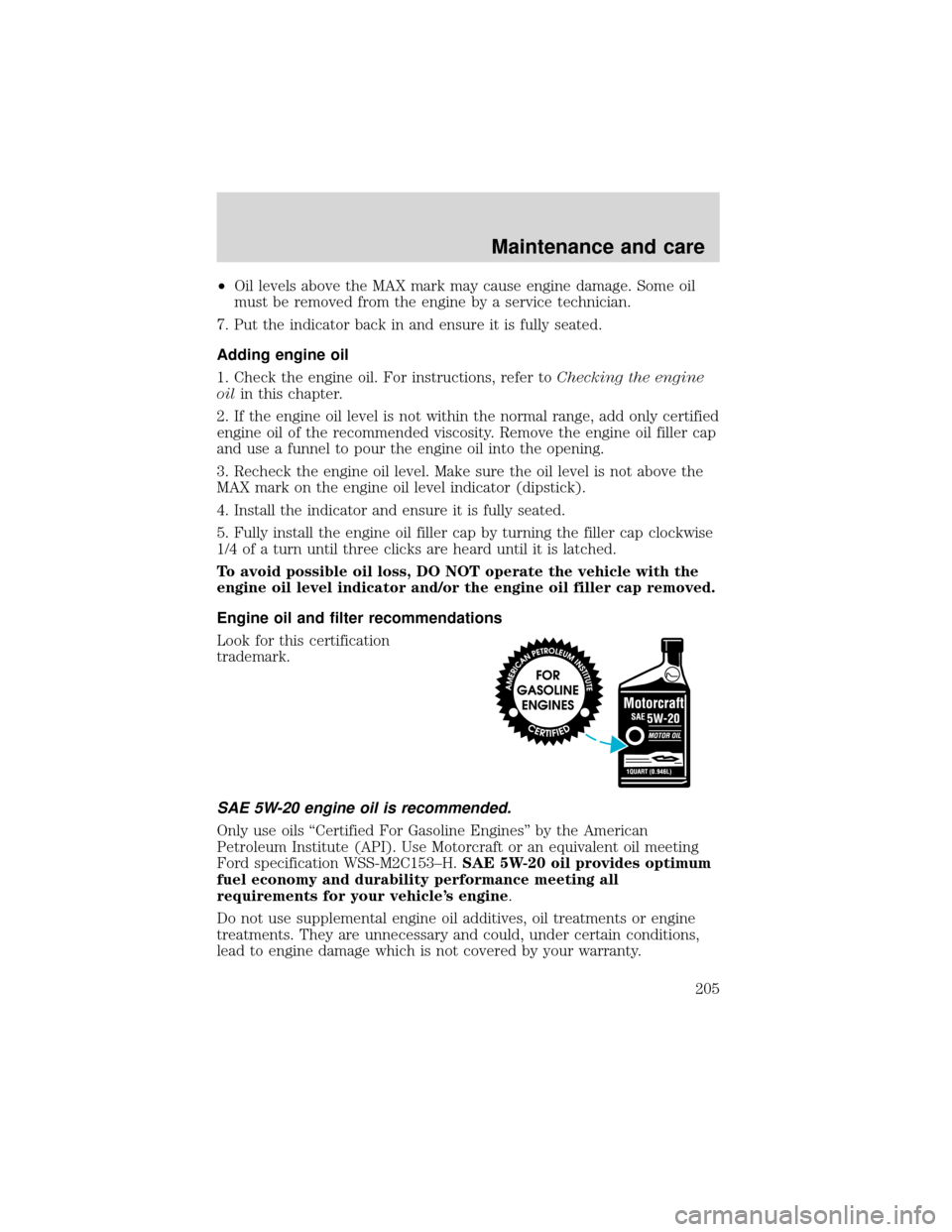
Look for this certification
trademark.
SAE 5W-20 engine oil is recommended.
Only use oils“Certified For Gasoline Engines”by the American
Petroleum Institute (API). Use Motorcraft or an equivalent oil meeting
Ford specification WSS-M2C153–H.SAE 5W-20 oil provides optimum
fuel economy and durability performance meeting all
requirements for your vehicle’s engine.
Do not use supplemental engine oil additives, oil treatments or engine
treatments. They are unnecessary and could, under certain conditions,
lead to engine damage which is not covered by your warranty.
Maintenance and care
205
Page 216 of 280
5. Remove the dipstick, wiping it clean with a clean, dry lint free rag. If
necessary, refer toIdentifying components in the engine compartment
in this chapter for the location of the dipstick.
6. Install the dipstick making sure it is fully seated in the filler tube.
7. Remove the dipstick and inspect the fluid level. The fluid should be in
the designated area for normal operating temperature or ambient
temperature.
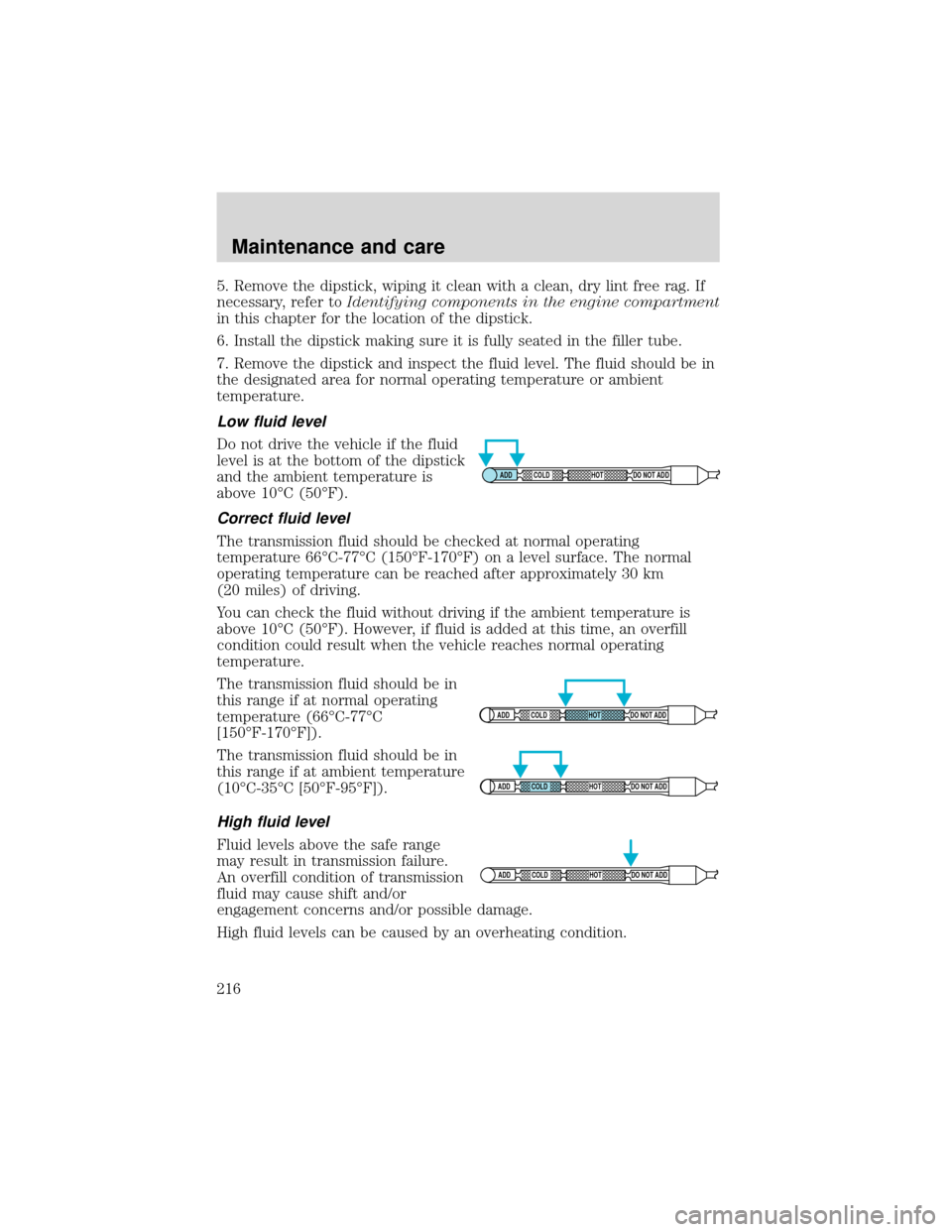
Low fluid level
Do not drive the vehicle if the fluid
level is at the bottom of the dipstick
and the ambient temperature is
above 10°C (50°F).
Correct fluid level
The transmission fluid should be checked at normal operating
temperature 66°C-77°C (150°F-170°F) on a level surface. The normal
operating temperature can be reached after approximately 30 km
(20 miles) of driving.
You can check the fluid without driving if the ambient temperature is
above 10°C (50°F). However, if fluid is added at this time, an overfill
condition could result when the vehicle reaches normal operating
temperature.
The transmission fluid should be in
this range if at normal operating
temperature (66°C-77°C
[150°F-170°F]).
The transmission fluid should be in
this range if at ambient temperature
(10°C-35°C [50°F-95°F]).
High fluid level
Fluid levels above the safe range
may result in transmission failure.
An overfill condition of transmission
fluid may cause shift and/or
engagement concerns and/or possible damage.
High fluid levels can be caused by an overheating condition.
ADD COLD HOT DO NOT ADD
ADD COLD HOT DO NOT ADD
ADD COLD HOT DO NOT ADD
ADD COLD HOT DO NOT ADD
Maintenance and care
216
Page 222 of 280
4. Install a new air filter element. Be careful not to crimp the filter
element edges between the air filter housing and cover. This could cause
filter damage and allow unmetered air to enter the engine if not properly
seated.
5. Replace the air filter cover and secure the clamp.
6. Replace the air inlet tube and secure the clamp.
WINDSHIELD WIPER BLADES
Check the wiper blades at least twice a year or when they seem less
effective. Substances such as tree sap and some hot wax treatments used
by commercial car washes reduce the effectiveness of wiper blades.
Checking the wiper blades
If the wiper blades do not wipe properly, clean both the windshield and
wiper blades using undiluted windshield wiper solution or a mild
detergent. Rinse thoroughly with clean water. To avoid damaging the
blades, do not use fuel, kerosene, paint thinner or other solvents.
Changing the wiper blades
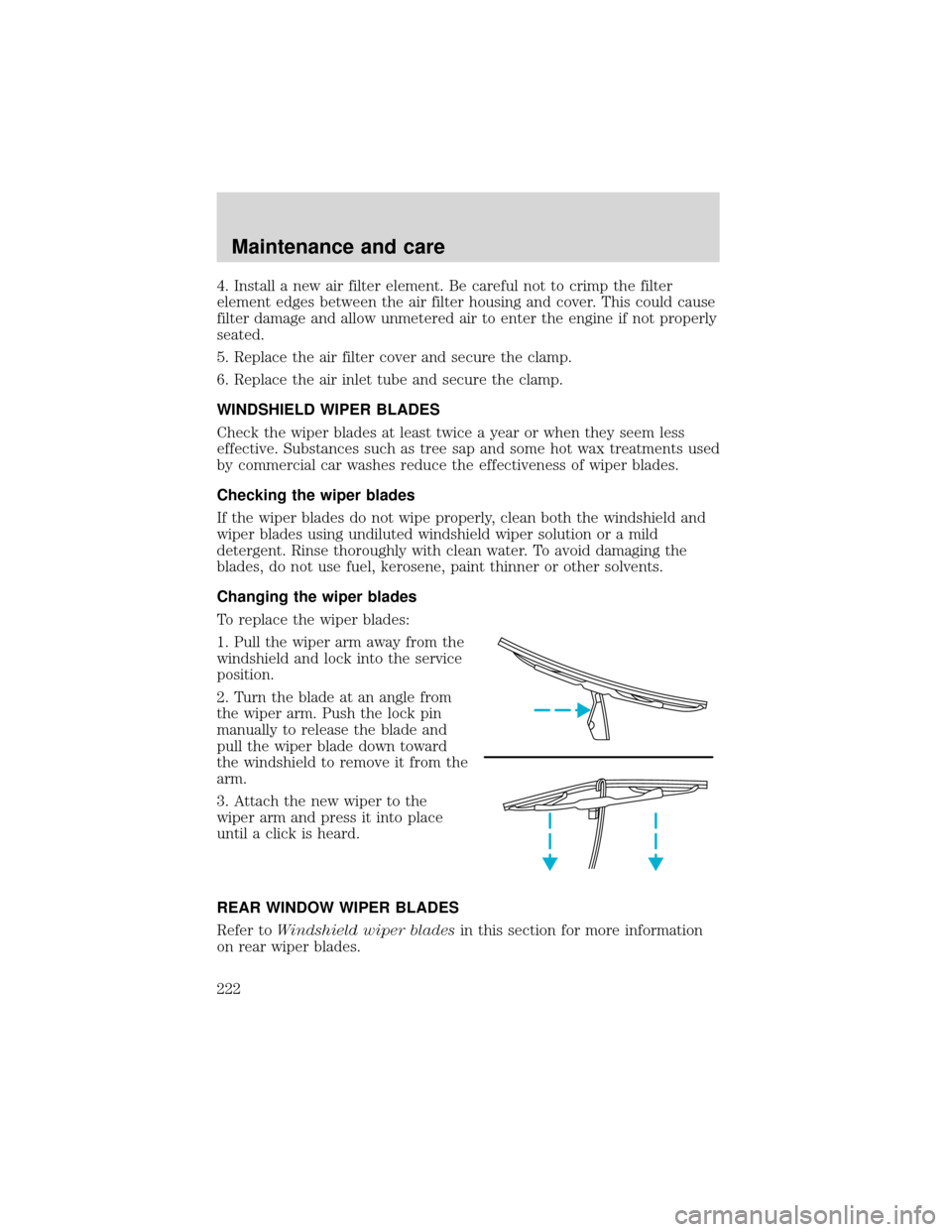
To replace the wiper blades:
1. Pull the wiper arm away from the
windshield and lock into the service
position.
2. Turn the blade at an angle from
the wiper arm. Push the lock pin
manually to release the blade and
pull the wiper blade down toward
the windshield to remove it from the
arm.
3. Attach the new wiper to the
wiper arm and press it into place
until a click is heard.
REAR WINDOW WIPER BLADES
Refer toWindshield wiper bladesin this section for more information
on rear wiper blades.
Maintenance and care
222
Page 239 of 280
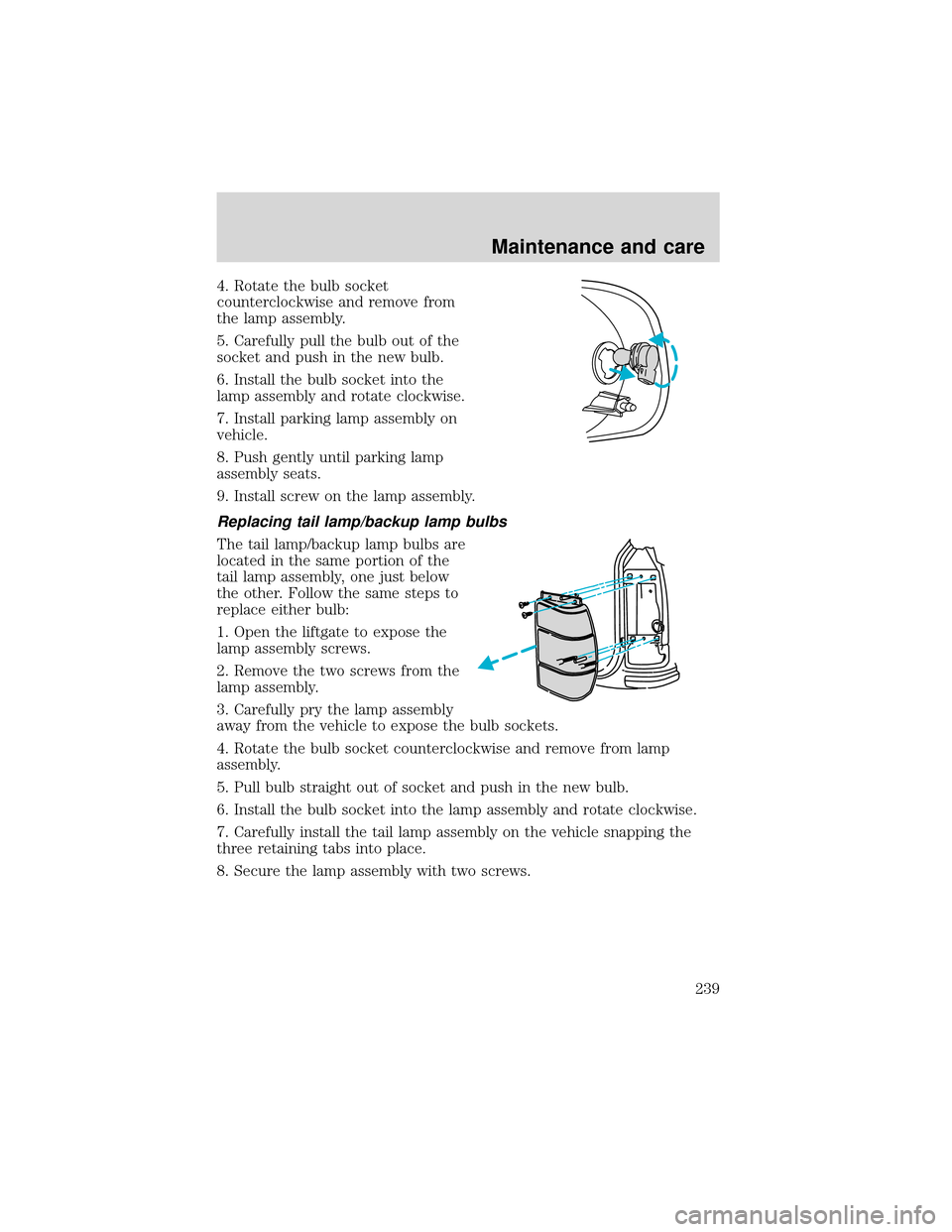
4. Rotate the bulb socket
counterclockwise and remove from
the lamp assembly.
5. Carefully pull the bulb out of the
socket and push in the new bulb.
6. Install the bulb socket into the
lamp assembly and rotate clockwise.
7. Install parking lamp assembly on
vehicle.
8. Push gently until parking lamp
assembly seats.
9. Install screw on the lamp assembly.
Replacing tail lamp/backup lamp bulbs
The tail lamp/backup lamp bulbs are
located in the same portion of the
tail lamp assembly, one just below
the other. Follow the same steps to
replace either bulb:
1. Open the liftgate to expose the
lamp assembly screws.
2. Remove the two screws from the
lamp assembly.
3. Carefully pry the lamp assembly
away from the vehicle to expose the bulb sockets.
4. Rotate the bulb socket counterclockwise and remove from lamp
assembly.
5. Pull bulb straight out of socket and push in the new bulb.
6. Install the bulb socket into the lamp assembly and rotate clockwise.
7. Carefully install the tail lamp assembly on the vehicle snapping the
three retaining tabs into place.
8. Secure the lamp assembly with two screws.
Maintenance and care
239
Page 247 of 280
Woodtone trim
Wipe stains with a soft cloth and a multi-purpose cleaning solution.
Cleaning leather seats (if equipped)
To clean, simply use a soft cloth dampened with water and a mild soap.
Wipe the leather again with a damp cloth to remove soap residue. Dry
with a soft cloth. For tougher soiling concerns, Ford recommends using
the Deluxe Leather Care Kit F8AZ-19G253–AA, which is available from
your Ford Dealer. This mild cleaner and special pad, cleans the leather
and maintains its natural beauty. Follow the instructions on the cleaner
label. Regular cleaning of your leather upholstery helps maintain its
resiliency and color.
Do not use household cleaning products, alcohol solutions,
solvents or cleaners intended for rubber, vinyl or plastics.
Cleaning seats equipped with side air bags
Remove dust and loose dirt with a whisk broom or a vacuum cleaner.
Remove fresh spots immediately. Follow the directions that come with
the cleaner. Do not saturate the seat cover with upholstery cleaner.
Do not use chemical solvents or strong detergents when cleaning
the seat mounted side air bag. Such products could contaminate
the side air bag system and affect performance of the side air bag in a
collision.
Cleaning and maintaining the safety belts
Clean the safety belts with a mild soap solution recommended for
cleaning upholstery or carpets. Do not bleach or dye the belts, because
these actions may weaken the belt webbing.
Check the safety belt system periodically to make sure there are no
nicks, tears or cuts. If your vehicle has been involved in an accident,
refer to theSafety belt maintenancesection in theSeating and safety
restraintschapter.
Maintenance and care
247
Page 251 of 280
2Indicates only approximate dry-fill capacity. Some applications may vary
based on cooler size and if equipped with an in-tank cooler. The amount
of transmission fluid and fluid level should be set by the indication on
the dipstick’s normal operating range.
3Add the coolant type originally equipped in your vehicle.
4Your vehicle’s rear axle is filled with a synthetic rear axle lubricant and
is considered lubricated for life. These lubricants are not to be checked
or changed unless a leak is suspected, service is required or the axle has
been submerged in water. The axle lubricant should be changed any time
the axle has been submerged in water. Add 118 ml (4 oz.) of Additive
Friction Modifier C8AZ-19B546-A or equivalent meeting Ford
specification EST-M2C118–A for complete refill of Traction-Lok axles.
Service refill capacities are determined by filling the rear axle 6 mm to
14 mm (1/4 inch to 9/16 inch) below the bottom of the filler hole.
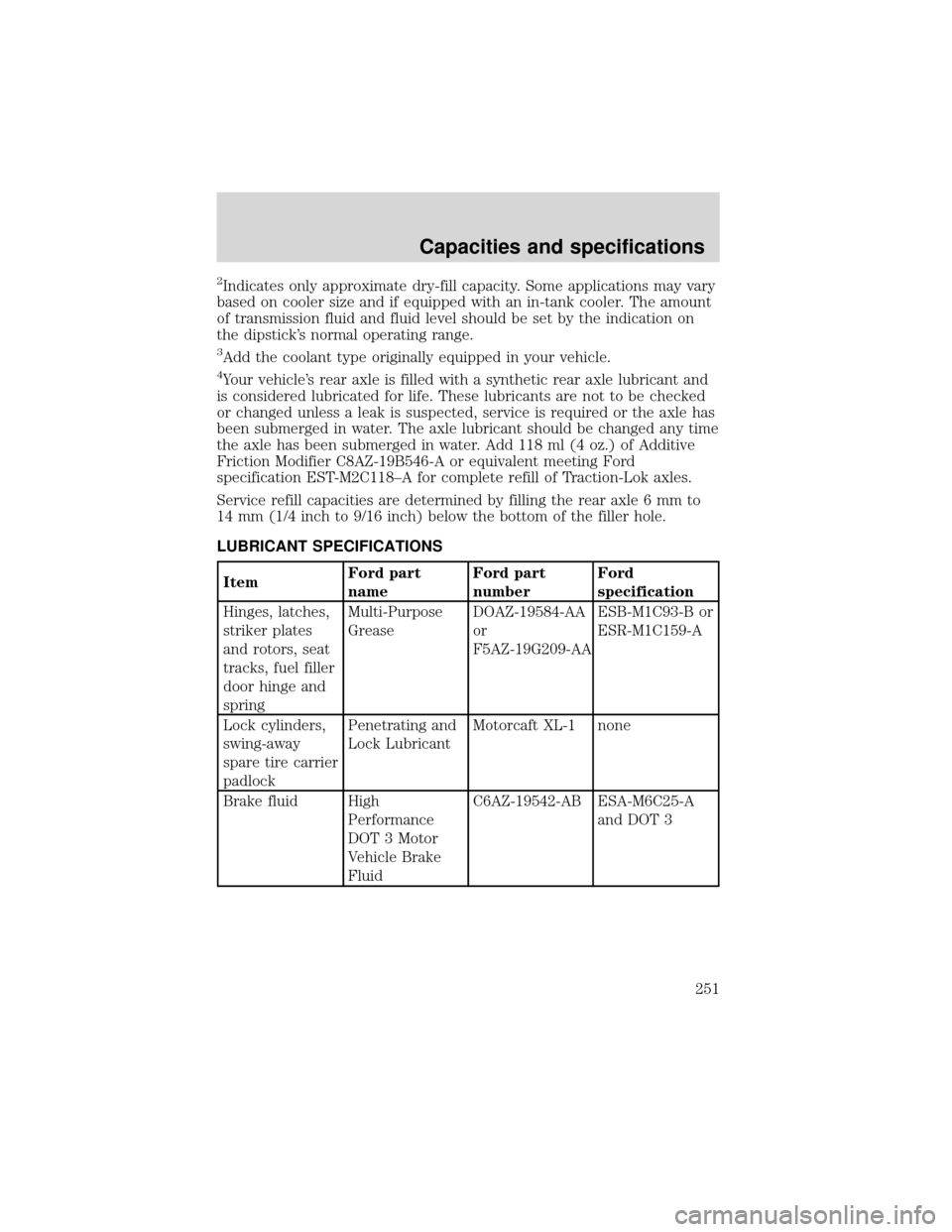
LUBRICANT SPECIFICATIONS
ItemFord part
nameFord part
numberFord
specification
Hinges, latches,
striker plates
and rotors, seat
tracks, fuel filler
door hinge and
springMulti-Purpose
GreaseDOAZ-19584-AA
or
F5AZ-19G209-AAESB-M1C93-B or
ESR-M1C159-A
Lock cylinders,
swing-away
spare tire carrier
padlockPenetrating and
Lock LubricantMotorcaft XL-1 none
Brake fluid High
Performance
DOT 3 Motor
Vehicle Brake
FluidC6AZ-19542-AB ESA-M6C25-A
and DOT 3
Capacities and specifications
251
Page 266 of 280
Carpeted cargo mat
Dash trim (wood grain)
Engine block heaters
Tire step
Travel equipment
Auto headlamps with DRL
Bike rack
Bumper mount bike carrier
Canoe carrier
Cell phone holder
Daytime running lights (DRL)
Factory luggage rack adaptors
Fog lights
Framed luggage covers
Hard side luggage box
Hard side ski box
Heavy-duty battery
Kayak carrier
Luggage/cargo basket
Removable luggage rack (Track rider bars)
Removable luggage rack adapters
Running boards (Molded and tubular)
Seatback organizer
Ski/snowboard carrier
Snow traction cables
Soft luggage cover
Towing mirrors (Removable and permanent)
Trailer hitch (Class III)
Trailer hitch bars and balls
Trailer hitch wiring adaptor
Customer assistance
266
Page 271 of 280
A
Accessory delay ..........................89
Air bag supplemental restraint
system ........................128–129, 134
and child safety seats ............131
description ......................129, 134
disposal ............................133, 137
driver air bag ..................131, 135
indicator light ...........11, 133, 136
operation .........................131, 135
passenger air bag ...........131, 135
side air bag ..............................134
Air cleaner filter .......220–221, 248
Air conditioning ..........................56
automatic temperature
control system ..........................60
auxiliary heater and air
conditioner ................................66
Air suspension ...........................156
description ..............................156
warning light .............................14
Ambulance packages ....................5
Antifreeze
(see Engine coolant) ................208
Anti-lock brake system
(see Brakes) ......................152–153
Anti-theft system
warning light .............................13
Armrests ....................................106
Audio system (see Radio) .........27
Automatic transmission
driving an automatic
overdrive .................................160
fluid, adding ............................215
fluid, checking ........................215
fluid, refill capacities ..............248fluid, specification ..................254
Auxiliary power point .................26
Axle
lubricant
specifications ..................251, 254
refill capacities ........................248
traction lok ..............................157
B
Battery .......................................217
acid, treating emergencies .....217
charging system
warning light .............................13
jumping a disabled battery ....194
maintenance-free ....................217
replacement, specifications ...248
servicing ..................................217
voltage gauge ............................18
Belt minder ...............................124
Brakes ........................................152
anti-lock ...........................152–153
anti-lock brake system (ABS)
warning light .....................12, 153
brake warning light ..................12
fluid, checking and adding ....206
fluid, refill capacities ..............248
fluid, specifications .........251, 254
lubricant
specifications ..................251, 254
parking ....................................154
pedals (see Power adjustable
foot pedals) ...............................23
shift interlock ..........................159
Break-in period .............................3
C
Capacities for refilling fluids ....248
Index
271