2001 FORD EXPEDITION parking brake
[x] Cancel search: parking brakePage 215 of 280
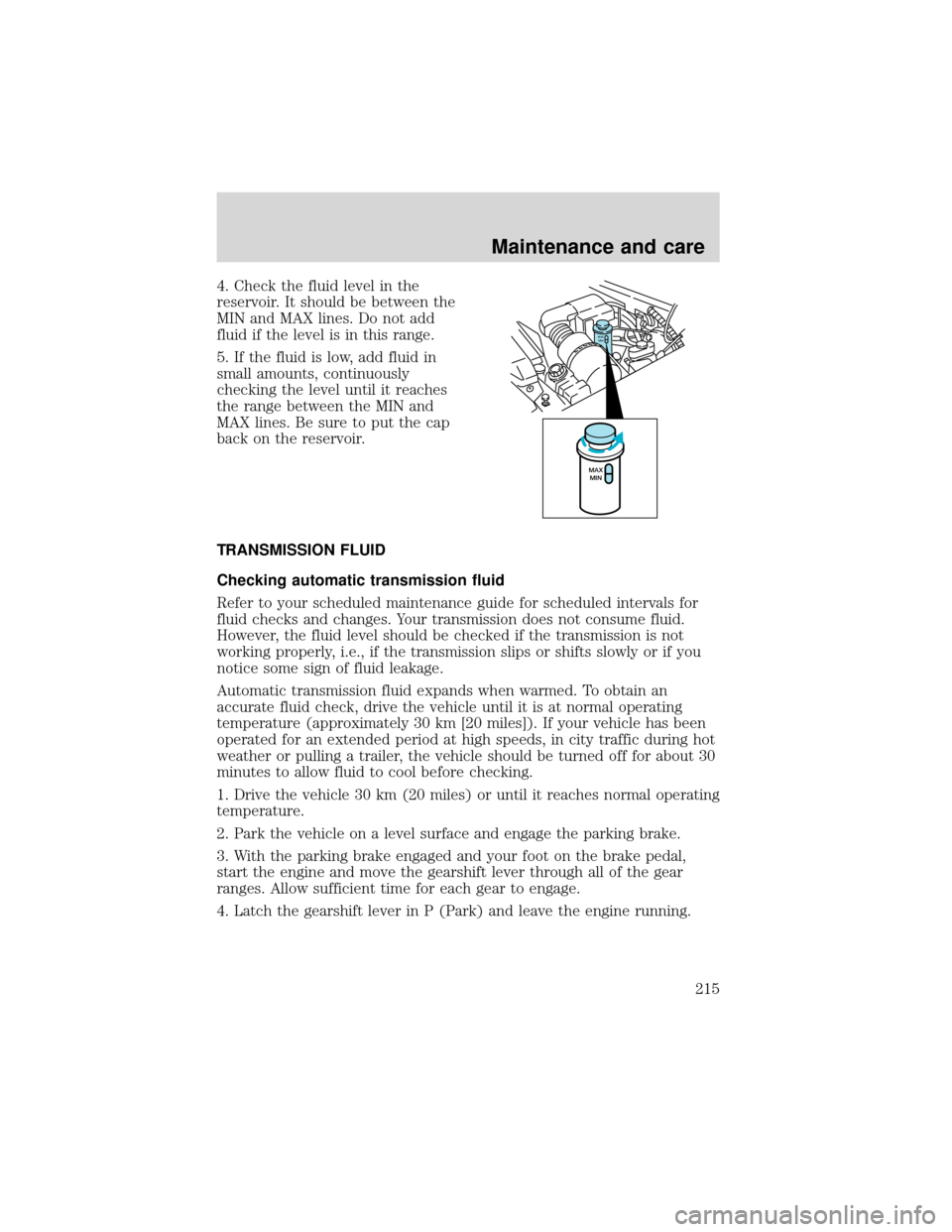
4. Check the fluid level in the
reservoir. It should be between the
MIN and MAX lines. Do not add
fluid if the level is in this range.
5. If the fluid is low, add fluid in
small amounts, continuously
checking the level until it reaches
the range between the MIN and
MAX lines. Be sure to put the cap
back on the reservoir.
TRANSMISSION FLUID
Checking automatic transmission fluid
Refer to your scheduled maintenance guide for scheduled intervals for
fluid checks and changes. Your transmission does not consume fluid.
However, the fluid level should be checked if the transmission is not
working properly, i.e., if the transmission slips or shifts slowly or if you
notice some sign of fluid leakage.
Automatic transmission fluid expands when warmed. To obtain an
accurate fluid check, drive the vehicle until it is at normal operating
temperature (approximately 30 km [20 miles]). If your vehicle has been
operated for an extended period at high speeds, in city traffic during hot
weather or pulling a trailer, the vehicle should be turned off for about 30
minutes to allow fluid to cool before checking.
1. Drive the vehicle 30 km (20 miles) or until it reaches normal operating
temperature.
2. Park the vehicle on a level surface and engage the parking brake.
3. With the parking brake engaged and your foot on the brake pedal,
start the engine and move the gearshift lever through all of the gear
ranges. Allow sufficient time for each gear to engage.
4. Latch the gearshift lever in P (Park) and leave the engine running.
MAX
MIN
MAX
MIN
Maintenance and care
215
Page 219 of 280
Battery posts, terminals and related accessories contain lead and
lead compunds.Wash hands after handling.
For information on transmission operation after the battery has been
disconnected see“Shift strategy”in the driving section.
To account for customer driving habits and conditions, your automatic
transmission (4R100) electronically controls the shift quality by using an
adaptive learning strategy. The adaptive learning strategy is maintained
by power from the battery. When the battery is disconnected or a new
battery is installed, the transmission must relearn its adaptive strategy.
Optimal shifting will resume within a few hundred kilometers (miles) of
operation.
If the shift quality does not improve within a few hundred
kilometers (miles) of operation, or if the downshifts and other
throttle conditions do not function normally or after a long
deceleration period, see your dealer or a qualified service
technician as soon as possible.
Because your vehicle’s engine is also electronically controlled by a
computer, some control conditions are maintained by power from the
battery. When the battery is disconnected or a new battery is installed,
the engine must relearn its idle and fuel trim strategy for optimum
driveability and performance. To begin this process:
1. With the vehicle at a complete stop, set the parking brake.
2. Put the gearshift in P (Park), turn off all accessories and start the
engine.
3. Run the engine until it reaches normal operating temperature.
4. Allow the engine to idle for at least one minute.
5. Turn the A/C on and allow the engine to idle for at least one minute.
6. With your foot on the brake pedal and with the A/C on, put the
vehicle in D (Drive) and allow the engine to idle for at least one minute.
7. Drive the vehicle to complete the relearning process.
•The vehicle may need to be driven 16 km (10 miles) or more to
relearn the idle and fuel trim strategy.
•If you do not allow the engine to relearn its idle trim, the idle
quality of your vehicle may be adversely affected until the idle
trim is eventually relearned.
Maintenance and care
219
Page 237 of 280
•Foglamps
•High-mount brakelamp
•Brakelamps
•Parking lamps
•Turn signals
•License plate lamp
•Tail lamps
•Back-up lamps
Do not remove lamp bulbs unless they can be replaced immediately with
new ones. If a bulb is removed for an extended period of time,
contaminants may enter the lamp housings and affect lamp performance.
Replacing headlamp bulbs
1. Make sure that the headlamp control is in the OFF position.
2. Open the hood.
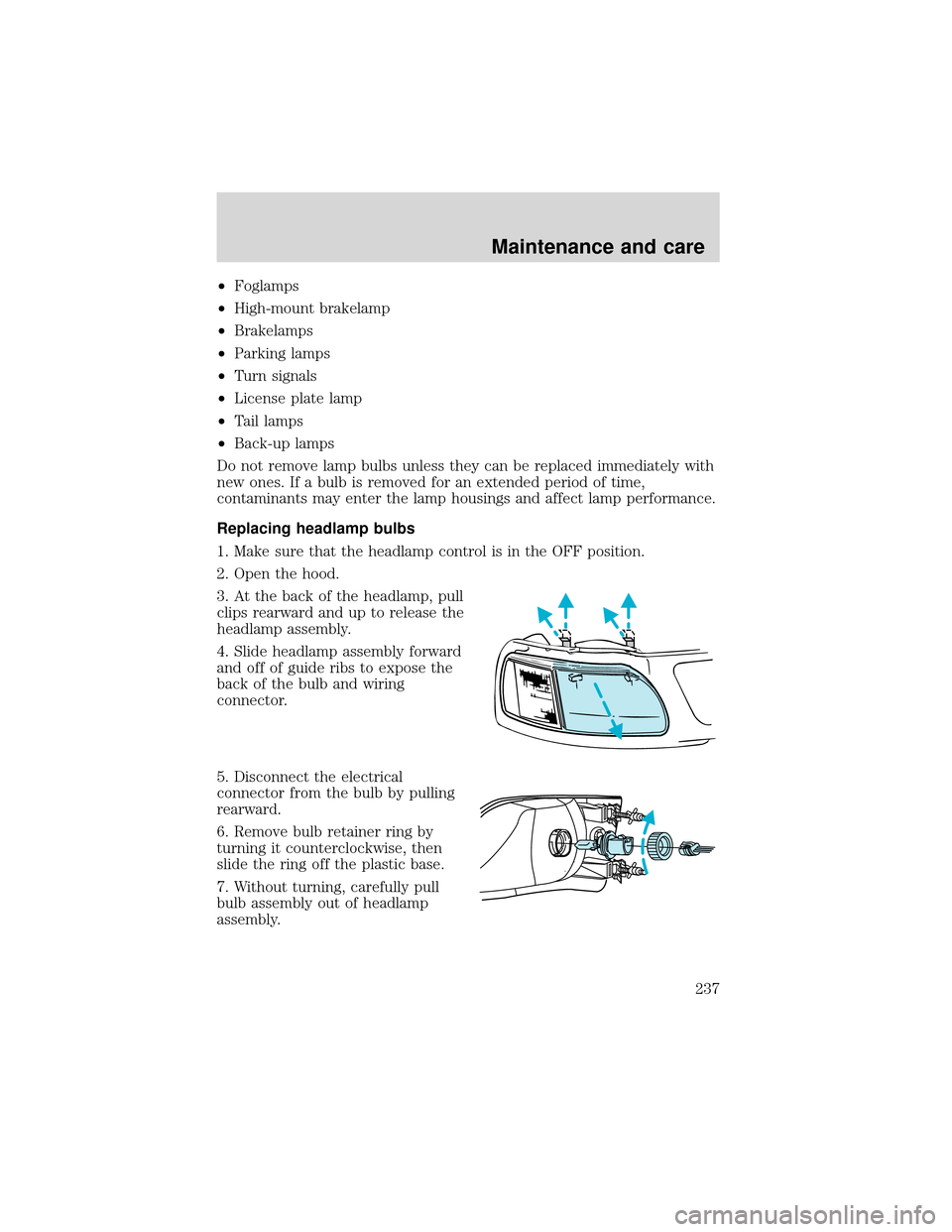
3. At the back of the headlamp, pull
clips rearward and up to release the
headlamp assembly.
4. Slide headlamp assembly forward
and off of guide ribs to expose the
back of the bulb and wiring
connector.
5. Disconnect the electrical
connector from the bulb by pulling
rearward.
6. Remove bulb retainer ring by
turning it counterclockwise, then
slide the ring off the plastic base.
7. Without turning, carefully pull
bulb assembly out of headlamp
assembly.
Maintenance and care
237
Page 271 of 280
A
Accessory delay ..........................89
Air bag supplemental restraint
system ........................128–129, 134
and child safety seats ............131
description ......................129, 134
disposal ............................133, 137
driver air bag ..................131, 135
indicator light ...........11, 133, 136
operation .........................131, 135
passenger air bag ...........131, 135
side air bag ..............................134
Air cleaner filter .......220–221, 248
Air conditioning ..........................56
automatic temperature
control system ..........................60
auxiliary heater and air
conditioner ................................66
Air suspension ...........................156
description ..............................156
warning light .............................14
Ambulance packages ....................5
Antifreeze
(see Engine coolant) ................208
Anti-lock brake system
(see Brakes) ......................152–153
Anti-theft system
warning light .............................13
Armrests ....................................106
Audio system (see Radio) .........27
Automatic transmission
driving an automatic
overdrive .................................160
fluid, adding ............................215
fluid, checking ........................215
fluid, refill capacities ..............248fluid, specification ..................254
Auxiliary power point .................26
Axle
lubricant
specifications ..................251, 254
refill capacities ........................248
traction lok ..............................157
B
Battery .......................................217
acid, treating emergencies .....217
charging system
warning light .............................13
jumping a disabled battery ....194
maintenance-free ....................217
replacement, specifications ...248
servicing ..................................217
voltage gauge ............................18
Belt minder ...............................124
Brakes ........................................152
anti-lock ...........................152–153
anti-lock brake system (ABS)
warning light .....................12, 153
brake warning light ..................12
fluid, checking and adding ....206
fluid, refill capacities ..............248
fluid, specifications .........251, 254
lubricant
specifications ..................251, 254
parking ....................................154
pedals (see Power adjustable
foot pedals) ...............................23
shift interlock ..........................159
Break-in period .............................3
C
Capacities for refilling fluids ....248
Index
271
Page 275 of 280
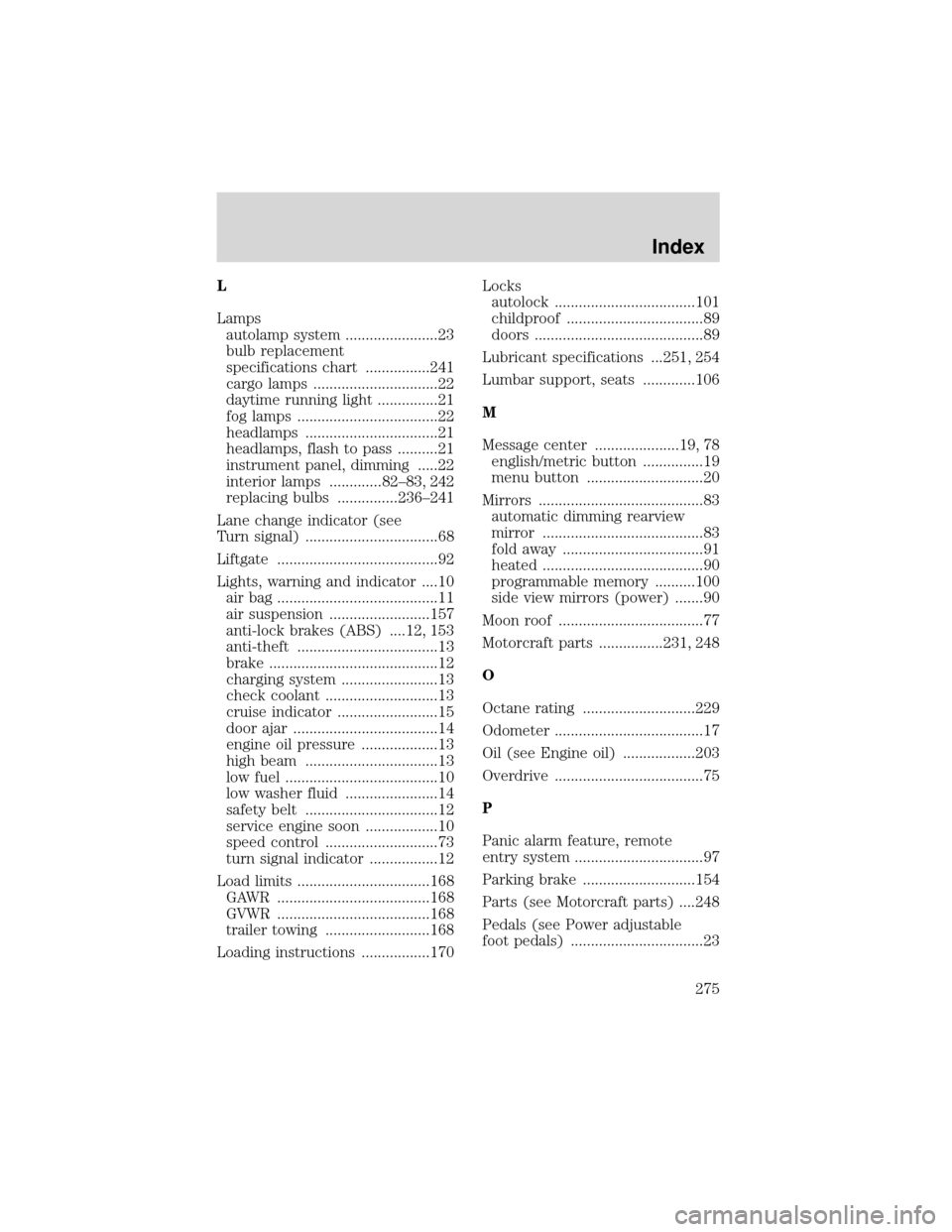
L
Lamps
autolamp system .......................23
bulb replacement
specifications chart ................241
cargo lamps ...............................22
daytime running light ...............21
fog lamps ...................................22
headlamps .................................21
headlamps, flash to pass ..........21
instrument panel, dimming .....22
interior lamps .............82–83, 242
replacing bulbs ...............236–241
Lane change indicator (see
Turn signal) .................................68
Liftgate ........................................92
Lights, warning and indicator ....10
air bag ........................................11
air suspension .........................157
anti-lock brakes (ABS) ....12, 153
anti-theft ...................................13
brake ..........................................12
charging system ........................13
check coolant ............................13
cruise indicator .........................15
door ajar ....................................14
engine oil pressure ...................13
high beam .................................13
low fuel ......................................10
low washer fluid .......................14
safety belt .................................12
service engine soon ..................10
speed control ............................73
turn signal indicator .................12
Load limits .................................168
GAWR ......................................168
GVWR ......................................168
trailer towing ..........................168
Loading instructions .................170Locks
autolock ...................................101
childproof ..................................89
doors ..........................................89
Lubricant specifications ...251, 254
Lumbar support, seats .............106
M
Message center .....................19, 78
english/metric button ...............19
menu button .............................20
Mirrors .........................................83
automatic dimming rearview
mirror ........................................83
fold away ...................................91
heated ........................................90
programmable memory ..........100
side view mirrors (power) .......90
Moon roof ....................................77
Motorcraft parts ................231, 248
O
Octane rating ............................229
Odometer .....................................17
Oil (see Engine oil) ..................203
Overdrive .....................................75
P
Panic alarm feature, remote
entry system ................................97
Parking brake ............................154
Parts (see Motorcraft parts) ....248
Pedals (see Power adjustable
foot pedals) .................................23
Index
275