2001 FORD ESCORT fuel filter
[x] Cancel search: fuel filterPage 5 of 216
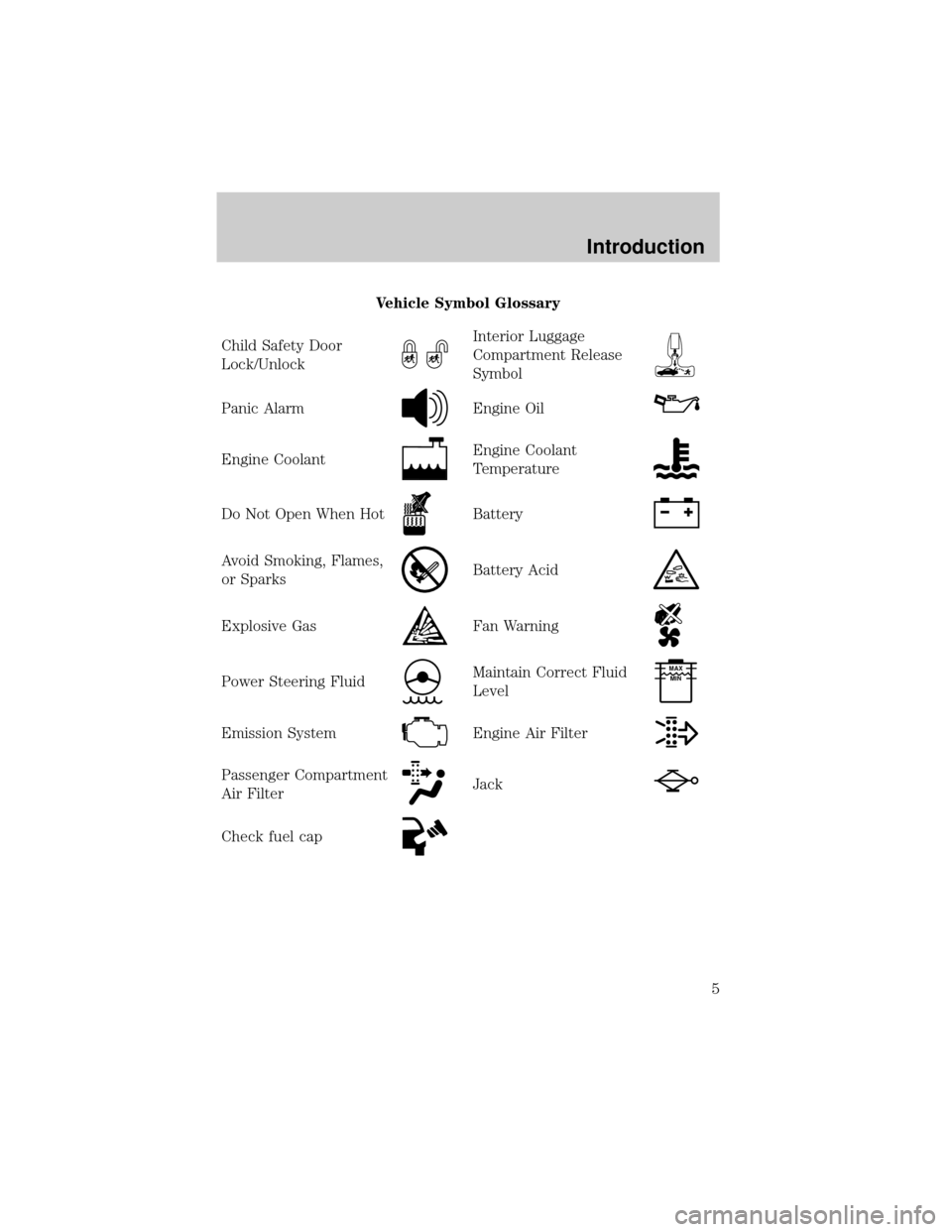
Vehicle Symbol Glossary
Child Safety Door
Lock/Unlock
Interior Luggage
Compartment Release
Symbol
Panic AlarmEngine Oil
Engine CoolantEngine Coolant
Temperature
Do Not Open When HotBattery
Avoid Smoking, Flames,
or SparksBattery Acid
Explosive GasFan Warning
Power Steering FluidMaintain Correct Fluid
LevelMAX
MIN
Emission SystemEngine Air Filter
Passenger Compartment
Air FilterJack
Check fuel cap
Introduction
5
Page 144 of 216
Adding engine oil
1. Check the engine oil. For instructions, refer toChecking the engine
oilin this chapter.
2. If the engine oil level is not within the normal range, add only certified
engine oil of the recommended viscosity. Remove the engine oil filler cap
and use a funnel to pour the engine oil into the opening.
3. Recheck the engine oil level. Make sure the oil level is not above the
MAX mark on the engine oil level indicator (dipstick).
4. Install the indicator and ensure it is fully seated.
5. Fully install the engine oil filler cap by turning the filler cap clockwise
1/4 of a turn until three clicks are heard until it is latched.
To avoid possible oil loss, DO NOT operate the vehicle with the
engine oil level indicator and/or the engine oil filler cap removed.
Engine oil and filter recommendations
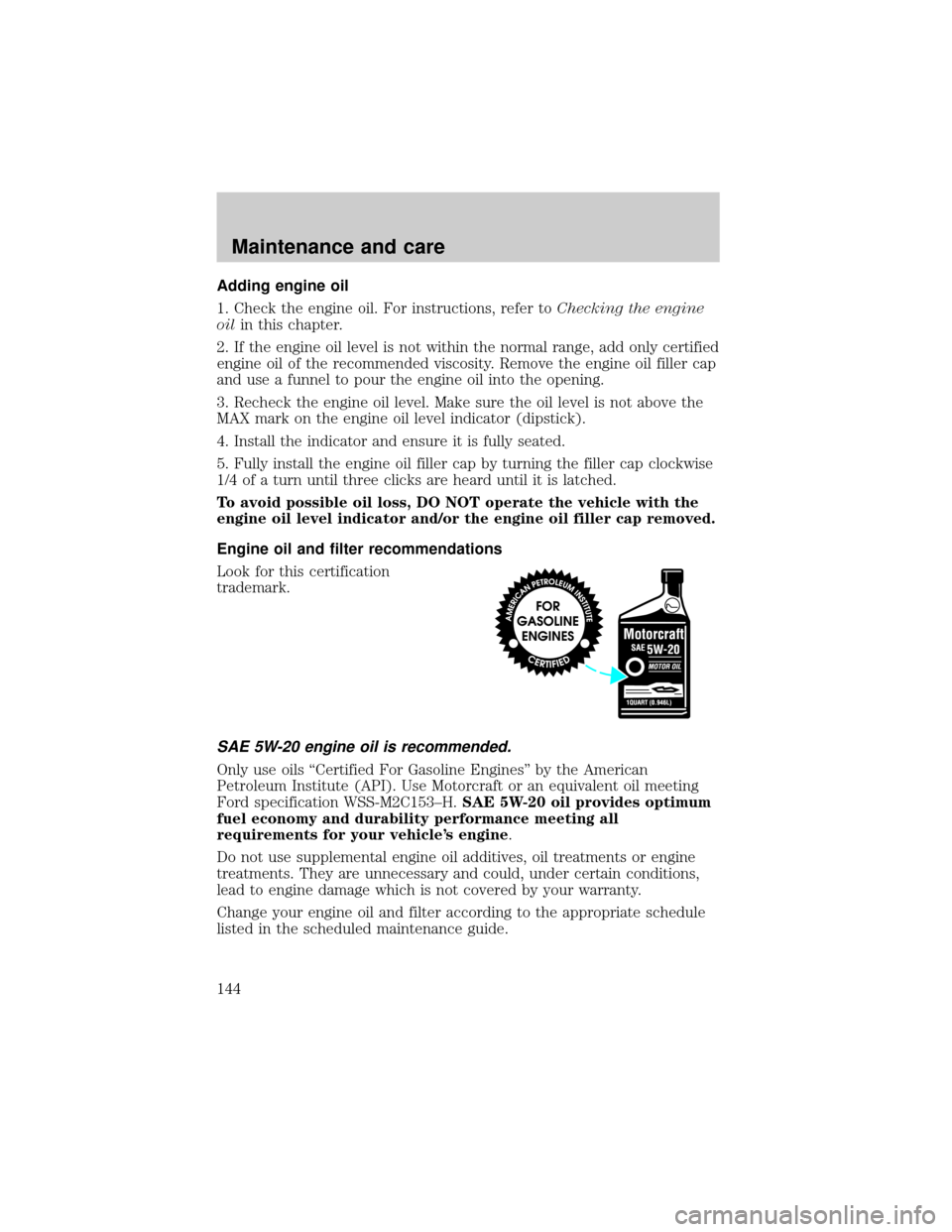
Look for this certification
trademark.
SAE 5W-20 engine oil is recommended.
Only use oils ªCertified For Gasoline Enginesº by the American
Petroleum Institute (API). Use Motorcraft or an equivalent oil meeting
Ford specification WSS-M2C153±H.SAE 5W-20 oil provides optimum
fuel economy and durability performance meeting all
requirements for your vehicle's engine.
Do not use supplemental engine oil additives, oil treatments or engine
treatments. They are unnecessary and could, under certain conditions,
lead to engine damage which is not covered by your warranty.
Change your engine oil and filter according to the appropriate schedule
listed in the scheduled maintenance guide.
Maintenance and care
144
Page 159 of 216
4. Allow the engine to idle for at least one minute.
5. Turn the A/C on and allow the engine to idle for at least one minute.
6. Drive the vehicle to complete the relearning process.
²The vehicle may need to be driven 16 km (10 miles) or more to
relearn the idle and fuel trim strategy.
²If you do not allow the engine to relearn its idle trim, the idle
quality of your vehicle may be adversely affected until the idle
trim is eventually relearned.
When the battery is disconnected or a new battery installed, the
transmission must learn its adaptive strategy. As a result of this, the
transmission may shift firmly. This operation is considered normal and
will fully update transmission operation to its optimum shift feel.
If the battery has been disconnected or a new battery has been installed,
the clock and the preset radio stations must be reset once the battery is
reconnected.
²Always dispose of automotive
batteries in a responsible manner.
Follow your local authorized
standards for disposal. Call your
local authorized recycling center
to find out more about recycling
automotive batteries.
AIR FILTER MAINTENANCE
Refer to the scheduled maintenance guide for the appropriate intervals
for changing the air filter element.
When changing the air filter element, use only the Motorcraft air filter
element listed. Refer toMotorcraft Part Numbers.
Note:Do not start your engine with the air cleaner removed and do not
remove it while the engine is running.
LEAD
RETURN
RECYCLE
Maintenance and care
159
Page 160 of 216
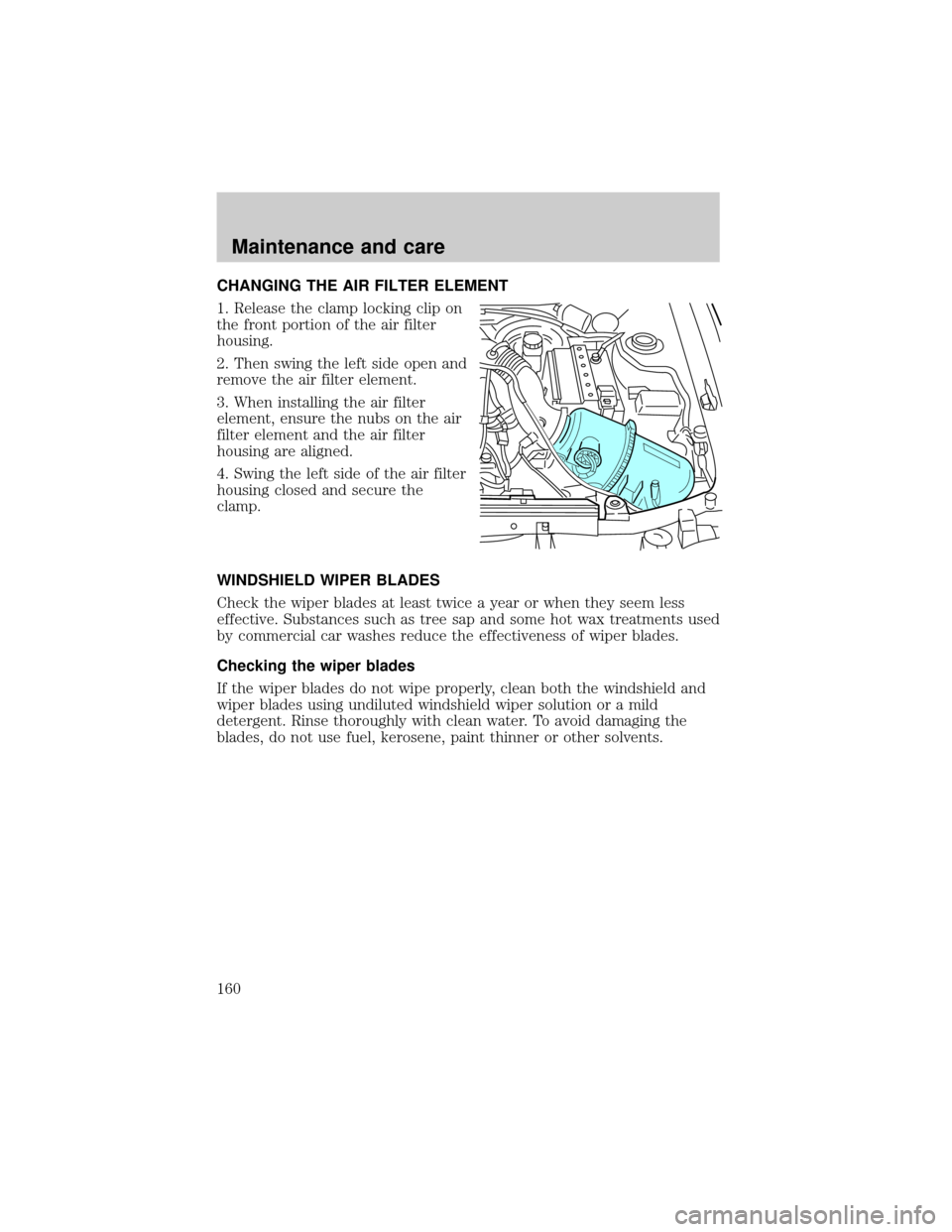
CHANGING THE AIR FILTER ELEMENT
1. Release the clamp locking clip on
the front portion of the air filter
housing.
2. Then swing the left side open and
remove the air filter element.
3. When installing the air filter
element, ensure the nubs on the air
filter element and the air filter
housing are aligned.
4. Swing the left side of the air filter
housing closed and secure the
clamp.
WINDSHIELD WIPER BLADES
Check the wiper blades at least twice a year or when they seem less
effective. Substances such as tree sap and some hot wax treatments used
by commercial car washes reduce the effectiveness of wiper blades.
Checking the wiper blades
If the wiper blades do not wipe properly, clean both the windshield and
wiper blades using undiluted windshield wiper solution or a mild
detergent. Rinse thoroughly with clean water. To avoid damaging the
blades, do not use fuel, kerosene, paint thinner or other solvents.
Maintenance and care
160
Page 171 of 216

Fuel Filter
For fuel filter replacement, see your dealer or a qualified service
technician. Refer to the scheduled maintenance guide for the appropriate
intervals for changing the fuel filter.
Replace the fuel filter with an authorized Motorcraft part. The
customer warranty may be void for any damage to the fuel system
if an authorized Motorcraft fuel filter is not used.
ESSENTIALS OF GOOD FUEL ECONOMY
Measuring techniques
Your best source of information about actual fuel economy is you, the
driver. You must gather information as accurately and consistently as
possible. Fuel expense, frequency of fillups or fuel gauge readings
are NOT accurate as a measure of fuel economy. We do not
recommend taking fuel economy measurements during the first
1 600 km (1 000 miles) of driving (engine break-in period). You
will get a more accurate measurement after 3 000 km±5 000 km
(2 000 miles-3 000 miles).
Filling the tank
The advertised fuel capacity of the fuel tank on your vehicle is equal to
the rated refill capacity of the fuel tank as listed in theRefill capacities
section ofthe Capacities and specificationschapter.
The advertised capacity is the amount of the indicated capacity and the
empty reserve combined. Indicated capacity is the difference in the
amount of fuel in a full tank and a tank when the fuel gauge indicates
empty. Empty reserve is the small amount of fuel remaining in the fuel
tank after the fuel gauge indicates empty.
The amount of usable fuel in the empty reserve varies and should
not be relied upon to increase driving range. When refueling your
vehicle after the fuel gauge indicates empty, you might not be
able to refuel the full amount of the advertised capacity of the
fuel tank due to the empty reserve still present in the tank.
For consistent results when filling the fuel tank:
²Turn the engine/ignition switch to the off position prior to refueling,
an error in the reading will result if the engine is left running.
²Use the same filling rate setting (low Ð medium Ð high) each time
the tank is filled.
Maintenance and care
171
Page 189 of 216
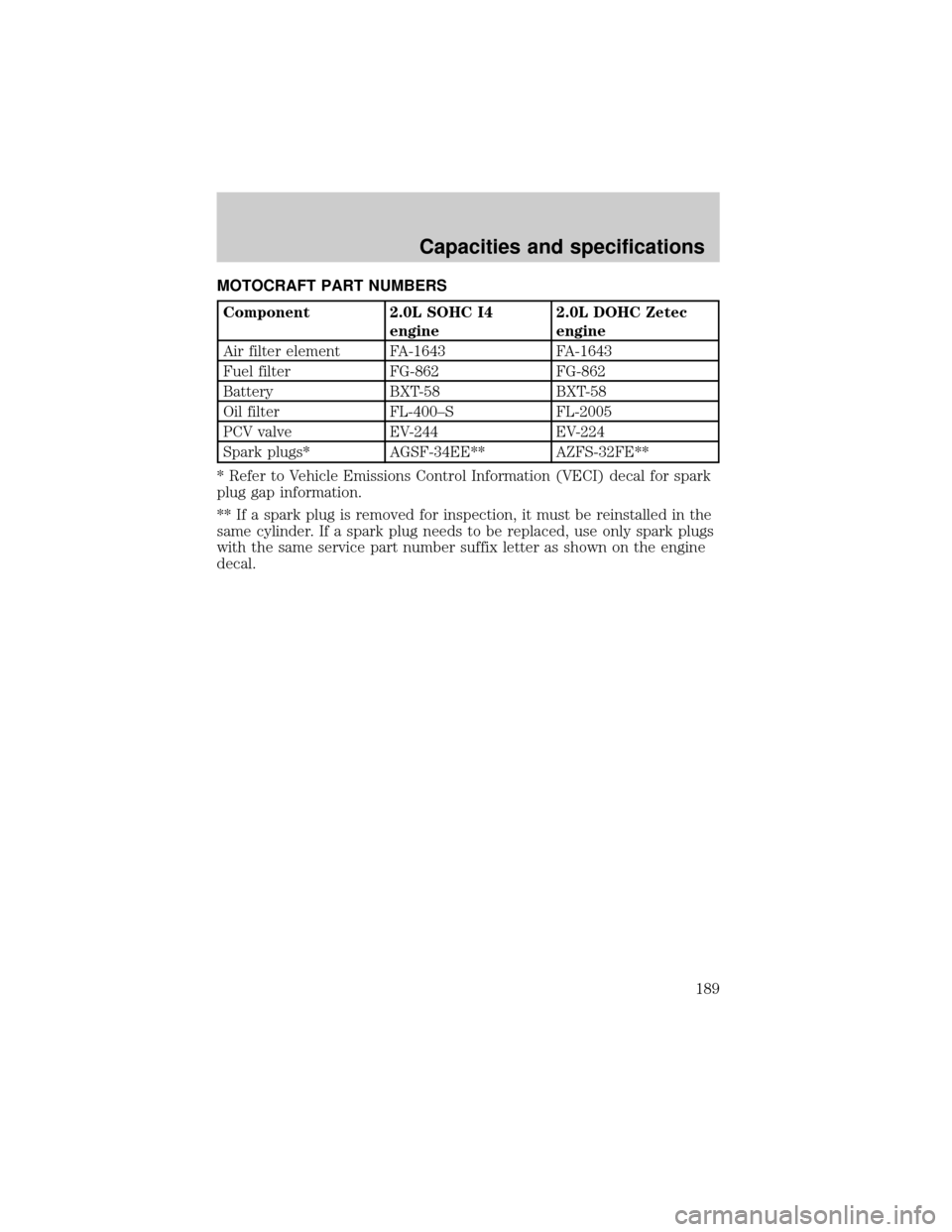
MOTOCRAFT PART NUMBERS
Component 2.0L SOHC I4
engine2.0L DOHC Zetec
engine
Air filter element FA-1643 FA-1643
Fuel filter FG-862 FG-862
Battery BXT-58 BXT-58
Oil filter FL-400±S FL-2005
PCV valve EV-244 EV-224
Spark plugs* AGSF-34EE** AZFS-32FE**
* Refer to Vehicle Emissions Control Information (VECI) decal for spark
plug gap information.
** If a spark plug is removed for inspection, it must be reinstalled in the
same cylinder. If a spark plug needs to be replaced, use only spark plugs
with the same service part number suffix letter as shown on the engine
decal.
Capacities and specifications
189
Page 190 of 216
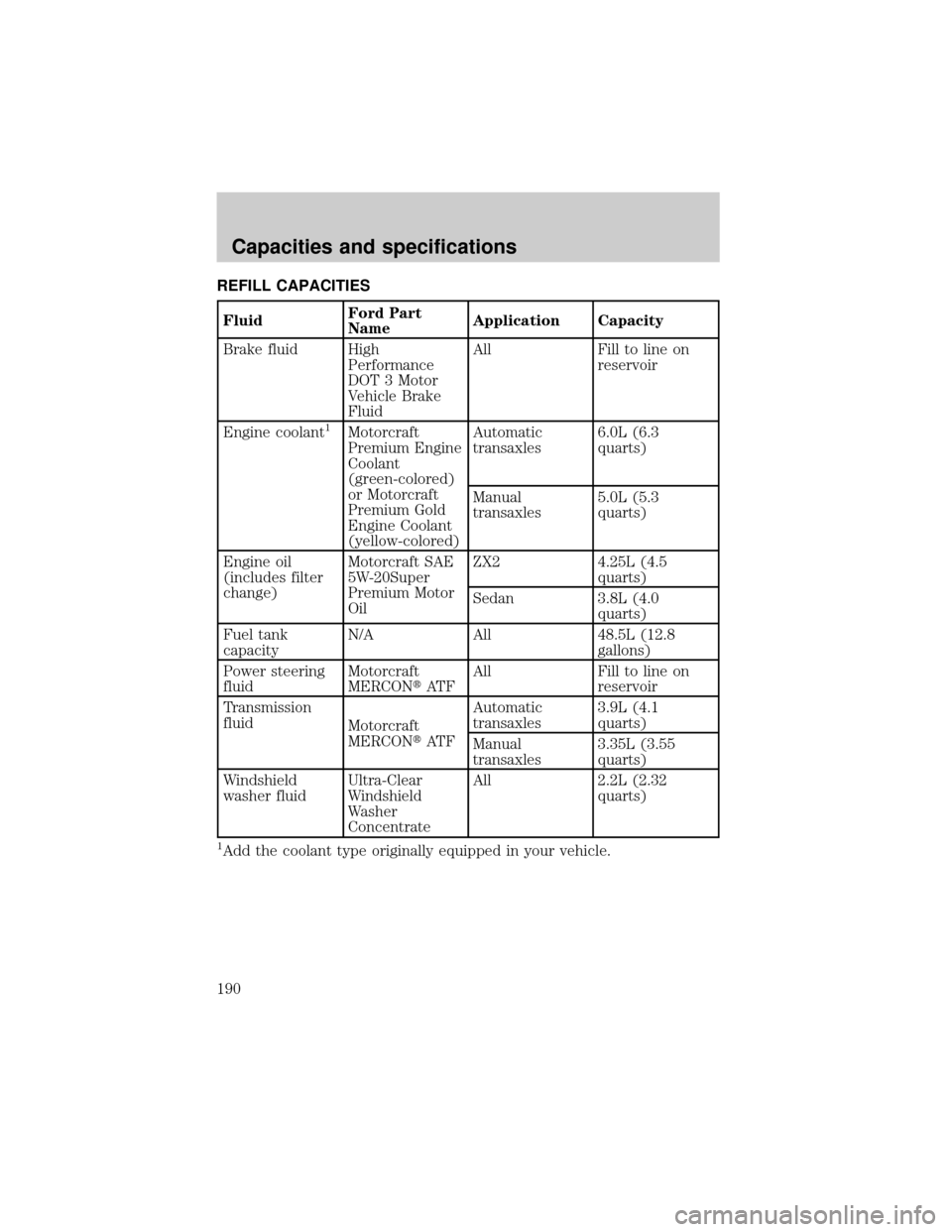
REFILL CAPACITIES
FluidFord Part
NameApplication Capacity
Brake fluid High
Performance
DOT 3 Motor
Vehicle Brake
FluidAll Fill to line on
reservoir
Engine coolant
1Motorcraft
Premium Engine
Coolant
(green-colored)
or Motorcraft
Premium Gold
Engine Coolant
(yellow-colored)Automatic
transaxles6.0L (6.3
quarts)
Manual
transaxles5.0L (5.3
quarts)
Engine oil
(includes filter
change)Motorcraft SAE
5W-20Super
Premium Motor
OilZX2 4.25L (4.5
quarts)
Sedan 3.8L (4.0
quarts)
Fuel tank
capacityN/A All 48.5L (12.8
gallons)
Power steering
fluidMotorcraft
MERCONtAT FAll Fill to line on
reservoir
Transmission
fluid
Motorcraft
MERCONtAT FAutomatic
transaxles3.9L (4.1
quarts)
Manual
transaxles3.35L (3.55
quarts)
Windshield
washer fluidUltra-Clear
Windshield
Washer
ConcentrateAll 2.2L (2.32
quarts)
1Add the coolant type originally equipped in your vehicle.
Capacities and specifications
190
Page 211 of 216

specifications ..................191±192
Exhaust fumes ............................97
F
Floor mats ...................................56
Fluid capacities .........................190
Foglamps .....................................45
Fuel ............................................166
calculating fuel economy .......171
cap .....................................12, 168
capacity ...................................190
choosing the right fuel ...........169
comparisons with EPA fuel
economy estimates .................174
detergent in fuel .....................170
filling your vehicle
with fuel ..................166, 168, 171
filter, specifications ........171, 189
fuel pump shut-off switch .....115
gauge .........................................14
improving fuel economy ........171
low fuel warning light ................8
octane rating ...........169, 192±193
quality ......................................170
running out of fuel .................170
safety information relating to
automotive fuels .....................166
Fuses ..................................117, 119
G
Gas cap (see Fuel cap) ......12, 168
Gas mileage (see Fuel
economy) ...................................171
Gauges .........................................13
engine coolant temperature
gauge .........................................14
fuel gauge ..................................14odometer ...................................15
speedometer .............................15
tachometer ................................16
trip odometer ............................16
GAWR (Gross Axle Weight
Rating) .......................................109
definition .................................109
driving with a heavy load ......109
location ....................................109
GVWR (Gross Vehicle Weight
Rating) .......................................109
calculating ...............................109
definition .................................109
driving with a heavy load ......109
location ....................................109
H
Hazard flashers .........................115
Head restraints ...........................65
Headlamps ...................................44
aiming ..............................181±183
bulb specifications ..................181
daytime running lights .............44
flash to pass ..............................45
high beam ...........................11, 45
replacing bulbs .......................176
turning on and off ....................44
warning chime ..........................13
Heating ........................................38
heater only system ...................38
heating and air conditioning
system .......................................40
Hood ..........................................138
I
Ignition .........................44, 192±193
Infant seats (see Safety seats) ..86
Index
211