2001 FORD ESCORT brakes
[x] Cancel search: brakesPage 113 of 216

²The trailer tongue weight should be 10% of the loaded trailer weight.
²After you have traveled 80 km (50 miles), thoroughly check your
hitch, electrical connections and trailer wheel lug nuts.
²When stopped in traffic for long periods of time in hot weather, place
the gearshift in P (Park) and increase idle speed. This aids engine
cooling and air conditioner efficiency.
²Vehicles with trailers should not be parked on a grade. If you must
park on a grade, place wheel chocks under the trailer's wheels.
Towing behind another vehicle
If your vehicle has an automatic transaxle, it cannot be flat-towed with
all wheels on the ground; front wheel dollies must be used.
If your vehicle has an manual transaxle, your vehicle can be flat-towed
with all wheels on the ground.
DRIVING THROUGH WATER
Do not drive quickly through standing water, especially if the depth is
unknown. Traction or brake capability may be limited and if the ignition
system gets wet, your engine may stall. Water may also enter your
engine's air intake and severely damage your engine.
If driving through deep or standing water is unavoidable, proceed very
slowly. Never drive through water that is higher than the bottom of the
hubs (for trucks) or the bottom of the wheel rims (for cars).
Once through the water, always try the brakes. Wet brakes do not stop
the vehicle as effectively as dry brakes. Drying can be improved by
moving your vehicle slowly while applying light pressure on the brake
pedal.
Driving through deep water where the transmission vent tube is
submerged may allow water into the transmission and cause
internal transmission damage.
LUGGAGE RACK (IF EQUIPPED)
Load the luggage as far back as safely possible on the rack without
exceeding the gross vehicle weight rating (GVWR) or the gross axle
weight rating (GAWR).
Use adjustable tie down loops to secure the load.
Driving
113
Page 145 of 216
Ford production and aftermarket (Motorcraft) oil filters are designed for
added engine protection and long life. If a replacement oil filter is used
that does not meet Ford material and design specifications, start-up
engine noises or knock may be experienced.
It is recommended you use the appropriate Motorcraft oil filter (or
another brand meeting Ford specifications) for your engine application.
BRAKE FLUID
Checking and adding brake fluid
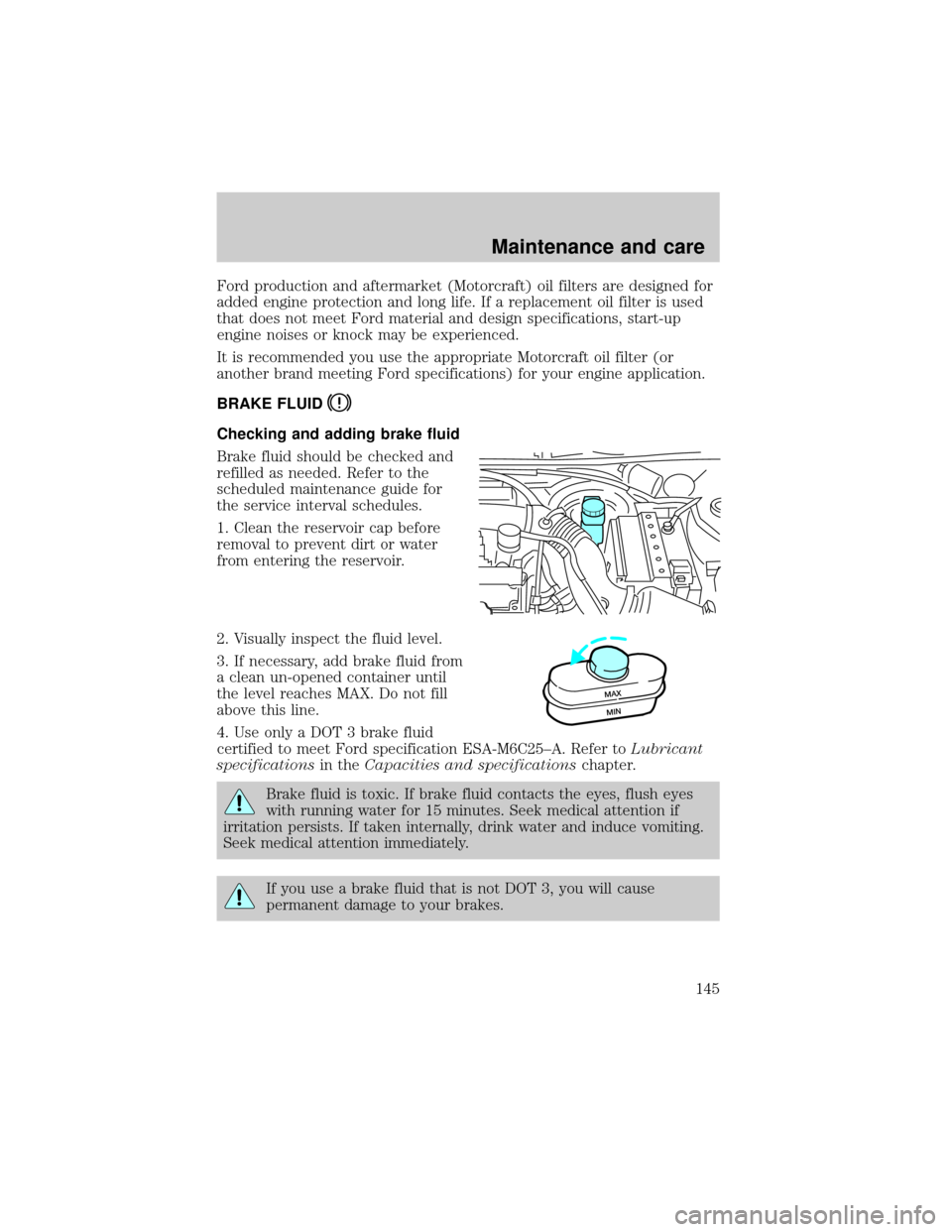
Brake fluid should be checked and
refilled as needed. Refer to the
scheduled maintenance guide for
the service interval schedules.
1. Clean the reservoir cap before
removal to prevent dirt or water
from entering the reservoir.
2. Visually inspect the fluid level.
3. If necessary, add brake fluid from
a clean un-opened container until
the level reaches MAX. Do not fill
above this line.
4. Use only a DOT 3 brake fluid
certified to meet Ford specification ESA-M6C25±A. Refer toLubricant
specificationsin theCapacities and specificationschapter.
Brake fluid is toxic. If brake fluid contacts the eyes, flush eyes
with running water for 15 minutes. Seek medical attention if
irritation persists. If taken internally, drink water and induce vomiting.
Seek medical attention immediately.
If you use a brake fluid that is not DOT 3, you will cause
permanent damage to your brakes.
MAX
MIN
Maintenance and care
145
Page 146 of 216
Do not let the fluid level in the reservoir for the master cylinder
fall below the MIN mark. If master cylinder runs dry, this may
cause the brakes to fail.
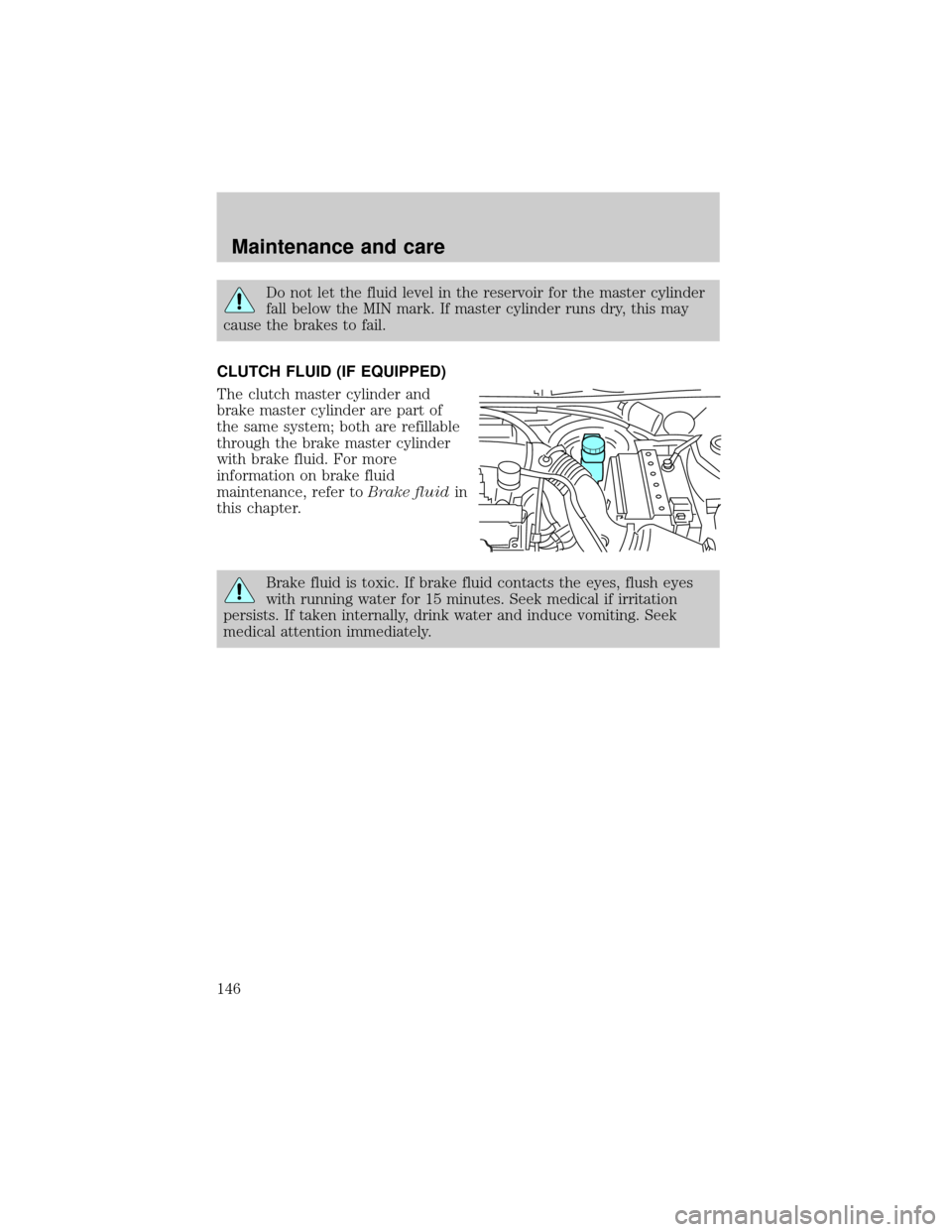
CLUTCH FLUID (IF EQUIPPED)
The clutch master cylinder and
brake master cylinder are part of
the same system; both are refillable
through the brake master cylinder
with brake fluid. For more
information on brake fluid
maintenance, refer toBrake fluidin
this chapter.
Brake fluid is toxic. If brake fluid contacts the eyes, flush eyes
with running water for 15 minutes. Seek medical if irritation
persists. If taken internally, drink water and induce vomiting. Seek
medical attention immediately.
Maintenance and care
146
Page 184 of 216
CLEANING AND CARING FOR YOUR VEHICLE
Refer to the Customer Assistance chapter for a list of Ford-approved
cleaners, polishes and waxes.
Washing your vehicle
Wash your vehicle regularly with
cold or lukewarm water. Never use
strong detergents or soap. If your
vehicle is particularly dirty, use a
quality car wash detergent. Always
use a clean sponge, washing glove
or similar device and plenty of water
for best results. To avoid spots,
avoid washing when the hood is still
warm, immediately after or during
exposure to strong sunlight.
During winter months, it is especially important to wash the vehicle on a
regular basis. Large quantities of dirt and road salt are difficult to
remove and also cause damage to the vehicle.
Any gasoline spilled on the vehicle or deposits such as bird droppings
should be washed and sponged off as soon as possible. Deposits not
removed promptly can cause damage to the vehicle's paintwork.
Remove any exterior accessories, such as antennas, before entering a car
wash. If you have wax applied to the vehicle at a commercial car wash, it
is recommended that you clean the wiper blades and windshield as
described inCleaning the wiper blades and windshield.
After washing, apply the brakes several times to dry them.
Underbody
Flush the complete underside of vehicle frequently. Keep body drain
holes unplugged. Inspect for road damage.
Waxing your vehicle
Waxing your vehicle on a regular basis will reduce minor scratches and
paint damage.
Wax when water stops beading on the surface. This could be every three
or four months, depending on operating conditions.
Maintenance and care
184
Page 209 of 216

A
Air bag supplemental restraint
system ....................................79±80
and child safety seats ..............82
description ................................80
disposal ......................................84
driver air bag ............................82
indicator light .....................10, 84
operation ...................................82
passenger air bag .....................82
Air cleaner filter .......159±160, 189
Air conditioning ..........................38
Antifreeze (see Engine
coolant) .....................................148
Anti-lock brake system (see
Brakes) ..................................98±99
Anti-theft system ........................62
arming the system ..............62±63
disarming a triggered
system .................................63±64
disarming an untriggered
system .......................................63
warning light .............................11
Audio system (see Radio) .........19
Automatic transaxle .................101
driving with .............................103
fluid, adding ............................154
fluid, checking ........................154
fluid, refill capacities ..............190
fluid, specification ..................192
Axle
lubricant specifications ..........191
B
Battery .......................................157
acid, treating emergencies .....157charging system warning
light ............................................11
jumping a disabled battery ....129
maintenance-free ....................157
replacement, specifications ...189
servicing ..................................157
Belt minder .................................75
Brakes ..........................................98
anti-lock ...............................98±99
anti-lock brake system
(ABS) warning light ...........11, 99
brake warning light ..................10
fluid, checking and adding ....145
fluid, refill capacities ..............190
fluid, specifications .........191±192
lubricant specifications ..191±192
parking ......................................99
shift interlock ..........................101
Break-in period .............................3
C
Capacities for refilling fluids ....190
Certification Label ....................194
Child safety restraints ................85
child safety belts ......................85
Child safety seats ........................86
attaching with tether straps ....90
in front seat ..............................88
in rear seat ................................88
Cleaning your vehicle ...............184
engine compartment ..............186
exterior ............................184±185
exterior lamps .........................186
instrument cluster lens ..........187
instrument panel ....................187
interior .............................187±188
mirrors .....................................185
plastic parts ............................185
Index
209
Page 212 of 216

Inspection/maintenance (I/M)
testing ........................................175
Instrument panel ..........................8
cleaning ...................................187
cluster ..................................8, 187
lighting up panel and
interior .......................................17
location of components ..............8
J
Jack ............................................125
positioning ...............................125
storage .....................................125
Jump-starting your vehicle ......129
K
Keys
key in ignition chime ...............13
positions of the ignition ...........44
L
Lamps
bulb replacement
specifications chart ................181
cargo lamps ...............................17
daytime running light ...............44
fog lamps ...................................45
headlamps .........................44, 176
headlamps, flash to pass ..........45
instrument panel, dimming .....17
interior lamps ...................53, 180
replacing bulbs .......176, 178±180
Lane change indicator (see
Turn signal) .................................46
Lights, warning and indicator ......8
air bag ........................................10
anti-lock brakes (ABS) ......11, 99anti-theft ...................................11
brake ..........................................10
charging system ........................11
fuel cap light .............................12
high beam .................................11
low fuel ........................................8
oil pressure ...............................12
safety belt .................................10
service engine soon ....................9
turn signal indicator .................11
Load limits .................................109
GAWR ......................................109
GVWR ......................................109
trailer towing ..........................109
Locks
childproof ..................................54
Lubricant specifications ...191±192
M
Manual transaxle
fluid capacities ........................190
lubricant specifications ..........192
reverse .....................................108
Mirrors
cleaning ...................................185
side view mirrors (power) .......18
Moon roof ....................................52
Motorcraft parts ................171, 189
O
Octane rating ............................169
Odometer .....................................15
Oil (see Engine oil) ..................142
Index
212