2001 FORD ESCAPE trailer
[x] Cancel search: trailerPage 179 of 280

Fuse/Relay
LocationFuse Amp
RatingPassenger Compartment Fuse
Panel Description
18 5A Illumination for: Cluster, Heater
Unit, Radio, Hazard Switch, Rear
Defrost Switch, 4WD Switch,
Front Fog Switch
19 10A Subwoofer Amp
20 15A Left/Right Turn Indicators,
Left/Right Front Side Turn Lamps,
Left/Right Front turn Lamps,
Left/Right Rear Turn Lamps,
Left/Right Trailer Turn, Flasher
Unit
21 10A Left /Right Trailer Position Lamps
22 15A Not Used
23 15A Left/Right Horn
24 15A Left/Right Stoplamps, High
Mounted Stoplamp, Left/Right
Trailer Stoplamp, ABS Unit, ASC
Unit (Brake Pedal Position
Switch), PCM, Shift Solenoid
25 30A Power Window Motor - Right
Front, Left Front, Right Rear, Left
Rear
26 30A Power Door Lock Motor - Right
Front, Left Front, Right Rear, Left
Rear, GEM (Door Lock Relay
Coil), Power Seat
27 10A Audio, Cluster, Interior Lamp,
Map Lamp Cargo Lamp
ACC Ð Accessory Relay
Roadside emergencies
179
Page 184 of 280
It is not recommended that the vehicle be operated in 4WD modes with
a temporary spare. If 4WD operation is necessary, do not operate above
speeds of 16 km/h (10 mph) or for distances above 80 km (50 miles).
If you use the temporary spare tire continuously or do not follow
these precautions, the tire could fail, causing you to lose control
of the vehicle, possibly injuring yourself or others.
When driving with the temporary spare tiredo not:
²exceed 80 km/h (50 mph) under any circumstances
²load the vehicle beyond maximum vehicle load rating listed on the
Safety Compliance Label
²tow a trailer
²use tire chains
²drive through an automatic car wash, because of the vehicle's reduced
ground clearance
²try to repair the temporary spare tire or remove it from its wheel rim
²use the wheel for any other type of vehicle
Tire change procedure
When one of the front wheels is off the ground, the transmission
alone will not prevent the vehicle from moving or slipping off the
jack, even if the vehicle is in P (Park) (automatic transaxle) or R
(Reverse) (manual transaxle).
To prevent the vehicle from moving when you change a tire, be
sure the parking brake is set, then block (in both directions) the
wheel that is diagonally opposite (other side and end of the vehicle) to
the tire being changed.
If the vehicle slips off the jack, you or someone else could be
seriously injured.
Roadside emergencies
184
Page 194 of 280
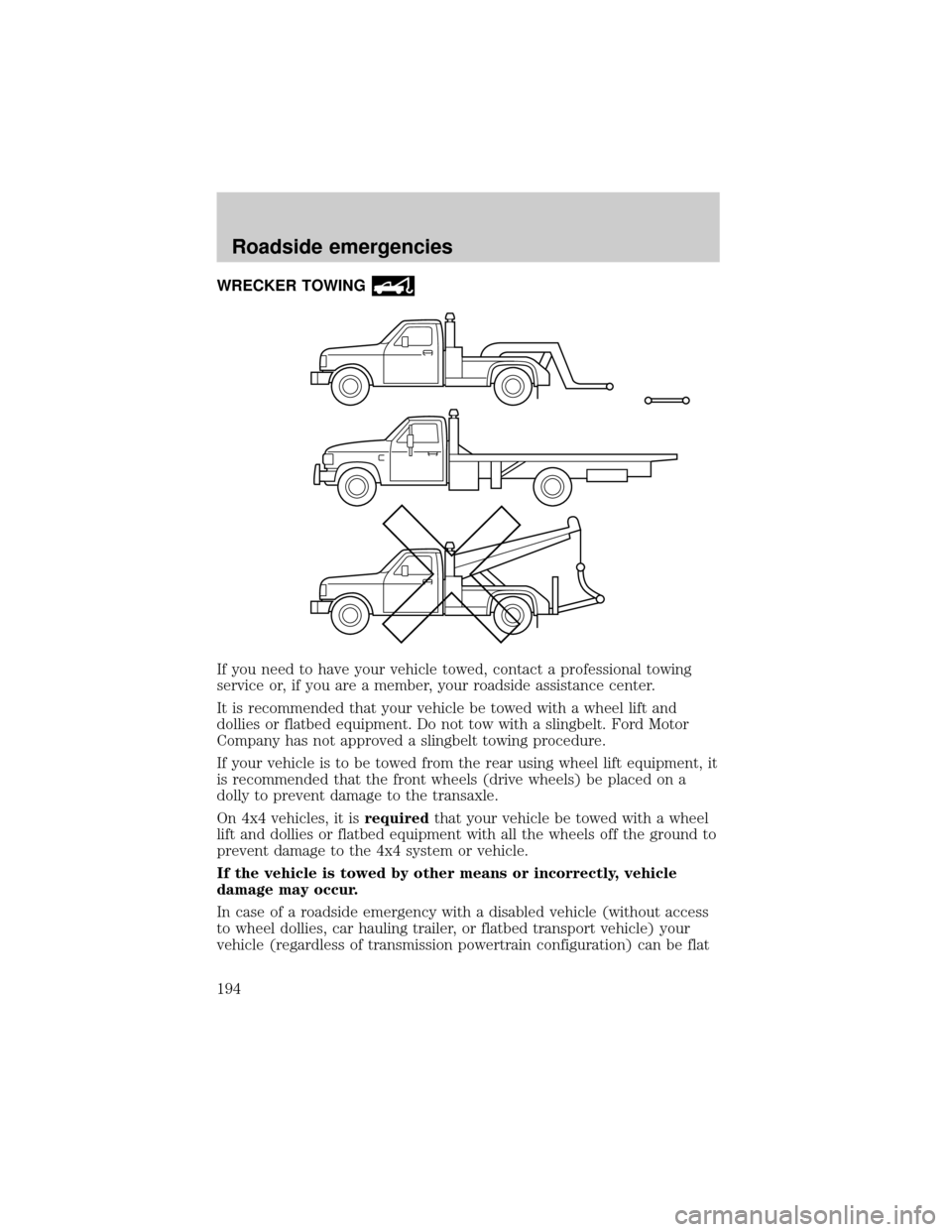
WRECKER TOWING
If you need to have your vehicle towed, contact a professional towing
service or, if you are a member, your roadside assistance center.
It is recommended that your vehicle be towed with a wheel lift and
dollies or flatbed equipment. Do not tow with a slingbelt. Ford Motor
Company has not approved a slingbelt towing procedure.
If your vehicle is to be towed from the rear using wheel lift equipment, it
is recommended that the front wheels (drive wheels) be placed on a
dolly to prevent damage to the transaxle.
On 4x4 vehicles, it isrequiredthat your vehicle be towed with a wheel
lift and dollies or flatbed equipment with all the wheels off the ground to
prevent damage to the 4x4 system or vehicle.
If the vehicle is towed by other means or incorrectly, vehicle
damage may occur.
In case of a roadside emergency with a disabled vehicle (without access
to wheel dollies, car hauling trailer, or flatbed transport vehicle) your
vehicle (regardless of transmission powertrain configuration) can be flat
Roadside emergencies
194
Page 214 of 280

5. If the fluid is low, add fluid in small amounts, continuously checking
the level until it reaches the range between the MIN and MAX lines. Be
sure to put the cap back on the reservoir.
TRANSMISSION FLUID
Checking automatic transmission fluid (if equipped)
Refer to your scheduled maintenance guide for scheduled intervals for
fluid checks and changes. Your transaxle does not consume fluid.
However, the fluid level should be checked if the transaxle is not working
properly, i.e., if the transaxle slips or shifts slowly or if you notice some
sign of fluid leakage.
Automatic transmission fluid expands when warmed. To obtain an
accurate fluid check, drive the vehicle until it is warmed up
(approximately 30 km [20 miles]). If your vehicle has been
operated for an extended period at high speeds, in city traffic
during hot weather or pulling a trailer, the vehicle should be
turned off for about 30 minutes to allow fluid to cool before
checking.
1. Drive the vehicle 30 km (20 miles) or until it reaches normal operating
temperature.
2. Park the vehicle on a level surface and engage the parking brake.
3. With the parking brake engaged and your foot on the brake pedal,
start the engine and move the gearshift lever through all of the gear
ranges. Allow sufficient time for each gear to engage.
4. Latch the gearshift lever in P (Park) and leave the engine running.
5. Remove the dipstick, wiping it clean with a clean, dry lint free rag. If
necessary, refer toIdentifying components in the engine compartment
in this chapter for the location of the dipstick.
6. Install the dipstick making sure it is fully seated in the filler tube.
7. Remove the dipstick and inspect the fluid level. The fluid should be in
the crosshatch zone for normal operating temperature.
Low fluid level
Do not drive the vehicle if the fluid
level is at the bottom of the dipstick
and the outside temperatures are
above 10ÉC (50ÉF).
Maintenance and care
214
Page 232 of 280

²Idling for long periods of time (greater than one minute) may waste
fuel.
²Anticipate stopping; slowing down may eliminate the need to stop.
²Sudden or hard accelerations may reduce fuel economy.
²Slow down gradually.
²Driving at reasonable speeds (traveling at 88 km/h [55 mph] uses 15%
less fuel than traveling at 105 km/h [65 mph]).
²Revving the engine before turning it off may reduce fuel economy.
²Using the air conditioner or defroster may reduce fuel economy.
²You may want to turn off the speed control in hilly terrain if
unnecessary shifting between third and fourth gear occurs.
Unnecessary shifting of this type could result in reduced fuel
economy.
²Warming up a vehicle on cold mornings is not required and may
reduce fuel economy.
²Resting your foot on the brake pedal while driving may reduce fuel
economy.
²Combine errands and minimize stop-and-go driving.
Maintenance
²Keep tires properly inflated and use only recommended size.
²Operating a vehicle with the wheels out of alignment will reduce fuel
economy.
²Perform all regularly scheduled maintenance items. Follow the
recommended maintenance schedule and owner maintenance checks
found in your vehicle scheduled maintenance guide.
Conditions
²Heavily loading a vehicle or towing a trailer may reduce fuel economy
at any speed.
²Carrying unnecessary weight may reduce fuel economy (approximately
0.4 km/L [1 mpg] is lost for every 180 kg [400 lb] of weight carried).
²Adding certain accessories to your vehicle (for example bug
deflectors, rollbars/light bars, running boards, ski/luggage racks) may
reduce fuel economy.
²Using fuel blended with alcohol may lower fuel economy.
Maintenance and care
232
Page 265 of 280

Engine block heaters
Floor cargo net
Tire step
Travel equipment
Auto headlamps with DRL (Daytime Running Lights)
Console
Daytime running lights
Factory luggage rack adaptors
Fog lights
Framed luggage covers
Heavy-duty battery
Hitch mounted bike rack
Interior mount bike rack
Mirror I/S electrochromic compass with and without temperature display
Pet guard
Removable luggage rack (Track riders)
Removable luggage rack adapters
Reverse parking aid
Running boards and running bars
Soft luggage cover
Speed control
Trailer hitch (Class II)
Trailer hitch bars and balls
Trailer hitch wiring adaptor
Customer assistance
265
Page 274 of 280

Load limits .................................155
GAWR ......................................155
GVWR ......................................155
trailer towing ..........................155
Loading instructions .................156
Locks
childproof ..................................84
Lubricant specifications ...250, 252
Lumbar support, seats .............100
M
Manual transaxle
fluid, checking and adding ....216
Manual transmission
fluid capacities ........................247
lubricant specifications ..........252
Mirrors
cleaning ...................................246
fold away ...................................20
side view mirrors (power) .......19
Moon roof ....................................79
Motorcraft parts ................230, 247
O
Octane rating ............................227
Odometer .....................................18
Off-Road Driving .......................152
Oil (see Engine oil) ..................201
Overdrive ...................................146
P
Panic alarm feature, remote
entry system ................................90
Parking brake ............................143Parts (see Motorcraft parts) ....247
Power distribution box (see
Fuses) ........................................180
Power door locks ........................84
Power steering ..........................144
fluid, checking and adding ....213
fluid, refill capacity ................247
fluid, specifications .........250, 252
Preparing to drive your
vehicle ........................................145
R
Radio ............................................26
Rear window defroster ...............20
Relays ........................................176
Remote entry system ...........89±90
illuminated entry ......................92
locking/unlocking doors ...........90
panic alarm ...............................90
replacement/additional
transmitters ...............................91
replacing the batteries .............91
Roof rack ...................................162
S
Safety belts (see Safety
restraints) ....................15, 107±111
Safety defects, reporting ..........269
Safety restraints ................107±111
belt minder .............................113
cleaning the safety
belts .................................117, 246
extension assembly ................112
for adults .........................108±110
for children .............................127
lap belt ....................................112
Index
274
Page 275 of 280

warning light and
chime ...........................12, 15, 113
Safety seats for children ..........128
Seat belts (see Safety
restraints) ..................................107
Seats ............................................98
child safety seats ....................128
cleaning ...................................245
SecuriLock passive anti-theft
system ....................................93±94
Servicing your vehicle ..............196
Snowplowing .................................5
Spark plugs,
specifications .....................247, 252
Special notice ................................4
ambulance conversions ..............5
utility-type vehicles ....................4
Specification chart,
lubricants ...........................250, 252
Speed control ..............................73
Speedometer ...............................17
Starting your vehicle ........137, 139
jump starting ..........................188
Steering wheel
controls ......................................73
T
Tachometer .................................17
Temperature control (see
Climate control) ..........................21
Tires ...........................183, 219±221
changing ..........................183±184
checking the pressure ............221
replacing ..................................223rotating ....................................221
snow tires and chains ............223
tire grades ...............................220
treadwear ................................220
Towing .......................................157
recreational towing .................161
trailer towing ..........................157
wrecker ....................................194
Transaxle
automatic operation ...............146
fluid, checking and adding
(manual) .................................216
Transmission
fluid, checking and adding
(automatic) .............................214
fluid, refill capacities ..............247
lubricant specifications ..250, 252
Turn signal ............................12, 71
V
Vehicle dimensions ...................252
Vehicle Identification Number
(VIN) ..........................................254
Vehicle loading ..........................155
Ventilating your vehicle ...........141
W
Warning chimes ...........................15
Warning lights (see Lights) .......10
Washer fluid ..............................206
Water, Driving through .............157
Windows
power .........................................82
rear wiper/washer .....................77
Index
275