2001 FORD CROWN VICTORIA brake light
[x] Cancel search: brake lightPage 157 of 248
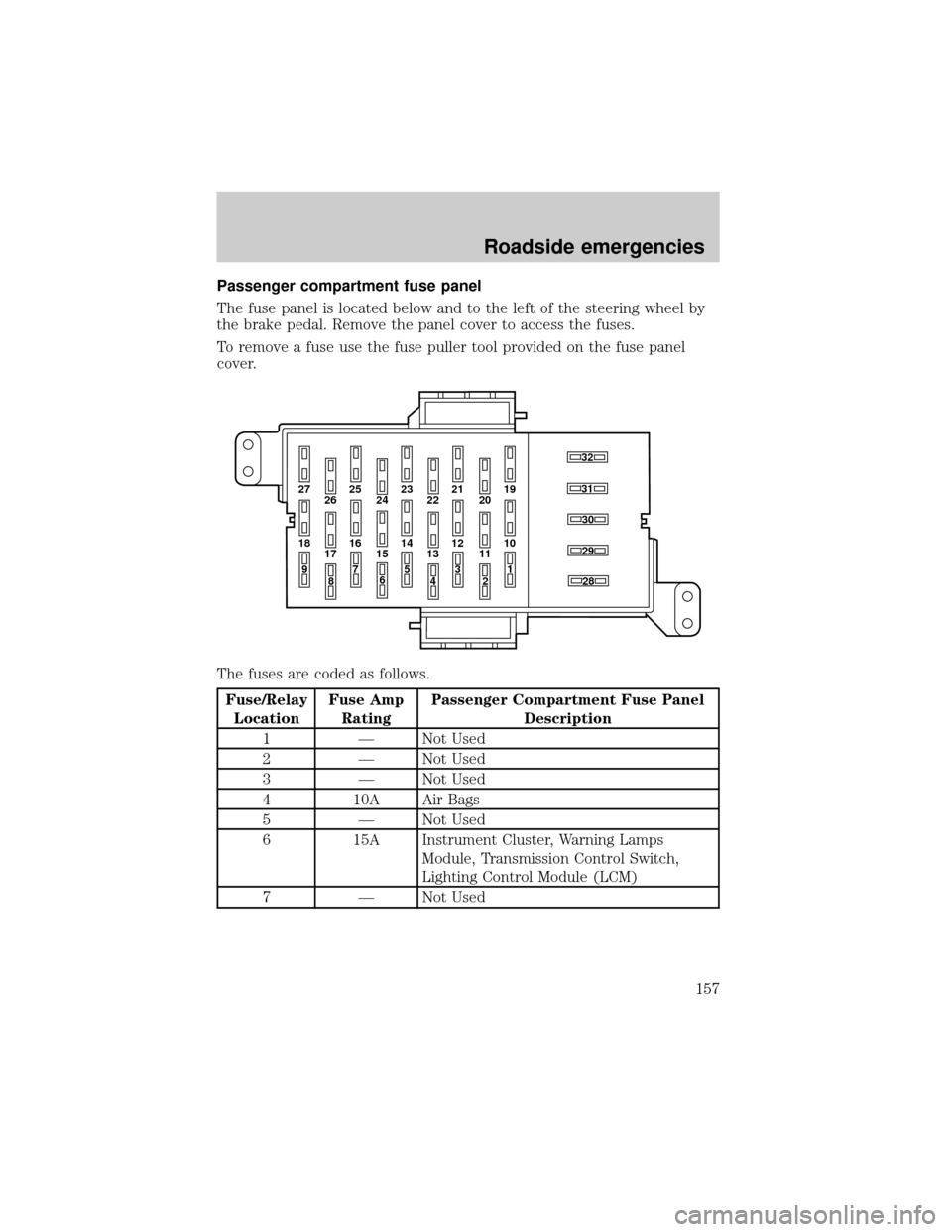
Passenger compartment fuse panel
The fuse panel is located below and to the left of the steering wheel by
the brake pedal. Remove the panel cover to access the fuses.
To remove a fuse use the fuse puller tool provided on the fuse panel
cover.
The fuses are coded as follows.
Fuse/Relay
LocationFuse Amp
RatingPassenger Compartment Fuse Panel
Description
1 Ð Not Used
2 Ð Not Used
3 Ð Not Used
4 10A Air Bags
5 Ð Not Used
6 15A Instrument Cluster, Warning Lamps
Module, Transmission Control Switch,
Lighting Control Module (LCM)
7 Ð Not Used
27 25
26 2423 21
2219
20
18 16
17 1514 12
131030
32
31
28
29
11
97
8653
41
2
Roadside emergencies
157
Page 158 of 248
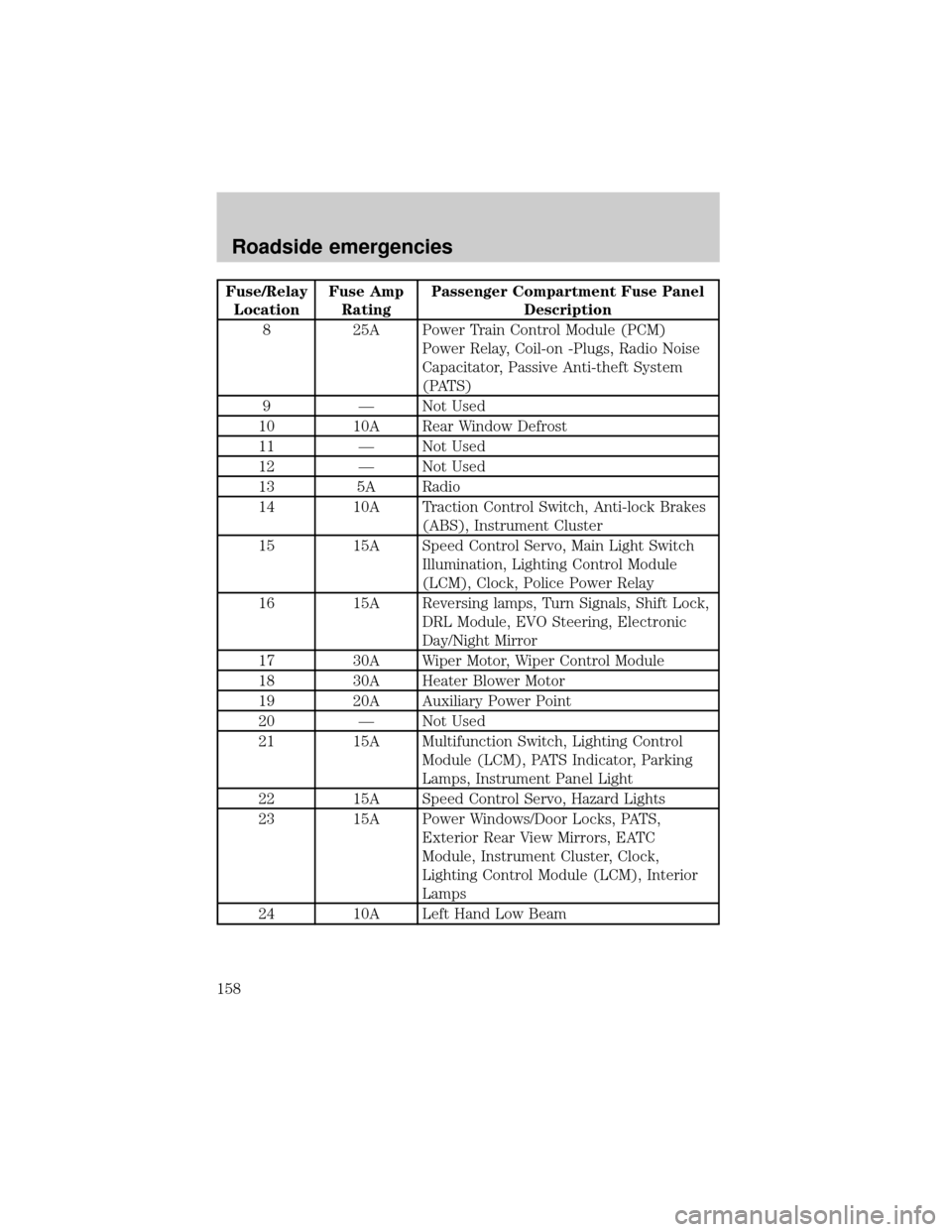
Fuse/Relay
LocationFuse Amp
RatingPassenger Compartment Fuse Panel
Description
8 25A Power Train Control Module (PCM)
Power Relay, Coil-on -Plugs, Radio Noise
Capacitator, Passive Anti-theft System
(PATS)
9 Ð Not Used
10 10A Rear Window Defrost
11 Ð Not Used
12 Ð Not Used
13 5A Radio
14 10A Traction Control Switch, Anti-lock Brakes
(ABS), Instrument Cluster
15 15A Speed Control Servo, Main Light Switch
Illumination, Lighting Control Module
(LCM), Clock, Police Power Relay
16 15A Reversing lamps, Turn Signals, Shift Lock,
DRL Module, EVO Steering, Electronic
Day/Night Mirror
17 30A Wiper Motor, Wiper Control Module
18 30A Heater Blower Motor
19 20A Auxiliary Power Point
20 Ð Not Used
21 15A Multifunction Switch, Lighting Control
Module (LCM), PATS Indicator, Parking
Lamps, Instrument Panel Light
22 15A Speed Control Servo, Hazard Lights
23 15A Power Windows/Door Locks, PATS,
Exterior Rear View Mirrors, EATC
Module, Instrument Cluster, Clock,
Lighting Control Module (LCM), Interior
Lamps
24 10A Left Hand Low Beam
Roadside emergencies
158
Page 191 of 248
Batteries normally produce explosive gases which can cause
personal injury. Therefore, do not allow flames, sparks or lighted
substances to come near the battery. When working near the battery,
always shield your face and protect your eyes. Always provide proper
ventilation.
When lifting a plastic-cased battery, excessive pressure on the
end walls could cause acid to flow through the vent caps,
resulting in personal injury and/or damage to the vehicle or battery.
Lift the battery with a battery carrier or with your hands on opposite
corners.
Keep batteries out of reach of children. Batteries contain sulfuric
acid. Avoid contact with skin, eyes or clothing. Shield your eyes
when working near the battery to protect against possible splashing of
acid solution. In case of acid contact with skin or eyes, flush
immediately with water for a minimum of 15 minutes and get prompt
medical attention. If acid is swallowed, call a physician immediately.
Battery posts, terminals and related accessories contain lead and
lead compounds.Wash hands after handling.
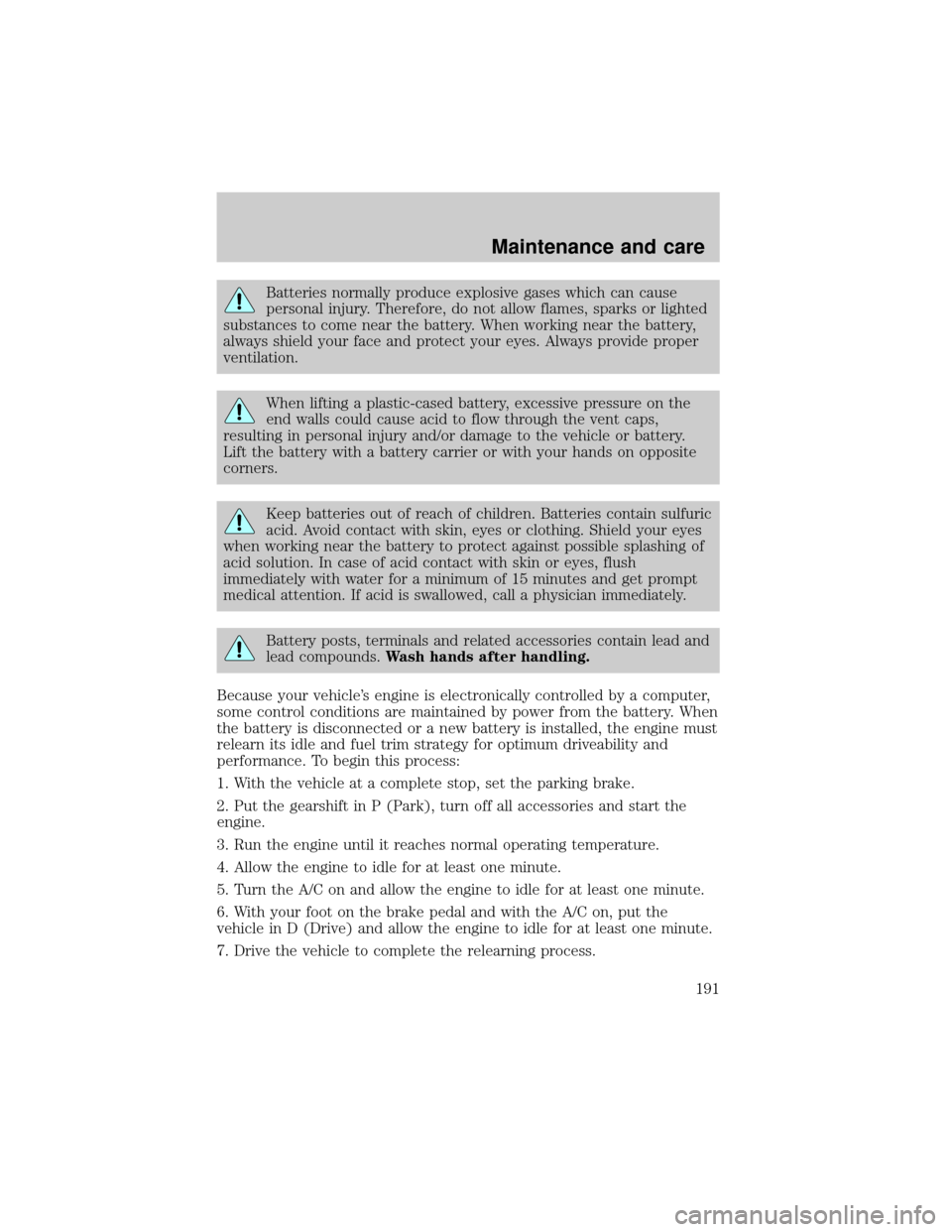
Because your vehicle's engine is electronically controlled by a computer,
some control conditions are maintained by power from the battery. When
the battery is disconnected or a new battery is installed, the engine must
relearn its idle and fuel trim strategy for optimum driveability and
performance. To begin this process:
1. With the vehicle at a complete stop, set the parking brake.
2. Put the gearshift in P (Park), turn off all accessories and start the
engine.
3. Run the engine until it reaches normal operating temperature.
4. Allow the engine to idle for at least one minute.
5. Turn the A/C on and allow the engine to idle for at least one minute.
6. With your foot on the brake pedal and with the A/C on, put the
vehicle in D (Drive) and allow the engine to idle for at least one minute.
7. Drive the vehicle to complete the relearning process.
Maintenance and care
191
Page 206 of 248
![FORD CROWN VICTORIA 2001 2.G Owners Manual ²Sudden or hard accelerations may reduce fuel economy.
²Slow down gradually.
²Driving at reasonable speeds (traveling at 88 km/h [55 mph] uses 15%
less fuel than traveling at 105 km/h [65 mph]).
²](/manual-img/11/4777/w960_4777-205.png "FORD CROWN VICTORIA 2001 2.G Owners Manual ²Sudden or hard accelerations may reduce fuel economy.
²Slow down gradually.
²Driving at reasonable speeds (traveling at 88 km/h [55 mph] uses 15%
less fuel than traveling at 105 km/h [65 mph]).
²")
²Sudden or hard accelerations may reduce fuel economy.
²Slow down gradually.
²Driving at reasonable speeds (traveling at 88 km/h [55 mph] uses 15%
less fuel than traveling at 105 km/h [65 mph]).
²Revving the engine before turning it off may reduce fuel economy.
²Using the air conditioner or defroster may reduce fuel economy.
²
You may want to turn off the speed control in hilly terrain if
unnecessary shifting between third and fourth gear occurs. Unnecessary
shifting of this type could result in reduced fuel economy.
²Warming up a vehicle on cold mornings is not required and may
reduce fuel economy.
²Resting your foot on the brake pedal while driving may reduce fuel
economy.
²Combine errands and minimize stop-and-go driving.
Maintenance
²Keep tires properly inflated and use only recommended size.
²Operating a vehicle with the wheels out of alignment will reduce fuel
economy.
²Perform all regularly scheduled maintenance items. Follow the
recommended maintenance schedule and owner maintenance checks
found in your vehicle scheduled maintenance guide.
Conditions
²Heavily loading a vehicle or towing a trailer may reduce fuel economy
at any speed.
²Carrying unnecessary weight may reduce fuel economy (approximately
0.4 km/L [1 mpg] is lost for every 180 kg [400 lb] of weight carried).
²Adding certain accessories to your vehicle (for example bug
deflectors, rollbars/light bars, running boards, ski/luggage racks) may
reduce fuel economy.
²Using fuel blended with alcohol may lower fuel economy.
²Fuel economy may decrease with lower temperatures during the first
12±16 km (8±10 miles) of driving.
²Driving on flat terrain offers improved fuel economy as compared to
driving on hilly terrain.
Maintenance and care
206
Page 214 of 248
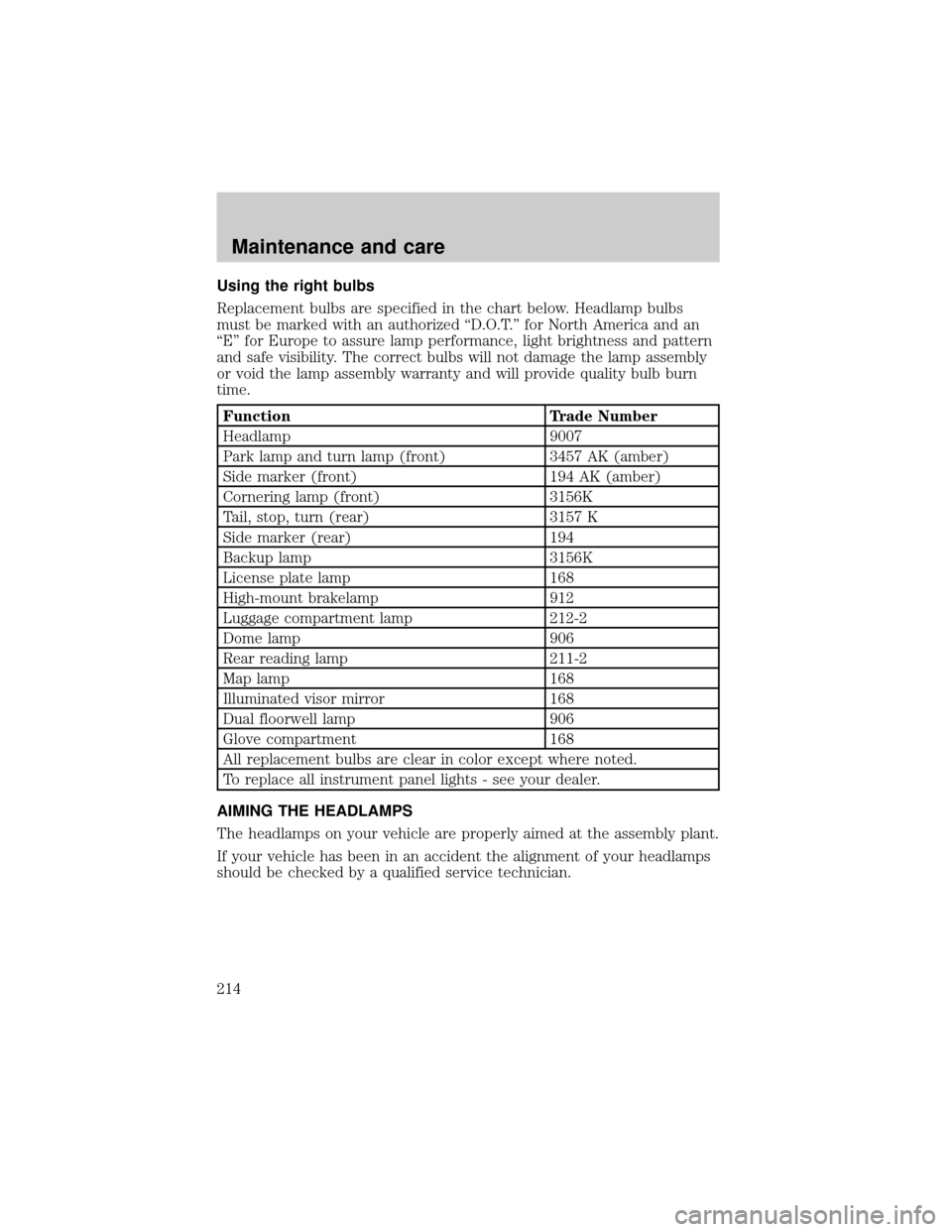
Using the right bulbs
Replacement bulbs are specified in the chart below. Headlamp bulbs
must be marked with an authorized ªD.O.T.º for North America and an
ªEº for Europe to assure lamp performance, light brightness and pattern
and safe visibility. The correct bulbs will not damage the lamp assembly
or void the lamp assembly warranty and will provide quality bulb burn
time.
Function Trade Number
Headlamp 9007
Park lamp and turn lamp (front) 3457 AK (amber)
Side marker (front) 194 AK (amber)
Cornering lamp (front) 3156K
Tail, stop, turn (rear) 3157 K
Side marker (rear) 194
Backup lamp 3156K
License plate lamp 168
High-mount brakelamp 912
Luggage compartment lamp 212-2
Dome lamp 906
Rear reading lamp 211-2
Map lamp 168
Illuminated visor mirror 168
Dual floorwell lamp 906
Glove compartment 168
All replacement bulbs are clear in color except where noted.
To replace all instrument panel lights - see your dealer.
AIMING THE HEADLAMPS
The headlamps on your vehicle are properly aimed at the assembly plant.
If your vehicle has been in an accident the alignment of your headlamps
should be checked by a qualified service technician.
Maintenance and care
214
Page 215 of 248
CLEANING AND CARING FOR YOUR VEHICLE
Refer to the Customer Assistance chapter for a list of Ford-approved
cleaners, polishes and waxes.
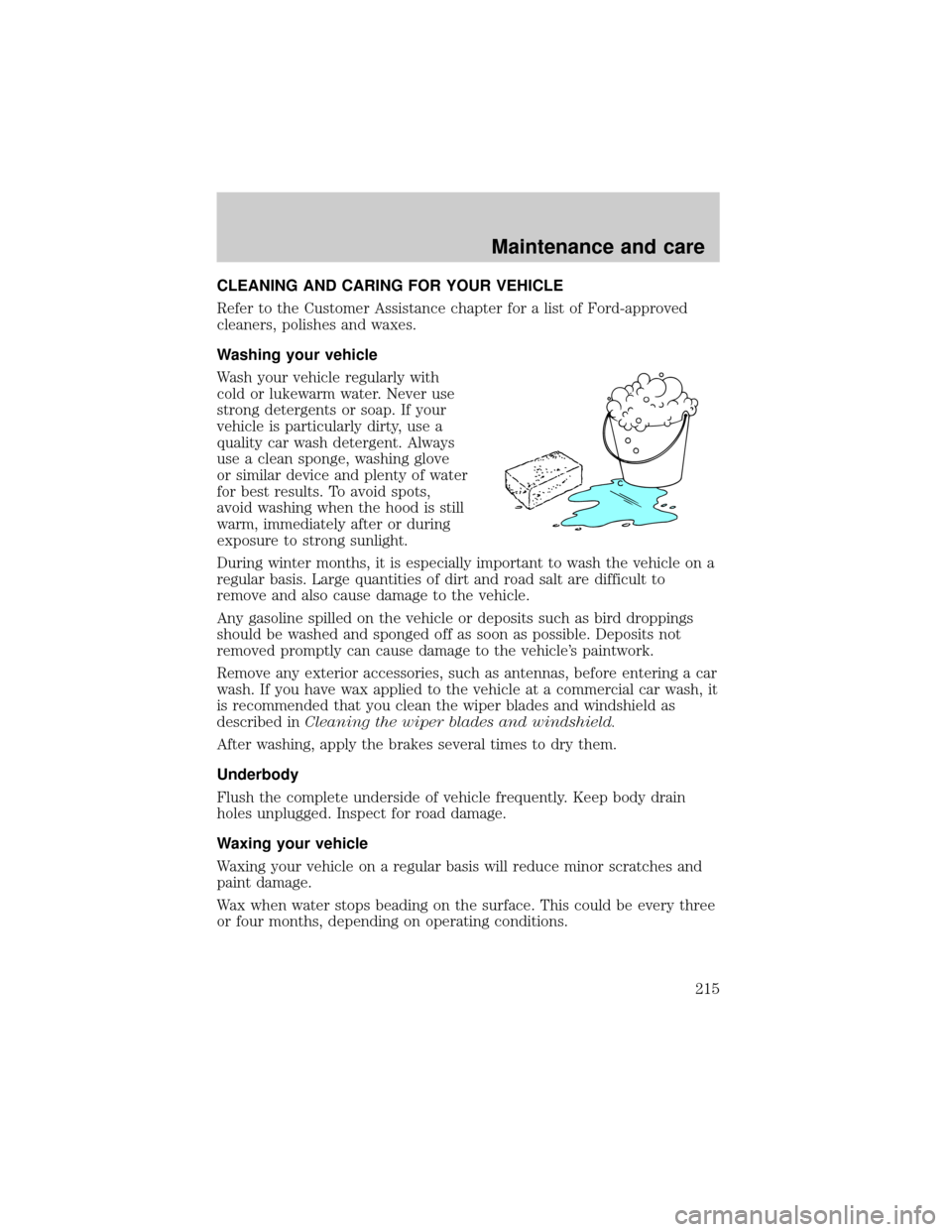
Washing your vehicle
Wash your vehicle regularly with
cold or lukewarm water. Never use
strong detergents or soap. If your
vehicle is particularly dirty, use a
quality car wash detergent. Always
use a clean sponge, washing glove
or similar device and plenty of water
for best results. To avoid spots,
avoid washing when the hood is still
warm, immediately after or during
exposure to strong sunlight.
During winter months, it is especially important to wash the vehicle on a
regular basis. Large quantities of dirt and road salt are difficult to
remove and also cause damage to the vehicle.
Any gasoline spilled on the vehicle or deposits such as bird droppings
should be washed and sponged off as soon as possible. Deposits not
removed promptly can cause damage to the vehicle's paintwork.
Remove any exterior accessories, such as antennas, before entering a car
wash. If you have wax applied to the vehicle at a commercial car wash, it
is recommended that you clean the wiper blades and windshield as
described inCleaning the wiper blades and windshield.
After washing, apply the brakes several times to dry them.
Underbody
Flush the complete underside of vehicle frequently. Keep body drain
holes unplugged. Inspect for road damage.
Waxing your vehicle
Waxing your vehicle on a regular basis will reduce minor scratches and
paint damage.
Wax when water stops beading on the surface. This could be every three
or four months, depending on operating conditions.
Maintenance and care
215
Page 241 of 248

A
Air bag supplemental restraint
system ........................................121
and child safety seats ............123
description ..............................121
disposal ....................................125
driver air bag ..........................123
indicator light ...................10, 125
operation .................................123
passenger air bag ...................123
Air cleaner filter ...............192, 220
Air conditioning ..........................29
automatic temperature
control system ..........................32
Air suspension ...........................142
description ..............................142
warning light .............................13
Antifreeze (see Engine
coolant) .....................................179
Anti-lock brake system
(see Brakes) ......................138±139
Audio system (see Radio) .........38
Automatic transmission
driving an automatic
overdrive .................................144
fluid, adding ............................187
fluid, checking ........................187
fluid, refill capacities ..............221
fluid, specification ..................224
Auxiliary power point ...........72, 88
Axle
lubricant specifications ..223±224
refill capacities ........................221
traction lok ..............................147B
Battery .......................................190
acid, treating emergencies .....190
charging system
warning light .............................13
jumping a disabled battery ....165
maintenance-free ....................190
replacement, specifications ...220
servicing ..................................190
voltage gauge ............................21
Belt minder ...............................117
Brakes ........................................138
anti-lock ...........................138±139
anti-lock brake system
(ABS) warning light .........12, 139
brake warning light ..................12
fluid, checking and adding ....178
fluid, refill capacities ..............221
fluid, specifications .........223±224
lubricant specifications ..223±224
pedals (see Power adjustable
foot pedals) ...............................71
shift interlock ..........................143
Break-in period .............................3
C
Capacities for refilling fluids ....221
Cassette tape player ...................57
CD changer .................................67
Certification Label ....................226
Child safety restraints ..............126
child safety belts ....................126
Child safety seats ......................127
attaching with tether straps ..132
in front seat ............................129
in rear seat ......................129, 131
Index
241
Page 244 of 248

Headlamps ...................................27
aiming ......................................214
autolamp system .......................28
bulb specifications ..................214
daytime running lights .............27
flash to pass ..............................28
high beam ...........................12, 28
replacing bulbs .......................209
turning on and off ....................27
warning chime ..........................16
Heating ........................................29
heating and air conditioning
system .......................................29
HomeLink universal
transceiver (see Garage door
opener) ..................................79±82
Hood ..........................................173
I
Ignition .........................73, 224±225
Infant seats
(see Safety seats) .....................127
Inspection/maintenance (I/M)
testing ........................................208
Instrument panel
cleaning ...................................218
cluster ..................................8, 218
lighting up panel
and interior ...............................27
location of components ..............8
J
Jack ............................................161
positioning ...............................161
storage .....................................161
Jump-starting your vehicle ......165K
Keyless entry system .................98
autolock .....................................91
keypad .......................................98
programming entry code .........99
Keys .......................................95±97
key in ignition chime ...............16
positions of the ignition ...........73
L
Lamps
autolamp system .......................28
bulb replacement
specifications chart ................214
cargo lamps ...............................27
daytime running light ...............27
headlamps .................................27
headlamps, flash to pass ..........28
instrument panel, dimming .....27
interior lamps ...................27, 213
replacing bulbs ...............209±213
Lane change indicator
(see Turn signal) ........................72
Lights, warning and indicator ......8
air bag ........................................10
air suspension ...........................13
anti-lock brakes (ABS) ....12, 139
brake ..........................................12
charging system ........................13
check engine ...............................9
fuel cap light .............................10
high beam .................................12
low coolant ................................11
low fuel ........................................8
oil pressure ...............................13
overdrive off ..............................14
safety belt .................................11
speed control ............................79
Index
244