2001 DODGE RAM Valve
[x] Cancel search: ValvePage 1617 of 2889
INSTALLATION
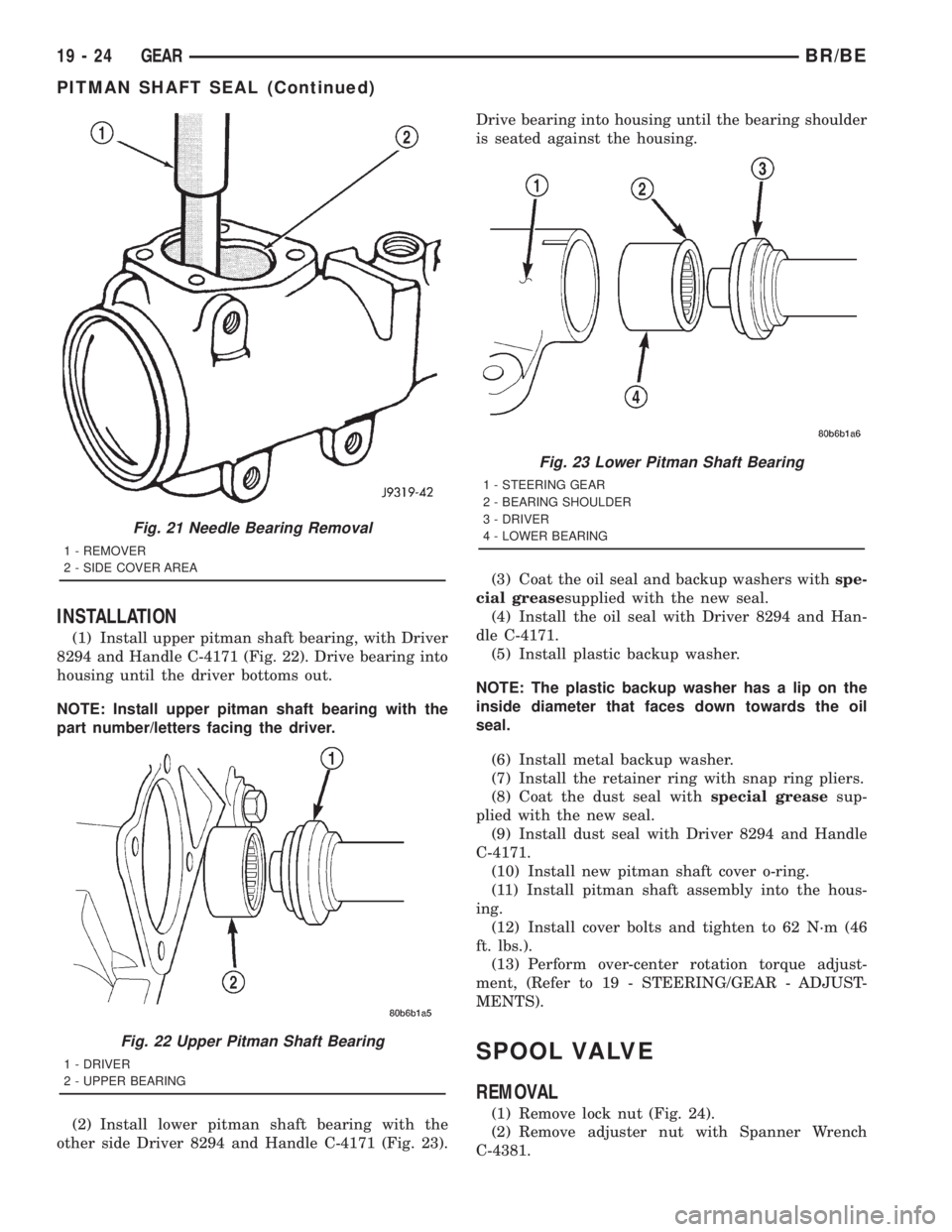
(1) Install upper pitman shaft bearing, with Driver
8294 and Handle C-4171 (Fig. 22). Drive bearing into
housing until the driver bottoms out.
NOTE: Install upper pitman shaft bearing with the
part number/letters facing the driver.
(2) Install lower pitman shaft bearing with the
other side Driver 8294 and Handle C-4171 (Fig. 23).Drive bearing into housing until the bearing shoulder
is seated against the housing.
(3) Coat the oil seal and backup washers withspe-
cial greasesupplied with the new seal.
(4) Install the oil seal with Driver 8294 and Han-
dle C-4171.
(5) Install plastic backup washer.
NOTE: The plastic backup washer has a lip on the
inside diameter that faces down towards the oil
seal.
(6) Install metal backup washer.
(7) Install the retainer ring with snap ring pliers.
(8) Coat the dust seal withspecial greasesup-
plied with the new seal.
(9) Install dust seal with Driver 8294 and Handle
C-4171.
(10) Install new pitman shaft cover o-ring.
(11) Install pitman shaft assembly into the hous-
ing.
(12) Install cover bolts and tighten to 62 N´m (46
ft. lbs.).
(13) Perform over-center rotation torque adjust-
ment, (Refer to 19 - STEERING/GEAR - ADJUST-
MENTS).
SPOOL VALVE
REMOVAL
(1) Remove lock nut (Fig. 24).
(2) Remove adjuster nut with Spanner Wrench
C-4381.
Fig. 21 Needle Bearing Removal
1 - REMOVER
2 - SIDE COVER AREA
Fig. 22 Upper Pitman Shaft Bearing
1 - DRIVER
2 - UPPER BEARING
Fig. 23 Lower Pitman Shaft Bearing
1 - STEERING GEAR
2 - BEARING SHOULDER
3 - DRIVER
4 - LOWER BEARING
19 - 24 GEARBR/BE
PITMAN SHAFT SEAL (Continued)
Page 1618 of 2889
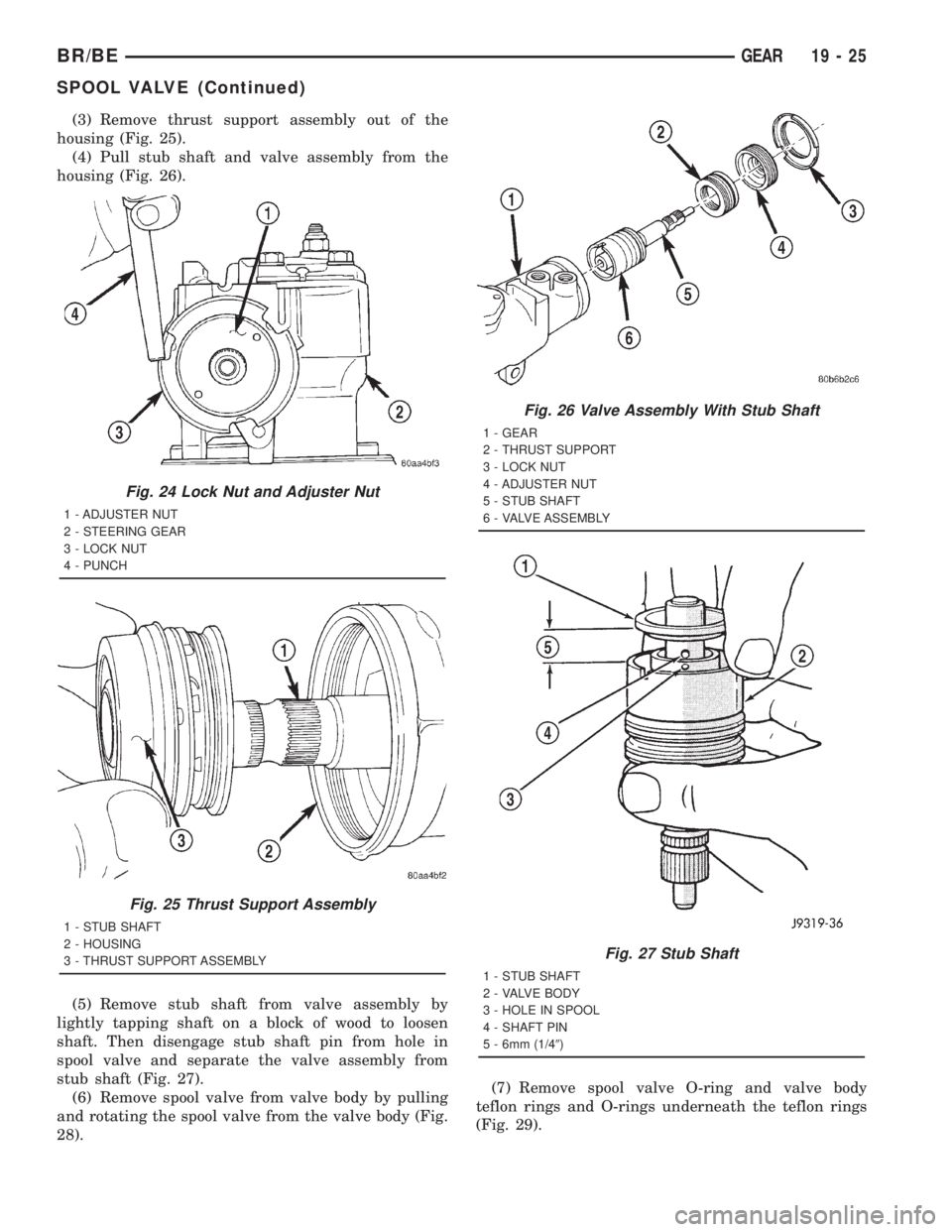
(3) Remove thrust support assembly out of the
housing (Fig. 25).
(4) Pull stub shaft and valve assembly from the
housing (Fig. 26).
(5) Remove stub shaft from valve assembly by
lightly tapping shaft on a block of wood to loosen
shaft. Then disengage stub shaft pin from hole in
spool valve and separate the valve assembly from
stub shaft (Fig. 27).
(6) Remove spool valve from valve body by pulling
and rotating the spool valve from the valve body (Fig.
28).(7) Remove spool valve O-ring and valve body
teflon rings and O-rings underneath the teflon rings
(Fig. 29).
Fig. 24 Lock Nut and Adjuster Nut
1 - ADJUSTER NUT
2 - STEERING GEAR
3 - LOCK NUT
4 - PUNCH
Fig. 25 Thrust Support Assembly
1 - STUB SHAFT
2 - HOUSING
3 - THRUST SUPPORT ASSEMBLY
Fig. 26 Valve Assembly With Stub Shaft
1 - GEAR
2 - THRUST SUPPORT
3 - LOCK NUT
4 - ADJUSTER NUT
5 - STUB SHAFT
6 - VALVE ASSEMBLY
Fig. 27 Stub Shaft
1 - STUB SHAFT
2 - VALVE BODY
3 - HOLE IN SPOOL
4 - SHAFT PIN
5 - 6mm (1/49)
BR/BEGEAR 19 - 25
SPOOL VALVE (Continued)
Page 1619 of 2889
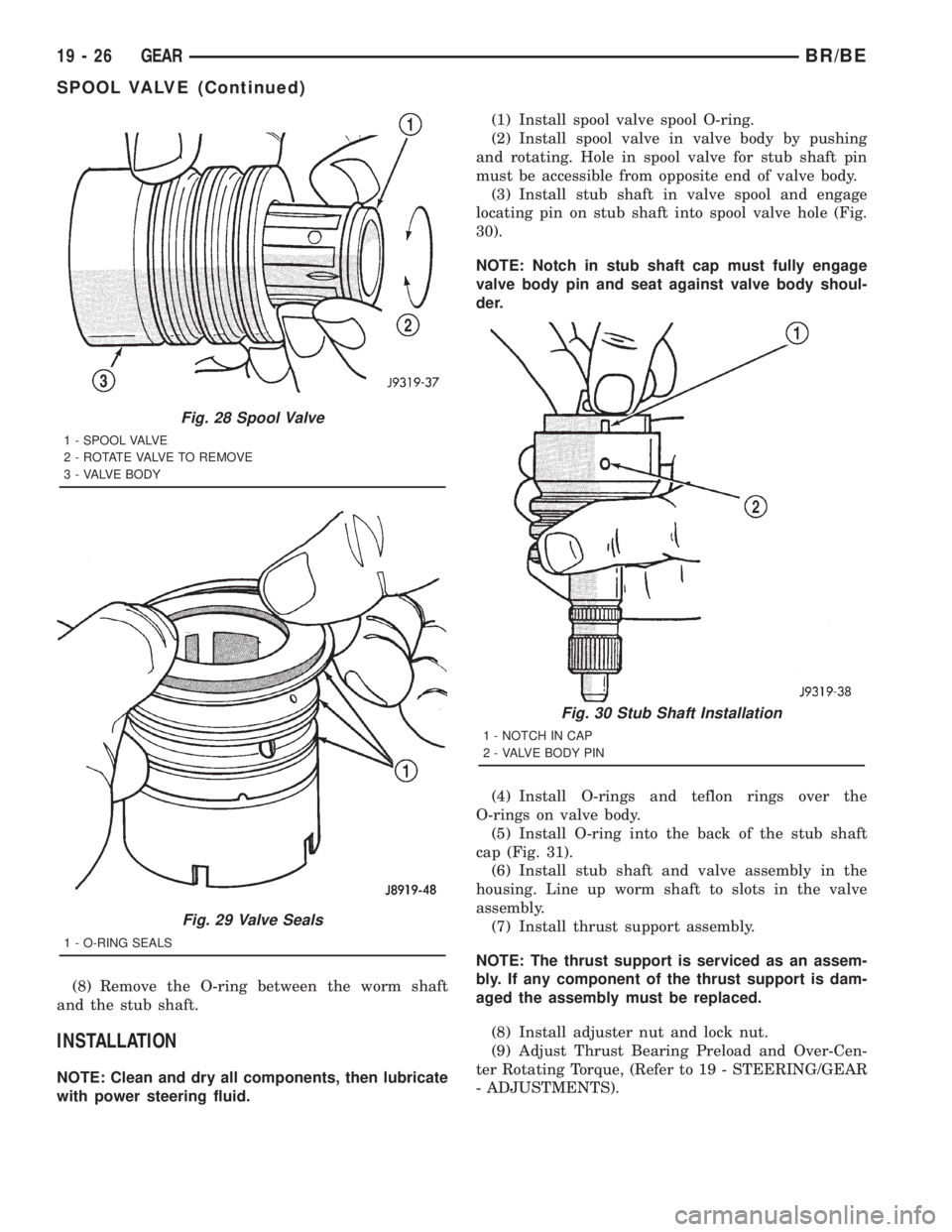
(8) Remove the O-ring between the worm shaft
and the stub shaft.
INSTALLATION
NOTE: Clean and dry all components, then lubricate
with power steering fluid.(1) Install spool valve spool O-ring.
(2) Install spool valve in valve body by pushing
and rotating. Hole in spool valve for stub shaft pin
must be accessible from opposite end of valve body.
(3) Install stub shaft in valve spool and engage
locating pin on stub shaft into spool valve hole (Fig.
30).
NOTE: Notch in stub shaft cap must fully engage
valve body pin and seat against valve body shoul-
der.
(4) Install O-rings and teflon rings over the
O-rings on valve body.
(5) Install O-ring into the back of the stub shaft
cap (Fig. 31).
(6) Install stub shaft and valve assembly in the
housing. Line up worm shaft to slots in the valve
assembly.
(7) Install thrust support assembly.
NOTE: The thrust support is serviced as an assem-
bly. If any component of the thrust support is dam-
aged the assembly must be replaced.
(8) Install adjuster nut and lock nut.
(9) Adjust Thrust Bearing Preload and Over-Cen-
ter Rotating Torque, (Refer to 19 - STEERING/GEAR
- ADJUSTMENTS).
Fig. 28 Spool Valve
1 - SPOOL VALVE
2 - ROTATE VALVE TO REMOVE
3 - VALVE BODY
Fig. 29 Valve Seals
1 - O-RING SEALS
Fig. 30 Stub Shaft Installation
1 - NOTCH IN CAP
2 - VALVE BODY PIN
19 - 26 GEARBR/BE
SPOOL VALVE (Continued)
Page 1620 of 2889
STEERING GEAR HOUSING
PLUG
REMOVAL
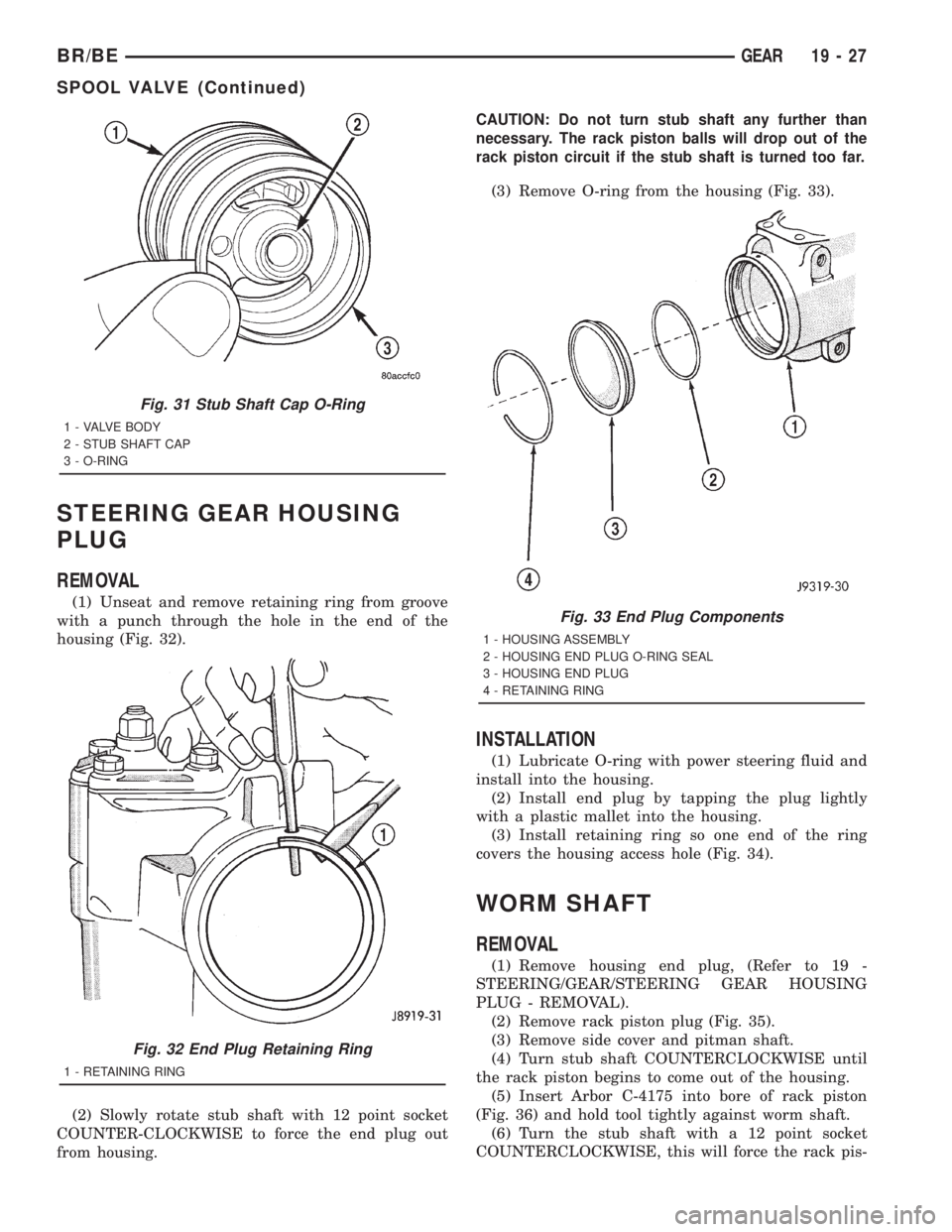
(1) Unseat and remove retaining ring from groove
with a punch through the hole in the end of the
housing (Fig. 32).
(2) Slowly rotate stub shaft with 12 point socket
COUNTER-CLOCKWISE to force the end plug out
from housing.
CAUTION: Do not turn stub shaft any further than
necessary. The rack piston balls will drop out of the
rack piston circuit if the stub shaft is turned too far.
(3) Remove O-ring from the housing (Fig. 33).
INSTALLATION
(1) Lubricate O-ring with power steering fluid and
install into the housing.
(2) Install end plug by tapping the plug lightly
with a plastic mallet into the housing.
(3) Install retaining ring so one end of the ring
covers the housing access hole (Fig. 34).
WORM SHAFT
REMOVAL
(1) Remove housing end plug, (Refer to 19 -
STEERING/GEAR/STEERING GEAR HOUSING
PLUG - REMOVAL).
(2) Remove rack piston plug (Fig. 35).
(3) Remove side cover and pitman shaft.
(4) Turn stub shaft COUNTERCLOCKWISE until
the rack piston begins to come out of the housing.
(5) Insert Arbor C-4175 into bore of rack piston
(Fig. 36) and hold tool tightly against worm shaft.
(6) Turn the stub shaft with a 12 point socket
COUNTERCLOCKWISE, this will force the rack pis-
Fig. 31 Stub Shaft Cap O-Ring
1 - VALVE BODY
2 - STUB SHAFT CAP
3 - O-RING
Fig. 32 End Plug Retaining Ring
1 - RETAINING RING
Fig. 33 End Plug Components
1 - HOUSING ASSEMBLY
2 - HOUSING END PLUG O-RING SEAL
3 - HOUSING END PLUG
4 - RETAINING RING
BR/BEGEAR 19 - 27
SPOOL VALVE (Continued)
Page 1621 of 2889
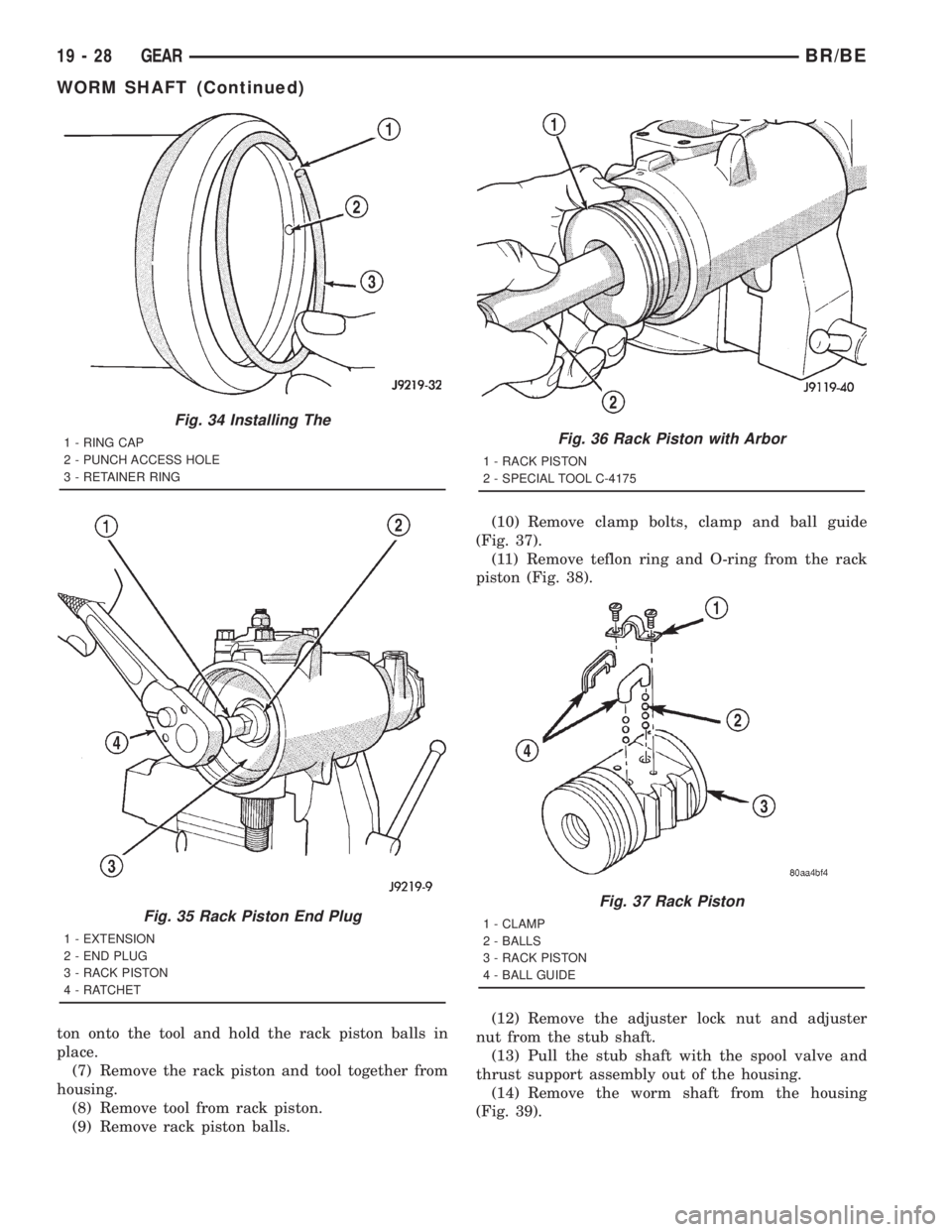
ton onto the tool and hold the rack piston balls in
place.
(7) Remove the rack piston and tool together from
housing.
(8) Remove tool from rack piston.
(9) Remove rack piston balls.(10) Remove clamp bolts, clamp and ball guide
(Fig. 37).
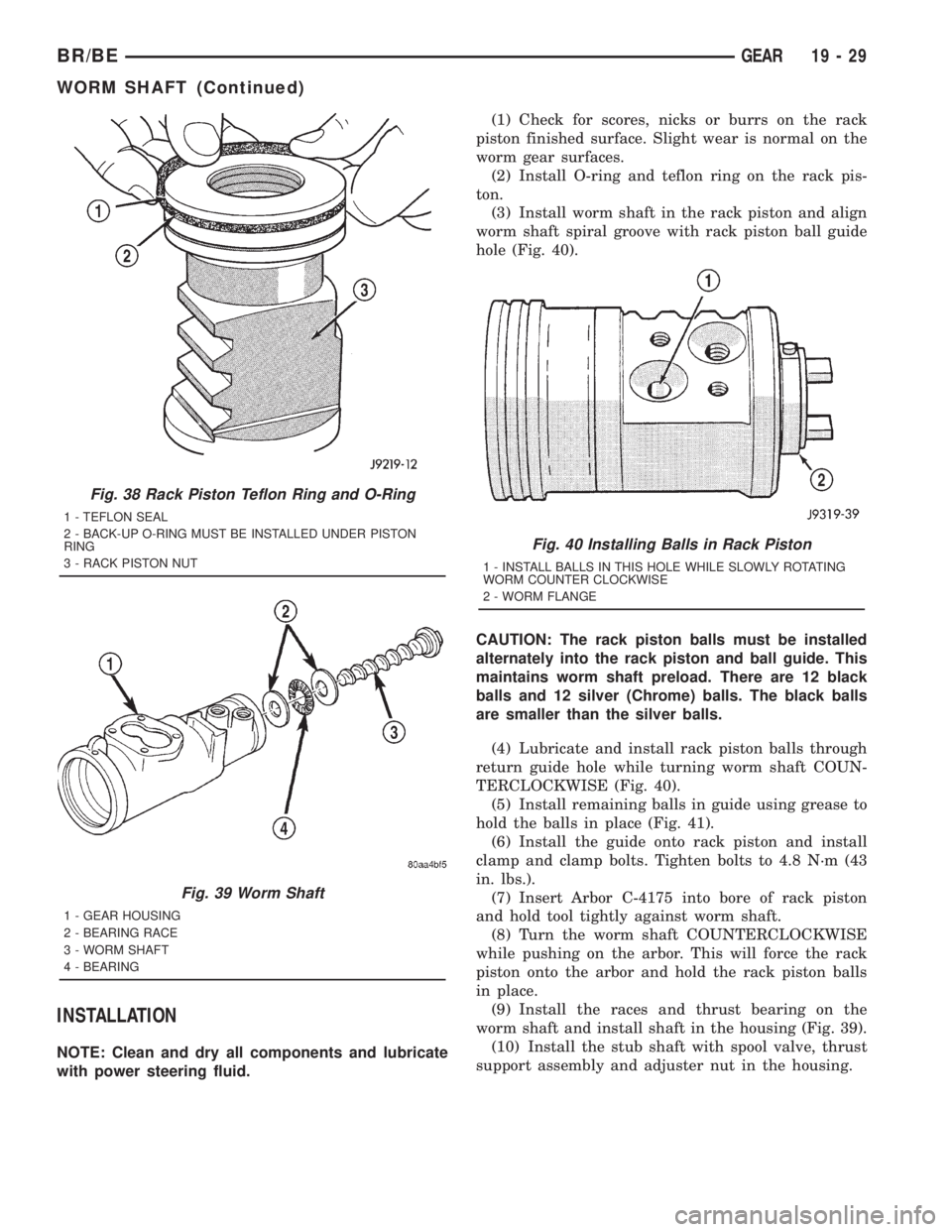
(11) Remove teflon ring and O-ring from the rack
piston (Fig. 38).
(12) Remove the adjuster lock nut and adjuster
nut from the stub shaft.
(13) Pull the stub shaft with the spool valve and
thrust support assembly out of the housing.
(14) Remove the worm shaft from the housing
(Fig. 39).
Fig. 34 Installing The
1 - RING CAP
2 - PUNCH ACCESS HOLE
3 - RETAINER RING
Fig. 35 Rack Piston End Plug
1 - EXTENSION
2 - END PLUG
3 - RACK PISTON
4 - RATCHET
Fig. 36 Rack Piston with Arbor
1 - RACK PISTON
2 - SPECIAL TOOL C-4175
Fig. 37 Rack Piston
1 - CLAMP
2 - BALLS
3 - RACK PISTON
4 - BALL GUIDE
19 - 28 GEARBR/BE
WORM SHAFT (Continued)
Page 1622 of 2889
INSTALLATION
NOTE: Clean and dry all components and lubricate
with power steering fluid.(1) Check for scores, nicks or burrs on the rack
piston finished surface. Slight wear is normal on the
worm gear surfaces.
(2) Install O-ring and teflon ring on the rack pis-
ton.
(3) Install worm shaft in the rack piston and align
worm shaft spiral groove with rack piston ball guide
hole (Fig. 40).
CAUTION: The rack piston balls must be installed
alternately into the rack piston and ball guide. This
maintains worm shaft preload. There are 12 black
balls and 12 silver (Chrome) balls. The black balls
are smaller than the silver balls.
(4) Lubricate and install rack piston balls through
return guide hole while turning worm shaft COUN-
TERCLOCKWISE (Fig. 40).
(5) Install remaining balls in guide using grease to
hold the balls in place (Fig. 41).
(6) Install the guide onto rack piston and install
clamp and clamp bolts. Tighten bolts to 4.8 N´m (43
in. lbs.).
(7) Insert Arbor C-4175 into bore of rack piston
and hold tool tightly against worm shaft.
(8) Turn the worm shaft COUNTERCLOCKWISE
while pushing on the arbor. This will force the rack
piston onto the arbor and hold the rack piston balls
in place.
(9) Install the races and thrust bearing on the
worm shaft and install shaft in the housing (Fig. 39).
(10) Install the stub shaft with spool valve, thrust
support assembly and adjuster nut in the housing.
Fig. 38 Rack Piston Teflon Ring and O-Ring
1 - TEFLON SEAL
2 - BACK-UP O-RING MUST BE INSTALLED UNDER PISTON
RING
3 - RACK PISTON NUT
Fig. 39 Worm Shaft
1 - GEAR HOUSING
2 - BEARING RACE
3 - WORM SHAFT
4 - BEARING
Fig. 40 Installing Balls in Rack Piston
1 - INSTALL BALLS IN THIS HOLE WHILE SLOWLY ROTATING
WORM COUNTER CLOCKWISE
2 - WORM FLANGE
BR/BEGEAR 19 - 29
WORM SHAFT (Continued)
Page 1625 of 2889
NOTE: Vehicles with long return lines or oil coolers
turn wheel 40 times.
(5) Start the engine. With the engine idling main-
tain the fluid level.
(6) Lower the front wheels and let the engine idle
for two minutes.
(7) Turn the steering wheel in both direction and
verify power assist and quit operation of the pump.
If the fluid is extremely foamy or milky looking,
allow the vehicle to stand a few minutes and repeat
the procedure.
CAUTION: Do not run a vehicle with foamy fluid for
an extended period. This may cause pump damage.
STANDARD PROCEDURE - FLUSHING POWER
STEERING SYSTEM
Flushing is required when the power steering/hy-
draulic booster system fluid has become contami-
nated. Contaminated fluid in the steering/booster
system can cause seal deterioration and affect steer-
ing gear/booster spool valve operation.(1) Raise the front end of the vehicle off the
ground until the wheels are free to turn.
(2) Remove the return line from the pump.
NOTE: If vehicle is equipped with a hydraulic
booster remove both return lines from the pump.
(3) Plug the return line port/ports at the pump.
(4) Position the return line/lines into a large con-
tainer to catch the fluid.
(5) While an assistant is filling the pump reservoir
start the engine.
(6) With the engine running at idle turn the wheel
back and forth.
NOTE: Do not contact or hold the wheel against the
steering stops.
(7) Run a quart of fluid through the system then
stop the engine and install the return line/lines.
Fig. 2 Power Steering Pump
1 - CHECK OIL LEVEL; IF LEAKAGE PERSISTS WITH THE
CORRECT LEVEL AND CAP TIGHT, REPLACE THE CAP
2 - SHAFT SEAL3 - RESERVOIR O-RING
4 - O-RING SEAL
19 - 32 PUMPBR/BE
PUMP (Continued)
Page 1770 of 2889
OVERRUNNING CLUTCH CAM/OVERDRIVE
PISTON RETAINER
DESCRIPTION..........................235
OPERATION............................235
DISASSEMBLY..........................235
CLEANING.............................236
INSPECTION...........................236
ASSEMBLY............................236
PARK/NEUTRAL POSITION SWITCH
DIAGNOSIS AND TESTING................237
PARK/NEUTRAL POSITION SWITCH.......237
REMOVAL.............................238
INSTALLATION..........................238
PISTONS
DESCRIPTION..........................238
OPERATION............................238
PLANETARY GEARTRAIN/OUTPUT SHAFT
DESCRIPTION..........................240
OPERATION............................240
DISASSEMBLY..........................240
INSPECTION...........................241
ASSEMBLY............................241
REAR CLUTCH
DESCRIPTION..........................246
OPERATION............................246
DISASSEMBLY..........................247
CLEANING.............................247
INSPECTION...........................248
ASSEMBLY............................248
REAR SERVO
DESCRIPTION..........................250
OPERATION............................250
DISASSEMBLY..........................251
CLEANING.............................251
ASSEMBLY............................251
SHIFT MECHANISM
DESCRIPTION..........................251OPERATION............................251
ADJUSTMENTS.........................252
SOLENOID
DESCRIPTION..........................252
OPERATION............................253
SPEED SENSOR
DESCRIPTION..........................253
OPERATION............................253
THROTTLE VALVE CABLE
DESCRIPTION..........................253
ADJUSTMENTS.........................254
TORQUE CONVERTER
DESCRIPTION..........................256
OPERATION............................260
REMOVAL.............................261
INSTALLATION..........................261
TORQUE CONVERTER DRAINBACK VALVE
DESCRIPTION..........................262
OPERATION............................262
STANDARD PROCEDURE.................262
TORQUE CONVERTER DRAINBACK VALVE . 262
TRANSMISSION TEMPERATURE SENSOR
DESCRIPTION..........................262
OPERATION............................262
VALVE BODY
DESCRIPTION..........................263
OPERATION............................267
REMOVAL.............................281
DISASSEMBLY..........................282
CLEANING.............................293
INSPECTION...........................293
ASSEMBLY............................294
INSTALLATION..........................303
ADJUSTMENTS.........................304
AUTOMATIC TRANSMISSION -
42RE
DESCRIPTION
The 42RE is a four speed fully automatic transmis-
sion (Fig. 1) with an electronic governor. The 42RE is
equipped with a lock-up clutch in the torque con-
verter. First through third gear ranges are provided
by the clutches, bands, overrunning clutch, and plan-
etary gear sets in the transmission. Fourth gear
range is provided by the overdrive unit that contains
an overdrive clutch, direct clutch, planetary gear set,
and overrunning clutch.
The transmission contains a front, rear, and direct
clutch which function as the input driving compo-
nents. It also contains the kickdown (front) and thelow/reverse (rear) bands which, along with the over-
running clutch and overdrive clutch, serve as the
holding components. The driving and holding compo-
nents combine to select the necessary planetary gear
components, in the front, rear, or overdrive planetary
gear set, transfer the engine power from the input
shaft through to the output shaft.
The valve body is mounted to the lower side of the
transmission and contains the valves to control pres-
sure regulation, fluid flow control, and clutch/band
application. The oil pump is mounted at the front of
the transmission and is driven by the torque con-
verter hub. The pump supplies the oil pressure nec-
essary for clutch/band actuation and transmission
lubrication.
BR/BEAUTOMATIC TRANSMISSION - 42RE 21 - 135