Page 4 of 460
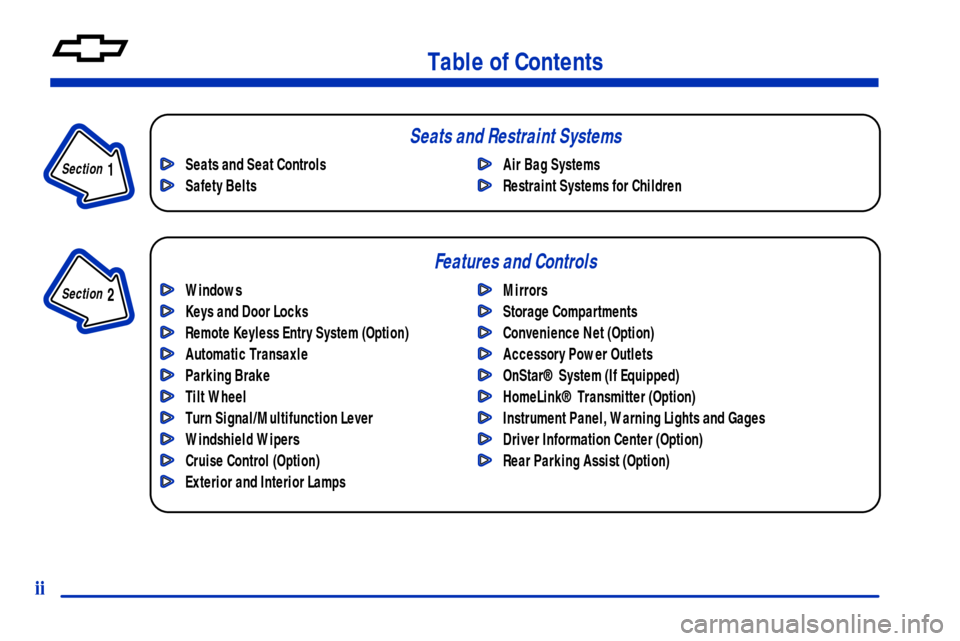
Table of Contents
Windows
Keys and Door Locks
Remote Keyless Entry System (Option)
Automatic Transaxle
Parking Brake
Tilt Wheel
Turn Signal/Multifunction Lever
Windshield Wipers
Cruise Control (Option)
Exterior and Interior LampsMirrors
Storage Compartments
Convenience Net (Option)
Accessory Power Outlets
OnStar® System (If Equipped)
HomeLink® Transmitter (Option)
Instrument Panel, Warning Lights and Gages
Driver Information Center (Option)
Rear Parking Assist (Option) Seats and Seat Controls
Safety BeltsAir Bag Systems
Restraint Systems for Children
Section
1
Section
2
Seats and Restraint Systems
Features and Controls
ii
Page 11 of 460
ix
For example,
these symbols
are used on an
original battery:
CAUTION
POSSIBLE
INJURY
PROTECT
EYES BY
SHIELDING
CAUSTIC
BATTERY
ACID COULD
CAUSE
BURNS
AVOID
SPARKS OR
FLAMES
SPARK OR
FLAME
COULD
EXPLODE
BATTERY
These symbols
are important for
you and your
passengers
whenever your
vehicle is driven:
CHILD
RESTRAINT
TOP STRAP
ANCHOR
DOOR LOCK
UNLOCK
FASTEN
SEAT
BELTS
POWER
WINDOW
AIR BAG
These symbols
have to do with
your lamps:
MASTER
LIGHTING
SWITCH
TURN
SIGNALS
PARKING
LAMPS
HAZARD
WARNING
FLASHER
DAYTIME
RUNNING
LAMPS
FOG LAMPS
These symbols
are on some of
your controls:
WINDSHIELD
WIPER
WINDSHIELD
WASHER
WINDSHIELD
DEFROSTER
REAR
WINDOW
DEFOGGER
VENTILATING
FAN
These symbols
are used on
warning and
indicator lights:
ENGINE
COOLANT
TEMP
BATTERY
CHARGING
SYSTEM
BRAKE
COOLANT
ENGINE OIL
PRESSURE
ANTI-LOCK
BRAKES
Here are some
other symbols
you may see:
FUSE
LIGHTER
HORN
FUEL
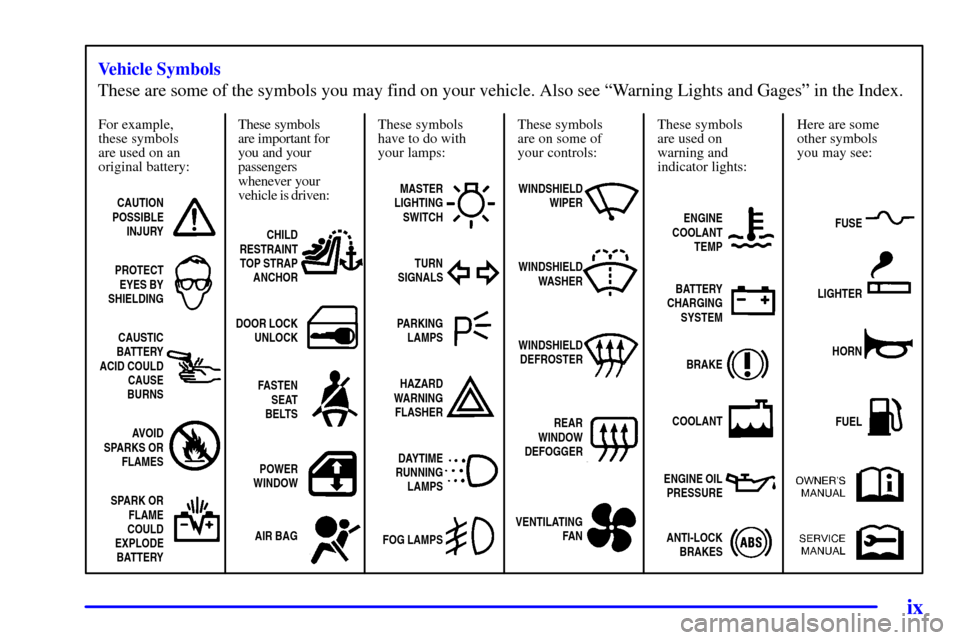
Vehicle Symbols
These are some of the symbols you may find on your vehicle. Also see ªWarning Lights and Gagesº in the Index.
Page 13 of 460
1-
1-1
Section 1 Seats and Restraint Systems
Here you'll find information about the seats in your vehicle and how to use your safety belts properly. You can also
learn about some things you should not do with air bags and safety belts.
1
-2 Seats and Seat Controls
1
-6 Rear Seats
1
-27 Safety Belts: They're for Everyone
1
-31 Here Are Questions Many People Ask
About Safety Belts
-- and the Answers
1
-32 How to Wear Safety Belts Properly
1
-32 Driver Position
1
-41 Safety Belt Use During Pregnancy
1
-42 Right Front Passenger Position
1
-43 Air Bag Systems
1
-50 Safety Belt Pretensioners
1
-50 Rear Seat Passengers1
-55 Rear Safety Belt Comfort Guides for
Children and Small Adults
1
-57 Center Passenger Position (Bench Seat)
1
-59 Center Passenger Position (Bucket Seat)
1
-60 Children
1
-64 Built-in Child Restraint (Option)
1
-75 Restraint Systems for Children
1
-97 Older Children
1
-100 Safety Belt Extender
1
-100 Checking Your Restraint Systems
1
-101 Replacing Restraint System Parts After
a Crash
Page 20 of 460
1-8 Split Bench Seats
If you have the split bench seat (50/50 or 40/60), the
seatbacks can be folded down individually and the
sections can be removed individually. The 40/60 sections
can also be adjusted forward or rearward individually.
The second row (40/60) split bench may be equipped
with a built
-in child restraint. See ªBuilt-In Child
Restraintº in the Index.
Folding or Reclining the Seatbacks
The seatbacks on each section of the split bench seat
can be either folded down or reclined. The following
explains how to use either the nylon strap or the lever
to fold or recline the seatbacks.
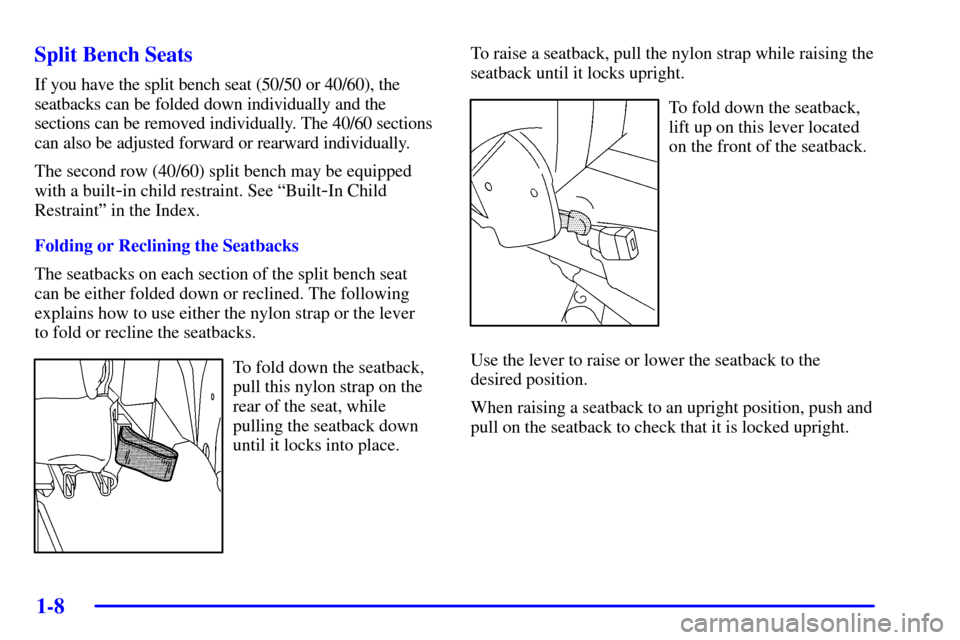
To fold down the seatback,
pull this nylon strap on the
rear of the seat, while
pulling the seatback down
until it locks into place.To raise a seatback, pull the nylon strap while raising the
seatback until it locks upright.
To fold down the seatback,
lift up on this lever located
on the front of the seatback.
Use the lever to raise or lower the seatback to the
desired position.
When raising a seatback to an upright position, push and
pull on the seatback to check that it is locked upright.
Page 44 of 460
1-32
Q:If I'm a good driver, and I never drive far from
home, why should I wear safety belts?
A:You may be an excellent driver, but if you're in an
accident
-- even one that isn't your fault -- you
and your passengers can be hurt. Being a good
driver doesn't protect you from things beyond your
control, such as bad drivers.
Most accidents occur within 25 miles (40 km)
of home. And the greatest number of serious
injuries and deaths occur at speeds of less than
40 mph (65 km/h).
Safety belts are for everyone.
How to Wear Safety Belts Properly
Adults
This part is only for people of adult size.
Be aware that there are special things to know about
safety belts and children. And there are different rules
for smaller children and babies. If a child will be riding
in your vehicle, see the part of this manual called
ªChildren.º Follow those rules for everyone's protection.
First, you'll want to know which restraint systems your
vehicle has.
We'll start with the driver position.
Driver Position
This part describes the driver's restraint system.
Lap-Shoulder Belt
The driver has a lap-shoulder belt. Here's how to wear
it properly.
1. Close and lock the door.
2. Adjust the seat so you can sit up straight.
To see how, see ªSeatsº in the Index.
Page 67 of 460
1-55
Rear Safety Belt Comfort Guides for
Children and Small Adults
Your vehicle may have rear shoulder belt comfort
guides. This feature will provide added safety belt
comfort for older children who have outgrown booster
seats and for small adults. When installed on a shoulder
belt, the comfort guide better positions the belt away
from the neck and head.
If your vehicle has bucket seats in the second row, there
is one guide for each outside passenger position. If your
vehicle has a bench seat in the second row, there is one
guide for the left
-hand outside passenger position.
To provide added safety belt comfort for children
who have outgrown child restraints and for smaller
adults, the comfort guides may be installed on the
shoulder belts. Here's how to install a comfort guide and use the
safety belt:
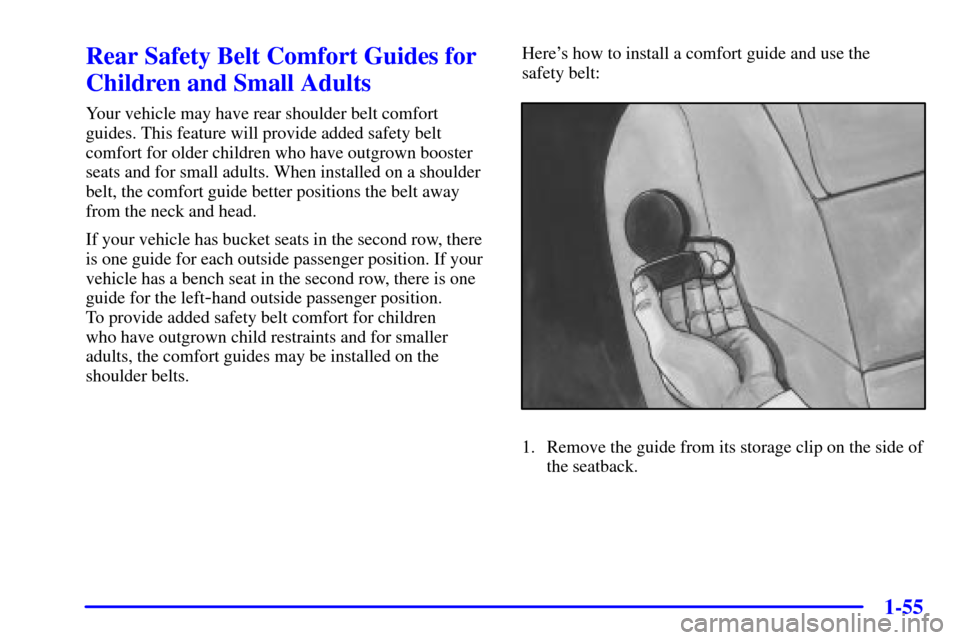
1. Remove the guide from its storage clip on the side of
the seatback.
Page 75 of 460
1-63
CAUTION:
Newborn infants need complete support,
including support for the head and neck. This
is necessary because a newborn infant's neck is
weak and its head weighs so much compared
with the rest of its body. In a crash, an infant
in a rear
-facing seat settles into the restraint,
so the crash forces can be distributed across the
strongest part of an infant's body, the back and
shoulders. Infants always should be secured in
appropriate infant restraints.
CAUTION:
The body structure of a young child is quite
unlike that of an adult or older child, for whom
the safety belts are designed. A young child's
hip bones are still so small that vehicle's regular
safety belt may not remain low on the hip bones,
as it should. Instead, it may settle up around the
child's abdomen. In a crash, the belt would apply
force on a body area that's unprotected by any
bony structure. This alone could cause serious
or fatal injuries. Young children always should
be secured in appropriate child restraints.
Page 76 of 460
1-64
Built-in Child Restraint (Option)
Bucket Seat
60/40 Bench Seat
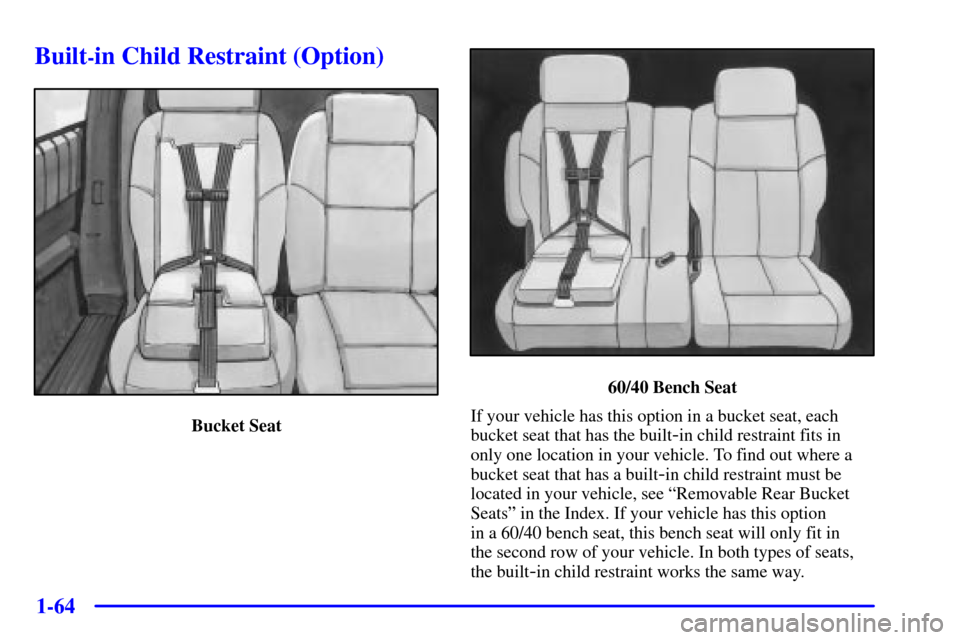
If your vehicle has this option in a bucket seat, each
bucket seat that has the built
-in child restraint fits in
only one location in your vehicle. To find out where a
bucket seat that has a built
-in child restraint must be
located in your vehicle, see ªRemovable Rear Bucket
Seatsº in the Index. If your vehicle has this option
in a 60/40 bench seat, this bench seat will only fit in
the second row of your vehicle. In both types of seats,
the built
-in child restraint works the same way.