Page 337 of 460
5-20
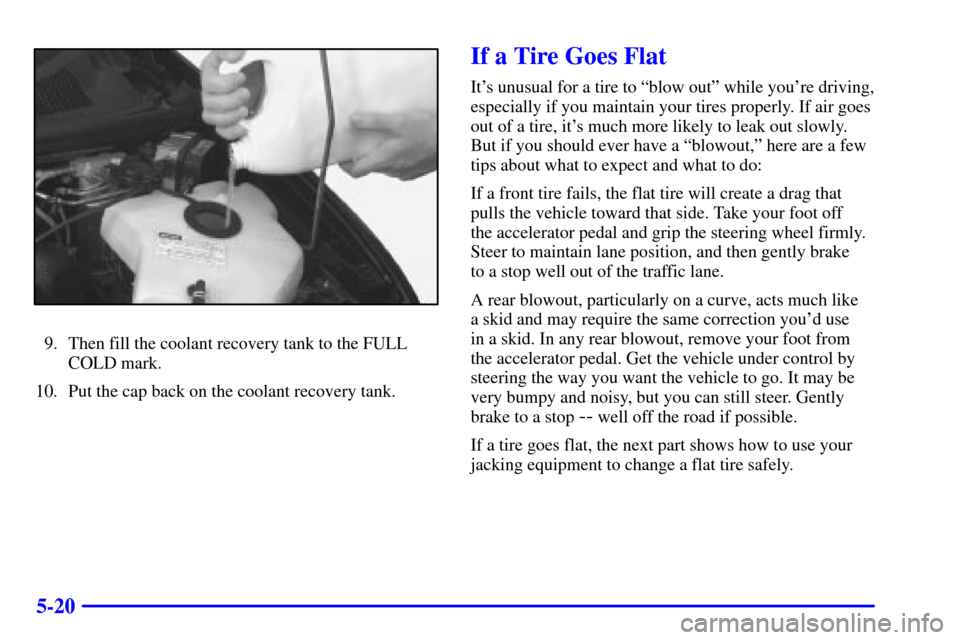
9. Then fill the coolant recovery tank to the FULL
COLD mark.
10. Put the cap back on the coolant recovery tank.
If a Tire Goes Flat
It's unusual for a tire to ªblow outº while you're driving,
especially if you maintain your tires properly. If air goes
out of a tire, it's much more likely to leak out slowly.
But if you should ever have a ªblowout,º here are a few
tips about what to expect and what to do:
If a front tire fails, the flat tire will create a drag that
pulls the vehicle toward that side. Take your foot off
the accelerator pedal and grip the steering wheel firmly.
Steer to maintain lane position, and then gently brake
to a stop well out of the traffic lane.
A rear blowout, particularly on a curve, acts much like
a skid and may require the same correction you'd use
in a skid. In any rear blowout, remove your foot from
the accelerator pedal. Get the vehicle under control by
steering the way you want the vehicle to go. It may be
very bumpy and noisy, but you can still steer. Gently
brake to a stop
-- well off the road if possible.
If a tire goes flat, the next part shows how to use your
jacking equipment to change a flat tire safely.
Page 351 of 460
5-34
If You're Stuck: In Sand, Mud,
Ice or Snow
In order to free your vehicle when it is stuck, you will
need to spin the wheels, but you don't want to spin
your wheels too fast. The method known as ªrockingº
can help you get out when you're stuck, but you must
use caution.
CAUTION:
If you let your tires spin at high speed, they
can explode, and you or others could be injured.
And, the transaxle or other parts of the vehicle
can overheat. That could cause an engine
compartment fire or other damage. When you're
stuck, spin the wheels as little as possible. Don't
spin the wheels above 35 mph (55 km/h) as shown
on the speedometer.
NOTICE:
Spinning your wheels can destroy parts of your
vehicle as well as the tires. If you spin the wheels
too fast while shifting your transaxle back and
forth, you can destroy your transaxle.
For information about using tire chains on your vehicle,
see ªTire Chainsº in the Index.
Rocking Your Vehicle To Get It Out
First, turn your steering wheel left and right. That will
clear the area around your front wheels. If your vehicle
has traction control, you should turn your traction
control system off. See ªTraction Control Systemº in the
Index. Then shift back and forth between REVERSE (R)
and a forward gear, spinning the wheels as little as
possible. Release the accelerator pedal while you shift,
and press lightly on the accelerator pedal when the
transaxle is in gear. By slowly spinning your wheels in
the forward and reverse directions, you will cause a
rocking motion that may free your vehicle. If that
doesn't get you out after a few tries, you may need
to be towed out. If you do need to be towed out,
see ªTowing Your Vehicleº in the Index.
Page 352 of 460

6-
6-1
Section 6 Service and Appearance Care
Here you will find information about the care of your vehicle. This section begins with service and fuel information,
and then it shows how to check important fluid and lubricant levels. There is also technical information about your
vehicle, and a part devoted to its appearance care.
6
-2 Service
6
-3 Fuel
6
-5 Fuels in Foreign Countries
6
-6 Filling Your Tank
6
-8 Filling a Portable Fuel Container
6
-9 Checking Things Under the Hood
6
-12 Engine Oil
6
-16 Engine Air Cleaner/Filter
6
-18 Passenger Compartment
Air Filter Replacement
6
-20 Automatic Transaxle Fluid
6
-23 Engine Coolant
6
-26 Radiator Pressure Cap
6
-27 Power Steering Fluid
6
-28 Windshield Washer Fluid
6
-29 Brakes6
-32 Battery
6
-33 Bulb Replacement
6
-40 Windshield Wiper Blade Replacement
6
-42 Tires
6
-51 Appearance Care
6
-51 Cleaning the Inside of Your Vehicle
6
-55 Cleaning the Outside of Your Vehicle
6
-58 Underbody Maintenance
6
-58 Chemical Paint Spotting
6
-59 GM Vehicle Care/Appearance Materials
6
-60 Vehicle Identification Number (VIN)
6
-61 Electrical System
6
-69 Replacement Bulbs
6
-69 Capacities and Specifications
6
-70 Normal Maintenance Replacement Parts
Page 362 of 460
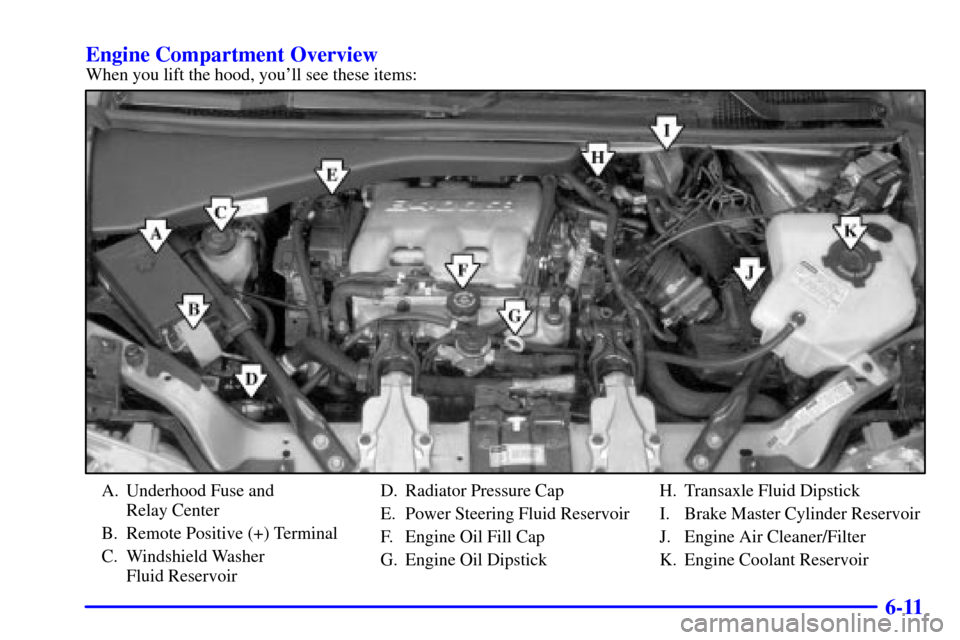
6-11 Engine Compartment Overview
When you lift the hood, you'll see these items:
A. Underhood Fuse and
Relay Center
B. Remote Positive (+) Terminal
C. Windshield Washer
Fluid ReservoirD. Radiator Pressure Cap
E. Power Steering Fluid Reservoir
F. Engine Oil Fill Cap
G. Engine Oil DipstickH. Transaxle Fluid Dipstick
I. Brake Master Cylinder Reservoir
J. Engine Air Cleaner/Filter
K. Engine Coolant Reservoir
Page 378 of 460
6-27
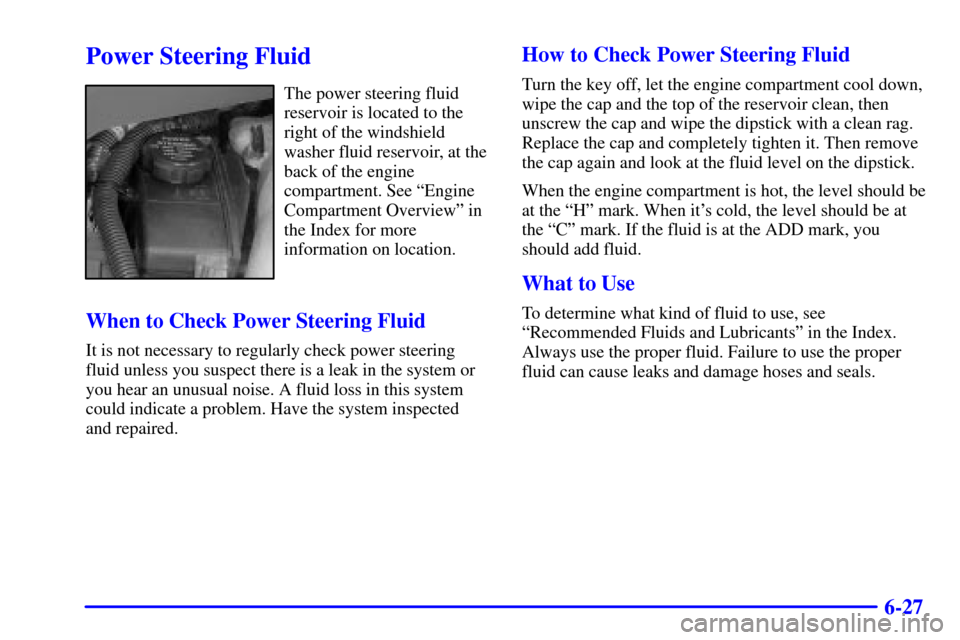
Power Steering Fluid
The power steering fluid
reservoir is located to the
right of the windshield
washer fluid reservoir, at the
back of the engine
compartment. See ªEngine
Compartment Overviewº in
the Index for more
information on location.
When to Check Power Steering Fluid
It is not necessary to regularly check power steering
fluid unless you suspect there is a leak in the system or
you hear an unusual noise. A fluid loss in this system
could indicate a problem. Have the system inspected
and repaired.
How to Check Power Steering Fluid
Turn the key off, let the engine compartment cool down,
wipe the cap and the top of the reservoir clean, then
unscrew the cap and wipe the dipstick with a clean rag.
Replace the cap and completely tighten it. Then remove
the cap again and look at the fluid level on the dipstick.
When the engine compartment is hot, the level should be
at the ªHº mark. When it's cold, the level should be at
the ªCº mark. If the fluid is at the ADD mark, you
should add fluid.
What to Use
To determine what kind of fluid to use, see
ªRecommended Fluids and Lubricantsº in the Index.
Always use the proper fluid. Failure to use the proper
fluid can cause leaks and damage hoses and seals.
Page 414 of 460
6-63
Circuit
BreakersUsage
1 Daytime Running Lamps (DRL)
Control Module, Headlamp and
Instrument Panel Dimmer Switch
2 Power Sliding Door
3 Front Power Windows
46
-Way Power Seat and Rear Side
Door Actuator Motor
5 Blower Motor Hi Speed
Relay ModuleFuses Usage
6 Steering Wheel Radio Control
Switches (Illumination)
7 Instrument Cluster to
PRNDL Indicators
8 Power Remote Control
Mirror Switch
9 Cruise Control Module,
Switch and Release Switch
10 Not Used
11 Power Control Module (PCM),
Ignition Crank
12 PASS
-Key� III System
13 Body Control Module (BCM)
14 Heated Mirrors
15 Not Used
16 Not Used
17 Cigarette Lighter, DIC, Front
Auxiliary Power Outlets
18 Turn Signal Switch
19 Interior Lamp and Multifunction
Switch (Power Vent Switch)
Page 427 of 460
Scheduled Maintenance
7-6Engine Oil and Chassis Lubrication
Scheduled Maintenance
Change engine oil and filter as indicated by the
GM Oil Life System� (or every 12 months,
whichever occurs first). Reset the system. The system
will show you when to change the oil
-- usually between
3,000 miles (5 000 km) and 10,000 miles (16 000 km)
since your last oil change. Under severe conditions, the
indicator may come on before 3,000 miles (5 000 km).
Never drive your vehicle more than 10,000 miles
(16 000 km) or 12 months without an oil and
filter change.The system won't detect dust in the oil. So if you drive
in a dusty area, be sure to change your oil and filter
every 3,000 miles (5 000 km) or sooner if the change
engine oil message appears. Remember to reset the
Oil Life System when the oil and filter have been
changed. See ªOil Life Systemº in the Index for
information on resetting.
An Emission Control Service.
Lubricate chassis components with each engine oil and
filter change. Lubricate the suspension, steering linkage,
transaxle shift linkage, parking brake cable guides and
the underbody contact points and linkage.
Page 441 of 460
7-20
Part C: Periodic
Maintenance Inspections
Listed in this part are inspections and services which
should be performed at least twice a year (for instance,
each spring and fall). You should let your dealer's
service department or other qualified service center
do these jobs. Make sure any necessary repairs are
completed at once.
Proper procedures to perform these services may be
found in a service manual. See ªService and Owner
Publicationsº in the Index.
Steering, Suspension and Front Drive Axle
Boot and Seal Inspection
Inspect the front and rear suspension and steering
system for damaged, loose or missing parts, signs of
wear or lack of lubrication. Inspect the power steering
lines and hoses for proper hook
-up, binding, leaks,
cracks, chafing, etc. Clean and then inspect the
drive axle boot seals for damage, tears or leakage.
Replace seals if necessary.
Exhaust System Inspection
Inspect the complete exhaust system. Inspect the body
near the exhaust system. Look for broken, damaged,
missing or out
-of-position parts as well as open seams,
holes, loose connections or other conditions which could
cause a heat build
-up in the floor pan or could let
exhaust fumes into the vehicle. See ªEngine Exhaustº
in the Index.