Page 253 of 391

6-
6-1
Section 6 Service and Appearance Care
Here you will find information about the care of your vehicle. This section begins with service and fuel information,
and then it shows how to check important fluid and lubricant levels. There is also technical information about your
vehicle, and a part devoted to its appearance care.
6
-2 Service
6
-3 Fuel
6
-5 Fuels in Foreign Countries
6
-6 Filling Your Tank
6
-8 Filling a Portable Fuel Container
6
-9 Checking Things Under the Hood
6
-14 Engine Oil
6
-20 Engine Air Cleaner/Filter
6
-22 Passenger Compartment Air Filter
(If Equipped)
6
-24 Automatic Transmission Fluid
6
-27 Manual Transmission Fluid
6
-32 Engine Coolant
6
-35 Radiator Pressure Cap
6
-35 Power Steering Fluid
6
-36 Windshield Washer Fluid
6
-37 Brakes
6
-41 Battery
6
-42 Bulb Replacement6
-46 Tires
6
-54 Appearance Care
6
-55 Cleaning the Inside of Your Vehicle
6
-57 Cleaning the Outside of the Windshield,
Backglass and Wiper Blades
6
-58 Cleaning the Outside of Your Vehicle
6
-60 Special Care for Canvas Top and Plastic
Windows
6
-61 Cleaning Aluminum Wheels (If Equipped)
6
-61 Cleaning Tires
6
-62 Finish Damage
6
-62 Underbody Maintenance
6
-63 GM Vehicle Care/Appearance Materials
6
-64 Vehicle Identification Number (VIN)
6
-65 Electrical System
6
-68 Replacement Bulbs
6
-69 Capacities and Specifications
6
-71 Normal Maintenance Replacement Parts
Page 298 of 391

6-46 Dome Lamp
1. Gently pry the dome lamp lens from the lamp
assembly using a screwdriver.
2. Remove the bulb by gently opening the retaining clip
and sliding the bulb out.
3. Insert a new bulb. Make sure that it is
seated properly.
4. Snap the dome lamp lens back into the dome
lamp assembly.
Tires
Your new vehicle comes with high-quality tires made by
a leading tire manufacturer. If you ever have questions
about your tire warranty and where to obtain service,
see your Chevrolet Warranty booklet for details.
CAUTION:
Poorly maintained and improperly used tires
are dangerous.
�Overloading your tires can cause
overheating as a result of too much friction.
You could have an air
-out and a serious
accident. See ªLoading Your Vehicleº in
the Index.
�Underinflated tires pose the same danger
as overloaded tires. The resulting accident
could cause serious injury. Check all tires
frequently to maintain the recommended
pressure. Tire pressure should be checked
when your tires are cold.
�Overinflated tires are more likely to be
cut, punctured or broken by a sudden
impact
-- such as when you hit a pothole.
Keep tires at the recommended pressure.
�Worn, old tires can cause accidents. If your
tread is badly worn, or if your tires have
been damaged, replace them.
Page 299 of 391

6-47 Inflation -- Tire Pressure
The Tire-Loading Information label, which is on the
driver's door lock pillar, shows the correct inflation
pressures for your tires when they're cold. ªColdº
means your vehicle has been sitting for at least
three hours or driven no more than 1 mile (1.6 km).
NOTICE:
Don't let anyone tell you that underinflation or
overinflation is all right. It's not. If your tires
don't have enough air (underinflation),
you can get the following:
�Too much flexing
�Too much heat
�Tire overloading
�Bad wear
�Bad handling
�Bad fuel economy.
NOTICE: (Continued)
NOTICE: (Continued)
If your tires have too much air (overinflation),
you can get the following:
�Unusual wear
�Bad handling
�Rough ride
�Needless damage from road hazards.
When to Check
Check your tires once a month or more. Also, check the
tire pressure of the spare tire.
How to Check
Use a good quality pocket
-type gage to check tire
pressure. You can't tell if your tires are properly inflated
simply by looking at them. Radial tires may look
properly inflated even when they're underinflated.
Be sure to put the valve caps back on the valve stems.
They help prevent leaks by keeping out dirt and moisture.
Page 300 of 391
6-48 Tire Inspection and Rotation
Tires should be rotated every 6,000 to 8,000 miles
(10 000 to 13 000 km). Any time you notice unusual
wear, rotate your tires as soon as possible and check
wheel alignment. Also check for damaged tires or
wheels. See ªWhen It's Time for New Tiresº and
ªWheel Replacementº later in this section for
more information.
The purpose of regular rotation is to achieve more
uniform wear for all tires on the vehicle. The first
rotation is the most important. See ªScheduled
Maintenance Servicesº in the Index for scheduled
rotation intervals.
When rotating your tires, always use one of the correct
rotation patterns shown here.
After the tires have been rotated, adjust the front and
rear inflation pressures as shown on the Tire
-Loading
Information label. Make certain that all wheel nuts
are properly tightened. See ªWheel Nut Torqueº
in the Index.
Page 312 of 391

6-60
Special Care for Canvas Top and
Plastic Windows
Your canvas top should be cleaned often. If you use an
automatic car wash, use one with water jets and hanging
cloths. High pressure car washes may cause water to
enter your vehicle.
When you hand wash the top, do it in partial shade.
Use a mild soap, lukewarm water and a soft sponge. A
chamois or cloth may leave lint on the top, and a brush
can chafe the threads in the top fabric. Don't use
detergents, harsh cleaners, solvents or bleaching agents.
Wet the entire vehicle and wash the top evenly to avoid
spots or rings. Let the soap remain on the fabric for a
few minutes. When the top is really dirty, use a mild
foam
-type cleaner. Thoroughly rinse the entire vehicle,
then let the top dry in direct sunlight.
To protect the canvas top:
�After you wash the vehicle, make sure the top is
completely dry before you open or remove it.
�Don't get any vinyl cleaner on the vehicle's painted
finish; it could leave streaks.�If you decide to go through an automatic car wash,
ask the manager if the equipment could damage
your top.
The plastic windows are pliable and can be scratched if
you don't take these precautions when you clean them:
�Wipe off dust with a soft cotton cloth moistened with
clean, cool or lukewarm water. Don't use a ªdryº
cloth. Wipe in one direction only, not back and forth.
�To remove frost, snow or ice, use lukewarm water.
Don't use a scraper or any de
-icing fluids.
�Wash the windows with a soft cloth and clean, cool
or lukewarm water. Never use a dry cloth, hot water,
strong soap or detergent, solvents or harsh cleaning
agents. Rinse thoroughly and wipe with a slightly
moist soft, clean cloth.
�Don't put any labels, stickers or tape on windows.
It's hard to remove adhesives left on the window
when such items are removed. If a sticker or label
must be removed, remove any adhesive left on the
window while the adhesive is still soft and sticky.
Press on a new sticker or piece of tape and then lift it
off again; keep doing this until all the adhesive lifts
off with the sticker or tape.
Page 322 of 391

6-70 1.6L Engine Specifications
VIN Engine Code 6. . . . . . . . . . . . . . . . . . . . . . . . . . .
Type L4. . . . . . . . . . . . . . . . . . . . . . . . . . . . . . . . . . . .
Horsepower 97. . . . . . . . . . . . . . . . . . . . . . . . . . . . . .
Firing Order 1
-3-4-2 . . . . . . . . . . . . . . . . . . . . . . . . . .
Thermostat Temperature 190�F (88�C) . . . . . . . . . . .
2.0L Engine Specifications
VIN Engine Code C. . . . . . . . . . . . . . . . . . . . . . . . . . .
Type L4. . . . . . . . . . . . . . . . . . . . . . . . . . . . . . . . . . . .
Horsepower 127. . . . . . . . . . . . . . . . . . . . . . . . . . . . .
Firing Order 1
-3-4-2 . . . . . . . . . . . . . . . . . . . . . . . . . .
Thermostat Temperature 179�F (82�C) . . . . . . . . . . .
2.5L Engine Specifications
VIN Engine Code 4. . . . . . . . . . . . . . . . . . . . . . . . . . .
Type V6. . . . . . . . . . . . . . . . . . . . . . . . . . . . . . . . . . . .
Horsepower 155. . . . . . . . . . . . . . . . . . . . . . . . . . . . .
Firing Order 1
-6-5-4-3-2 . . . . . . . . . . . . . . . . . . . . . .
Thermostat Temperature 179�F (82�C) . . . . . . . . . . .
Wheel and Tires
Wheel Nut Torque 69 lb-ft (95 N´m) . . . . . . . . . . . . .
Tire Pressure See the Tire
-Loading . . . . . . . . . . . . . .
Information label. See ªLoading
Your Vehicleº in the Index.
Page 351 of 391

Short Trip/City Scheduled Maintenance
7-27
�Inspect camshaft timing belt (1.6L Code 6 engine only).
An Emission Control Service. (See footnote �.)
�Inspect fuel tank, cap and lines for damage or leaks. Inspect fuel cap
gasket for any damage. Replace parts as needed.
An Emission Control Service. (See footnote �.)
�Inspect ignition coil plug cap (or every 30 months, whichever occurs first).
An Emission Control Service.
�Drain, flush and refill cooling system (or every 30 months, whichever occurs
first). See ªEngine Coolantº in the Index for what to use. Inspect hoses.
Clean radiator, condenser, pressure cap and neck. Pressure test the cooling
system and pressure cap.
An Emission Control Service. (See footnote �.)
�Replace engine air cleaner filter.
An Emission Control Service.
�Rotate tires. See ªTire Inspection and Rotationº in the Index for proper
rotation pattern and additional information. (See footnote +.)
�Change manual transmission fluid.
�Change transfer case fluid.
�Change differential fluid.
(Continued)
Page 357 of 391
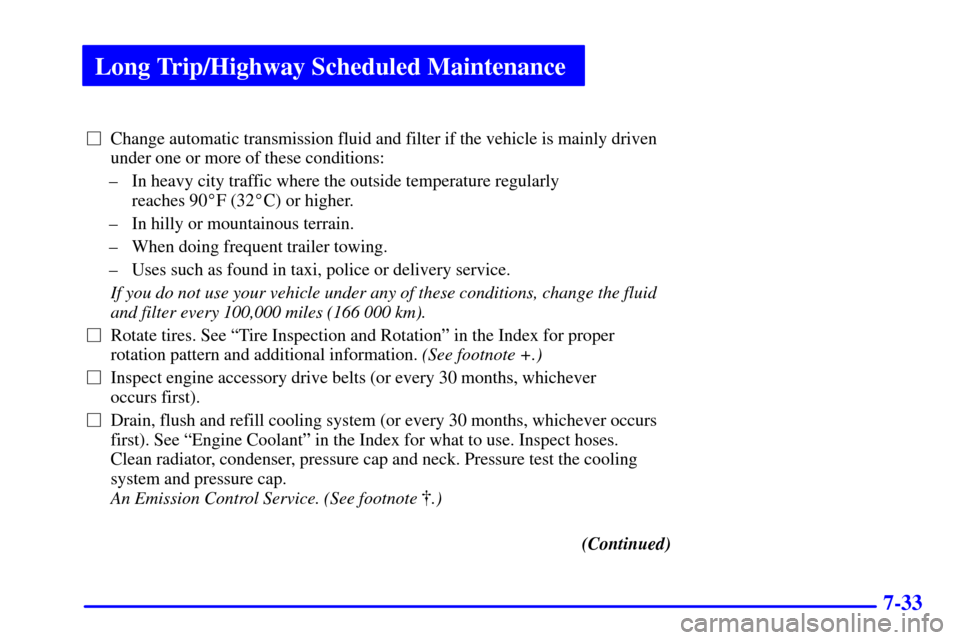
Long Trip/Highway Scheduled Maintenance
7-33
�Change automatic transmission fluid and filter if the vehicle is mainly driven
under one or more of these conditions:
± In heavy city traffic where the outside temperature regularly
reaches 90�F (32�C) or higher.
± In hilly or mountainous terrain.
± When doing frequent trailer towing.
± Uses such as found in taxi, police or delivery service.
If you do not use your vehicle under any of these conditions, change the fluid
and filter every 100,000 miles (166 000 km).
�Rotate tires. See ªTire Inspection and Rotationº in the Index for proper
rotation pattern and additional information. (See footnote +.)
�Inspect engine accessory drive belts (or every 30 months, whichever
occurs first).
�Drain, flush and refill cooling system (or every 30 months, whichever occurs
first). See ªEngine Coolantº in the Index for what to use. Inspect hoses.
Clean radiator, condenser, pressure cap and neck. Pressure test the cooling
system and pressure cap.
An Emission Control Service. (See footnote �.)
(Continued)
