Page 148 of 391
3-5
Do not attach anything like a temporary vehicle license
or a decal across the defogger grid on the rear window.
NOTICE:
Don't use a razor blade or something else sharp
on the inside of the rear window. If you do, you
could cut or damage the warming grid, and the
repairs wouldn't be covered by your warranty.
Ventilation System
For mild outside temperatures, when little heating or
cooling is needed, you can still direct outside air through
your vehicle.
Move the air intake lever to OUTSIDE AIR and the
airflow lever to BI
-LEVEL. Adjust the temperature
control lever to a comfortable setting and move the fan
control lever toward the fan symbol.
Your vehicle's flow
-through ventilation system supplies
outside air into the vehicle when it is moving. Outside
air will also enter the vehicle when the fan is running
and the air intake lever is at OUTSIDE AIR.
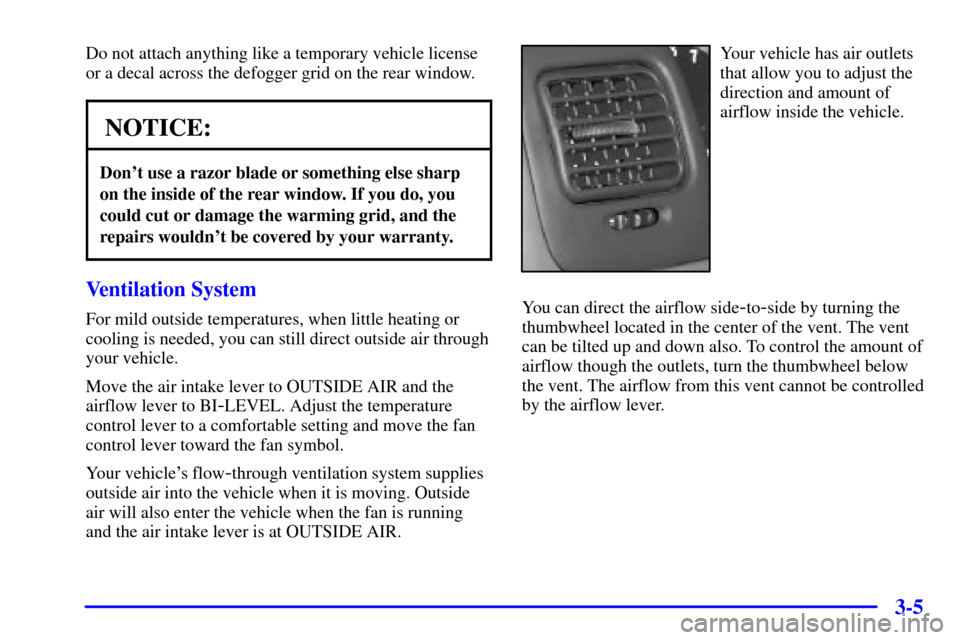
Your vehicle has air outlets
that allow you to adjust the
direction and amount of
airflow inside the vehicle.
You can direct the airflow side
-to-side by turning the
thumbwheel located in the center of the vent. The vent
can be tilted up and down also. To control the amount of
airflow though the outlets, turn the thumbwheel below
the vent. The airflow from this vent cannot be controlled
by the airflow lever.
Page 221 of 391
5-
5-1
Section 5 Problems on the Road
Here you'll find what to do about some problems that can occur on the road.
5
-2 Hazard Warning Flashers
5
-2 Other Warning Devices
5
-3 Jump Starting
5
-8 Towing Your Vehicle5
-9 Engine Overheating
5
-11 Cooling System
5
-18 If a Tire Goes Flat
5
-18 Changing a Flat Tire
5
-31 If You're Stuck: In Sand, Mud, Ice or Snow
Page 229 of 391
5-9
Engine Overheating
You will find a coolant temperature gage on your
vehicle's instrument panel cluster. See ªEngine Coolant
Temperature Gageº in the Index.
If Steam Is Coming From Your Engine
CAUTION:
Steam from an overheated engine can burn you
badly, even if you just open the hood. Stay away
from the engine if you see or hear steam coming
from it. Just turn it off and get everyone away
from the vehicle until it cools down. Wait until
there is no sign of steam or coolant before you
open the hood.
If you keep driving when your engine is
overheated, the liquids in it can catch fire. You or
others could be badly burned. Stop your engine
if it overheats, and get out of the vehicle until the
engine is cool.
NOTICE:
If your engine catches fire because you keep
driving with no coolant, your vehicle can be
badly damaged. The costly repairs would not be
covered by your warranty.
Page 284 of 391

6-32
Engine Coolant
The following explains your cooling system and how
to add coolant when it is low. If you have a problem
with engine overheating, see ªEngine Overheatingº
in the Index.
A 50/50 mixture of clean, drinkable water and the
proper coolant will:
�Give freezing protection down to
-33�F (-36�C).
�Give boiling protection up to 258�F (125�C).
�Protect against rust and corrosion.
�Help keep the proper engine temperature.
�Let the warning lights and gages work as
they should.
What to Use
Use a mixture of one-half clean, drinkable water and
one
-half coolant that meets GM Specification 1825-M,
which won't damage aluminum parts. You can also use a
recycled coolant conforming to GM Specification 1825
-M
with a complete coolant flush and refill. If you use this
coolant mixture, you don't need to add anything else.
CAUTION:
Adding only plain water to your cooling system
can be dangerous. Plain water, or some other
liquid like alcohol, can boil before the proper
coolant mixture will. Your vehicle's coolant
warning system is set for the proper coolant
mixture. With plain water or the wrong mixture,
your engine could get too hot but you wouldn't
get the overheat warning. Your engine could
catch fire and you or others could be burned.
Use a 50/50 mixture of clean, drinkable water
and the proper coolant.
Page 287 of 391
6-35
Radiator Pressure Cap
NOTICE:
Your radiator cap is a 15.6 psi (110 kPa)
pressure
-type cap and must be tightly installed to
prevent coolant loss and possible engine damage
from overheating. Be sure the arrows on the cap
line up with the overflow tube on the radiator
filler neck.
Power Steering Fluid
When to Check Power Steering Fluid
It is not necessary to regularly check power steering
fluid unless you suspect there is a leak in the system
or you hear an unusual noise. A fluid loss in this system
could indicate a problem. Have the system inspected
and repaired.
Page 298 of 391

6-46 Dome Lamp
1. Gently pry the dome lamp lens from the lamp
assembly using a screwdriver.
2. Remove the bulb by gently opening the retaining clip
and sliding the bulb out.
3. Insert a new bulb. Make sure that it is
seated properly.
4. Snap the dome lamp lens back into the dome
lamp assembly.
Tires
Your new vehicle comes with high-quality tires made by
a leading tire manufacturer. If you ever have questions
about your tire warranty and where to obtain service,
see your Chevrolet Warranty booklet for details.
CAUTION:
Poorly maintained and improperly used tires
are dangerous.
�Overloading your tires can cause
overheating as a result of too much friction.
You could have an air
-out and a serious
accident. See ªLoading Your Vehicleº in
the Index.
�Underinflated tires pose the same danger
as overloaded tires. The resulting accident
could cause serious injury. Check all tires
frequently to maintain the recommended
pressure. Tire pressure should be checked
when your tires are cold.
�Overinflated tires are more likely to be
cut, punctured or broken by a sudden
impact
-- such as when you hit a pothole.
Keep tires at the recommended pressure.
�Worn, old tires can cause accidents. If your
tread is badly worn, or if your tires have
been damaged, replace them.


