Page 4 of 351
Table of Contents
Windows
Keys and Door Locks
Remote Keyless Entry System
Remote Trunk Release
Automatic Transaxle
Parking Brake
Tilt Wheel
Turn Signal/Multifunction Lever
Windshield WipersCruise Control (If Equipped)
Exterior and Interior Lamps
Mirrors
Storage Compartments
Convenience Net (If Equipped)
Accessory Power Outlet
Sunroof (Option)
Instrument Panel, Warning Lights and Gages Seats and Seat Controls
Safety BeltsSupplemental Restraint System (SRS)
Restraint Systems for Children
Section
1
Section
2
Seats and Restraint Systems
Features and Controls
ii
Page 101 of 351
2-36 Cruise Control (If Equipped)
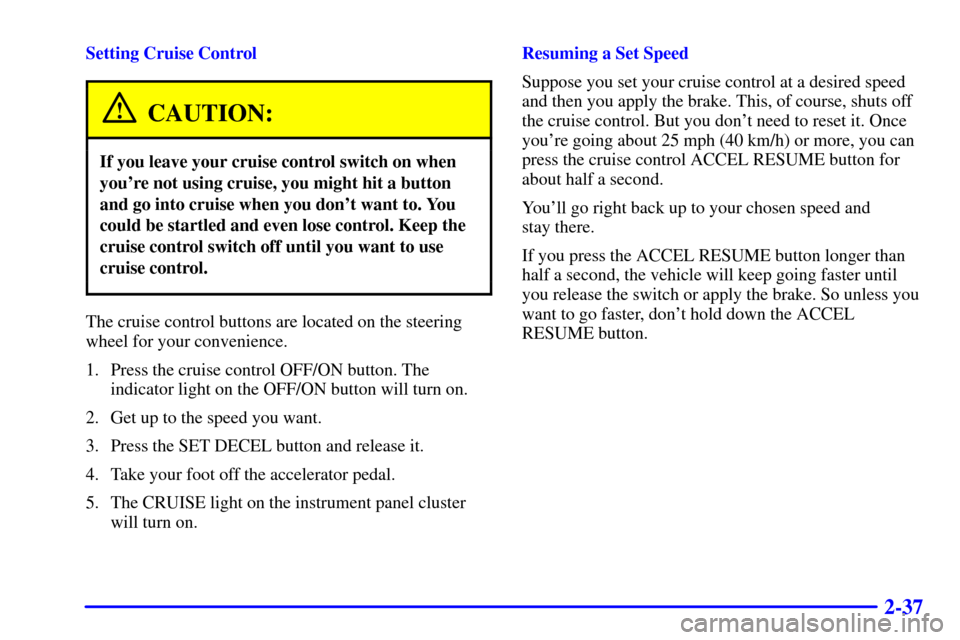
With cruise control, you can maintain a speed of about
25 mph (40 km/h) or more without keeping your foot
on the accelerator. This can really help on long trips.
Cruise control does not work at speeds below
25 mph (40 km/h).
When you apply your brake, the cruise control shuts off.
CAUTION:
�Cruise control can be dangerous where you
can't drive safely at a steady speed. So,
don't use your cruise control on winding
roads or in heavy traffic.
�Cruise control can be dangerous on
slippery roads. On such roads, fast changes
in tire traction can cause needless wheel
spinning, and you could lose control. Don't
use cruise control on slippery roads.
Page 102 of 351
2-37
Setting Cruise Control
CAUTION:
If you leave your cruise control switch on when
you're not using cruise, you might hit a button
and go into cruise when you don't want to. You
could be startled and even lose control. Keep the
cruise control switch off until you want to use
cruise control.
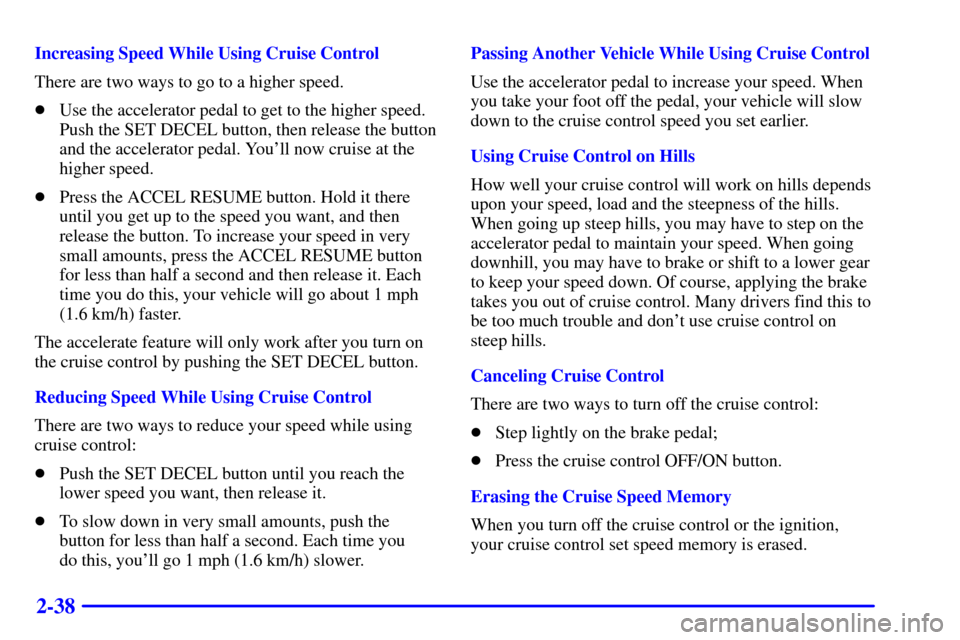
The cruise control buttons are located on the steering
wheel for your convenience.
1. Press the cruise control OFF/ON button. The
indicator light on the OFF/ON button will turn on.
2. Get up to the speed you want.
3. Press the SET DECEL button and release it.
4. Take your foot off the accelerator pedal.
5. The CRUISE light on the instrument panel cluster
will turn on.Resuming a Set Speed
Suppose you set your cruise control at a desired speed
and then you apply the brake. This, of course, shuts off
the cruise control. But you don't need to reset it. Once
you're going about 25 mph (40 km/h) or more, you can
press the cruise control ACCEL RESUME button for
about half a second.
You'll go right back up to your chosen speed and
stay there.
If you press the ACCEL RESUME button longer than
half a second, the vehicle will keep going faster until
you release the switch or apply the brake. So unless you
want to go faster, don't hold down the ACCEL
RESUME button.
Page 103 of 351
2-38
Increasing Speed While Using Cruise Control
There are two ways to go to a higher speed.
�Use the accelerator pedal to get to the higher speed.
Push the SET DECEL button, then release the button
and the accelerator pedal. You'll now cruise at the
higher speed.
�Press the ACCEL RESUME button. Hold it there
until you get up to the speed you want, and then
release the button. To increase your speed in very
small amounts, press the ACCEL RESUME button
for less than half a second and then release it. Each
time you do this, your vehicle will go about 1 mph
(1.6 km/h) faster.
The accelerate feature will only work after you turn on
the cruise control by pushing the SET DECEL button.
Reducing Speed While Using Cruise Control
There are two ways to reduce your speed while using
cruise control:
�Push the SET DECEL button until you reach the
lower speed you want, then release it.
�To slow down in very small amounts, push the
button for less than half a second. Each time you
do this, you'll go 1 mph (1.6 km/h) slower.Passing Another Vehicle While Using Cruise Control
Use the accelerator pedal to increase your speed. When
you take your foot off the pedal, your vehicle will slow
down to the cruise control speed you set earlier.
Using Cruise Control on Hills
How well your cruise control will work on hills depends
upon your speed, load and the steepness of the hills.
When going up steep hills, you may have to step on the
accelerator pedal to maintain your speed. When going
downhill, you may have to brake or shift to a lower gear
to keep your speed down. Of course, applying the brake
takes you out of cruise control. Many drivers find this to
be too much trouble and don't use cruise control on
steep hills.
Canceling Cruise Control
There are two ways to turn off the cruise control:
�Step lightly on the brake pedal;
�Press the cruise control OFF/ON button.
Erasing the Cruise Speed Memory
When you turn off the cruise control or the ignition,
your cruise control set speed memory is erased.
Page 114 of 351
2-49
The main components of your instrument panel are the following:
A. Side Window Defogger Vents
B. Vent Outlets
C. Instrument Panel Brightness Control
D. Fog Lamp Button (If Equipped)
E. Turn Signal/Multifunction Lever
F. Cruise Control Buttons (If Equipped)
G. Instrument Panel Cluster
H. Windshield Wiper/Washer Lever
I. Ignition Switch
J. Hazard Warning Flashers Button
K. Instrument Panel Fuse BlocksL. Instrument Panel Cupholder
M. Remote Trunk Release Button
N. Hood Release
O. Tilt Wheel Lever
P. Parking Brake
Q. Horn
R. Audio System
S. Cigarette Lighter
T. Ashtray
U. Accessory Power Outlet
V. Climate Control System
Page 129 of 351
2-64 Cruise Light (If Equipped)
The CRUISE light comes
on whenever you set your
cruise control.
Low Washer Light
The LOW WASH light will
come on briefly when you
turn on the ignition.
It will also stay on or come on and chime, if the fluid
reservoir is less than one
-third full.
Page 297 of 351
6-58
Instrument Panel Fuse Block-Passenger's SideFuse Usage
A Instrument Panel Lights, Dimmer
B Cruise Control Switches
C Climate Control System
D Cruise Control
E Fog Lamps
F Interior Lamps, Body Function
Control Module
G Radio
H Sunroof
CIRCUIT BRKR
PWR WNDWSPower Windows
MICRO RELAY
FOG LPSFog Lamps
Page 332 of 351
7-30 Throttle System Inspection
Inspect the throttle system for interference or binding,
and for damaged or missing parts. Replace parts as
needed. Replace any components that have high effort
or excessive wear. Do not lubricate accelerator and
cruise control cables.
Brake System Inspection
Inspect the complete system. Inspect brake lines and
hoses for proper hook
-up, binding, leaks, cracks,
chafing, etc. Inspect disc brake pads for wear and rotors
for surface condition. Also inspect drum brake linings
for wear and cracks. Inspect other brake parts, including
drums, wheel cylinders, calipers, parking brake, etc. The
parking brake is self
-adjusting and no manual
adjustment is required. You may need to have your
brakes inspected more often if your driving habits or
conditions result in frequent braking.