Page 4 of 392
Table of Contents
Windows
Keys and Door Locks
Remote Keyless Entry System (If Equipped)
Remote Trunk Release
Automatic Transaxle
Parking Brake
Tilt Wheel
Turn Signal/Multifunction Lever
Windshield Wipers
Cruise Control (If Equipped)Exterior and Interior Lamps
Mirrors
Storage Compartments
Trunk Convenience Net (If Equipped)
Accessory Power Outlet/Auxiliary Power Connection
OnStar® System (If Equipped)
Power Sunroof (Option)
HomeLink® Transmitter (Option)
Instrument Panel, Warning Lights and Gages
Driver Information Center (Option) Seats and Seat Controls
Safety BeltsAir Bag Systems
Restraint Systems for Children
Section
1
Section
2
Seats and Restraint Systems
Features and Controls
ii
Page 13 of 392
1-
1-1
Section 1 Seats and Restraint Systems
Here you'll find information about the seats in your vehicle and how to use your safety belts properly. You can also
learn about some things you should not do with air bags and safety belts.
1
-2 Seats and Seat Controls
1
-8 Safety Belts: They're for Everyone
1
-13 Here Are Questions Many People Ask
About Safety Belts
-- and the Answers
1
-14 How to Wear Safety Belts Properly
1
-14 Driver Position
1
-21 Safety Belt Use During Pregnancy
1
-22 Right Front Passenger Position
1
-23 Air Bag Systems
1
-32 Center Front Passenger Position1
-33 Rear Seat Passengers
1
-37 Rear Safety Belt Comfort Guides for
Children and Small Adults
1
-39 Children
1
-43 Restraint Systems for Children
1
-55 Older Children
1
-58 Safety Belt Extender
1
-58 Checking Your Restraint Systems
1
-58 Replacing Restraint System Parts After
a Crash
Page 14 of 392
1-2
Seats and Seat Controls
This section tells you how to adjust the seats and
explains reclining seatbacks and head restraints.
Manual Front Seat
CAUTION:
You can lose control of the vehicle if you try to
adjust a manual driver's seat while the vehicle is
moving. The sudden movement could startle and
confuse you, or make you push a pedal when you
don't want to. Adjust the driver's seat only when
the vehicle is not moving.
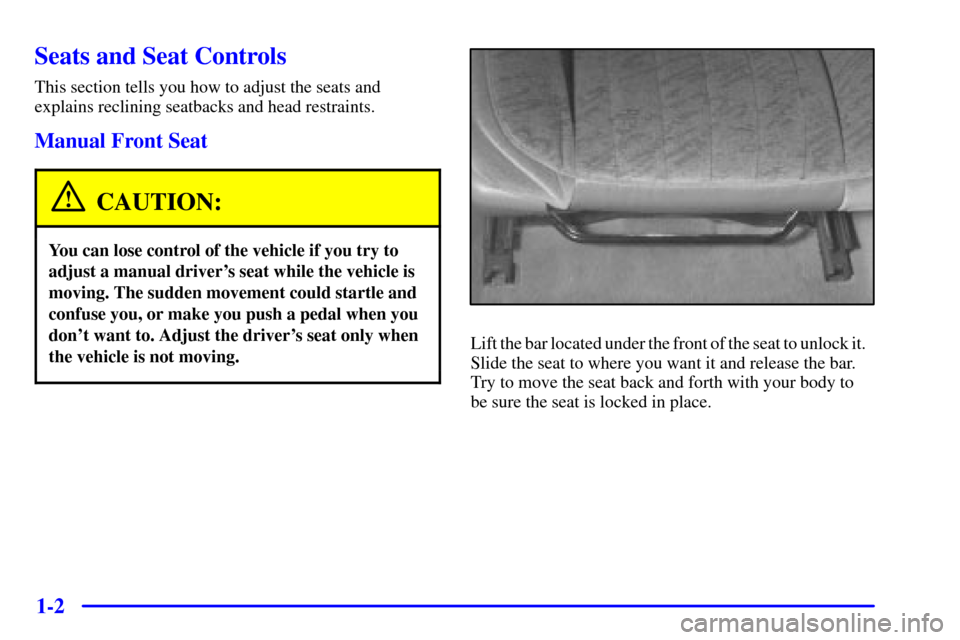
Lift the bar located under the front of the seat to unlock it.
Slide the seat to where you want it and release the bar.
Try to move the seat back and forth with your body to
be sure the seat is locked in place.
Page 15 of 392
1-3 6-Way Power Seat (If Equipped)
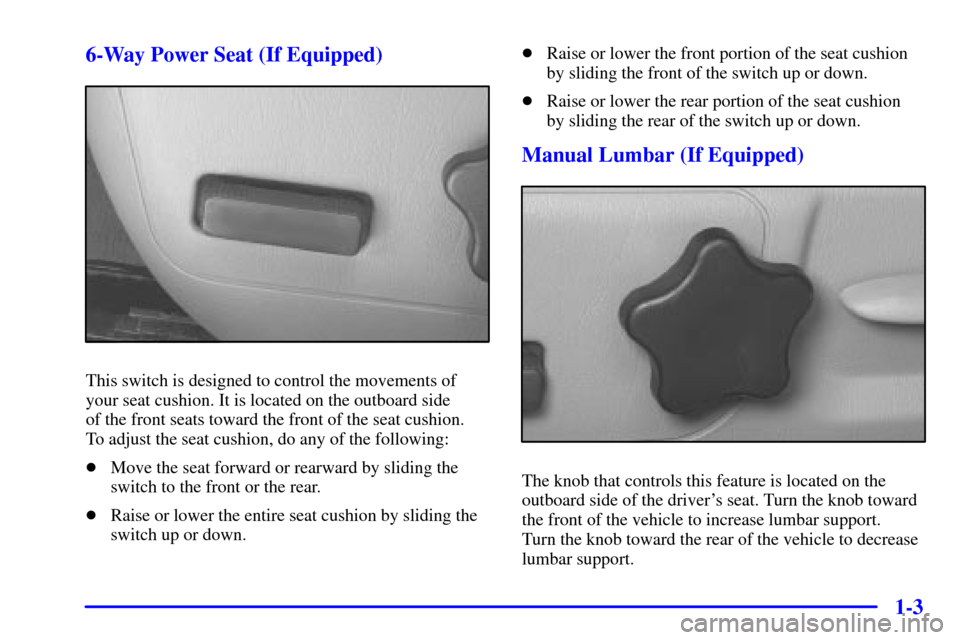
This switch is designed to control the movements of
your seat cushion. It is located on the outboard side
of the front seats toward the front of the seat cushion.
To adjust the seat cushion, do any of the following:
�Move the seat forward or rearward by sliding the
switch to the front or the rear.
�Raise or lower the entire seat cushion by sliding the
switch up or down.�Raise or lower the front portion of the seat cushion
by sliding the front of the switch up or down.
�Raise or lower the rear portion of the seat cushion
by sliding the rear of the switch up or down.
Manual Lumbar (If Equipped)
The knob that controls this feature is located on the
outboard side of the driver's seat. Turn the knob toward
the front of the vehicle to increase lumbar support.
Turn the knob toward the rear of the vehicle to decrease
lumbar support.
Page 16 of 392
1-4 Heated Front Seat (Option)
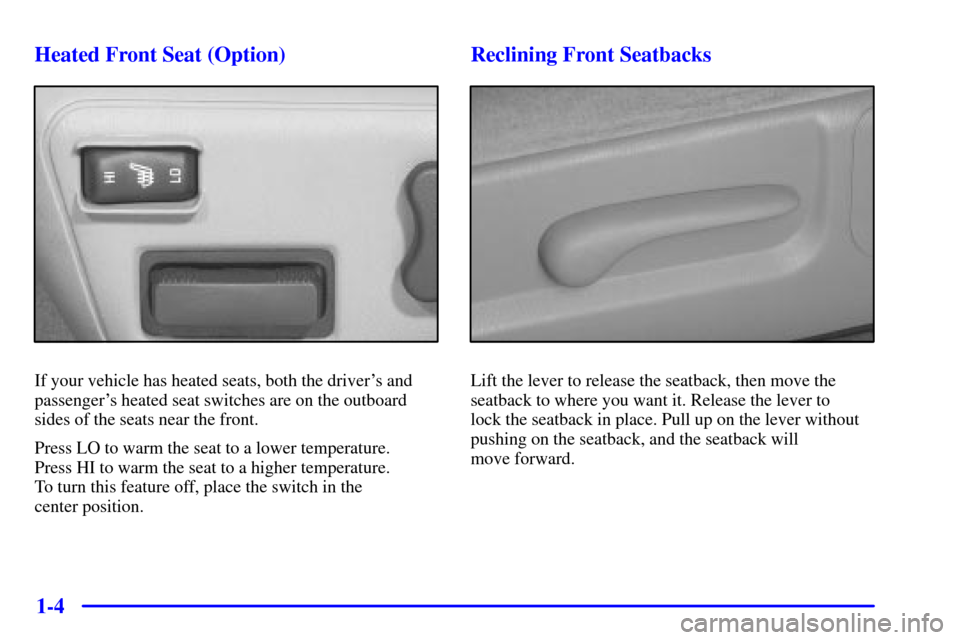
If your vehicle has heated seats, both the driver's and
passenger's heated seat switches are on the outboard
sides of the seats near the front.
Press LO to warm the seat to a lower temperature.
Press HI to warm the seat to a higher temperature.
To turn this feature off, place the switch in the
center position.
Reclining Front Seatbacks
Lift the lever to release the seatback, then move the
seatback to where you want it. Release the lever to
lock the seatback in place. Pull up on the lever without
pushing on the seatback, and the seatback will
move forward.
Page 21 of 392
1-9
CAUTION:
It is extremely dangerous to ride in a cargo area,
inside or outside of a vehicle. In a collision,
people riding in these areas are more likely to be
seriously injured or killed. Do not allow people
to ride in any area of your vehicle that is not
equipped with seats and safety belts. Be sure
everyone in your vehicle is in a seat and using a
safety belt properly.
Your vehicle has a light
that comes on as a reminder
to buckle up. See ªSafety
Belt Reminder Lightº in
the Index.In most states and Canadian provinces, the law says to
wear safety belts. Here's why: They work.
You never know if you'll be in a crash. If you do have
a crash, you don't know if it will be a bad one.
A few crashes are mild, and some crashes can be so
serious that even buckled up a person wouldn't survive.
But most crashes are in between. In many of them,
people who buckle up can survive and sometimes walk
away. Without belts they could have been badly hurt
or killed.
After more than 30 years of safety belts in vehicles,
the facts are clear. In most crashes buckling up does
matter ... a lot!
Page 26 of 392
1-14
How to Wear Safety Belts Properly
Adults
This part is only for people of adult size.
Be aware that there are special things to know about
safety belts and children. And there are different
rules for smaller children and babies. If a child will be
riding in your vehicle, see the part of this manual
called ªChildren.º Follow those rules for
everyone's protection.
First, you'll want to know which restraint systems
your vehicle has.
We'll start with the driver position.
Driver Position
This part describes the driver's restraint system.
Lap-Shoulder Belt
The driver has a lap-shoulder belt. Here's how to wear
it properly.
1. Close and lock the door.
2. Adjust the seat so you can sit up straight.
To see how, see ªSeatsº in the Index.
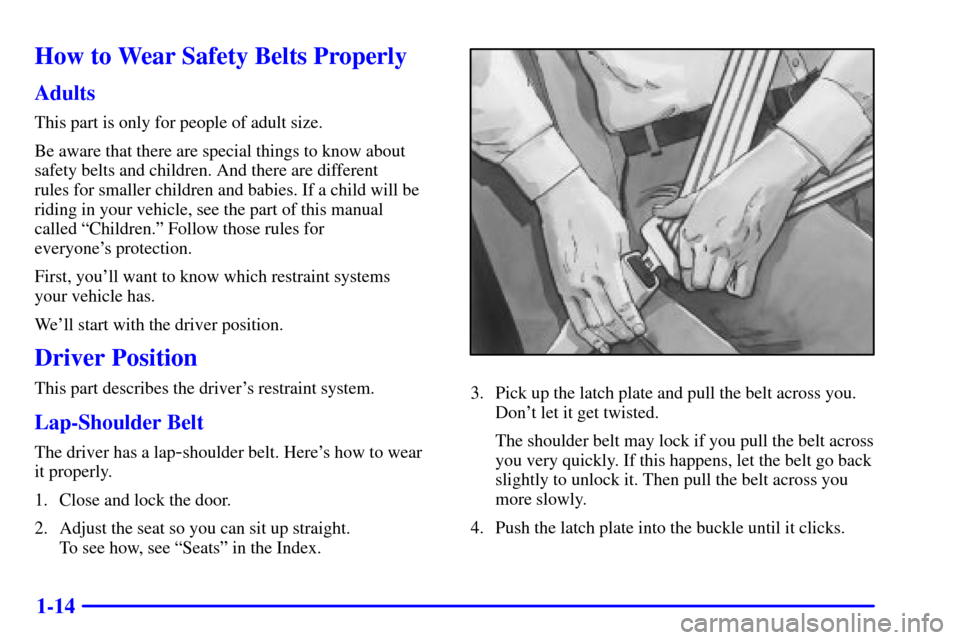
3. Pick up the latch plate and pull the belt across you.
Don't let it get twisted.
The shoulder belt may lock if you pull the belt across
you very quickly. If this happens, let the belt go back
slightly to unlock it. Then pull the belt across you
more slowly.
4. Push the latch plate into the buckle until it clicks.
Page 49 of 392
1-37
Rear Safety Belt Comfort Guides for
Children and Small Adults
Rear shoulder belt comfort guides will provide
added safety belt comfort for older children who
have outgrown booster seats and for small adults.
When installed on a shoulder belt, the comfort guide
better positions the belt away from the neck and head.
There is one guide for each outside passenger position
in the rear seat. To provide added safety belt comfort
for children who have outgrown child restraints and for
smaller adults, the comfort guides may be installed on
the shoulder belts. Here's how to install a comfort guide
and use the safety belt:
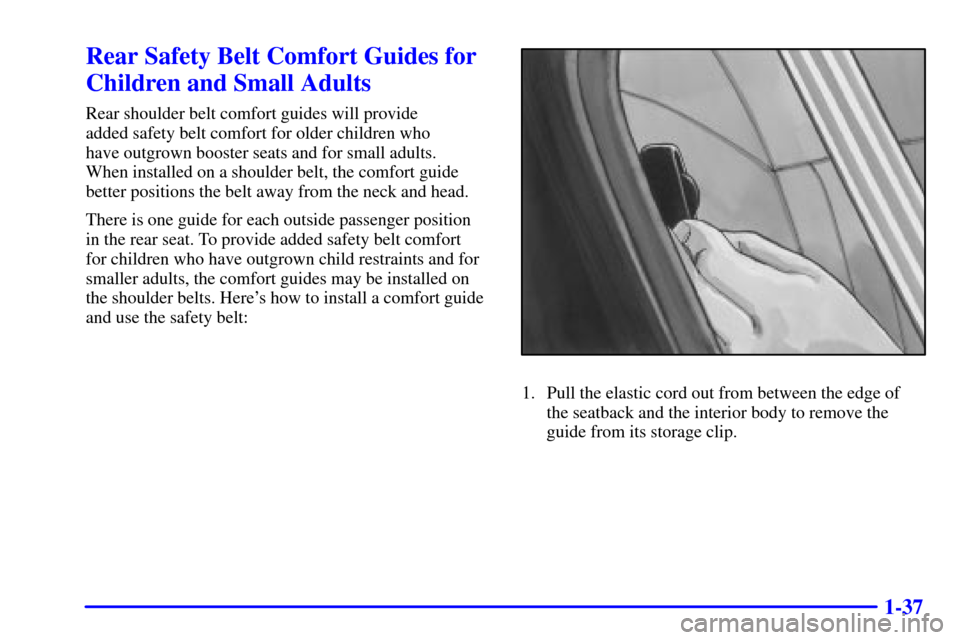
1. Pull the elastic cord out from between the edge of
the seatback and the interior body to remove the
guide from its storage clip.