Page 127 of 392

2-57
Battery Rundown Protection
Your vehicle has a feature to help prevent you from
draining the battery in case you accidentally leave the
interior courtesy lamps, reading/map lamps, visor vanity
lamps, trunk lamp or glove box lamps on. If you leave
any of these lamps on, they will automatically turn off
after 10 minutes, if the ignition is in OFF. The lamps
won't come back on again until you do the following:
�Turn the ignition on or
�turn the lamp switch off, then on again.
If your vehicle has less than 15 miles (25 km) on the
odometer, the battery saver will turn off the lamps after
only three minutes.
Battery rundown protection will also work if the
headlamps are left on. After having been left on for
10 minutes, the headlamps and the parking lamps will
flash three times. They will remain on for one more
minute before being turned off automatically.
Mirrors
Adjust all the mirrors so you can see clearly when you
are sitting in a comfortable driving position.
Inside Day/Night Rearview Mirror with
Map Lamps
To reduce glare from headlamps behind you, pull the
lever at the bottom of the mirror toward you (to the
night position). To return the mirror back to the day
position, push the lever away from you.
There are two map lamps located on the bottom of the
mirror. Each lamp is turned on and off by pressing the
button next to the lamp.
Page 131 of 392

2-61
Storage Compartments
Glove Box
Use the door key to lock and unlock the glove box.
To open, lift the latch.
Front Armrest (If Equipped)
If your vehicle has the split bench front seat, there is an
armrest located in the center of the seat. Dual cupholders
are located in front of the armrest.
Center Console (If Equipped)
The console has cupholders, a cassette tape storage
area and a coinholder. To open the console's storage
area, pull up on the latch located in the front of the
console lid.
Rear Seat Armrest and Cupholder
(If Equipped)
If your vehicle has the split folding rear seat, there will
be two cupholders in the rear seat armrest. To access
them, pull down on the cloth strap located toward the
top of your center back seat cushion. You will then have
access to the dual cupholders.
Trunk Convenience Net (If Equipped)
Your vehicle may have a convenience net. You'll see it
on the back wall of the trunk.
Put small loads, like grocery bags, behind or inside the
net. It can help keep them from falling over during sharp
turns or quick starts and stops.
The net isn't for larger, heavier loads. Store those in the
trunk as far forward as you can.
You can unhook the net so that it will lie flat when
you're not using it.
Ashtrays and Lighter
The front ashtray may be on the instrument panel or
on the console. To remove the instrument panel ashtray,
open it, push down on the locking tab and pull out
the ashtray.
To remove the console ashtray, open the ashtray door,
lift up on the ashtray and pull it out.
If your vehicle is equipped with a center console, a rear
ashtray is located behind a small door at the rear of the
console. Push on the right side of the door. The ashtray
will then turn to the right for usage. You can only access
the ashtray by pushing on the door's right side.
Page 145 of 392
2-75
The main components of your instrument panel are listed here:
A. Instrument Panel Fuse Block
B. Traction Control On/Off Switch (If Equipped)
C. Multifunction Lever
D. Audio Steering Wheel Controls (Option)
E. Hazard Warning Flasher Switch
F. Audio System
G. Exterior Lamp ControlsH. Remote Trunk Release
I. Hood Release
J. Steering Wheel Cruise Control Switches
(If Equipped)
K. Ignition Switch
L. Center Console Shift Lever (If Equipped)
M. Climate Controls
Page 166 of 392
2-96
Service Vehicle Soon
United States Canada
This message will come on if you have engine problems.
These problems may not be obvious and may not
affect vehicle performance or durability. Consult a
qualified dealership for necessary repairs to maintain
top vehicle performance.
This message may also appear if there are electrical
problems with the trunk release sensor. See ªTrunk
Release Sensorº in the Index for more information.Trunk OpenUnited States Canada
This message will appear if the trunk is not completely
closed and the ignition is in ON.
If you are in a forward or reverse gear position you will
also hear four chimes.
If this message flashes for one minute after the ignition
is turned on, the trunk release sensor is turned off.
See ªTrunk Release Sensorº in the Index for
more information.
Page 242 of 392
4-26
Winter Driving
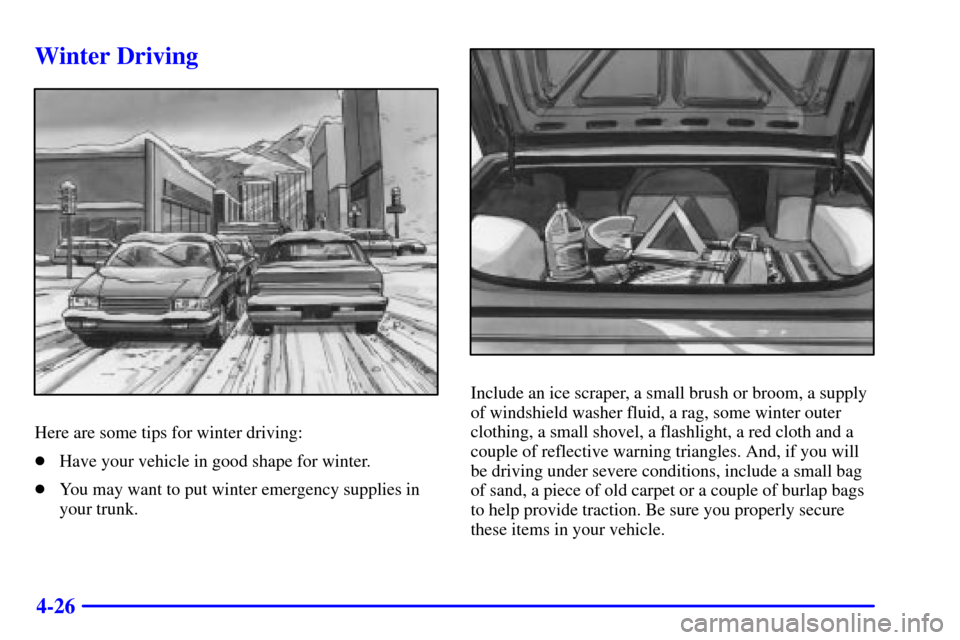
Here are some tips for winter driving:
�Have your vehicle in good shape for winter.
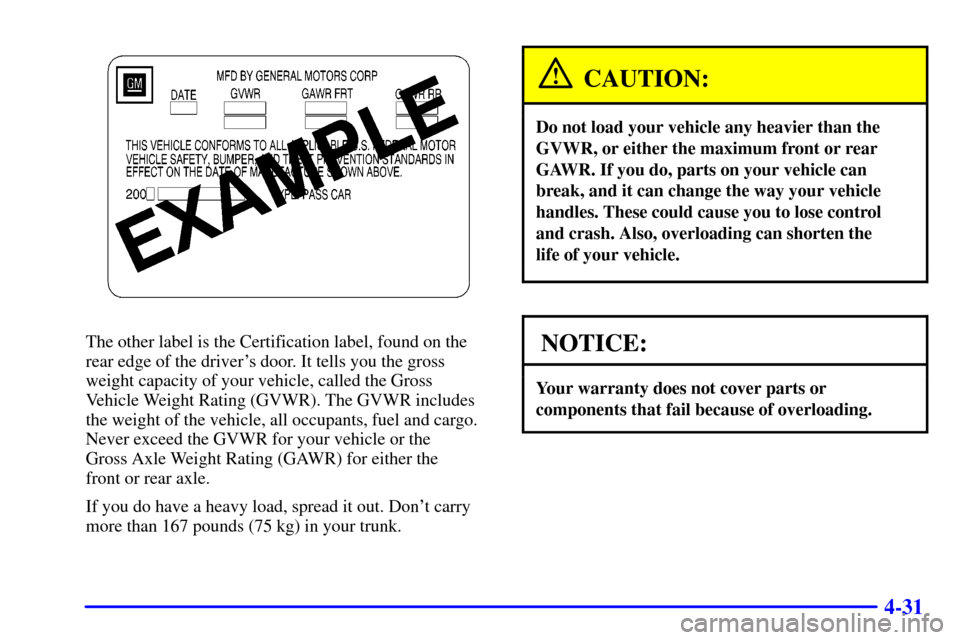
�You may want to put winter emergency supplies in
your trunk.
Include an ice scraper, a small brush or broom, a supply
of windshield washer fluid, a rag, some winter outer
clothing, a small shovel, a flashlight, a red cloth and a
couple of reflective warning triangles. And, if you will
be driving under severe conditions, include a small bag
of sand, a piece of old carpet or a couple of burlap bags
to help provide traction. Be sure you properly secure
these items in your vehicle.
Page 246 of 392
4-30
Run your engine only as long as you must. This saves
fuel. When you run the engine, make it go a little faster
than just idle. That is, push the accelerator slightly. This
uses less fuel for the heat that you get and it keeps the
battery charged. You will need a well
-charged battery to
restart the vehicle, and possibly for signaling later on
with your headlamps. Let the heater run for a while.
Then, shut the engine off and close the window almost
all the way to preserve the heat. Start the engine again
and repeat this only when you feel really uncomfortable
from the cold. But do it as little as possible. Preserve the
fuel as long as you can. To help keep warm, you can get
out of the vehicle and do some fairly vigorous exercises
every half hour or so until help comes.
Recreational Vehicle Towing
Your vehicle was not designed to be towed with all four
wheels on the ground. If your vehicle must be towed,
see ªTowing Your Vehicleº in the Index.
NOTICE:
Towing your vehicle with all four wheels on the
ground will damage drivetrain components.
Loading Your Vehicle
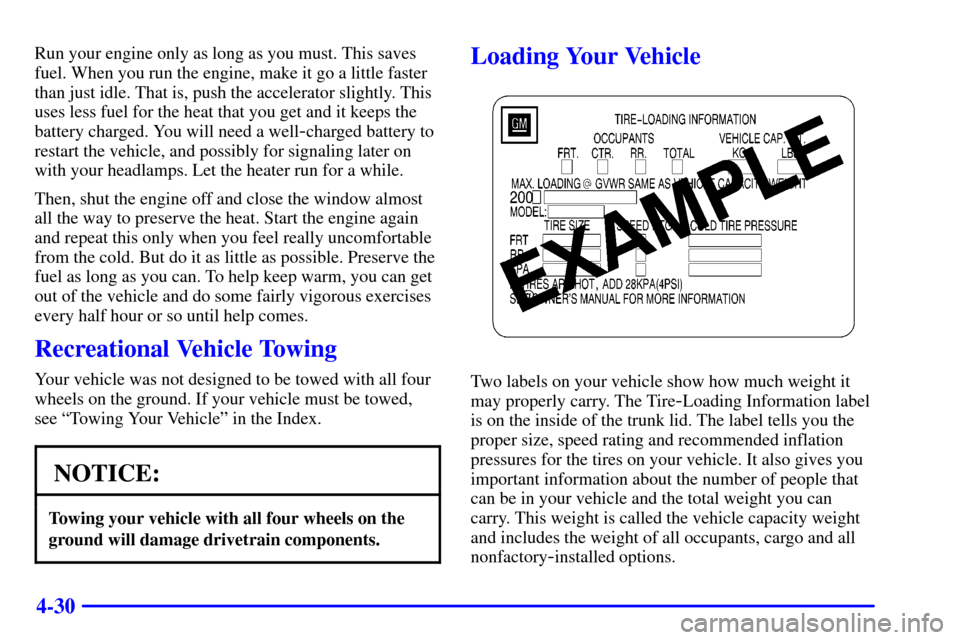
Two labels on your vehicle show how much weight it
may properly carry. The Tire
-Loading Information label
is on the inside of the trunk lid. The label tells you the
proper size, speed rating and recommended inflation
pressures for the tires on your vehicle. It also gives you
important information about the number of people that
can be in your vehicle and the total weight you can
carry. This weight is called the vehicle capacity weight
and includes the weight of all occupants, cargo and all
nonfactory
-installed options.
Page 247 of 392
4-31
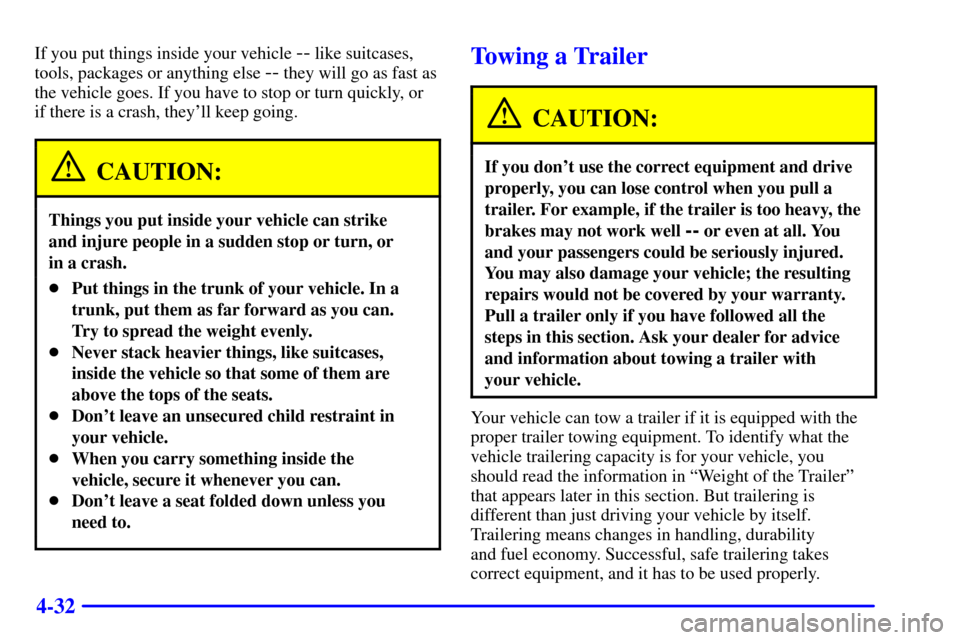
The other label is the Certification label, found on the
rear edge of the driver's door. It tells you the gross
weight capacity of your vehicle, called the Gross
Vehicle Weight Rating (GVWR). The GVWR includes
the weight of the vehicle, all occupants, fuel and cargo.
Never exceed the GVWR for your vehicle or the
Gross Axle Weight Rating (GAWR) for either the
front or rear axle.
If you do have a heavy load, spread it out. Don't carry
more than 167 pounds (75 kg) in your trunk.
CAUTION:
Do not load your vehicle any heavier than the
GVWR, or either the maximum front or rear
GAWR. If you do, parts on your vehicle can
break, and it can change the way your vehicle
handles. These could cause you to lose control
and crash. Also, overloading can shorten the
life of your vehicle.
NOTICE:
Your warranty does not cover parts or
components that fail because of overloading.
Page 248 of 392
4-32
If you put things inside your vehicle -- like suitcases,
tools, packages or anything else
-- they will go as fast as
the vehicle goes. If you have to stop or turn quickly, or
if there is a crash, they'll keep going.
CAUTION:
Things you put inside your vehicle can strike
and injure people in a sudden stop or turn, or
in a crash.
�Put things in the trunk of your vehicle. In a
trunk, put them as far forward as you can.
Try to spread the weight evenly.
�Never stack heavier things, like suitcases,
inside the vehicle so that some of them are
above the tops of the seats.
�Don't leave an unsecured child restraint in
your vehicle.
�When you carry something inside the
vehicle, secure it whenever you can.
�Don't leave a seat folded down unless you
need to.
Towing a Trailer
CAUTION:
If you don't use the correct equipment and drive
properly, you can lose control when you pull a
trailer. For example, if the trailer is too heavy, the
brakes may not work well
-- or even at all. You
and your passengers could be seriously injured.
You may also damage your vehicle; the resulting
repairs would not be covered by your warranty.
Pull a trailer only if you have followed all the
steps in this section. Ask your dealer for advice
and information about towing a trailer with
your vehicle.
Your vehicle can tow a trailer if it is equipped with the
proper trailer towing equipment. To identify what the
vehicle trailering capacity is for your vehicle, you
should read the information in ªWeight of the Trailerº
that appears later in this section. But trailering is
different than just driving your vehicle by itself.
Trailering means changes in handling, durability
and fuel economy. Successful, safe trailering takes
correct equipment, and it has to be used properly.