Page 273 of 392
5-19
3400 V6 engine: There are two bleed valves. One is
located on the thermostat housing. The other is
located on the thermostat bypass tube.
3800 V6 engine: There is one bleed valve.
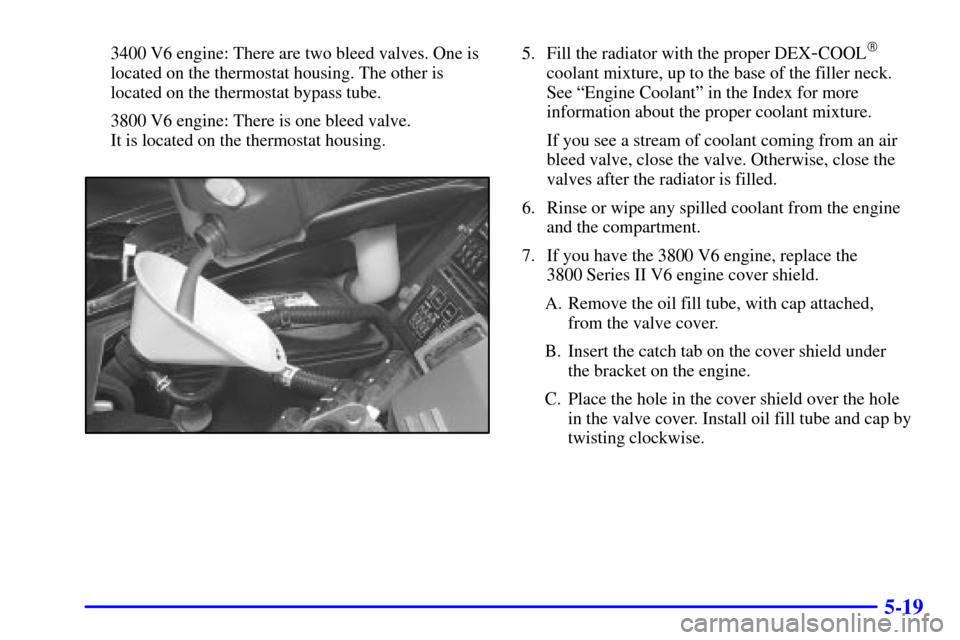
It is located on the thermostat housing.5. Fill the radiator with the proper DEX-COOL�
coolant mixture, up to the base of the filler neck.
See ªEngine Coolantº in the Index for more
information about the proper coolant mixture.
If you see a stream of coolant coming from an air
bleed valve, close the valve. Otherwise, close the
valves after the radiator is filled.
6. Rinse or wipe any spilled coolant from the engine
and the compartment.
7. If you have the 3800 V6 engine, replace the
3800 Series II V6 engine cover shield.
A. Remove the oil fill tube, with cap attached,
from the valve cover.
B. Insert the catch tab on the cover shield under
the bracket on the engine.
C. Place the hole in the cover shield over the hole
in the valve cover. Install oil fill tube and cap by
twisting clockwise.
Page 282 of 392
5-28
CAUTION:
Never use oil or grease on studs or nuts. If you
do, the nuts might come loose. Your wheel could
fall off, causing a serious accident.
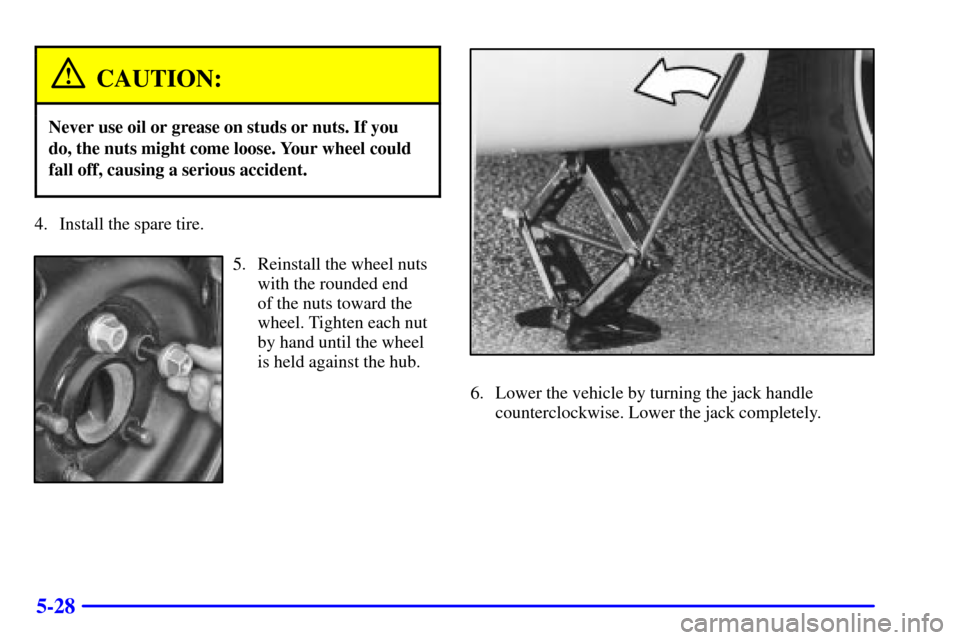
4. Install the spare tire.
5. Reinstall the wheel nuts
with the rounded end
of the nuts toward the
wheel. Tighten each nut
by hand until the wheel
is held against the hub.
6. Lower the vehicle by turning the jack handle
counterclockwise. Lower the jack completely.
Page 288 of 392
6-
6-1
Section 6 Service and Appearance Care
Here you will find information about the care of your vehicle. This section begins with service and fuel information,
and then it shows how to check important fluid and lubricant levels. There is also technical information about your
vehicle, and a part devoted to its appearance care.
6
-2 Service
6
-3 Fuel
6
-5 Fuels in Foreign Countries
6
-5 Filling Your Tank
6
-8 Filling a Portable Fuel Container
6
-8 Checking Things Under the Hood
6
-12 Engine Oil
6
-19 Engine Air Cleaner/Filter
6
-20 Passenger Compartment Air Filter
(If Equipped)
6
-21 Automatic Transaxle Fluid
6
-24 Engine Coolant
6
-28 Radiator Pressure Cap
6
-28 Power Steering Fluid
6
-29 Windshield Washer Fluid
6
-31 Brakes6
-34 Battery
6
-35 Bulb Replacement
6
-40 Windshield Wiper Blade Replacement
6
-41 Tires
6
-51 Appearance Care
6
-51 Cleaning the Inside of Your Vehicle
6
-53 Care of Safety Belts
6
-55 Cleaning the Outside of Your Vehicle
6
-57 Finish Damage
6
-58 GM Vehicle Care/Appearance Materials
6
-59 Vehicle Identification Number (VIN)
6
-59 Service Parts Identification Label
6
-60 Electrical System
6
-67 Replacement Bulbs
6
-67 Capacities and Specifications
6
-68 Normal Maintenance Replacement Parts
Page 292 of 392
6-5
To provide cleaner air, all gasolines in the United States
are now required to contain additives that will help
prevent deposits from forming in your engine and fuel
system, allowing your emission control system to
function properly. Therefore, you should not have
to add anything to the fuel. In addition, gasolines
containing oxygenates, such as ethers and ethanol, and
reformulated gasolines may be available in your area to
contribute to clean air. General Motors recommends that
you use these gasolines, particularly if they comply with
the specifications described earlier.
NOTICE:
Your vehicle was not designed for fuel that
contains methanol. Don't use it. It can corrode
metal parts in your fuel system and also damage
plastic and rubber parts. That damage wouldn't
be covered under your warranty.
Fuels in Foreign Countries
If you plan on driving in another country outside the
United States or Canada, the proper fuel may be hard
to find. Never use leaded gasoline or any other fuel not
recommended in the previous text on fuel. Costly repairs
caused by use of improper fuel wouldn't be covered by
your warranty.
To check on fuel availability, ask an auto club, or
contact a major oil company that does business in the
country where you'll be driving.
Filling Your Tank
CAUTION:
Gasoline vapor is highly flammable. It burns
violently, and that can cause very bad injuries.
Don't smoke if you're near gasoline or refueling
your vehicle. Keep sparks, flames and smoking
materials away from gasoline.
Page 295 of 392
6-8
Filling a Portable Fuel Container
CAUTION:
Never fill a portable fuel container while it is in
your vehicle. Static electricity discharge from the
container can ignite the gasoline vapor. You can
be badly burned and your vehicle damaged if this
occurs. To help avoid injury to you and others:
�Dispense gasoline only into
approved containers.
�Do not fill a container while it is inside a
vehicle, in a vehicle's trunk, pickup bed or
on any surface other than the ground.
�Bring the fill nozzle in contact with the
inside of the fill opening before operating
the nozzle. Contact should be maintained
until the filling is complete.
�Don't smoke while pumping gasoline.
Checking Things Under the Hood
CAUTION:
An electric fan under the hood can start up and
injure you even when the engine is not running.
Keep hands, clothing and tools away from any
underhood electric fan.
CAUTION:
Things that burn can get on hot engine parts and
start a fire. These include liquids like gasoline,
oil, coolant, brake fluid, windshield washer and
other fluids, and plastic or rubber. You or others
could be burned. Be careful not to drop or spill
things that will burn onto a hot engine.
Page 297 of 392
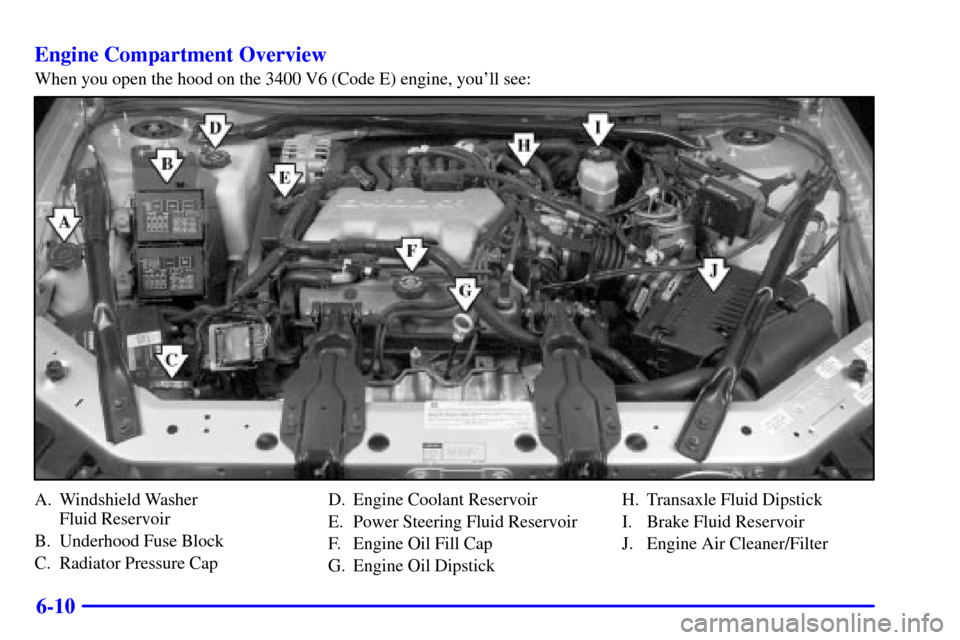
6-10 Engine Compartment Overview
When you open the hood on the 3400 V6 (Code E) engine, you'll see:
A. Windshield Washer
Fluid Reservoir
B. Underhood Fuse Block
C. Radiator Pressure CapD. Engine Coolant Reservoir
E. Power Steering Fluid Reservoir
F. Engine Oil Fill Cap
G. Engine Oil DipstickH. Transaxle Fluid Dipstick
I. Brake Fluid Reservoir
J. Engine Air Cleaner/Filter
Page 298 of 392
6-11
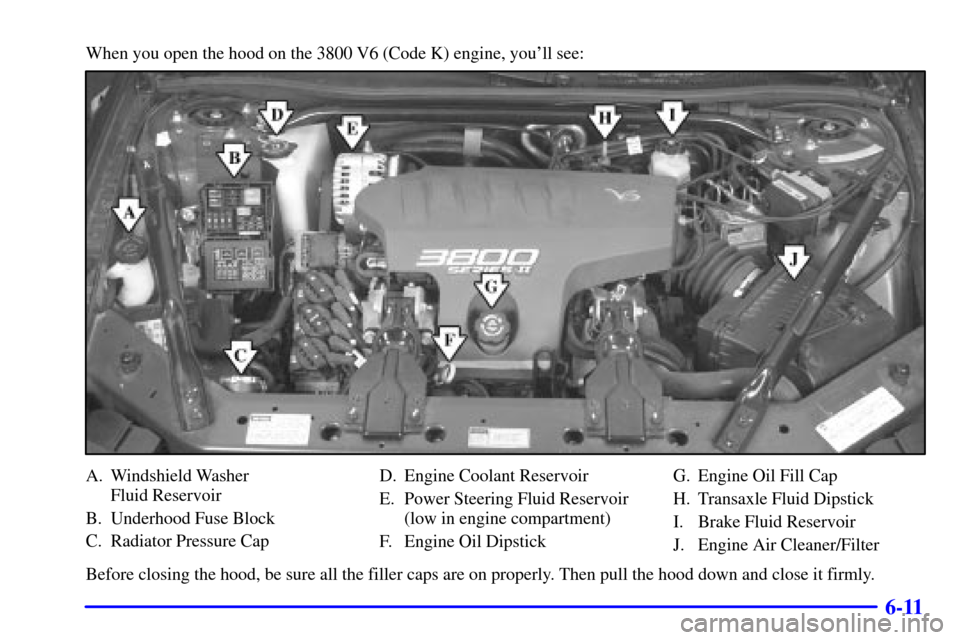
When you open the hood on the 3800 V6 (Code K) engine, you'll see:
A. Windshield Washer
Fluid Reservoir
B. Underhood Fuse Block
C. Radiator Pressure CapD. Engine Coolant Reservoir
E. Power Steering Fluid Reservoir
(low in engine compartment)
F. Engine Oil DipstickG. Engine Oil Fill Cap
H. Transaxle Fluid Dipstick
I. Brake Fluid Reservoir
J. Engine Air Cleaner/Filter
Before closing the hood, be sure all the filler caps are on properly. Then pull the hood down and close it firmly.
Page 299 of 392
6-12
Engine Oil
United States Canada
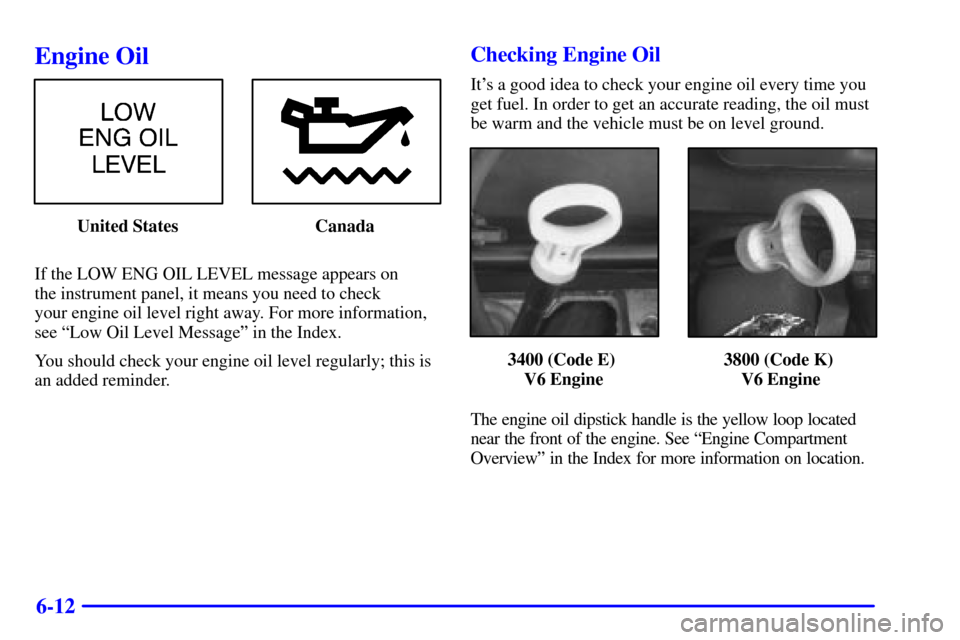
If the LOW ENG OIL LEVEL message appears on
the instrument panel, it means you need to check
your engine oil level right away. For more information,
see ªLow Oil Level Messageº in the Index.
You should check your engine oil level regularly; this is
an added reminder.
Checking Engine Oil
It's a good idea to check your engine oil every time you
get fuel. In order to get an accurate reading, the oil must
be warm and the vehicle must be on level ground.
3400 (Code E)
V6 Engine3800 (Code K)
V6 Engine
The engine oil dipstick handle is the yellow loop located
near the front of the engine. See ªEngine Compartment
Overviewº in the Index for more information on location.