Page 271 of 392
5-17
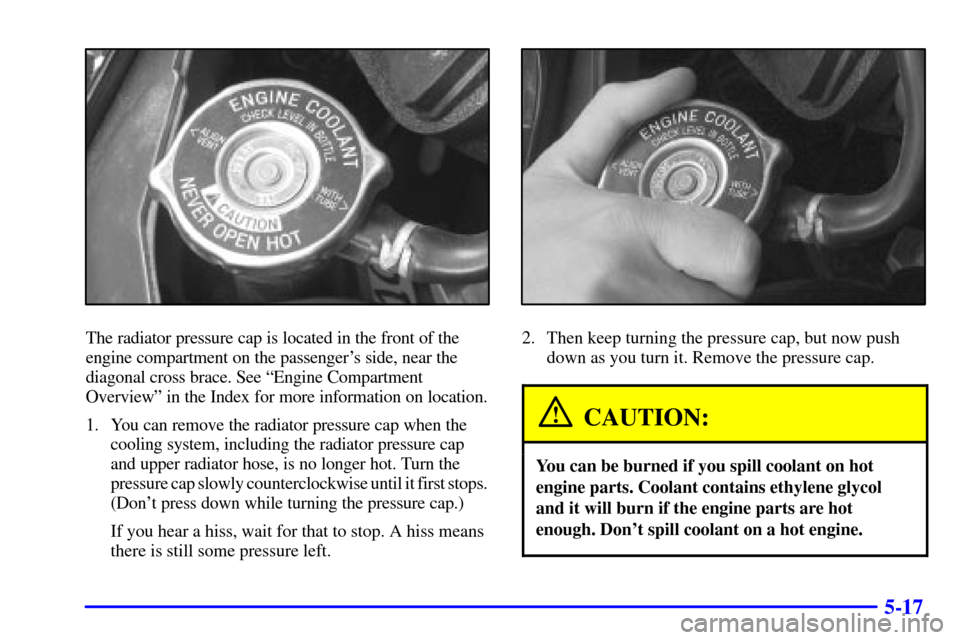
The radiator pressure cap is located in the front of the
engine compartment on the passenger's side, near the
diagonal cross brace. See ªEngine Compartment
Overviewº in the Index for more information on location.
1. You can remove the radiator pressure cap when the
cooling system, including the radiator pressure cap
and upper radiator hose, is no longer hot. Turn the
pressure cap slowly counterclockwise until it first stops.
(Don't press down while turning the pressure cap.)
If you hear a hiss, wait for that to stop. A hiss means
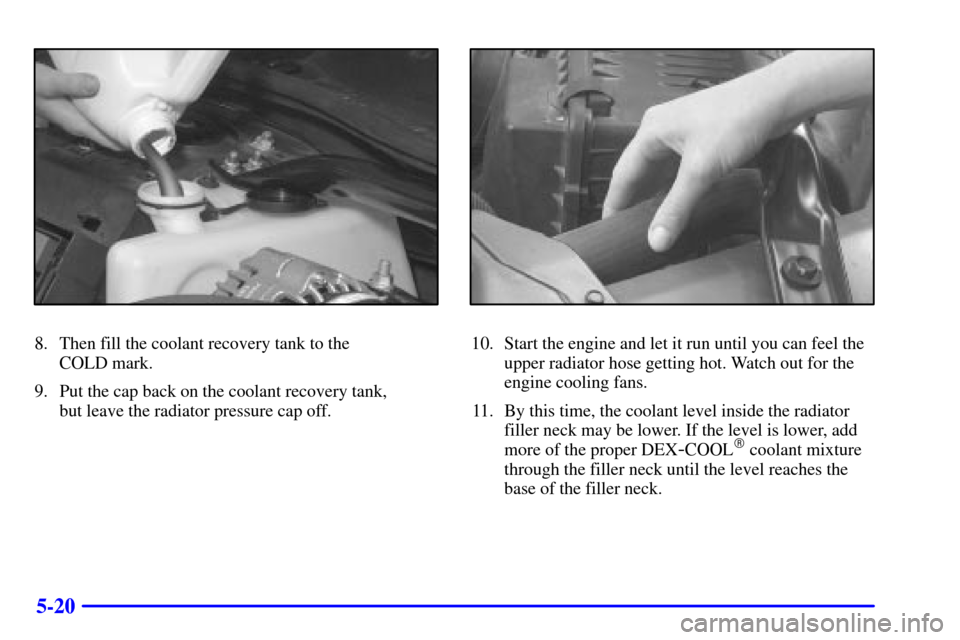
there is still some pressure left.2. Then keep turning the pressure cap, but now push
down as you turn it. Remove the pressure cap.
CAUTION:
You can be burned if you spill coolant on hot
engine parts. Coolant contains ethylene glycol
and it will burn if the engine parts are hot
enough. Don't spill coolant on a hot engine.
Page 274 of 392
5-20
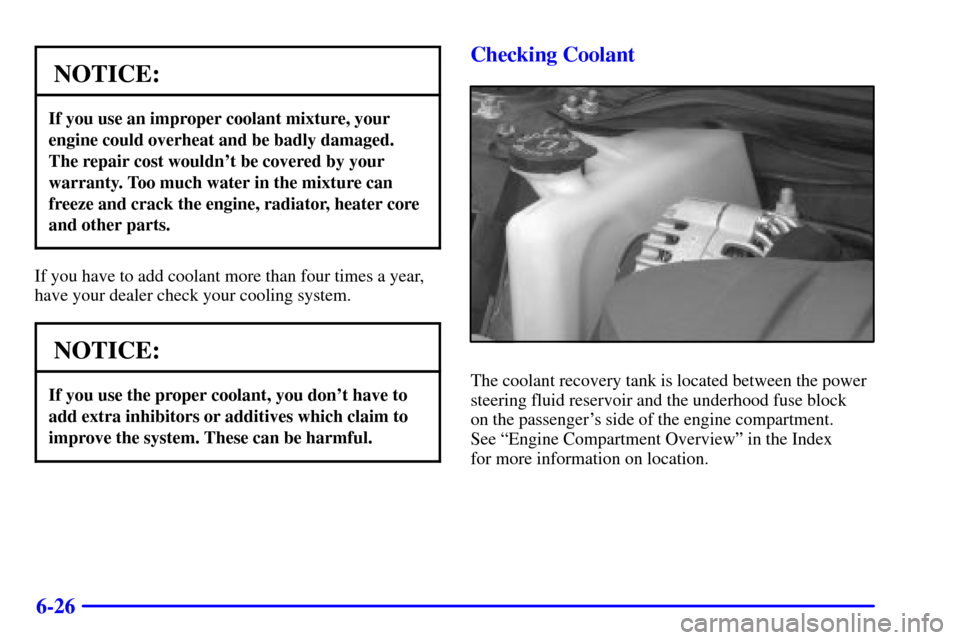
8. Then fill the coolant recovery tank to the
COLD mark.
9. Put the cap back on the coolant recovery tank,
but leave the radiator pressure cap off.10. Start the engine and let it run until you can feel the
upper radiator hose getting hot. Watch out for the
engine cooling fans.
11. By this time, the coolant level inside the radiator
filler neck may be lower. If the level is lower, add
more of the proper DEX
-COOL� coolant mixture
through the filler neck until the level reaches the
base of the filler neck.
Page 311 of 392
6-24 How to Add Fluid
Refer to the Maintenance Schedule to determine what
kind of transaxle fluid to use. See ªRecommended
Fluids and Lubricantsº in the Index.
If the fluid level is low, add only enough of the proper
fluid to bring the level into the cross
-hatched area on
the dipstick.
1. Pull out the dipstick.
2. Using a long
-neck funnel, add enough fluid at the
dipstick hole to bring it to the proper level.
It doesn't take much fluid, generally less than
one pint (0.5 L). Don't overfill.
NOTICE:
We recommend you use only fluid labeled
DEXRON�-III, because fluid with that label is
made especially for your automatic transaxle.
Damage caused by fluid other than DEXRON
�-III
is not covered by your new vehicle warranty.
3. After adding fluid, recheck the fluid level as
described under ªHow to Check.º
4. When the correct fluid level is obtained,
push the dipstick back in all the way.
Engine Coolant
The cooling system in your vehicle is filled with
DEX
-COOL� engine coolant. This coolant is
designed to remain in your vehicle for 5 years or
150,000 miles (240 000 km), whichever occurs first,
if you add only DEX
-COOL� extended life coolant.
The following explains your cooling system and how to
add coolant when it is low. If you have a problem with
engine overheating or if you need to add coolant to
your radiator, see ªEngine Overheatingº in the Index.
Page 312 of 392
6-25
A 50/50 mixture of clean, drinkable water and
DEX
-COOL� coolant will:
�Give freezing protection down to
-34�F (-37�C).
�Give boiling protection up to 265�F (129�C).
�Protect against rust and corrosion.
�Help keep the proper engine temperature.
�Let the warning lights and gages work as
they should.
NOTICE:
When adding coolant, it is important that you
use only DEX
-COOL� (silicate-free) coolant.
If coolant other than DEX-COOL is added to
the system, premature engine, heater core or
radiator corrosion may result. In addition, the
engine coolant will require change sooner
-- at
30,000 miles (50 000 km) or 24 months, whichever
occurs first. Damage caused by the use of coolant
other than DEX
-COOL� is not covered by your
new vehicle warranty.
What to Use
Use a mixture of one-half clean, drinkable water and
one
-half DEX-COOL� coolant which won't damage
aluminum parts. If you use this coolant mixture, you
don't need to add anything else.
CAUTION:
Adding only plain water to your cooling system
can be dangerous. Plain water, or some other
liquid like alcohol, can boil before the proper
coolant mixture will. Your vehicle's coolant
warning system is set for the proper coolant
mixture. With plain water or the wrong mixture,
your engine could get too hot but you wouldn't
get the overheat warning. Your engine could
catch fire and you or others could be burned.
Use a 50/50 mixture of clean, drinkable water
and DEX
-COOL� coolant.
Page 313 of 392
6-26
NOTICE:
If you use an improper coolant mixture, your
engine could overheat and be badly damaged.
The repair cost wouldn't be covered by your
warranty. Too much water in the mixture can
freeze and crack the engine, radiator, heater core
and other parts.
If you have to add coolant more than four times a year,
have your dealer check your cooling system.
NOTICE:
If you use the proper coolant, you don't have to
add extra inhibitors or additives which claim to
improve the system. These can be harmful.
Checking Coolant
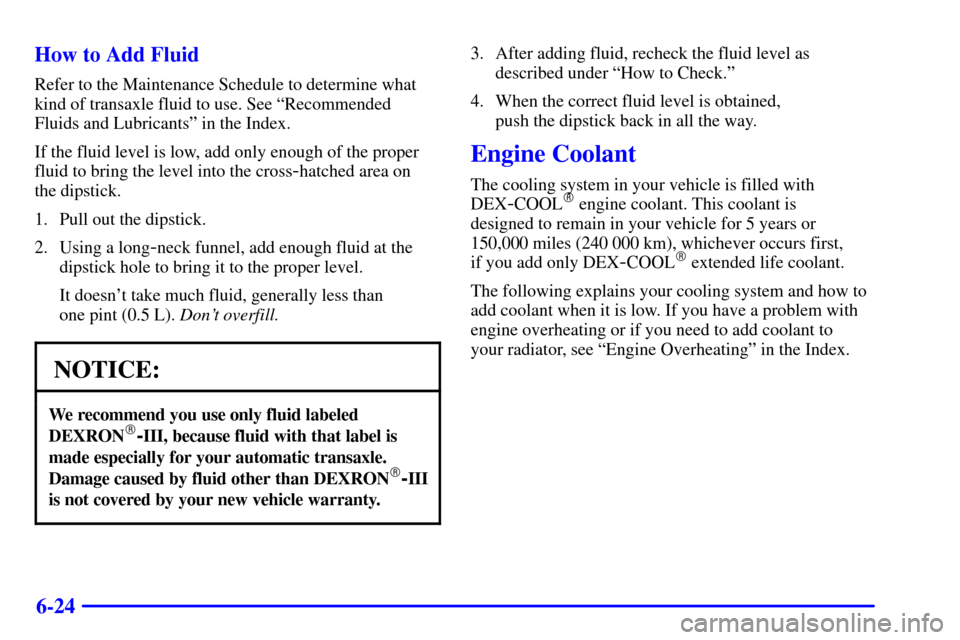
The coolant recovery tank is located between the power
steering fluid reservoir and the underhood fuse block
on the passenger's side of the engine compartment.
See ªEngine Compartment Overviewº in the Index
for more information on location.
Page 314 of 392
6-27
The vehicle must be on a level surface. When your
engine is cold, the coolant level should be at the COLD
mark or a little higher. When your engine is warm, the
level should be up to the HOT mark or a little higher.
United States Canada
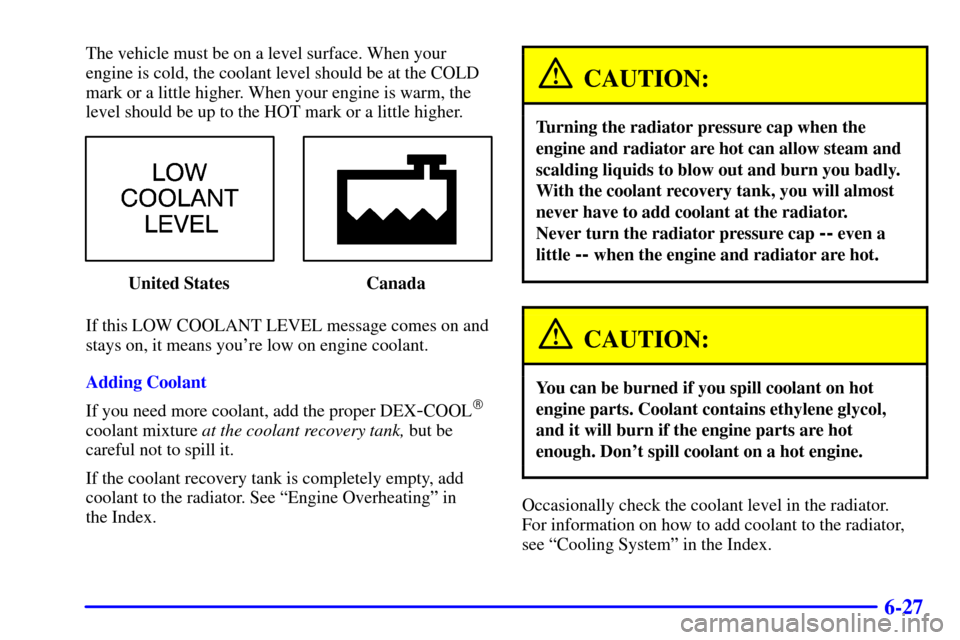
If this LOW COOLANT LEVEL message comes on and
stays on, it means you're low on engine coolant.
Adding Coolant
If you need more coolant, add the proper DEX
-COOL�
coolant mixture at the coolant recovery tank, but be
careful not to spill it.
If the coolant recovery tank is completely empty, add
coolant to the radiator. See ªEngine Overheatingº in
the Index.
CAUTION:
Turning the radiator pressure cap when the
engine and radiator are hot can allow steam and
scalding liquids to blow out and burn you badly.
With the coolant recovery tank, you will almost
never have to add coolant at the radiator.
Never turn the radiator pressure cap
-- even a
little
-- when the engine and radiator are hot.
CAUTION:
You can be burned if you spill coolant on hot
engine parts. Coolant contains ethylene glycol,
and it will burn if the engine parts are hot
enough. Don't spill coolant on a hot engine.
Occasionally check the coolant level in the radiator.
For information on how to add coolant to the radiator,
see ªCooling Systemº in the Index.
Page 337 of 392

6-50
NOTICE:
The wrong wheel can also cause problems with
bearing life, brake cooling, speedometer or
odometer calibration, headlamp aim, bumper
height, vehicle ground clearance and tire or tire
chain clearance to the body and chassis.
See ªChanging a Flat Tireº in the Index for
more information.
Used Replacement Wheels
CAUTION:
Putting a used wheel on your vehicle is
dangerous. You can't know how it's been used or
how far it's been driven. It could fail suddenly
and cause an accident. If you have to replace a
wheel, use a new GM original equipment wheel.
Tire Chains
NOTICE:
Use tire chains only where legal and only when
you must. Use only SAE Class ªSº type chains
that are the proper size for your tires. Install
them on the front tires and tighten them as
tightly as possible with the ends securely
fastened. Drive slowly and follow the chain
manufacturer's instructions. If you can hear the
chains contacting your vehicle, stop and retighten
them. If the contact continues, slow down until it
stops. Driving too fast or spinning the wheels
with chains on will damage your vehicle.
Page 353 of 392

6-66
Underhood Fuse Block (Lower)
Some fuses are in a fuse block on the passenger's side of
the engine compartment. See ªEngine Compartment
Overviewº in the Index for more information on location.
Circuit Relay Description
FAN CONT #3 Secondary Cooling Fan
(Passenger's Side)
FAN CONT #2 Cooling Fan Control Relay
FAN CONT #1 Primary Cooling Fan
(Driver's Side)Circuit Relay Description
IGN RELAY Ignition Relay
A/C CMPR HVAC Compressor
Maxi Fuses Description
IGN SW Ignition Switch
RT I/P #3 Rear Defogger, Audio System
U/HOOD #2 Ignition Relay, AIR Pump
COOLING
FANSCooling Fans (Battery)
Mini Fuses Description
FAN
CONT #2 & #3Cooling Fan Control
Relays #2 & #3
FAN CONT #1 Cooling Fan Control Relays #1
AIR PMP RLY Air Induction Reaction Pump
Relay (Battery)
FUEL INJ Fuel Injectors
TRANS SOL Transmission Solenoids
A/C RLY
(COIL)HVAC Control Relay
ENG DEVICES Canister Purge Solenoid, Mass Air
Flow Sensor (MAF), AIR Pump
Relay & Valve Control
DFI MDL Direct Fire Ignition Module
OXY SEN Oxygen Sensors
(Pre and Post Converter)