Page 116 of 392
2-46
Turn Signal/Multifunction Lever
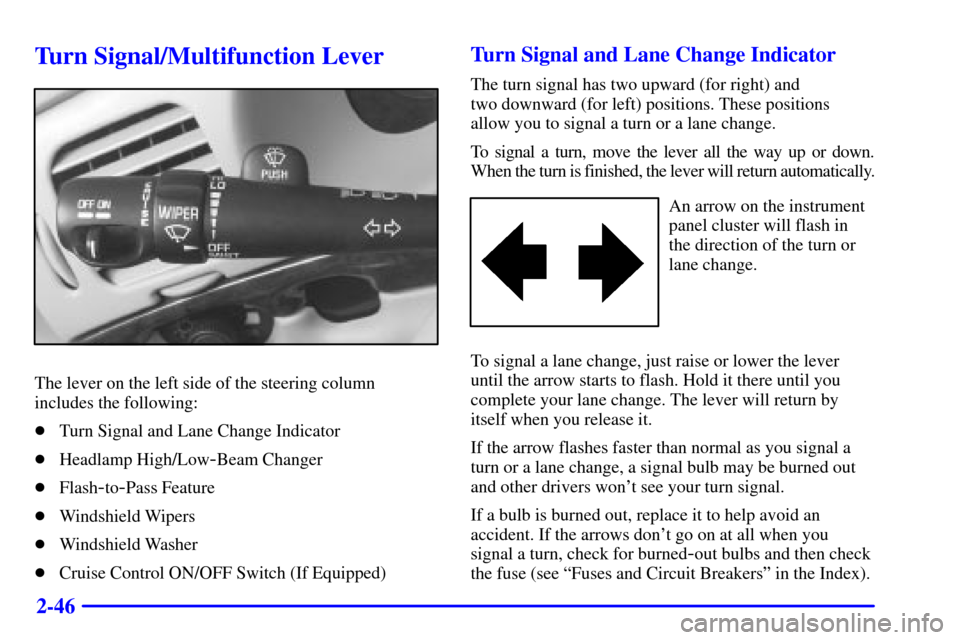
The lever on the left side of the steering column
includes the following:
�Turn Signal and Lane Change Indicator
�Headlamp High/Low
-Beam Changer
�Flash
-to-Pass Feature
�Windshield Wipers
�Windshield Washer
�Cruise Control ON/OFF Switch (If Equipped)
Turn Signal and Lane Change Indicator
The turn signal has two upward (for right) and
two downward (for left) positions. These positions
allow you to signal a turn or a lane change.
To signal a turn, move the lever all the way up or down.
When the turn is finished, the lever will return automatically.
An arrow on the instrument
panel cluster will flash in
the direction of the turn or
lane change.
To signal a lane change, just raise or lower the lever
until the arrow starts to flash. Hold it there until you
complete your lane change. The lever will return by
itself when you release it.
If the arrow flashes faster than normal as you signal a
turn or a lane change, a signal bulb may be burned out
and other drivers won't see your turn signal.
If a bulb is burned out, replace it to help avoid an
accident. If the arrows don't go on at all when you
signal a turn, check for burned
-out bulbs and then check
the fuse (see ªFuses and Circuit Breakersº in the Index).
Page 120 of 392
2-50
Setting Cruise Control
CAUTION:
If you leave your cruise control switch on when
you're not using cruise, you might hit a button
and go into cruise when you don't want to. You
could be startled and even lose control. Keep the
cruise control switch off until you want to use
cruise control.
1. Slide the cruise control ON lever on the turn signal
lever to the right to turn it on.
2. Get up to the speed you want.
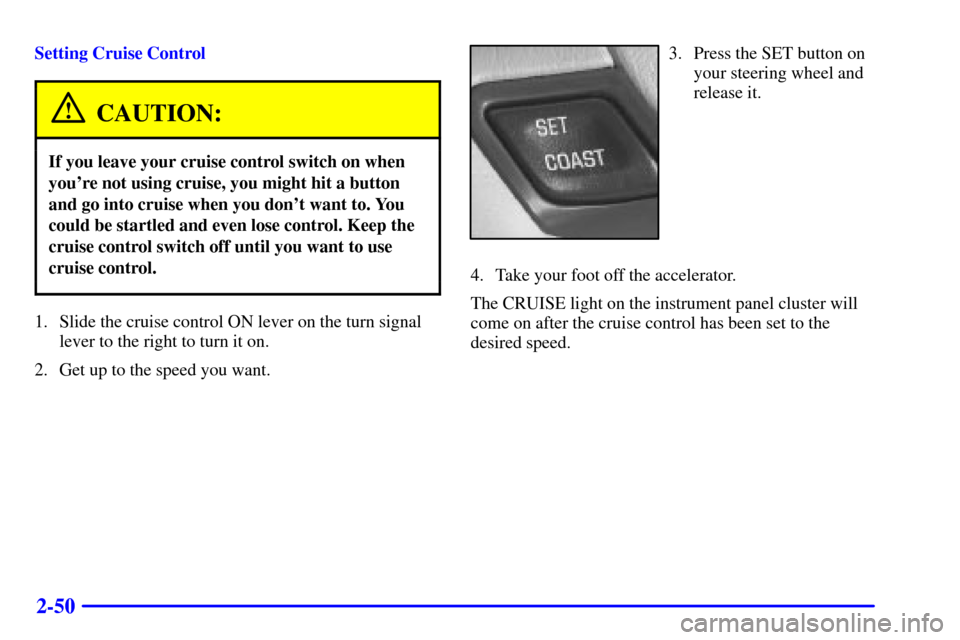
3. Press the SET button on
your steering wheel and
release it.
4. Take your foot off the accelerator.
The CRUISE light on the instrument panel cluster will
come on after the cruise control has been set to the
desired speed.
Page 121 of 392
2-51
Resuming a Set Speed
Suppose you set your cruise control at a desired speed
and then you apply the brake. This, of course shuts off
the cruise control. But you don't need to reset it.
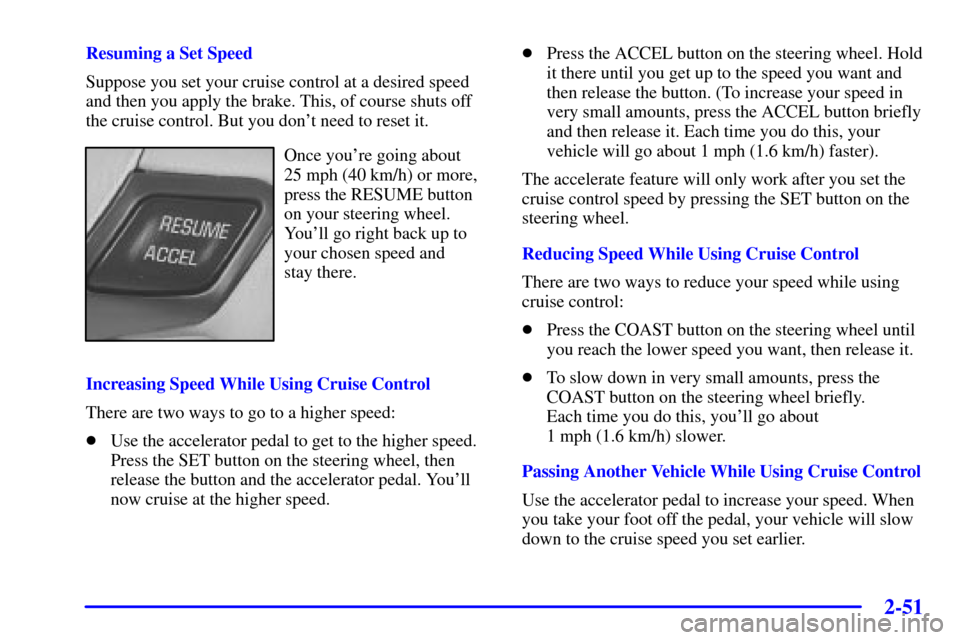
Once you're going about
25 mph (40 km/h) or more,
press the RESUME button
on your steering wheel.
You'll go right back up to
your chosen speed and
stay there.
Increasing Speed While Using Cruise Control
There are two ways to go to a higher speed:
�Use the accelerator pedal to get to the higher speed.
Press the SET button on the steering wheel, then
release the button and the accelerator pedal. You'll
now cruise at the higher speed.�Press the ACCEL button on the steering wheel. Hold
it there until you get up to the speed you want and
then release the button. (To increase your speed in
very small amounts, press the ACCEL button briefly
and then release it. Each time you do this, your
vehicle will go about 1 mph (1.6 km/h) faster).
The accelerate feature will only work after you set the
cruise control speed by pressing the SET button on the
steering wheel.
Reducing Speed While Using Cruise Control
There are two ways to reduce your speed while using
cruise control:
�Press the COAST button on the steering wheel until
you reach the lower speed you want, then release it.
�To slow down in very small amounts, press the
COAST button on the steering wheel briefly.
Each time you do this, you'll go about
1 mph (1.6 km/h) slower.
Passing Another Vehicle While Using Cruise Control
Use the accelerator pedal to increase your speed. When
you take your foot off the pedal, your vehicle will slow
down to the cruise speed you set earlier.
Page 124 of 392
2-54 Delayed Headlamp Illumination
Delayed headlamp illumination provides a period of
exterior lighting as you leave the area. The feature is
activated when the headlamps are on due to the
automatic headlamp control feature described previously
in this section, and when the ignition is turned off. Your
headlamps will then remain on until the headlamp
switch is moved from OFF to the parking lamp position
or until either a 30 second or 60 second lighting period
has ended.
If you turn off the ignition with the headlamp switch in
the parking lamp or headlamp position, the delayed
headlamp illumination cycle will not occur.
To disable the delayed headlamp illumination feature or
change the time of delay, see ªVehicle Customization
Settingsº in the Index.
Fog Lamps (If Equipped)
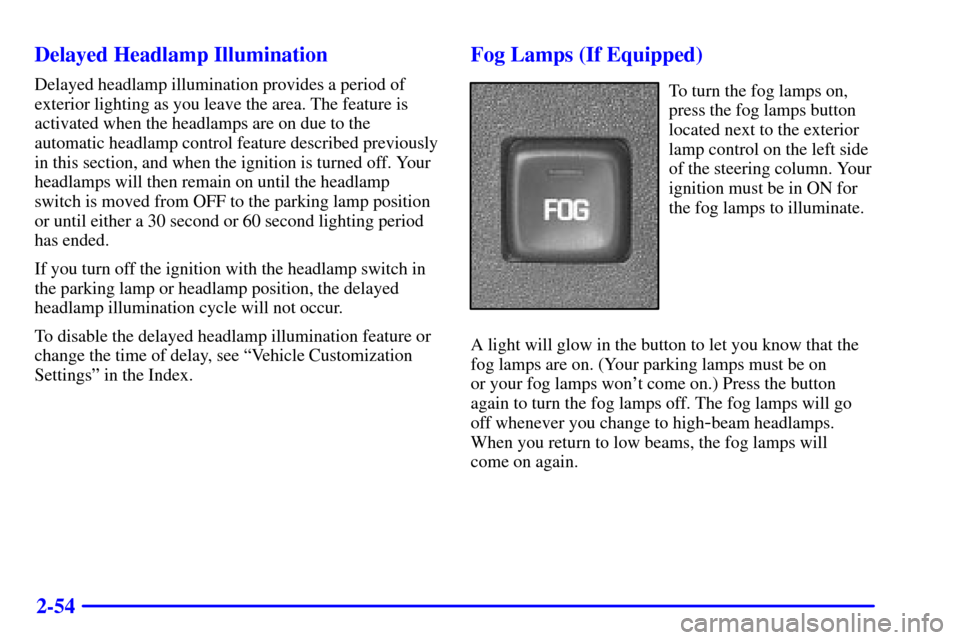
To turn the fog lamps on,
press the fog lamps button
located next to the exterior
lamp control on the left side
of the steering column. Your
ignition must be in ON for
the fog lamps to illuminate.
A light will glow in the button to let you know that the
fog lamps are on. (Your parking lamps must be on
or your fog lamps won't come on.) Press the button
again to turn the fog lamps off. The fog lamps will go
off whenever you change to high
-beam headlamps.
When you return to low beams, the fog lamps will
come on again.
Page 135 of 392
2-65
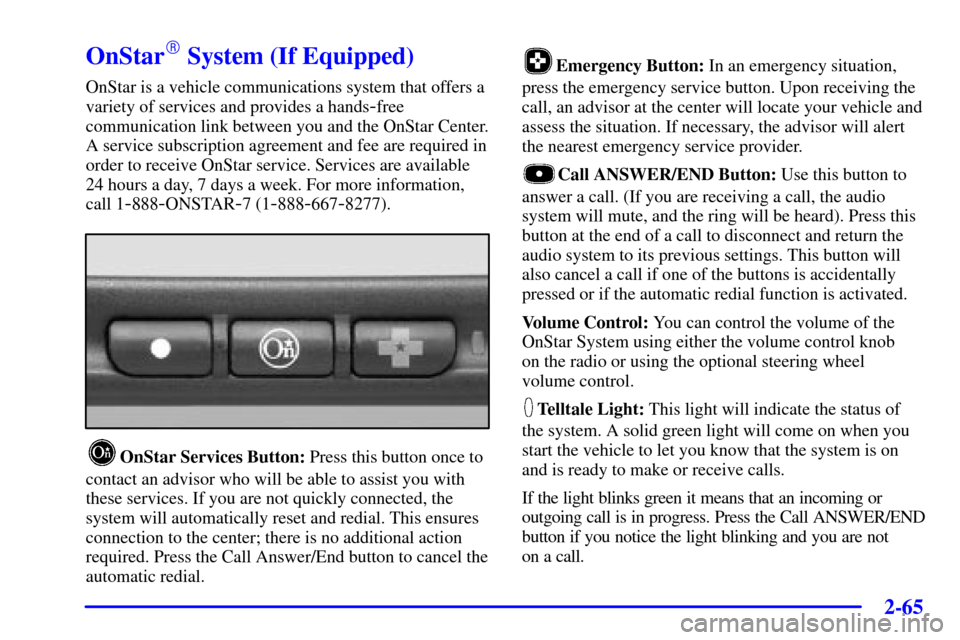
OnStar� System (If Equipped)
OnStar is a vehicle communications system that offers a
variety of services and provides a hands
-free
communication link between you and the OnStar Center.
A service subscription agreement and fee are required in
order to receive OnStar service. Services are available
24 hours a day, 7 days a week. For more information,
call 1
-888-ONSTAR-7 (1-888-667-8277).
OnStar Services Button: Press this button once to
contact an advisor who will be able to assist you with
these services. If you are not quickly connected, the
system will automatically reset and redial. This ensures
connection to the center; there is no additional action
required. Press the Call Answer/End button to cancel the
automatic redial.
Emergency Button: In an emergency situation,
press the emergency service button. Upon receiving the
call, an advisor at the center will locate your vehicle and
assess the situation. If necessary, the advisor will alert
the nearest emergency service provider.
Call ANSWER/END Button: Use this button to
answer a call. (If you are receiving a call, the audio
system will mute, and the ring will be heard). Press this
button at the end of a call to disconnect and return the
audio system to its previous settings. This button will
also cancel a call if one of the buttons is accidentally
pressed or if the automatic redial function is activated.
Volume Control: You can control the volume of the
OnStar System using either the volume control knob
on the radio or using the optional steering wheel
volume control.
Telltale Light: This light will indicate the status of
the system. A solid green light will come on when you
start the vehicle to let you know that the system is on
and is ready to make or receive calls.
If the light blinks green it means that an incoming or
outgoing call is in progress. Press the Call ANSWER/END
button if you notice the light blinking and you are not
on a call.
Page 145 of 392
2-75
The main components of your instrument panel are listed here:
A. Instrument Panel Fuse Block
B. Traction Control On/Off Switch (If Equipped)
C. Multifunction Lever
D. Audio Steering Wheel Controls (Option)
E. Hazard Warning Flasher Switch
F. Audio System
G. Exterior Lamp ControlsH. Remote Trunk Release
I. Hood Release
J. Steering Wheel Cruise Control Switches
(If Equipped)
K. Ignition Switch
L. Center Console Shift Lever (If Equipped)
M. Climate Controls
Page 171 of 392
3-
3-1
Section 3 Comfort Controls and Audio Systems
In this section, you'll find out how to operate the comfort control and audio systems offered with your vehicle.
Be sure to read about the particular systems supplied with your vehicle.
3
-2 Comfort Controls
3
-2 Manual Single Zone Climate Control
3
-4 Dual ComforTemp� Climate Control
(If Equipped)
3
-6 Air Conditioning
3
-6 Heating
3
-6 Ventilation
3
-6 Defogging and Defrosting
3
-7 Rear Window Defogger
3
-8 Ventilation System
3
-9 Audio Systems
3
-9 Setting the Clock
3
-9 Setting the Clock for Systems with Radio
Data System
3
-10 AM-FM Stereo
3
-13 AM-FM Stereo with Cassette Tape Player
with Radio Data System (RDS) and Automatic
Tone Control (If Equipped)3
-22 AM-FM Stereo with Compact Disc Player
with Radio Data System (RDS) and Automatic
Tone Control (Option)
3
-31 AM-FM Stereo with Cassette Tape and
Compact Disc Player with Radio Data System
(RDS) and Automatic Tone Control (Option)
3
-41 Theft-Deterrent Feature Non-RDS Radios
3
-41 Theft-Deterrent Feature RDS Radios
(If Equipped)
3
-42 Audio Steering Wheel Controls (If Equipped)
3
-43 Understanding Radio Reception
3
-43 Tips About Your Audio System
3
-44 Care of Your Cassette Tape Player
3
-45 Care of Your Compact Discs
3
-45 Care of Your Compact Disc Player
3
-46 Backglass Antenna
3
-46 Vehicle Customization Settings
3
-46 Chime Level Adjustment
Page 212 of 392

3-42 Audio Steering Wheel Controls
(If Equipped)
If your vehicle has this feature, you can control certain
radio functions using the buttons on your steering wheel.
SEEK: Press the up arrow to tune to the next radio
station and the down arrow to tune to the previous
radio station.
If a cassette tape or compact disc is playing, the player
will advance with the up arrow and reverse with the
down arrow. Holding SEEK for three seconds or more
will activate the PSCAN mode.SEEK TYPE: Press this button to go to a station with
the last selected PTY TYPE and the last selected PTY
will appear on the display, if it is not already showing.
If a station with the selected PTY is not found, the radio
will return to the original station. If both SEEK TYPE
and TRAF are on, the radio will search for stations with
traffic announcements and the selected PTY.
PRESET: Press this button to play a station you have
programmed on the radio preset buttons.
MODE: Press this button to choose AM, FM1 or FM2.
If a cassette tape or compact disc is playing, it will stop
and the radio will play.
VOL: Press the up or down arrow to increase or
decrease volume.
MUTE: Press this button to silence the system.
Press it again to turn on the sound.