Page 288 of 392
6-
6-1
Section 6 Service and Appearance Care
Here you will find information about the care of your vehicle. This section begins with service and fuel information,
and then it shows how to check important fluid and lubricant levels. There is also technical information about your
vehicle, and a part devoted to its appearance care.
6
-2 Service
6
-3 Fuel
6
-5 Fuels in Foreign Countries
6
-5 Filling Your Tank
6
-8 Filling a Portable Fuel Container
6
-8 Checking Things Under the Hood
6
-12 Engine Oil
6
-19 Engine Air Cleaner/Filter
6
-20 Passenger Compartment Air Filter
(If Equipped)
6
-21 Automatic Transaxle Fluid
6
-24 Engine Coolant
6
-28 Radiator Pressure Cap
6
-28 Power Steering Fluid
6
-29 Windshield Washer Fluid
6
-31 Brakes6
-34 Battery
6
-35 Bulb Replacement
6
-40 Windshield Wiper Blade Replacement
6
-41 Tires
6
-51 Appearance Care
6
-51 Cleaning the Inside of Your Vehicle
6
-53 Care of Safety Belts
6
-55 Cleaning the Outside of Your Vehicle
6
-57 Finish Damage
6
-58 GM Vehicle Care/Appearance Materials
6
-59 Vehicle Identification Number (VIN)
6
-59 Service Parts Identification Label
6
-60 Electrical System
6
-67 Replacement Bulbs
6
-67 Capacities and Specifications
6
-68 Normal Maintenance Replacement Parts
Page 295 of 392
6-8
Filling a Portable Fuel Container
CAUTION:
Never fill a portable fuel container while it is in
your vehicle. Static electricity discharge from the
container can ignite the gasoline vapor. You can
be badly burned and your vehicle damaged if this
occurs. To help avoid injury to you and others:
�Dispense gasoline only into
approved containers.
�Do not fill a container while it is inside a
vehicle, in a vehicle's trunk, pickup bed or
on any surface other than the ground.
�Bring the fill nozzle in contact with the
inside of the fill opening before operating
the nozzle. Contact should be maintained
until the filling is complete.
�Don't smoke while pumping gasoline.
Checking Things Under the Hood
CAUTION:
An electric fan under the hood can start up and
injure you even when the engine is not running.
Keep hands, clothing and tools away from any
underhood electric fan.
CAUTION:
Things that burn can get on hot engine parts and
start a fire. These include liquids like gasoline,
oil, coolant, brake fluid, windshield washer and
other fluids, and plastic or rubber. You or others
could be burned. Be careful not to drop or spill
things that will burn onto a hot engine.
Page 297 of 392
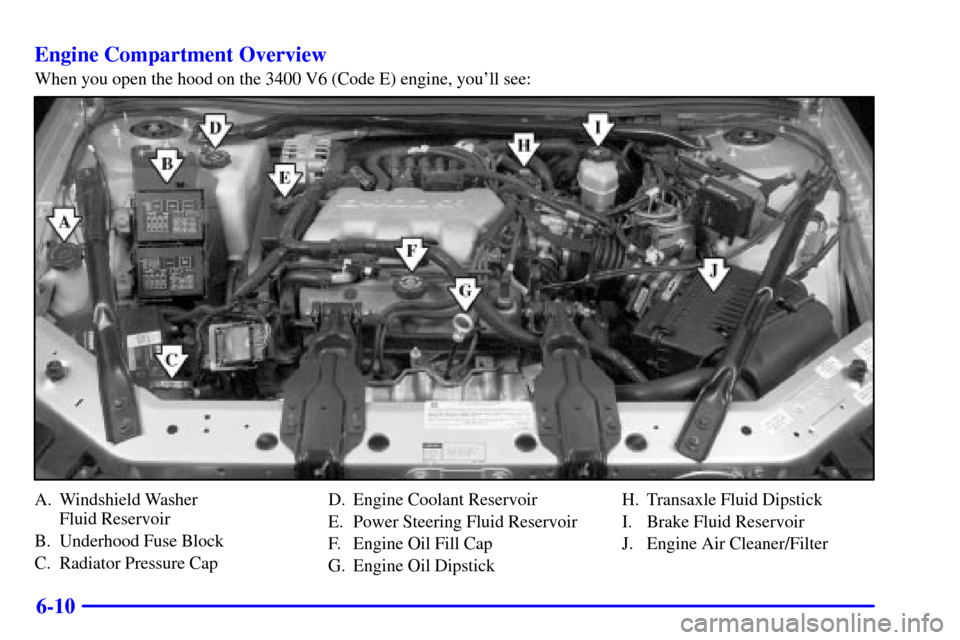
6-10 Engine Compartment Overview
When you open the hood on the 3400 V6 (Code E) engine, you'll see:
A. Windshield Washer
Fluid Reservoir
B. Underhood Fuse Block
C. Radiator Pressure CapD. Engine Coolant Reservoir
E. Power Steering Fluid Reservoir
F. Engine Oil Fill Cap
G. Engine Oil DipstickH. Transaxle Fluid Dipstick
I. Brake Fluid Reservoir
J. Engine Air Cleaner/Filter
Page 298 of 392
6-11
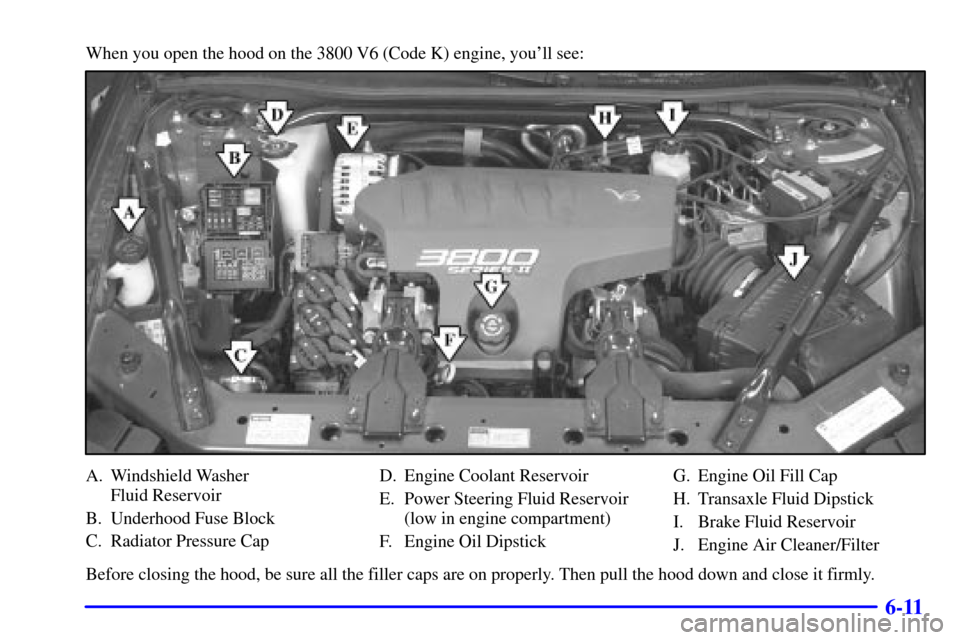
When you open the hood on the 3800 V6 (Code K) engine, you'll see:
A. Windshield Washer
Fluid Reservoir
B. Underhood Fuse Block
C. Radiator Pressure CapD. Engine Coolant Reservoir
E. Power Steering Fluid Reservoir
(low in engine compartment)
F. Engine Oil DipstickG. Engine Oil Fill Cap
H. Transaxle Fluid Dipstick
I. Brake Fluid Reservoir
J. Engine Air Cleaner/Filter
Before closing the hood, be sure all the filler caps are on properly. Then pull the hood down and close it firmly.
Page 309 of 392
6-22 How to Check
Because this operation can be a little difficult, you
may choose to have this done at the dealership
service department.
If you do it yourself, be sure to follow all the instructions
here, or you could get a false reading on the dipstick.
NOTICE:
Too much or too little fluid can damage your
transaxle. Too much can mean that some of the
fluid could come out and fall on hot engine parts
or exhaust system parts, starting a fire. Be sure to
get an accurate reading if you check your
transaxle fluid.
Wait at least 30 minutes before checking the transaxle
fluid level if you have been driving:
�When outside temperatures are above 90�F (32�C).
�At high speed for quite a while.�In heavy traffic
-- especially in hot weather.
�While pulling a trailer.
To get the right reading, the fluid should be at
normal operating temperature, which is 180�F
to 200�F (82�C to 93�C).
Get the vehicle warmed up by driving about 15 miles (24 km)
when outside temperatures are above 50�F (10�C). If it's
colder than 50�F (10�C), you may have to drive longer.
Checking the Fluid Level
Prepare your vehicle as follows:
�Park your vehicle on a level place. Keep the
engine running.
�With the parking brake applied, place the shift
lever in PARK (P).
�With your foot on the brake pedal, move the shift
lever through each gear range, pausing for about
three seconds in each range. Then, position the shift
lever in PARK (P).
�Let the engine run at idle for three to five minutes.
Page 318 of 392
6-31
Brakes
Brake Fluid
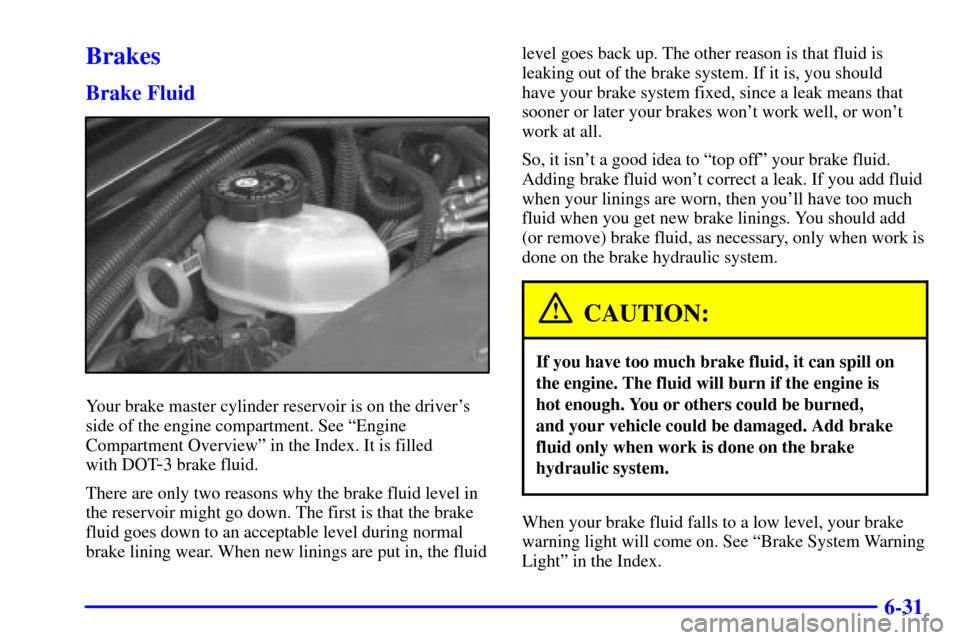
Your brake master cylinder reservoir is on the driver's
side of the engine compartment. See ªEngine
Compartment Overviewº in the Index. It is filled
with DOT
-3 brake fluid.
There are only two reasons why the brake fluid level in
the reservoir might go down. The first is that the brake
fluid goes down to an acceptable level during normal
brake lining wear. When new linings are put in, the fluidlevel goes back up. The other reason is that fluid is
leaking out of the brake system. If it is, you should
have your brake system fixed, since a leak means that
sooner or later your brakes won't work well, or won't
work at all.
So, it isn't a good idea to ªtop offº your brake fluid.
Adding brake fluid won't correct a leak. If you add fluid
when your linings are worn, then you'll have too much
fluid when you get new brake linings. You should add
(or remove) brake fluid, as necessary, only when work is
done on the brake hydraulic system.
CAUTION:
If you have too much brake fluid, it can spill on
the engine. The fluid will burn if the engine is
hot enough. You or others could be burned,
and your vehicle could be damaged. Add brake
fluid only when work is done on the brake
hydraulic system.
When your brake fluid falls to a low level, your brake
warning light will come on. See ªBrake System Warning
Lightº in the Index.
Page 319 of 392
6-32
What to Add
When you do need brake fluid, use only DOT
-3 brake
fluid. Use new brake fluid from a sealed container only.
Refer to ªRecommended Fluids and Lubricantsº in
the Maintenance Schedule.
Always clean the brake fluid reservoir cap and the area
around the cap before removing it. This will help keep
dirt from entering the reservoir.
CAUTION:
With the wrong kind of fluid in your brake
system, your brakes may not work well, or they
may not even work at all. This could cause a
crash. Always use the proper brake fluid.
NOTICE:
�Using the wrong fluid can badly damage
brake system parts. For example, just a few
drops of mineral
-based oil, such as engine
oil, in your brake system can damage brake
system parts so badly that they'll have to be
replaced. Don't let someone put in the
wrong kind of fluid.
�If you spill brake fluid on your vehicle's
painted surfaces, the paint finish can be
damaged. Be careful not to spill brake fluid
on your vehicle. If you do, wash it off
immediately. See ªAppearance Careº in
the Index.
Page 376 of 392
7-21
Part D: Recommended Fluids
and Lubricants
NOTE: Fluids and lubricants identified below by name,
part number or specification may be obtained from
your dealer.
USAGE
FLUID/LUBRICANT
Engine OilEngine oil with the American
Petroleum Institute Certified for
Gasoline Engines starburst symbol
of the proper viscosity. To
determine the preferred viscosity
for your vehicle's engine, see
ªEngine Oilº in the Index.
Engine Coolant50/50 mixture of clean, drinkable
water and use only GM
Goodwrench
� DEX-COOL� or
Havoline� DEX-COOL�
Coolant. See ªEngine Coolantº in
the Index.
Hydraulic
Brake SystemDelco Supreme 11� Brake Fluid
(GM Part No. 12377967 or
equivalent DOT
-3 brake fluid).
USAGEFLUID/LUBRICANT
Windshield
Washer SolventGM Optikleen� Washer Solvent
(GM Part No. 1051515)
or equivalent.
Power
Steering SystemGM Power Steering Fluid
(GM Part No. 1052884
- 1 pint,
1050017
- 1 quart, or equivalent).
Automatic
TransaxleDEXRON�-III Automatic
Transmission Fluid.
Key
Lock CylindersMulti-Purpose Lubricant,
Superlube� (GM Part
No. 12346241 or equivalent).
Hood Latch
Assembly,
Secondary Latch,
Pivots, Spring
Anchor and
Release PawlLubriplate� Lubricant Aerosol
(GM Part No. 12346293 or
equivalent) or lubricant meeting
requirements of NLGI # 2,
Category LB or GC
-LB.
Hood and
Door HingesMulti-Purpose Lubricant,
Superlube� (GM Part
No. 12346241 or equivalent).
Weatherstrip
ConditioningDielectric Silicone Grease (GM
Part No. 12345579 or equivalent).