Page 216 of 412
4-24
If you drive regularly in steep country, or if you're
planning to visit there, here are some tips that can make
your trips safer and more enjoyable.
�Keep your vehicle in good shape. Check all fluid
levels and also the brakes, tires, cooling system and
transmission. These parts can work hard on
mountain roads.
�Know how to go down hills. The most important
thing to know is this: let your engine do some of the
slowing down. Shift to a lower gear when you go
down a steep or long hill.
CAUTION:
If you don't shift down, your brakes could get
so hot that they wouldn't work well. You would
then have poor braking or even none going
down a hill. You could crash. Shift down to let
your engine assist your brakes on a steep
downhill slope.
CAUTION:
Coasting downhill in NEUTRAL (N) or with the
ignition off is dangerous. Your brakes will have to
do all the work of slowing down. They could get
so hot that they wouldn't work well. You would
then have poor braking or even none going down
a hill. You could crash. Always have your engine
running and your vehicle in gear when you
go downhill.
�Know how to go uphill. You may want to shift down
to a lower gear. The lower gears help cool your engine
and transmission, and you can climb the hill better.
�Stay in your own lane when driving on two
-lane
roads in hills or mountains. Don't swing wide or cut
across the center of the road. Drive at speeds that let
you stay in your own lane.
�As you go over the top of a hill, be alert. There could be
something in your lane, like a stalled car or an accident.
�You may see highway signs on mountains that warn of
special problems. Examples are long grades, passing or
no
-passing zones, a falling rocks area or winding
roads. Be alert to these and take appropriate action.
Page 231 of 412
4-39 Driving with a Trailer
CAUTION:
If you have a rear-most window open and you
pull a trailer with your vehicle, carbon monoxide
(CO) could come into your vehicle. You can't
see or smell CO. It can cause unconsciousness
or death. See ªEngine Exhaustº in the Index.
To maximize your safety when towing a trailer:
�Have your exhaust system inspected for
leaks, and make necessary repairs before
starting on your trip.
�Keep the rear
-most windows closed.
�If exhaust does come into your vehicle
through a window in the rear or another
opening, drive with your front, main
heating or cooling system on and with the
fan on any speed. This will bring fresh,
outside air into your vehicle. Do not use
MAX A/C because it only recirculates the
air inside your vehicle. See ªComfort
Controlsº in the Index.
Towing a trailer requires a certain amount of experience.
Before setting out for the open road, you'll want to get
to know your rig. Acquaint yourself with the feel of
handling and braking with the added weight of the
trailer. And always keep in mind that the vehicle you are
driving is now a good deal longer and not nearly as
responsive as your vehicle is by itself.
Before you start, check the trailer hitch and platform
(and attachments), safety chains, electrical connector,
lamps, tires and mirror adjustment. If the trailer has
electric brakes, start your vehicle and trailer moving and
then apply the trailer brake controller by hand to be sure
the brakes are working. This lets you check your
electrical connection at the same time.
During your trip, check occasionally to be sure that the
load is secure, and that the lamps and any trailer brakes
are still working.
Following Distance
Stay at least twice as far behind the vehicle ahead as you
would when driving your vehicle without a trailer. This
can help you avoid situations that require heavy braking
and sudden turns.
Page 234 of 412

4-42 Maintenance When Trailer Towing
Your vehicle will need service more often when you're
pulling a trailer. See the Maintenance Schedule for more
on this. Things that are especially important in trailer
operation are automatic transmission fluid (don't overfill),
engine oil, axle lubricant, belt, cooling system and brake
system. Each of these is covered in this manual, and the
Index will help you find them quickly. If you're trailering,
it's a good idea to review these sections before you
start your trip.
Check periodically to see that all hitch nuts and bolts
are tight.
Trailer Wiring Harness
The optional heavy-duty trailer wiring package is a
seven
-wire harness assembly. The four-wire portion of
the harness assembly is stored under the vehicle, along
the driver's side rear corner of the frame rail. The
three
-wire portion of the harness assembly is stored in a
frame pocket under the rear of the vehicle, on the
driver's side. The heavy
-duty trailer wiring harness has
a 30
-amp feed wire. Both harnesses come without
connectors and should be wired by a qualified electrical
technician. The technician can use the following color
code chart when connecting the wiring harness to
your trailer.Four
-Wire Harness
�Light Green: Back
-up lamps
�Brown: Parking lamps
�Yellow: Left stoplamp and turn signal
�Dark Green: Right stoplamp and turn signal
Three
-Wire Harness
�Dark Blue: Use for electric trailer brakes
(seven
-wire harness only)
�Orange: Trailer accessory (seven
-wire harness only)
�White (heavy gage): Ground wire
Securely attach the harness to the trailer, then tape or
strap it to your vehicle's frame rail. Be sure you leave it
loose enough so the wiring doesn't bend or break, but
not so loose that it drags on the ground. Store the
harness in its original place. Wrap the harness together
and tie it neatly so it won't be damaged.
Page 235 of 412
5-
5-1
Section 5 Problems on the Road
Here you'll find what to do about some problems that can occur on the road.
5
-2 Hazard Warning Flashers
5
-3 Other Warning Devices
5
-3 Jump Starting
5
-9 Towing Your Vehicle
5
-9 Engine Overheating (Gasoline Engine)5
-12 Cooling System (Gasoline Engine)
5
-19 Engine Fan Noise
5
-19 If a Tire Goes Flat
5
-20 Changing a Flat Tire
5
-35 If You're Stuck: In Sand, Mud, Ice or Snow
Page 246 of 412
5-12
Cooling System (Gasoline Engine)
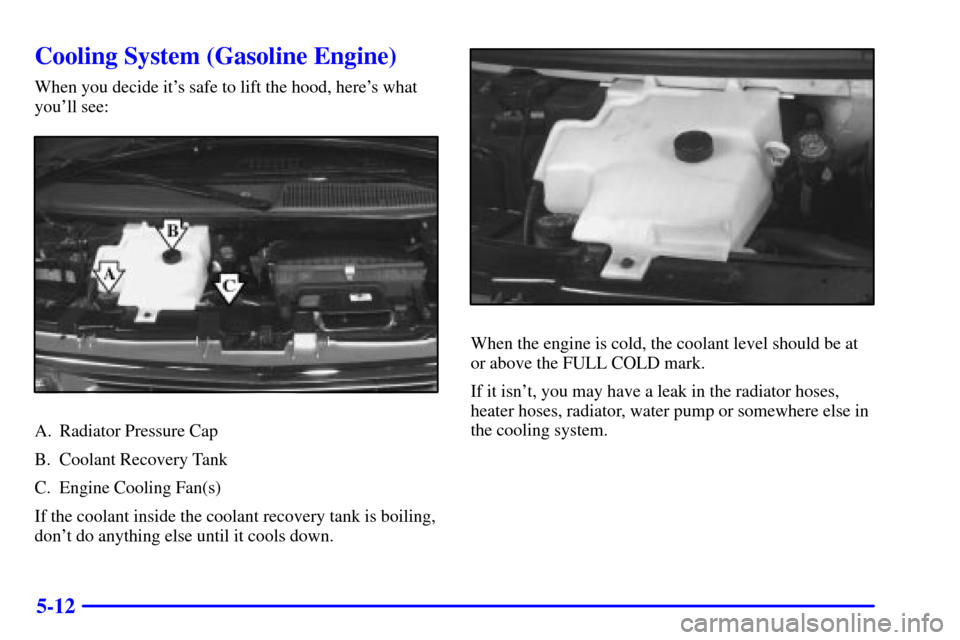
When you decide it's safe to lift the hood, here's what
you'll see:
A. Radiator Pressure Cap
B. Coolant Recovery Tank
C. Engine Cooling Fan(s)
If the coolant inside the coolant recovery tank is boiling,
don't do anything else until it cools down.
When the engine is cold, the coolant level should be at
or above the FULL COLD mark.
If it isn't, you may have a leak in the radiator hoses,
heater hoses, radiator, water pump or somewhere else in
the cooling system.
Page 247 of 412
5-13
CAUTION:
Heater and radiator hoses, and other engine
parts, can be very hot. Don't touch them.
If you do, you can be burned.
Don't run the engine if there is a leak. If you run
the engine, it could lose all coolant. That could
cause an engine fire, and you could be burned.
Get any leak fixed before you drive the vehicle.
NOTICE:
Engine damage from running your engine
without coolant isn't covered by your warranty.
NOTICE:
When adding coolant, it is important that you
use only DEX
-COOL� (silicate-free) coolant.
If coolant other than DEX-COOL is added to
the system, premature engine, heater core or
radiator corrosion may result. In addition, the
engine coolant will require change sooner
-- at
30,000 miles (50 000 km) or 24 months,
whichever occurs first. Damage caused by the
use of coolant other than DEX
-COOL� is not
covered by your new vehicle warranty.
If there seems to be no leak, start the engine again.
See if the engine cooling fan speed increases when idle
speed is doubled by pushing the accelerator pedal
down. If it doesn't, your vehicle needs service.
Turn off the engine.
Page 248 of 412
5-14 How to Add Coolant to the Coolant
Recovery Tank
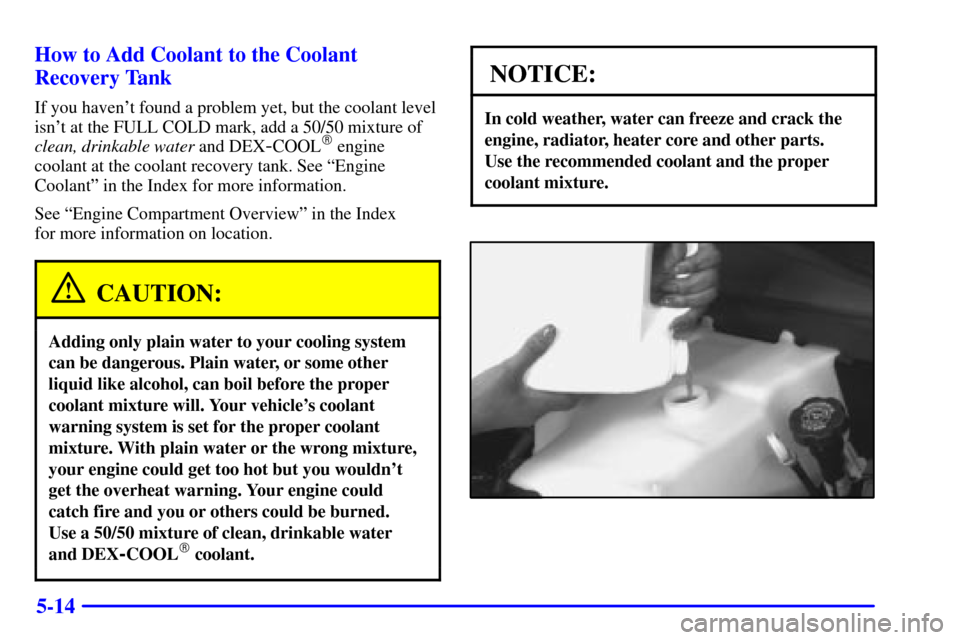
If you haven't found a problem yet, but the coolant level
isn't at the FULL COLD mark, add a 50/50 mixture of
clean, drinkable water and DEX
-COOL� engine
coolant at the coolant recovery tank. See ªEngine
Coolantº in the Index for more information.
See ªEngine Compartment Overviewº in the Index
for more information on location.
CAUTION:
Adding only plain water to your cooling system
can be dangerous. Plain water, or some other
liquid like alcohol, can boil before the proper
coolant mixture will. Your vehicle's coolant
warning system is set for the proper coolant
mixture. With plain water or the wrong mixture,
your engine could get too hot but you wouldn't
get the overheat warning. Your engine could
catch fire and you or others could be burned.
Use a 50/50 mixture of clean, drinkable water
and DEX
-COOL� coolant.
NOTICE:
In cold weather, water can freeze and crack the
engine, radiator, heater core and other parts.
Use the recommended coolant and the proper
coolant mixture.
Page 249 of 412
5-15
CAUTION:
You can be burned if you spill coolant on hot
engine parts. Coolant contains ethylene glycol
and it will burn if the engine parts are hot
enough. Don't spill coolant on a hot engine.
When the coolant in the coolant recovery tank is at the
FULL COLD mark, start your vehicle.
If the overheat warning continues, there's one more
thing you can try. You can add the proper coolant
mixture directly to the radiator, but be sure the cooling
system is cool before you do it.
CAUTION:
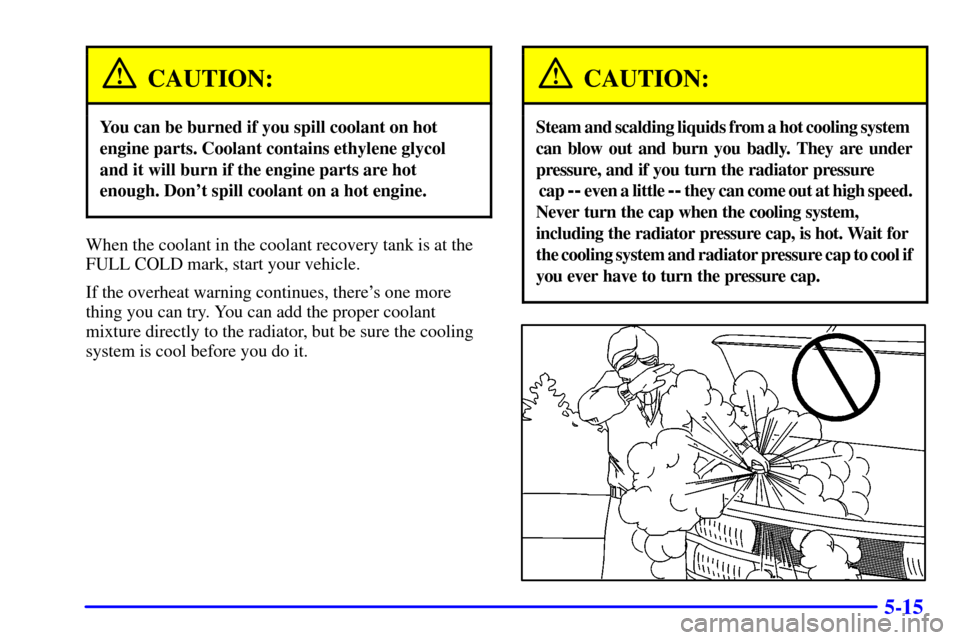
Steam and scalding liquids from a hot cooling system
can blow out and burn you badly. They are under
pressure, and if you turn the radiator pressure
cap
-- even a little -- they can come out at high speed.
Never turn the cap when the cooling system,
including the radiator pressure cap, is hot. Wait for
the cooling system and radiator pressure cap to cool if
you ever have to turn the pressure cap.