Page 330 of 412
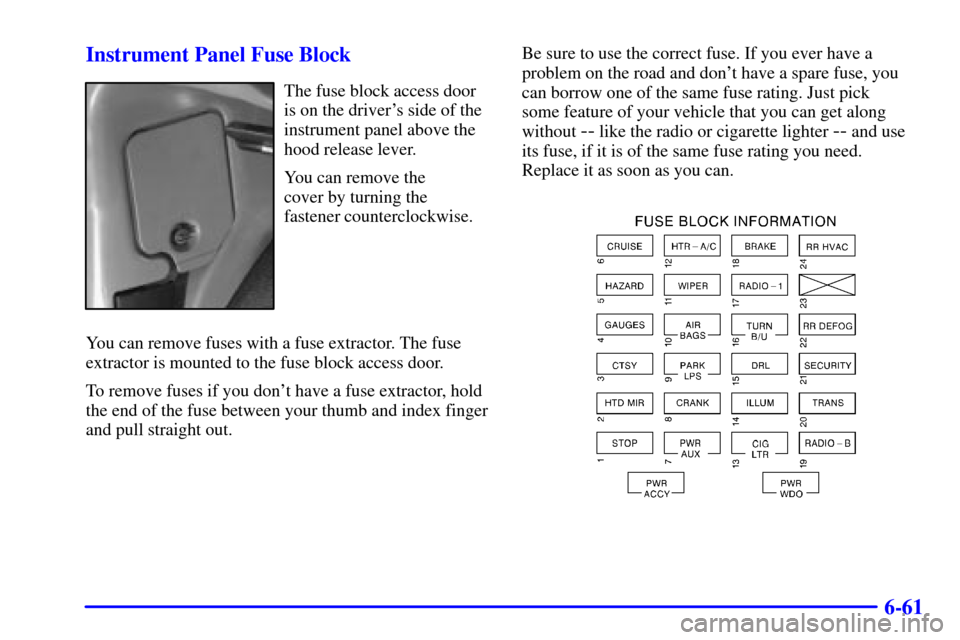
6-61 Instrument Panel Fuse Block
The fuse block access door
is on the driver's side of the
instrument panel above the
hood release lever.
You can remove the
cover by turning the
fastener counterclockwise.
You can remove fuses with a fuse extractor. The fuse
extractor is mounted to the fuse block access door.
To remove fuses if you don't have a fuse extractor, hold
the end of the fuse between your thumb and index finger
and pull straight out.Be sure to use the correct fuse. If you ever have a
problem on the road and don't have a spare fuse, you
can borrow one of the same fuse rating. Just pick
some feature of your vehicle that you can get along
without
-- like the radio or cigarette lighter -- and use
its fuse, if it is of the same fuse rating you need.
Replace it as soon as you can.
Page 332 of 412
6-63
POSITION NAME CIRCUITS PROTECTED
15. DRL DRL Relay
16. TURN B/U
Front Turn, RR Turn, Back
-up Lamps, BTSI Solenoid
17.
RADIO
-1Radio (Ign, Accy), Upfitter Provision Relay
18. BRAKE 4WAL PCM, ABS, Cruise Control
19.
RADIO
-BRadio (Battery), Power Antenna
20. TRANS PRNDL, Automatic Transmission
21. SECURITY Passlock
22. RR DEFOG Rear Window Defog
23. NOT USED Not Used
24. RR HVAC RR HVAC Controls, HIGH, MED, LOW Relays
A. PWR ACCY
Power Door Lock, Six
-Way Power Seat, Keyless Entry
Illumination Module
B. PWR WDO Power Windows
Page 333 of 412
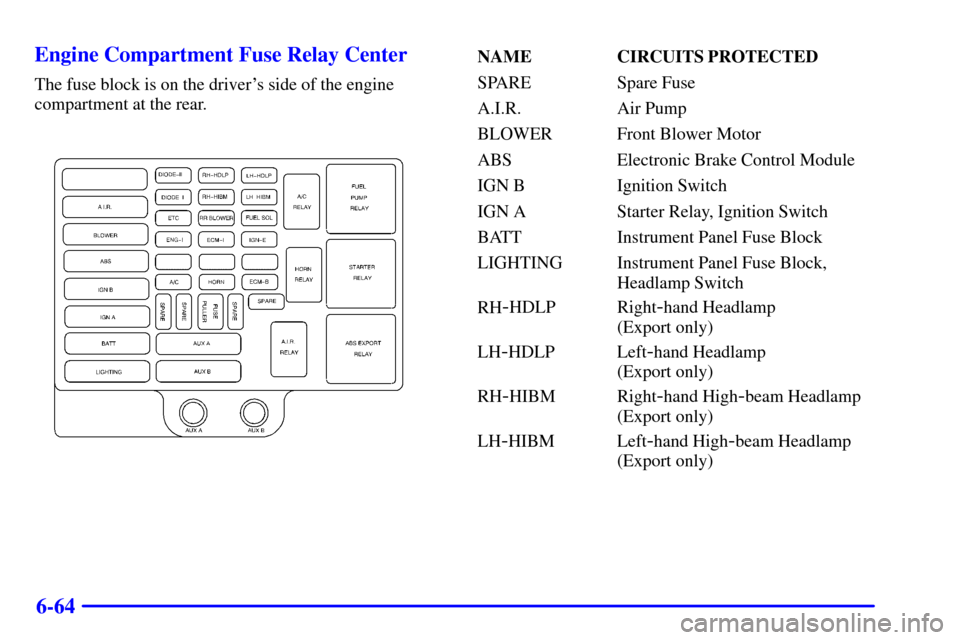
6-64 Engine Compartment Fuse Relay Center
The fuse block is on the driver's side of the engine
compartment at the rear.
NAME CIRCUITS PROTECTED
SPARE Spare Fuse
A.I.R. Air Pump
BLOWER Front Blower Motor
ABS Electronic Brake Control Module
IGN B Ignition Switch
IGN A Starter Relay, Ignition Switch
BATT Instrument Panel Fuse Block
LIGHTING Instrument Panel Fuse Block,
Headlamp Switch
RH
-HDLP Right-hand Headlamp
(Export only)
LH
-HDLP Left-hand Headlamp
(Export only)
RH
-HIBM Right-hand High-beam Headlamp
(Export only)
LH
-HIBM Left-hand High-beam Headlamp
(Export only)
Page 348 of 412
Short Trip/City Scheduled Maintenance
7-9
The services shown in this schedule up to 100,000 miles
(166 000 km) should be performed after 100,000 miles
(166 000 km) at the same intervals. The services shown
at 150,000 miles (240 000 km) should be performed at
the same interval after 150,000 miles (240 000 km).
See ªOwner Checks and Servicesº and
ªPeriodic Maintenance Inspectionsº following.
Footnotes
� The U.S. Environmental Protection Agency or the
California Air Resources Board has determined that the
failure to perform this maintenance item will not nullify
the emission warranty or limit recall liability prior to
the completion of the vehicle's useful life. We, however,
urge that all recommended maintenance services be
performed at the indicated intervals and the
maintenance be recorded.# Lubricate the front suspension, kingpin bushings,
steering linkage and rear driveline center splines.
+ A good time to check your brakes is during tire
rotation. See ªBrake System Inspectionº under
ªPeriodic Maintenance Inspectionsº in Part C of
this schedule.
** Drive axle service. See ªRecommended Fluids and
Lubricantsº in the Index for proper lubricant to use:
�Check fluid level and add fluid as needed. If driving
in dusty areas or when towing a trailer, drain fluid
and refill every 15,000 miles (25 000 km).
�If your vehicle has a locking differential, drain fluid
and refill at first engine oil change.
�More frequent lubrication may be required for
heavy
-duty use.
Page 372 of 412
Long Trip/Highway Scheduled Maintenance
7-33
The services shown in this schedule up to 100,000 miles
(166 000 km) should be performed after 100,000 miles
(166 000 km) at the same intervals. The services shown
at 150,000 miles (240 000 km) should be performed at
the same interval after 150,000 miles (240 000 km).
See ªOwner Checks and Servicesº and
ªPeriodic Maintenance Inspectionsº following.
Footnotes
� The U.S. Environmental Protection Agency or the
California Air Resources Board has determined that the
failure to perform this maintenance item will not nullify
the emission warranty or limit recall liability prior to
the completion of the vehicle's useful life. We, however,
urge that all recommended maintenance services be
performed at the indicated intervals and the
maintenance be recorded.# Lubricate the front suspension, kingpin bushings,
steering linkage and rear driveline center splines.
+ A good time to check your brakes is during tire
rotation. See ªBrake System Inspectionº under
ªPeriodic Maintenance Inspectionsº in Part C of
this schedule.
** Drive axle service. See ªRecommended Fluids and
Lubricantsº in the Index for proper lubricant to use:
�Check fluid level and add fluid as needed.
�If your vehicle has a locking differential, drain fluid
and refill at first engine oil change.
Page 389 of 412
7-50 At Least Once a Year
Key Lock Cylinders Service
Lubricate the key lock cylinders with the lubricant
specified in Part D.
Body Lubrication Service
Lubricate all hood hinges, hood prop rod pivot, fuel
filler door, rear compartment hinges, latches, locks,
hood latch assembly, secondary latch, pivots, spring
anchor, release pawl and any moving seat hardware.
Part D tells you what to use. More frequent
lubrication may be required when exposed to a
corrosive environment.Starter Switch Check
CAUTION:
When you are doing this check, the vehicle could
move suddenly. If it does, you or others could be
injured. Follow the steps below.
1. Before you start, be sure you have enough room
around the vehicle.
2. Firmly apply both the parking brake and the regular
brake. See ªParking Brakeº in the Index if necessary.
NOTE: Do not use the accelerator pedal, and be
ready to turn off the engine immediately if it starts.
3. Try to start the engine in each gear. The starter
should work only in PARK (P) or NEUTRAL (N).
If the starter works in any other position, your
vehicle needs service.
Page 390 of 412
7-51
Automatic Transmission Shift Lock Control
System Check
CAUTION:
When you are doing this check, the vehicle could
move suddenly. If it does, you or others could be
injured. Follow the steps below.
1. Before you start, be sure you have enough
room around the vehicle. It should be parked on a
level surface.
2. Firmly apply the parking brake. See ªParking Brakeº
in the Index if necessary.
NOTE: Be ready to apply the regular brake
immediately if the vehicle begins to move.3. With the engine off, turn the key to the RUN
position, but don't start the engine. Without applying
the regular brake, try to move the shift lever out of
PARK (P) with normal effort. If the shift lever
moves out of PARK (P), your vehicle needs service.
Ignition Transmission Lock Check
While parked, and with the parking brake set, try to turn
the ignition key to LOCK in each shift lever position.
�The key should turn to LOCK only when the shift
lever is in PARK (P).
�The key should come out only in LOCK.
Page 395 of 412

7-56
USAGEFLUID/LUBRICANT
Hydraulic
Brake SystemDelco Supreme 11� Brake Fluid
(GM Part No. 12377967 or
equivalent DOT
-3 brake fluid).
Windshield
Washer SolventGM Optikleen� Washer Solvent
(GM Part No. 1051515)
or equivalent.
Parking Brake
Cable GuidesChassis Lubricant (GM Part
No. 12377985 or equivalent) or
lubricant meeting requirements
of NLGI # 2, Category LB
or GC
-LB.
Power
Steering SystemGM Power Steering Fluid
(GM Part No. 1052884
- 1 pint,
1050017
- 1 quart, or equivalent).
Automatic
TransmissionDEXRON�-III Automatic
Transmission Fluid.
USAGEFLUID/LUBRICANT
Key Lock
CylindersMulti-Purpose Lubricant,
Superlube� (GM Part
No. 12346241 or equivalent).
Chassis
LubricationChassis Lubricant (GM Part
No. 12377985 or equivalent)
or lubricant meeting requirements
of NLGI # 2, Category LB
or GC
-LB.
Front Wheel
BearingsWheel bearing lubricant meeting
requirements of NLGI # 2,
Category GC or GC
-LB (GM
Part No. 1051344 or equivalent).
Rear Axle
(Standard
Differential)SAE 80W-90 Axle Lubricant
(GM Part No. 1052271
or equivalent).