Page 6 of 383
Table of Contents (cont'd)
Maintenance Schedule Service and Appearance Care
Section
7
Section
6
Scheduled Maintenance
Owner Checks and Services
Periodic Maintenance InspectionsRecommended Fluids and Lubricants
Maintenance Records Fuel
Checking Fluids and Lubricants
GM Oil Life System™
Engine Air Cleaner/Filter
Brakes
Bulb ReplacementWindshield Wiper Blade Replacement
Tires and Wheels
Appearance Care
Electrical System/Fuses and Circuit Breakers
Capacities and Specifications
Normal Maintenance Replacement Parts
iv
Page 7 of 383
Table of Contents (cont'd)
Customer Assistance Information
In the Index you will find an alphabetical listing of almost every subject in this manual.
You can use it to quickly find something you want to read.
Section
8Customer Satisfaction Procedures
Customer Assistance Offices
Roadside Assistance and Courtesy Transportation
Warranty Information (See Warranty Manual)
Reporting Safety Defects on page 8-10
Service Publications
Index
Section
9
Please refer to the last page of this manual for your Service Station Guide
v
Page 18 of 383
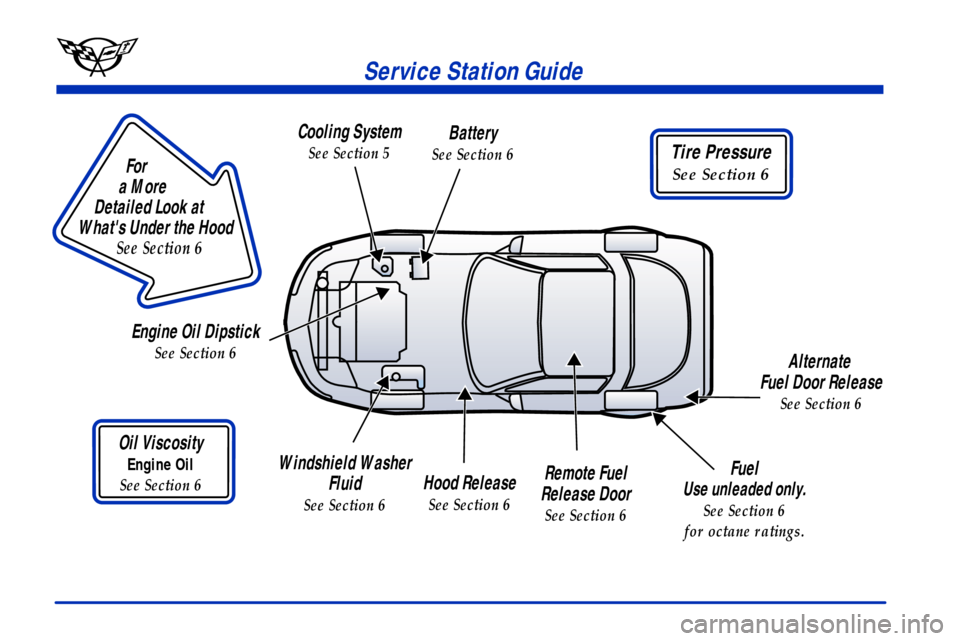
Service Station Guide
Oil Viscosity
Engine Oil
See Section 6
Tire Pressure
See Section 6
Engine Oil Dipstick
See Section 6
Cooling System
See Section 5
Battery
See Section 6
Windshield Washer
Fluid
See Section 6
Hood Release
See Section 6
Remote Fuel
Release Door
See Section 6
For
a More
Detailed Look at
What's Under the Hood
See Section 6
Alternate
Fuel Door Release
See Section 6
Fuel
Use unleaded only.
See Section 6
for octane ratings.
Page 41 of 383
1-23
How does an air bag restrain?
In moderate to severe frontal or near
-frontal collisions,
even belted occupants can contact the steering wheel or
the instrument panel. Air bags supplement the protection
provided by safety belts. Air bags distribute the force of
the impact more evenly over the occupant's upper body,
stopping the occupant more gradually. But air bags
would not help you in many types of collisions,
including rollovers, rear impacts and side impacts,
primarily because an occupant's motion is not toward
those air bags. Air bags should never be regarded as
anything more than a supplement to safety belts,
and then only in moderate to severe frontal or
near
-frontal collisions.
What will you see after an air bag inflates?
After an air bag inflates, it quickly deflates, so quickly
that some people may not even realize the air bag
inflated. Some components of the air bag module
-- the
steering wheel hub for the driver's air bag, or the
instrument panel for the passenger's bag
-- will be hot
for a short time. The parts of the bag that come into
contact with you may be warm, but not too hot to touch.
There will be some smoke and dust coming from vents
in the deflated air bags. Air bag inflation doesn't prevent
the driver from seeing or from being able to steer the
vehicle, nor does it stop people from leaving the vehicle.
CAUTION:
When an air bag inflates, there is dust in the air.
This dust could cause breathing problems for
people with a history of asthma or other
breathing trouble. To avoid this, everyone in the
vehicle should get out as soon as it is safe to do so.
If you have breathing problems but can't get out
of the vehicle after an air bag inflates, then get
fresh air by opening a window or door.
In many crashes severe enough to inflate an air bag,
windshields are broken by vehicle deformation.
Additional windshield breakage may also occur from the
passenger air bag.
�Air bags are designed to inflate only once. After they
inflate, you'll need some new parts for your air bag
system. If you don't get them, the air bag system
won't be there to help protect you in another crash.
A new system will include air bag modules and
possibly other parts. The service manual for your
vehicle covers the need to replace other parts.
Page 42 of 383
1-24
�Your vehicle is equipped with a diagnostic module,
which records information about the air bag system.
The module records information about the readiness
of the system, when the system commands air bag
inflation and driver's safety belt usage at
deployment. The module also records speed, engine
rpm, brake and throttle data.
�Let only qualified technicians work on your air bag
system. Improper service can mean that your air
bag system won't work properly. See your dealer
for service.
NOTICE:
If you damage the covering for the driver's or the
passenger's air bag, the bag may not work
properly. You may have to replace the air bag
module in the steering wheel or both the air bag
module and the instrument panel for the
passenger's air bag. Do not open or break the air
bag coverings.
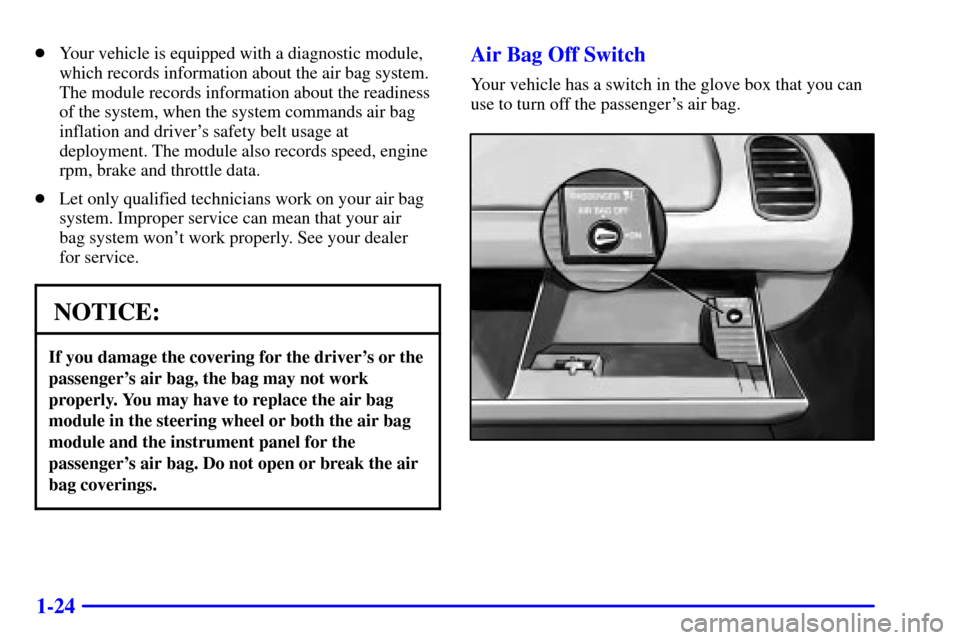
Air Bag Off Switch
Your vehicle has a switch in the glove box that you can
use to turn off the passenger's air bag.
Page 45 of 383
1-27
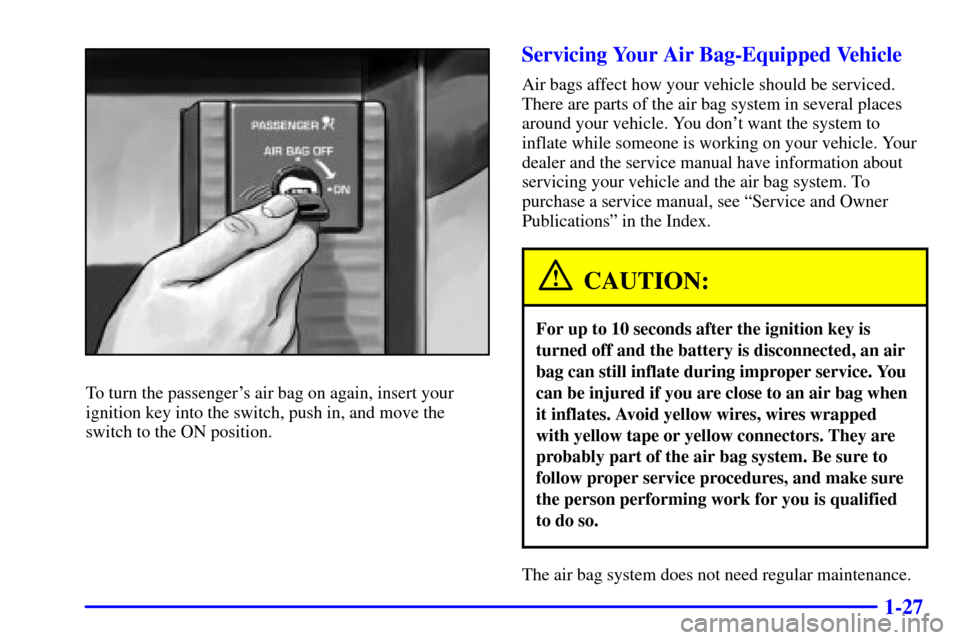
To turn the passenger's air bag on again, insert your
ignition key into the switch, push in, and move the
switch to the ON position.
Servicing Your Air Bag-Equipped Vehicle
Air bags affect how your vehicle should be serviced.
There are parts of the air bag system in several places
around your vehicle. You don't want the system to
inflate while someone is working on your vehicle. Your
dealer and the service manual have information about
servicing your vehicle and the air bag system. To
purchase a service manual, see ªService and Owner
Publicationsº in the Index.
CAUTION:
For up to 10 seconds after the ignition key is
turned off and the battery is disconnected, an air
bag can still inflate during improper service. You
can be injured if you are close to an air bag when
it inflates. Avoid yellow wires, wires wrapped
with yellow tape or yellow connectors. They are
probably part of the air bag system. Be sure to
follow proper service procedures, and make sure
the person performing work for you is qualified
to do so.
The air bag system does not need regular maintenance.
Page 55 of 383
1-37
CAUTION:
A child in a rear-facing child restraint can be
seriously injured or killed if the passenger's air
bag inflates. This is because the back of the
rear
-facing child restraint would be very close to
the inflating air bag. Do not use a rear
-facing
child restraint in this vehicle unless the
passenger's air bag has been turned off.
If a forward-facing child restraint is suitable for
your child, always move the passenger seat as far
back as it will go.
CAUTION:
If the air bag readiness light ever comes on when
you have turned off the air bag, it means that
something may be wrong with the air bag system.
The passenger's air bag could inflate even though
the switch is off. If this ever happens, don't let
anyone whom the national government has
identified as a member of a passenger air bag
risk group sit in the passenger's position (for
example, don't secure a rear
-facing child
restraint in your vehicle) until you have your
vehicle serviced. See ªAir Bag Off Switchº in
the Index.
Page 71 of 383
2-9
Remote Keyless Entry (RKE) System
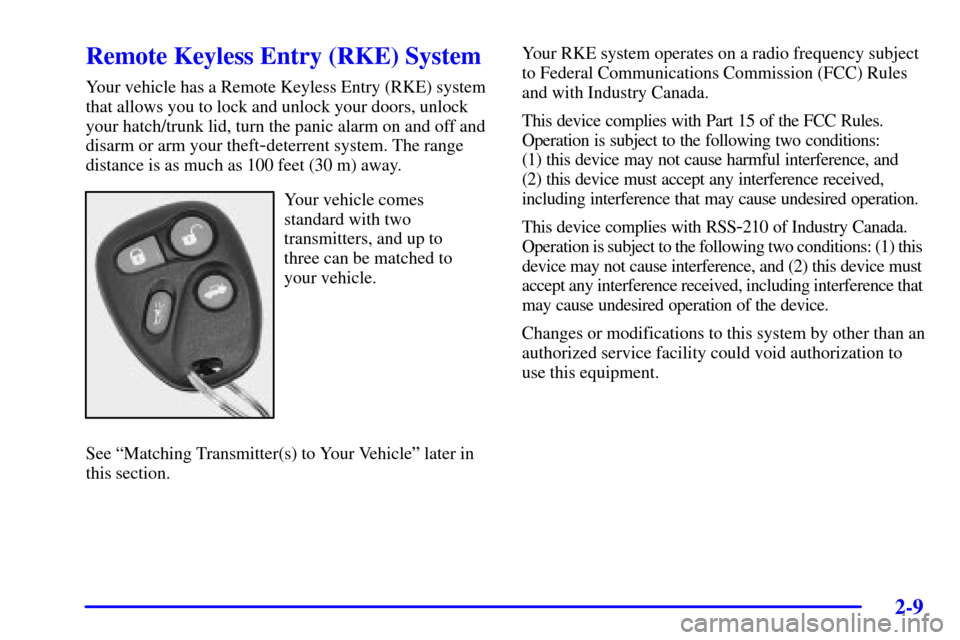
Your vehicle has a Remote Keyless Entry (RKE) system
that allows you to lock and unlock your doors, unlock
your hatch/trunk lid, turn the panic alarm on and off and
disarm or arm your theft
-deterrent system. The range
distance is as much as 100 feet (30 m) away.
Your vehicle comes
standard with two
transmitters, and up to
three can be matched to
your vehicle.
See ªMatching Transmitter(s) to Your Vehicleº later in
this section.Your RKE system operates on a radio frequency subject
to Federal Communications Commission (FCC) Rules
and with Industry Canada.
This device complies with Part 15 of the FCC Rules.
Operation is subject to the following two conditions:
(1) this device may not cause harmful interference, and
(2) this device must accept any interference received,
including interference that may cause undesired operation.
This device complies with RSS
-210 of Industry Canada.
Operation is subject to the following two conditions: (1) this
device may not cause interference, and (2) this device must
accept any interference received, including interference that
may cause undesired operation of the device.
Changes or modifications to this system by other than an
authorized service facility could void authorization to
use this equipment.