Page 6 of 383
Table of Contents (cont'd)
Maintenance Schedule Service and Appearance Care
Section
7
Section
6
Scheduled Maintenance
Owner Checks and Services
Periodic Maintenance InspectionsRecommended Fluids and Lubricants
Maintenance Records Fuel
Checking Fluids and Lubricants
GM Oil Life System™
Engine Air Cleaner/Filter
Brakes
Bulb ReplacementWindshield Wiper Blade Replacement
Tires and Wheels
Appearance Care
Electrical System/Fuses and Circuit Breakers
Capacities and Specifications
Normal Maintenance Replacement Parts
iv
Page 161 of 383
2-99
Remember, you must reset the OIL LIFE yourself after
each oil change. It will not reset itself. Also, be careful
not to reset the OIL LIFE accidentally at any time other
than when the oil has just been changed. It can't be reset
accurately until the next oil change.
To reset the system, see ªHow to Reset the Change Oil
Soon Messageº in the Index.
Also, see ªEngine Oil, When to Changeº and
ªMaintenance Scheduleº in the Index.
4 OPTIONS
This button allows you to choose personal options that
may be available on your vehicle, depending on the
options your vehicle is equipped with. Some of these
functions work along with the remote keyless
entry transmitter.
When returning to the options menu, the first item of the
options list will always be displayed, not the one you
were last in when you changed buttons.
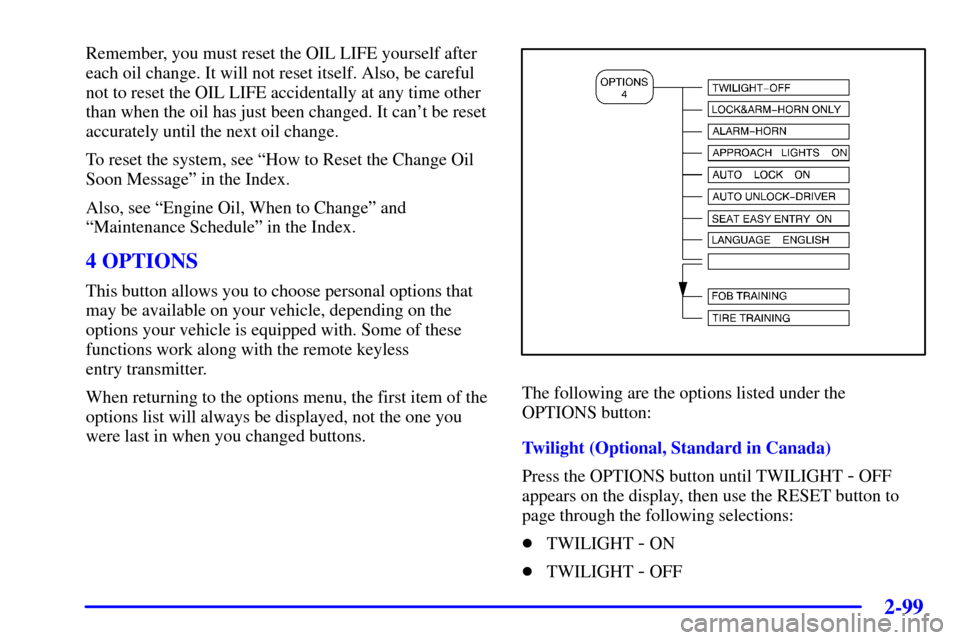
The following are the options listed under the
OPTIONS button:
Twilight (Optional, Standard in Canada)
Press the OPTIONS button until TWILIGHT
- OFF
appears on the display, then use the RESET button to
page through the following selections:
�TWILIGHT
- ON
�TWILIGHT
- OFF
Page 286 of 383
6-17
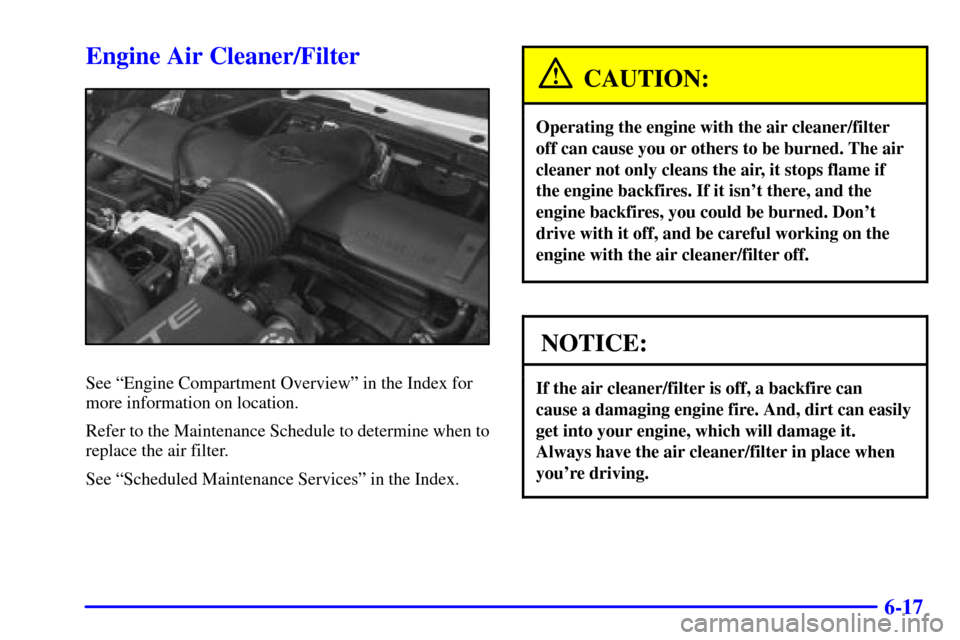
Engine Air Cleaner/Filter
See ªEngine Compartment Overviewº in the Index for
more information on location.
Refer to the Maintenance Schedule to determine when to
replace the air filter.
See ªScheduled Maintenance Servicesº in the Index.
CAUTION:
Operating the engine with the air cleaner/filter
off can cause you or others to be burned. The air
cleaner not only cleans the air, it stops flame if
the engine backfires. If it isn't there, and the
engine backfires, you could be burned. Don't
drive with it off, and be careful working on the
engine with the air cleaner/filter off.
NOTICE:
If the air cleaner/filter is off, a backfire can
cause a damaging engine fire. And, dirt can easily
get into your engine, which will damage it.
Always have the air cleaner/filter in place when
you're driving.
Page 288 of 383
6-19
Automatic Transmission Fluid
How to Check
It is not necessary to check the transmission fluid level.
A transmission fluid leak is the only reason for fluid
loss. If a leak occurs, take the vehicle to your dealer
service department and have it repaired as soon
as possible.
There is a special procedure for checking and changing
the transmission fluid. Because this procedure is
difficult, you should have this done at your dealer
service department. Contact your dealer for additional
information or the procedure can be found in the service
manual. To purchase a service manual, see ªService and
Owner Publicationsº in the Index.
NOTICE:
We recommend that only fluid labeled
DEXRON�-III be used, because fluid with that
label is made specially for your automatic
transmission. Damage caused by fluid other than
DEXRON
�-III is not covered by your new
vehicle warranty.
Change both the fluid and filter every 50,000 miles
(80 000 km) if the vehicle is mainly driven under one of
these conditions:
�In heavy city traffic where the outside temperature
regularly reaches 90�F (32�C) or higher.
�In hilly or mountainous terrain.
�High performance operation.
If you do not use your vehicle under one of these
conditions, change the fluid and filter every
100,000 miles (166 000 km).
See ªScheduled Maintenance Servicesº in the Index for
the proper service intervals for the transmission fluid
and filter.
Manual Transmission Fluid
When to Check
A good time to have it checked is when the engine oil is
changed. However, the fluid in your manual
transmission doesn't require changing.
Page 290 of 383
6-21 How to Add Fluid
Here's how to add fluid. Refer to the Maintenance
Schedule to determine what kind of fluid to use. See
ªRecommended Fluids and Lubricantsº in the Index.
1. Remove the filler plug.
2. Add fluid at the filler plug hole. Add only enough
fluid to bring the fluid level up to the bottom of the
filler plug hole.
3. Install the filler plug. Be sure the plug is fully seated.
4. Tighten the plug to 20 lb
-ft (27 N´m).
Hydraulic Clutch
The hydraulic clutch linkage in your vehicle is
self
-adjusting. The clutch master cylinder reservoir is
filled with hydraulic clutch fluid.
It is not necessary to regularly check clutch fluid unless
you suspect there is a leak in the system. Adding fluid
won't correct a leak.
A fluid loss in this system could indicate a problem.
Have the system inspected and repaired.
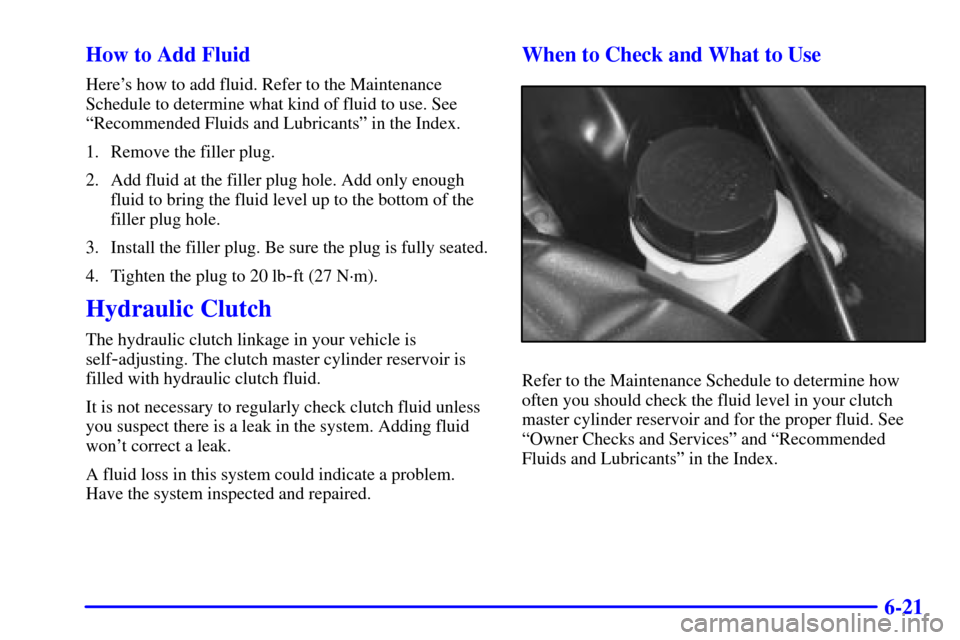
When to Check and What to Use
Refer to the Maintenance Schedule to determine how
often you should check the fluid level in your clutch
master cylinder reservoir and for the proper fluid. See
ªOwner Checks and Servicesº and ªRecommended
Fluids and Lubricantsº in the Index.
Page 291 of 383
6-22 How to Check and Add Fluid
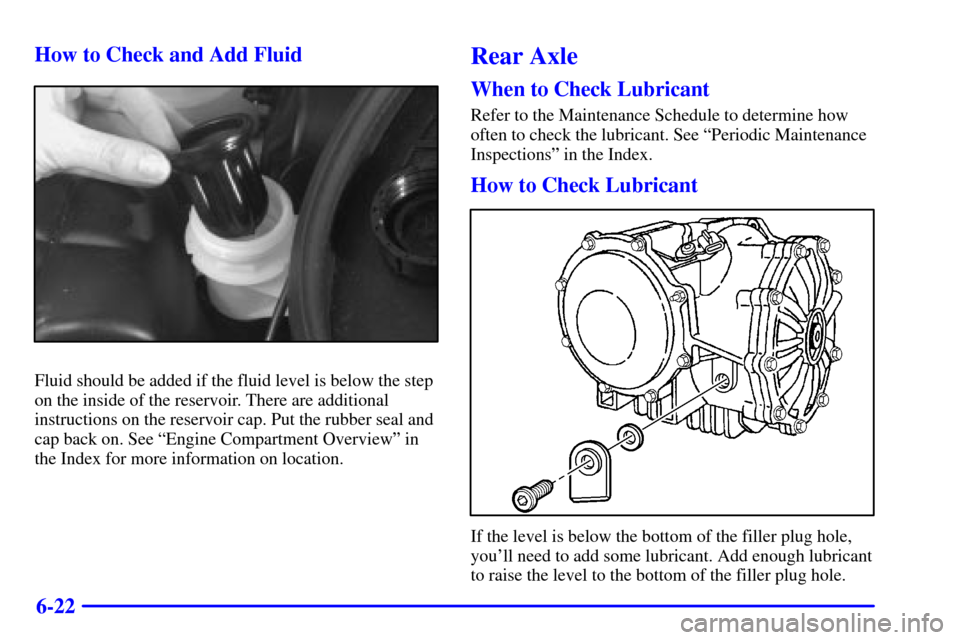
Fluid should be added if the fluid level is below the step
on the inside of the reservoir. There are additional
instructions on the reservoir cap. Put the rubber seal and
cap back on. See ªEngine Compartment Overviewº in
the Index for more information on location.
Rear Axle
When to Check Lubricant
Refer to the Maintenance Schedule to determine how
often to check the lubricant. See ªPeriodic Maintenance
Inspectionsº in the Index.
How to Check Lubricant
If the level is below the bottom of the filler plug hole,
you'll need to add some lubricant. Add enough lubricant
to raise the level to the bottom of the filler plug hole.
Page 298 of 383
6-29
Brakes
Brake Fluid
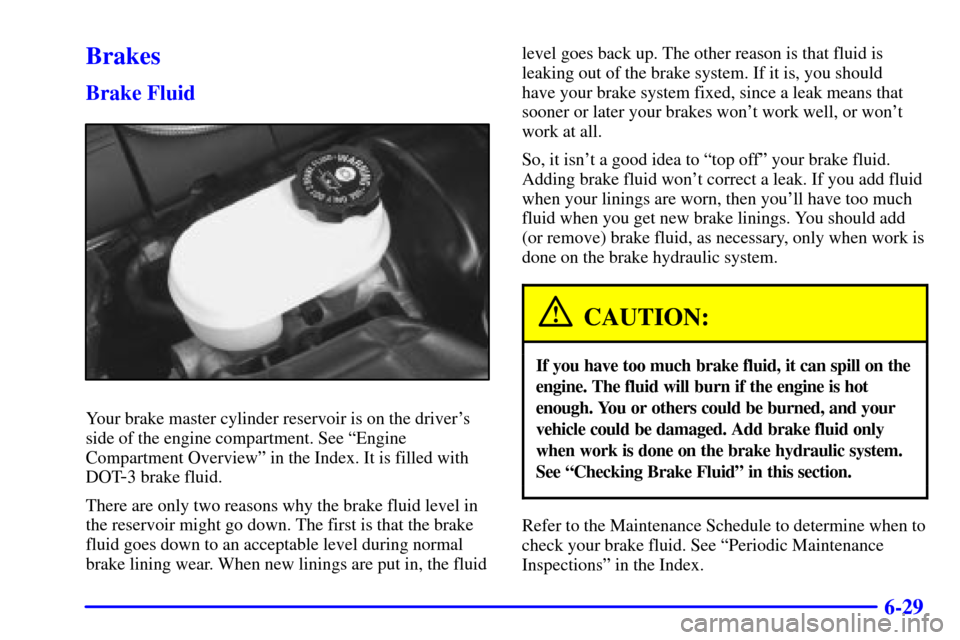
Your brake master cylinder reservoir is on the driver's
side of the engine compartment. See ªEngine
Compartment Overviewº in the Index. It is filled with
DOT
-3 brake fluid.
There are only two reasons why the brake fluid level in
the reservoir might go down. The first is that the brake
fluid goes down to an acceptable level during normal
brake lining wear. When new linings are put in, the fluidlevel goes back up. The other reason is that fluid is
leaking out of the brake system. If it is, you should
have your brake system fixed, since a leak means that
sooner or later your brakes won't work well, or won't
work at all.
So, it isn't a good idea to ªtop offº your brake fluid.
Adding brake fluid won't correct a leak. If you add fluid
when your linings are worn, then you'll have too much
fluid when you get new brake linings. You should add
(or remove) brake fluid, as necessary, only when work is
done on the brake hydraulic system.
CAUTION:
If you have too much brake fluid, it can spill on the
engine. The fluid will burn if the engine is hot
enough. You or others could be burned, and your
vehicle could be damaged. Add brake fluid only
when work is done on the brake hydraulic system.
See ªChecking Brake Fluidº in this section.
Refer to the Maintenance Schedule to determine when to
check your brake fluid. See ªPeriodic Maintenance
Inspectionsº in the Index.
Page 299 of 383
6-30
Checking Brake Fluid
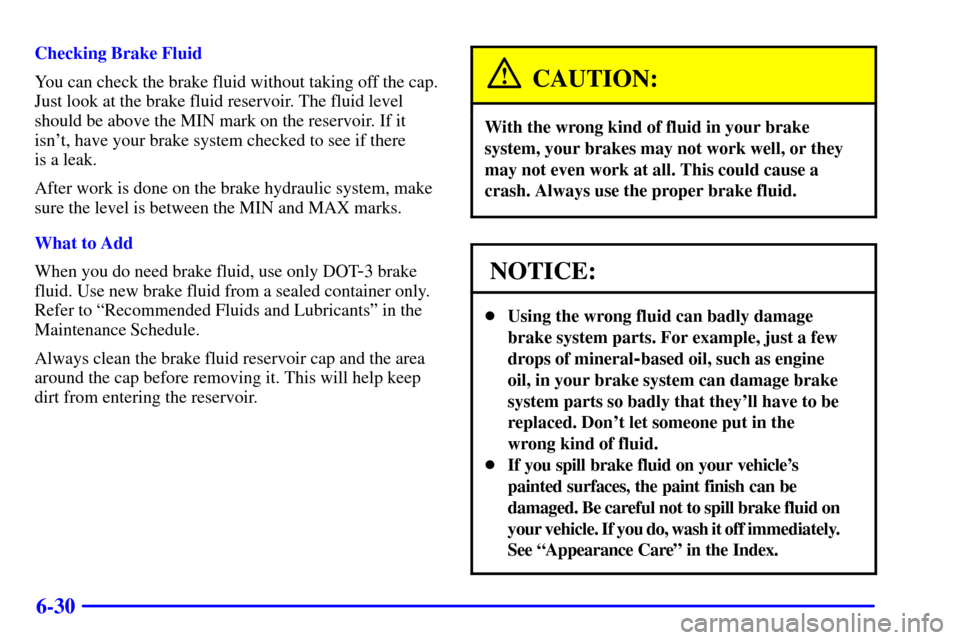
You can check the brake fluid without taking off the cap.
Just look at the brake fluid reservoir. The fluid level
should be above the MIN mark on the reservoir. If it
isn't, have your brake system checked to see if there
is a leak.
After work is done on the brake hydraulic system, make
sure the level is between the MIN and MAX marks.
What to Add
When you do need brake fluid, use only DOT
-3 brake
fluid. Use new brake fluid from a sealed container only.
Refer to ªRecommended Fluids and Lubricantsº in the
Maintenance Schedule.
Always clean the brake fluid reservoir cap and the area
around the cap before removing it. This will help keep
dirt from entering the reservoir.
CAUTION:
With the wrong kind of fluid in your brake
system, your brakes may not work well, or they
may not even work at all. This could cause a
crash. Always use the proper brake fluid.
NOTICE:
�Using the wrong fluid can badly damage
brake system parts. For example, just a few
drops of mineral
-based oil, such as engine
oil, in your brake system can damage brake
system parts so badly that they'll have to be
replaced. Don't let someone put in the
wrong kind of fluid.
�If you spill brake fluid on your vehicle's
painted surfaces, the paint finish can be
damaged. Be careful not to spill brake fluid on
your vehicle. If you do, wash it off immediately.
See ªAppearance Careº in the Index.