Page 5 of 383
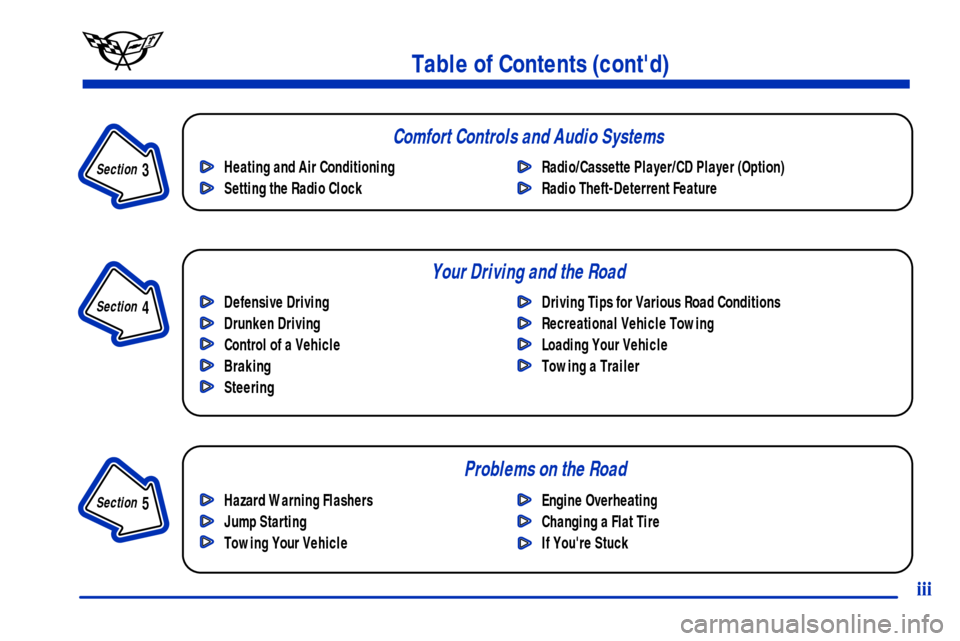
Table of Contents (cont'd)
Defensive Driving
Drunken Driving
Control of a Vehicle
Braking
SteeringDriving Tips for Various Road Conditions
Recreational Vehicle Towing
Loading Your Vehicle
Towing a Trailer Heating and Air Conditioning
Setting the Radio ClockRadio/Cassette Player/CD Player (Option)
Radio Theft-Deterrent Feature
Hazard Warning Flashers
Jump Starting
Towing Your VehicleEngine Overheating
Changing a Flat Tire
If You're Stuck
Problems on the Road
Section
3
Section
4
Section
5
iii
Your Driving and the Road Comfort Controls and Audio Systems
Page 244 of 383
5-
5-1
Section 5 Problems on the Road
Here you'll find what to do about some problems that can occur on the road.
5
-2 Hazard Warning Flashers
5
-2 Other Warning Devices
5
-3 Jump Starting
5
-8 Towing Your Vehicle
5
-8 Engine Overheating5
-11 Cooling System
5
-18 If a Tire Goes Flat
5
-20 Tire Inflator Kit (Z06 Models Only)
5
-26 If You're Stuck: In Sand, Mud, Ice or Snow
Page 246 of 383
5-3
Jump Starting
If your battery has run down, you may want to use
another vehicle and some jumper cables to start your
vehicle. But please use the following steps to do
it safely.
CAUTION:
Batteries can hurt you. They can be
dangerous because:
�They contain acid that can burn you.
�They contain gas that can explode or ignite.
�They contain enough electricity to
burn you.
If you don't follow these steps exactly, some or all
of these things can hurt you.
NOTICE:
Ignoring these steps could result in costly damage
to your vehicle that wouldn't be covered by
your warranty.
Trying to start your vehicle by pushing or pulling
it won't work, and it could damage your vehicle.
1. Check the other vehicle. It must have a 12-volt
battery with a negative ground system.
NOTICE:
If the other system isn't a 12-volt system with a
negative ground, both vehicles can be damaged.
Page 247 of 383
5-4
2. Get the vehicles close enough so that the jumper
cables can reach, but be sure the vehicles aren't
touching each other. If they are, it could cause a
ground connection you don't want. You wouldn't be
able to start your vehicle, and the bad grounding
could damage the electrical systems.
To avoid the possibility of the vehicles rolling, set
the parking brake firmly on both vehicles involved in
the jump start procedure. Put an automatic
transmission in PARK (P) or a manual transmission
in NEUTRAL before setting the parking brake.
3. Turn off the ignition on both vehicles. Unplug
unnecessary accessories plugged into the cigarette
lighter or accessory plug. Turn off all lamps that
aren't needed as well as radios. This will avoid
sparks and help save both batteries. In addition, it
could save your radio.
NOTICE:
If you leave your radio on, it could be badly
damaged. The repairs wouldn't be covered by
your warranty.
4. Open the hoods and locate the batteries. Find the
positive (+) and negative (
-) terminals on each.
CAUTION:
An electric fan can start up even when the engine
is not running and can injure you. Keep hands,
clothing and tools away from any underhood
electric fan.
Page 250 of 383
5-7
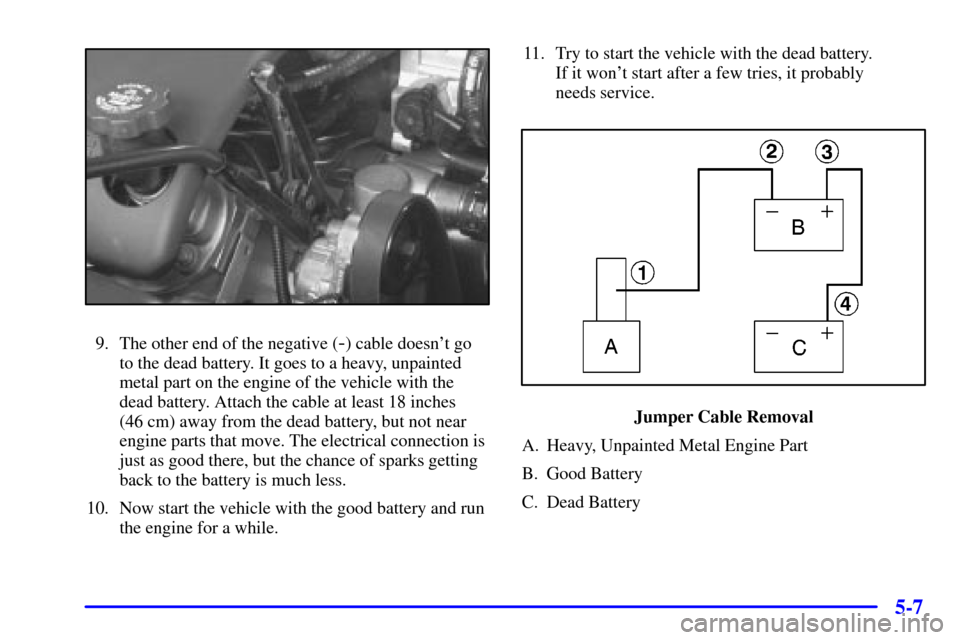
9. The other end of the negative (-) cable doesn't go
to the dead battery. It goes to a heavy, unpainted
metal part on the engine of the vehicle with the
dead battery. Attach the cable at least 18 inches
(46 cm) away from the dead battery, but not near
engine parts that move. The electrical connection is
just as good there, but the chance of sparks getting
back to the battery is much less.
10. Now start the vehicle with the good battery and run
the engine for a while.11. Try to start the vehicle with the dead battery.
If it won't start after a few tries, it probably
needs service.
Jumper Cable Removal
A. Heavy, Unpainted Metal Engine Part
B. Good Battery
C. Dead Battery
Page 302 of 383
6-33 Vehicle Storage
If you're not going to drive your vehicle for 25 days
or more, remove the black, negative (
-) cable from
the battery. This will help keep your battery from
running down.
CAUTION:
Batteries have acid that can burn you and gas
that can explode. You can be badly hurt if you
aren't careful. See ªJump Startingº in the Index
for tips on working around a battery without
getting hurt.
Contact your dealer to learn how to prepare your vehicle
for longer storage periods.
Also, for your audio system, see ªTheft
-Deterrent
Featureº in the Index.
Bulb Replacement
For the proper type of replacement bulb, see
ªReplacement Bulbsº in the Index.
For any bulb changing procedure not listed in
this section, contact your Chevrolet dealer's
service department.
Halogen Bulbs
CAUTION:
Halogen bulbs have pressurized gas inside and
can burst if you drop or scratch the bulb. You or
others could be injured. Be sure to read and
follow the instructions on the bulb package.
Page 376 of 383

8-6
Chevrolet Roadside Assistance Program
To enhance Chevrolet's strong commitment to customer
satisfaction, Chevrolet is excited to announce the
establishment of the Chevrolet Roadside Assistance
Center. As the owner of a 2001 Chevrolet, membership
in Roadside Assistance is free.
Roadside Assistance is available 24 hours a day,
365 days a year, by calling 1
-800-CHEV-USA (243-8872).
This toll-free number will provide you over
-the-phone
roadside assistance with minor mechanical problems. If your problem cannot be resolved over the phone,
our advisors have access to a nationwide network of dealer
recommended service providers. Roadside membership
is free; however some services may incur costs.
Roadside offers two levels of service to the customer,
Basic Care and Courtesy Care:
�Toll
-free number, 1-800-CHEV-USA (243-8872),
text telephone (TTY) users, call 1
-888-889-2438
�Free towing for warranty repairs
�Basic over
-the-phone technical advice
�Available dealer services at reasonable costs
(i.e., wrecker services, locksmith/key service,
glass repair, etc.)
ROADSIDE Courtesy Care PROVIDES:
�Roadside Basic Care services (as outlined previously)
Plus:
�FREE Non
-Warranty Towing (to the closest dealer
from a legal roadway)
�FREE Locksmith/Key Service (when keys are lost
on the road or locked inside)
�FREE Jump Start (at home or on the road)
�FREE Fuel Delivery ($5 of fuel delivered on the road)