Page 299 of 383
6-30
Checking Brake Fluid
You can check the brake fluid without taking off the cap.
Just look at the brake fluid reservoir. The fluid level
should be above the MIN mark on the reservoir. If it
isn't, have your brake system checked to see if there
is a leak.
After work is done on the brake hydraulic system, make
sure the level is between the MIN and MAX marks.
What to Add
When you do need brake fluid, use only DOT
-3 brake
fluid. Use new brake fluid from a sealed container only.
Refer to ªRecommended Fluids and Lubricantsº in the
Maintenance Schedule.
Always clean the brake fluid reservoir cap and the area
around the cap before removing it. This will help keep
dirt from entering the reservoir.
CAUTION:
With the wrong kind of fluid in your brake
system, your brakes may not work well, or they
may not even work at all. This could cause a
crash. Always use the proper brake fluid.
NOTICE:
�Using the wrong fluid can badly damage
brake system parts. For example, just a few
drops of mineral
-based oil, such as engine
oil, in your brake system can damage brake
system parts so badly that they'll have to be
replaced. Don't let someone put in the
wrong kind of fluid.
�If you spill brake fluid on your vehicle's
painted surfaces, the paint finish can be
damaged. Be careful not to spill brake fluid on
your vehicle. If you do, wash it off immediately.
See ªAppearance Careº in the Index.
Page 300 of 383
6-31 Brake Wear
Your vehicle has four-wheel disc brakes.
Disc brake pads have built
-in wear indicators that
make a high
-pitched warning sound when the brake
pads are worn and new pads are needed. The sound
may come and go or be heard all the time your vehicle
is moving (except when you are pushing on the brake
pedal firmly).
CAUTION:
The brake wear warning sound means that soon
your brakes won't work well. That could lead to
an accident. When you hear the brake wear
warning sound, have your vehicle serviced.
NOTICE:
Continuing to drive with worn-out brake pads
could result in costly brake repair.
Some driving conditions or climates may cause a brake
squeal when the brakes are first applied or lightly
applied. This does not mean something is wrong with
your brakes.
Brake linings should always be replaced as complete
axle sets.
See ªBrake System Inspectionº in Section 7 of this
manual under Part C ªPeriodic Maintenance Inspections.º
Brake Pedal Travel
See your dealer if the brake pedal does not return to
normal height, or if there is a rapid increase in pedal
travel. This could be a sign of brake trouble.
Page 301 of 383
6-32 Brake Adjustment
As you make brake stops, your disc brakes
automatically adjust for wear.
Replacing Brake System Parts
The braking system on a vehicle is complex. Its many
parts have to be of top quality and work well together if
the vehicle is to have really good braking. Your vehicle
was designed and tested with top
-quality GM brake
parts. When you replace parts of your braking
system
-- for example, when your brake linings wear
down and you have to have new ones put in
-- be sure
you get new approved GM replacement parts. If you
don't, your brakes may no longer work properly. For
example, if someone puts in brake linings that are wrong
for your vehicle, the balance between your front and
rear brakes can change
-- for the worse. The braking
performance you've come to expect can change in many
other ways if someone puts in the wrong replacement
brake parts.
Battery
Your new vehicle comes with a maintenance free
ACDelco� battery. When it's time for a new battery, get
one that has the replacement number shown on the
original battery's label. We recommend an ACDelco
battery. For battery replacement, see your dealer or the
service manual. To purchase a service manual, see
ªService and Owner Publicationsº in the Index. After
the battery has been replaced, refer to the ªRemote
Keyless Entry Systemº in the Index to resynchronize
your transmitter(s). See ªEngine Compartment
Overviewº in the Index for battery location.
WARNING: Battery posts, terminals and related
accessories contain lead and lead compounds, chemicals
known to the State of California to cause cancer and
reproductive harm. Wash hands after handling.
Page 307 of 383
6-38
Windshield Wiper
Blade Replacement
Windshield wiper blades should be inspected at least
twice a year for wear or cracking. See ªWiper Blade
Checkº in the index for more information.
Replacement blades come in different types and are
removed in different ways. For the proper type and
length, see ªNormal Maintenance Replacement Partsº in
the Index.
It's a good idea to clean or replace the wiper blade
assembly every six months.
NOTICE:
Use care when removing or installing a blade
assembly. Accidental bumping can cause the arm
to fall back and strike the windshield.
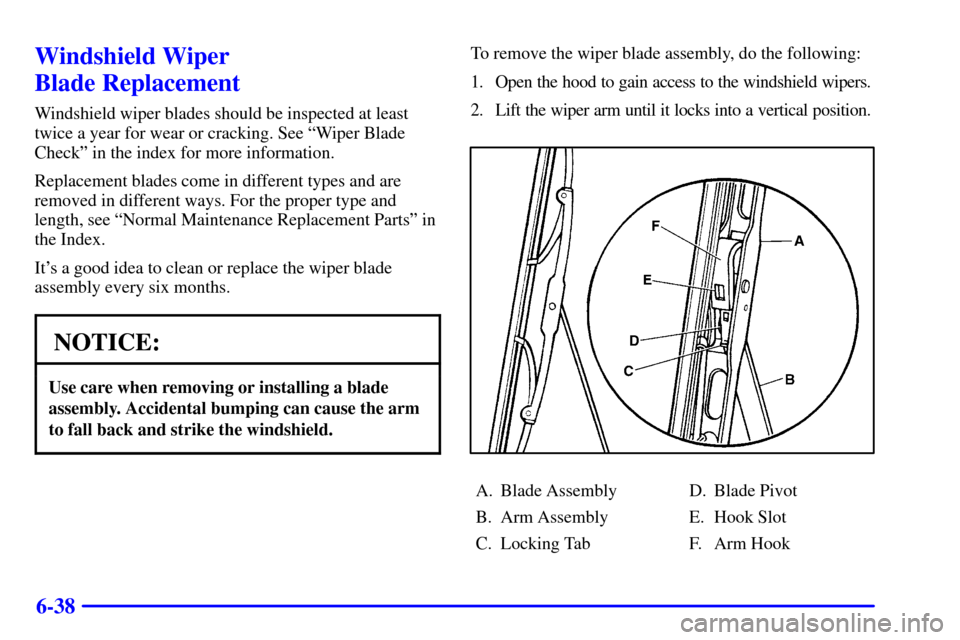
To remove the wiper blade assembly, do the following:
1. Open the hood to gain access to the windshield wipers.
2. Lift the wiper arm until it locks into a vertical position.
A. Blade Assembly
B. Arm Assembly
C. Locking TabD. Blade Pivot
E. Hook Slot
F. Arm Hook
Page 332 of 383
6-63
Cleaning Tires
To clean your tires, use a stiff brush with a tire cleaner.
NOTICE:
When applying a tire dressing always take care to
wipe off any overspray or splash from all painted
surfaces on the body or wheels of the vehicle.
Petroleum
-based products may damage the paint
finish and tires.
Finish Damage
Any stone chips, fractures or deep scratches in the finish
should be repaired right away.
Minor chips and scratches can be repaired with touch
-up
materials available from your dealer or other service
outlets. Larger areas of finish damage can be corrected
in your dealer's body and paint shop.
Magnesium Wheel Finish
NOTICE:
Improper paint repair or refinishing can cause
corrosion damage to a magnesium wheel. See
your dealer if a magnesium wheel needs paint
repair or refinishing.
Underbody Maintenance
Chemicals used for ice and snow removal and dust
control can collect on the underbody. If these are not
removed, accelerated corrosion (rust) can occur on
the underbody parts such as fuel lines, frame, floor
pan and exhaust system even though they have
corrosion protection.
At least every spring, flush these materials from the
underbody with plain water. Clean any areas where mud
and other debris can collect. Dirt packed in closed areas
of the frame should be loosened before being flushed.
Your dealer or an underbody car washing system can do
this for you.
Page 345 of 383

6-76 Engine Specifications
Type5.7L V8 . . . . . . . . . . . . . . . . . . . . . . . . . . . . . . . .
VIN Engine Code
LS1 G. . . . . . . . . . . . . . . . . . . . . . . . . . . . . . . . . . . .
LS6 S. . . . . . . . . . . . . . . . . . . . . . . . . . . . . . . . . . . .
Displacement346 cubic inches (5665 cc) . . . . . . . . .
Fuel DeliverySequential Multi
-Port . . . . . . . . . . . . .
Fuel Injection (SFI)
Valve ArrangementOverhead Valve . . . . . . . . . . . . .
Piston Displacement5.7L . . . . . . . . . . . . . . . . . . . . . .
Bore3.90 inches (9.9 cm) . . . . . . . . . . . . . . . . . . . . . .
Stroke3.62 inches (9.2 cm) . . . . . . . . . . . . . . . . . . . .
Compression Ratio
LS1 10.0:1. . . . . . . . . . . . . . . . . . . . . . . . . . . . . . . .
LS6 10.5:1. . . . . . . . . . . . . . . . . . . . . . . . . . . . . . . .
Horsepower
LS1 350@5600 rpm. . . . . . . . . . . . . . . . . . . . . . . . .
LS6 380@6000 rpm. . . . . . . . . . . . . . . . . . . . . . . . .
Torque
LS1 (Automatic Transmission) 360@4000 rpm. . . .
LS1 (Manual Transmission) 370@4400 rpm. . . . . .
LS6 380@4800 rpm. . . . . . . . . . . . . . . . . . . . . . . . .
Firing Order1
-8-7-2-6-5-4-3 . . . . . . . . . . . . . . . . . .
Thermostat Starts to Open187�F (86�C) . . . . . . . .
Normal Maintenance
Replacement Parts
Engine Air Cleaner/FilterA917C* . . . . . . . . . . . . . .
Battery75P
-7YR* . . . . . . . . . . . . . . . . . . . . . . . . . . . .
Coolant Surge Tank CapGM Part No. 10296465 . . .
15 psi (105 kPa)
Engine Oil FilterPF44* . . . . . . . . . . . . . . . . . . . . . . .
PCV ValveCV948C* . . . . . . . . . . . . . . . . . . . . . . . . .
0.060 inch (1.524 mm)
Spark PlugPTJ16R15 (0.060 inch Gap) . . . . . . . . . .
Denso Type Number
Windshield Wiper Blade
Length 22 inches (55.9 cm). . . . . . . . . . . . . . . . . . . .
Type 9 mm x 3 mm Shepherd's Hook. . . . . . . . . . . .
* ACDelco
� part number.
Page 347 of 383
7-
7-1
Section 7 Maintenance Schedule
This section covers the maintenance required for your vehicle. Your vehicle needs these services to retain its safety,
dependability and emission control performance.
7
-2 Introduction
7
-4 Part A: Scheduled Maintenance Services
7
-13 Part B: Owner Checks and Services7
-17 Part C: Periodic Maintenance Inspections
7
-19 Part D: Recommended Fluids and Lubricants
7
-21 Part E: Maintenance Record
Page 348 of 383
7-2
Have you purchased the GM Protection Plan? The Plan
supplements your new vehicle warranties. See your
Warranty and Owner Assistance booklet or your dealer
for details.
Introduction
Your Vehicle and the Environment
Proper vehicle maintenance not only helps to keep your
vehicle in good working condition, but also helps the
environment. All recommended maintenance procedures
are important. Improper vehicle maintenance can even
affect the quality of the air we breathe. Improper fluid
levels or the wrong tire inflation can increase the level
of emissions from your vehicle. To help protect our
environment, and to keep your vehicle in good
condition, please maintain your vehicle properly.
Maintenance Requirements
Maintenance intervals, checks, inspections and
recommended fluids and lubricants as prescribed in this
manual are necessary to keep your vehicle in good
working condition. Any damage caused by failure to
follow recommended maintenance may not be covered
by warranty.