Page 52 of 357
1-40
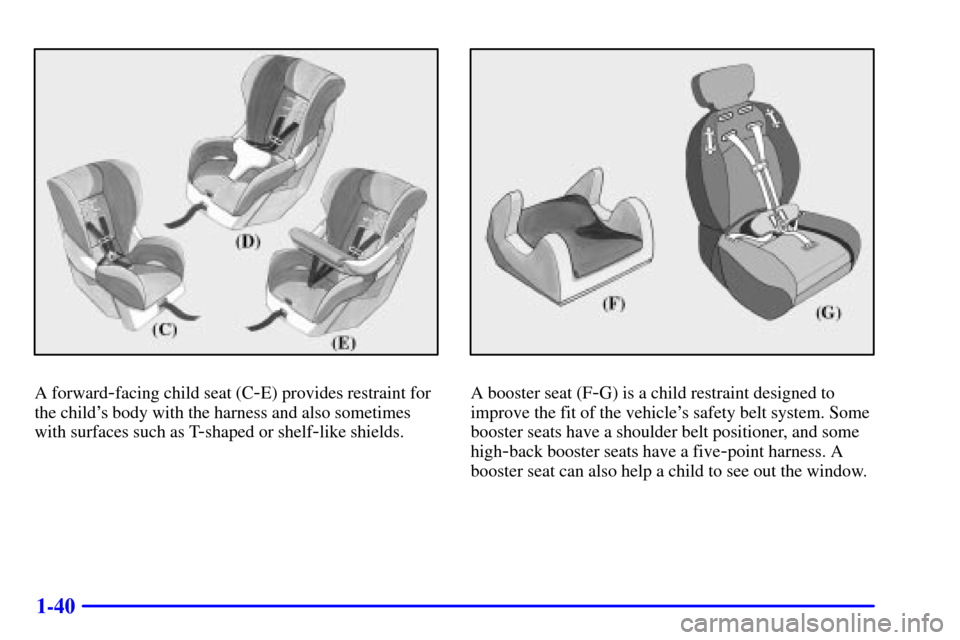
A forward-facing child seat (C-E) provides restraint for
the child's body with the harness and also sometimes
with surfaces such as T
-shaped or shelf-like shields.
A booster seat (F-G) is a child restraint designed to
improve the fit of the vehicle's safety belt system. Some
booster seats have a shoulder belt positioner, and some
high
-back booster seats have a five-point harness. A
booster seat can also help a child to see out the window.
Page 60 of 357
1-48 Securing a Child Restraint in the Right
Front Seat Position
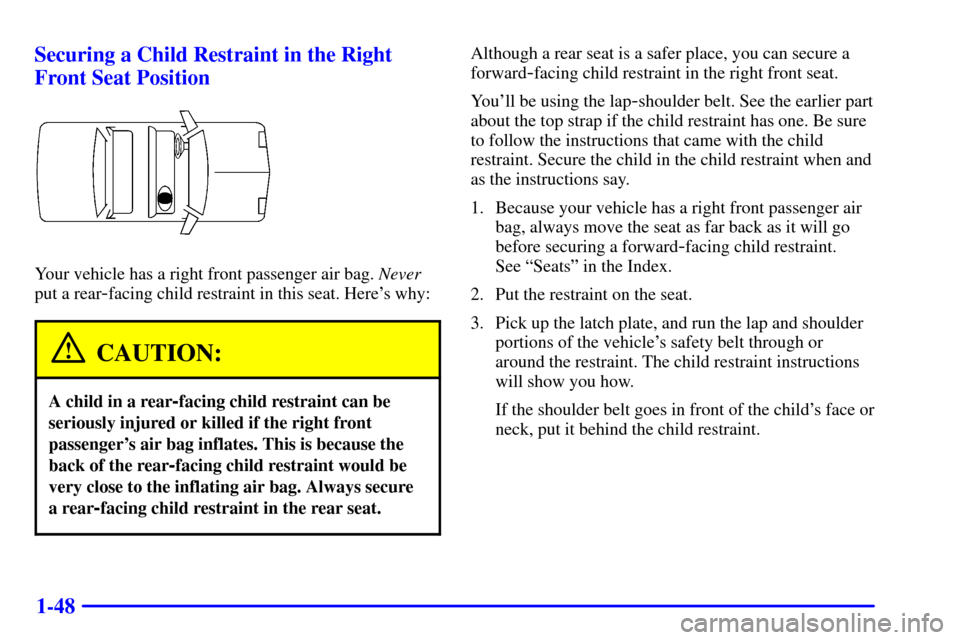
Your vehicle has a right front passenger air bag. Never
put a rear
-facing child restraint in this seat. Here's why:
CAUTION:
A child in a rear-facing child restraint can be
seriously injured or killed if the right front
passenger's air bag inflates. This is because the
back of the rear
-facing child restraint would be
very close to the inflating air bag. Always secure
a rear
-facing child restraint in the rear seat.
Although a rear seat is a safer place, you can secure a
forward
-facing child restraint in the right front seat.
You'll be using the lap
-shoulder belt. See the earlier part
about the top strap if the child restraint has one. Be sure
to follow the instructions that came with the child
restraint. Secure the child in the child restraint when and
as the instructions say.
1. Because your vehicle has a right front passenger air
bag, always move the seat as far back as it will go
before securing a forward
-facing child restraint.
See ªSeatsº in the Index.
2. Put the restraint on the seat.
3. Pick up the latch plate, and run the lap and shoulder
portions of the vehicle's safety belt through or
around the restraint. The child restraint instructions
will show you how.
If the shoulder belt goes in front of the child's face or
neck, put it behind the child restraint.
Page 63 of 357
1-51
Older Children
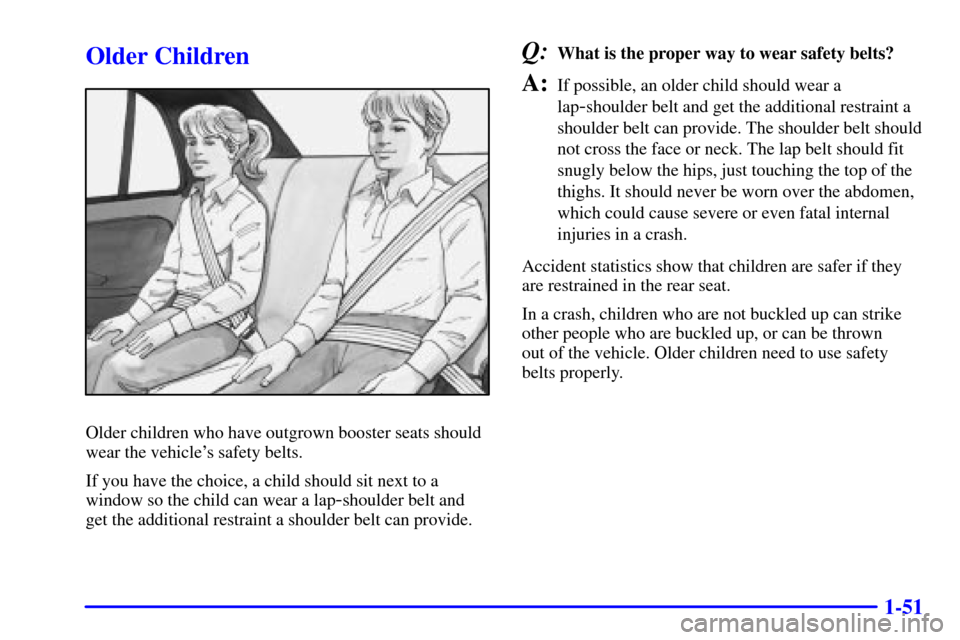
Older children who have outgrown booster seats should
wear the vehicle's safety belts.
If you have the choice, a child should sit next to a
window so the child can wear a lap
-shoulder belt and
get the additional restraint a shoulder belt can provide.
Q:What is the proper way to wear safety belts?
A:If possible, an older child should wear a
lap
-shoulder belt and get the additional restraint a
shoulder belt can provide. The shoulder belt should
not cross the face or neck. The lap belt should fit
snugly below the hips, just touching the top of the
thighs. It should never be worn over the abdomen,
which could cause severe or even fatal internal
injuries in a crash.
Accident statistics show that children are safer if they
are restrained in the rear seat.
In a crash, children who are not buckled up can strike
other people who are buckled up, or can be thrown
out of the vehicle. Older children need to use safety
belts properly.
Page 90 of 357

2-24 To Use the Engine Coolant Heater
1. Turn off the engine.
2. Open the hood and unwrap the electrical cord. On
vehicles with a 2.2L L4 engine, the electrical cord is
located near the engine oil dipstick. On vehicles with
a 2.4L L4 engine, the electrical cord is located in
front of the engine coolant surge tank on the
passenger's side.
3. Plug it into a normal, grounded 110
-volt AC outlet.
CAUTION:
Plugging the cord into an ungrounded outlet
could cause an electrical shock. Also, the wrong
kind of extension cord could overheat and cause
a fire. You could be seriously injured. Plug the
cord into a properly grounded three
-prong
11 0
-volt AC outlet. If the cord won't reach, use a
heavy
-duty three-prong extension cord rated for
at least 15 amps.
4. Before starting the engine, be sure to unplug
and store the cord as it was before to keep it away
from moving engine parts. If you don't, it could
be damaged.
How long should you keep the coolant heater plugged
in? The answer depends on the outside temperature, the
kind of oil you have, and some other things. Instead of
trying to list everything here, we ask that you contact
your dealer in the area where you'll be parking your
vehicle. The dealer can give you the best advice for that
particular area.
Automatic Transaxle Operation
Your vehicle may be equipped with a three-speed
automatic or a four
-speed automatic transaxle. The shift
lever is located on the console between the seats.
There are six different positions for the shift lever on
the three
-speed automatic and seven positions for the
four
-speed automatic transaxles. While PARK (P),
REVERSE (R) and NEUTRAL (N) operate identically
for both transaxles, the forward gear positions represent
different gearing and operation. See ªForward Gears
(3
-Speed)º or ªForward Gears (4-Speed)º later in
this section.
Page 97 of 357
2-31
Parking Brake
Automatic shown, manual similar
The parking brake lever is located between the
bucket seats.To set the parking brake, hold the brake pedal down and
pull up on the parking brake lever. If the ignition is on,
the brake system warning light will come on.
To release the parking brake, hold the brake pedal down.
Pull the parking brake lever up until you can press the
release button. Hold the release button in as you move
the brake lever all the way down.
If you forget to release your parking brake prior to
driving away, a chime will sound to remind you to
release the parking brake.
NOTICE:
Driving with the parking brake on can cause
your rear brakes to overheat. You may have to
replace them, and you could also damage other
parts of your vehicle.
Page 140 of 357

3-5
It is normal for the A/C indicator light to come on while
in DEFROST.
Running the compressor will help reduce vehicle
interior fogging.
Air Conditioning (If Equipped)
On very hot days, open the windows long enough to
let hot, inside air escape. This reduces the time it takes
for your vehicle to cook down, which should help
fuel economy.
For quick cool down on very hot days, use max with the
temperature knob all the way in the blue area. If this
setting is used for long periods of time, the air in your
vehicle may become too dry. The best cool down
happens if you start in one of the other modes and then
switch to max.
For normal cooling on hot days, use vent with the
temperature knob in the blue area and the A/C button
pushed in. The system will bring in outside air and cool it.
On cool, but sunny days, the sun may warm your upper
body, but your lower body may not be warm enough.
You can use bi
-level with the temperature knob in the
middle and the A/C button pushed in. The system will
bring in outside air and direct slightly warmer air to
your lower body. You may notice this temperature
difference more at some times than others.
Heating
On cold days, use floor with the temperature knob all
the way in the red area. The system will bring in outside
air, heat it and send it to the floor ducts.
Your vehicle has heat ducts that are directed toward
the rear seat. Keep the area under the front seats clear
of obstructions so the heated air can reach the rear
seat passengers.
If your vehicle has an engine coolant heater, you can use
it to help your system provide warm air faster when it's
cold outside (0�F (
-18�C) or lower). An engine coolant
heater warms the coolant your engine and heating
system use to provide heat. See ªEngine Coolant
Heaterº in the Index.
Defogging and Defrosting
Your system has two settings for clearing the front and
side windows. To defrost the windows quickly, use
DEFROST with the temperature knob all the way in
the red area. To warm passengers while keeping the
windows clean, use DEFOG.
Page 142 of 357
3-7 Ventilation System
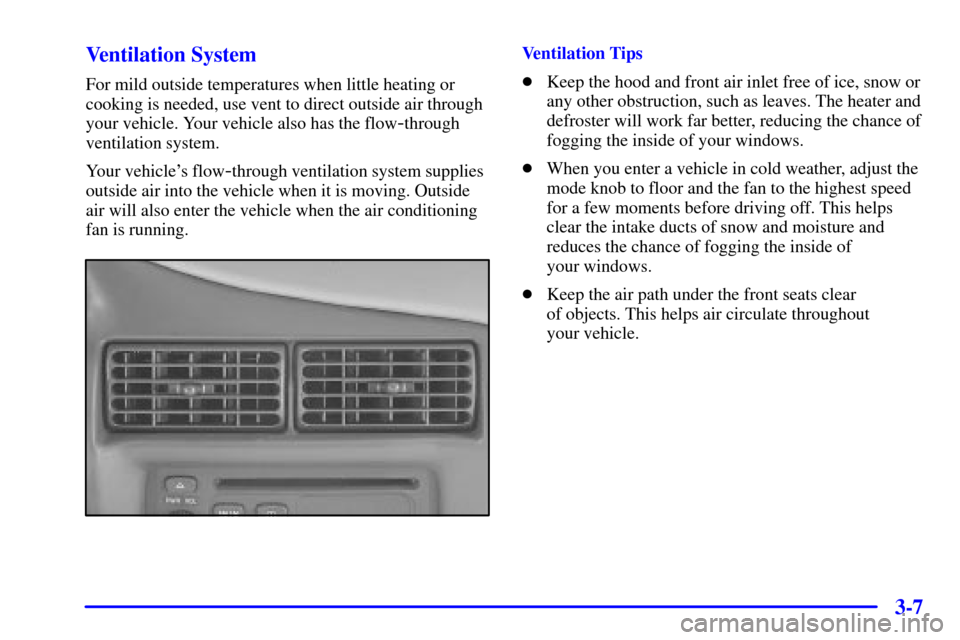
For mild outside temperatures when little heating or
cooking is needed, use vent to direct outside air through
your vehicle. Your vehicle also has the flow
-through
ventilation system.
Your vehicle's flow
-through ventilation system supplies
outside air into the vehicle when it is moving. Outside
air will also enter the vehicle when the air conditioning
fan is running.
Ventilation Tips
�Keep the hood and front air inlet free of ice, snow or
any other obstruction, such as leaves. The heater and
defroster will work far better, reducing the chance of
fogging the inside of your windows.
�When you enter a vehicle in cold weather, adjust the
mode knob to floor and the fan to the highest speed
for a few moments before driving off. This helps
clear the intake ducts of snow and moisture and
reduces the chance of fogging the inside of
your windows.
�Keep the air path under the front seats clear
of objects. This helps air circulate throughout
your vehicle.
Page 201 of 357
4-35
CAUTION:
Things you put inside your vehicle can strike and
injure people in a sudden stop or turn, or in a crash.
�Put things in the trunk or rear area of your
vehicle. In a trunk, put them as far forward
as you can. Try to spread the weight evenly.
If you have fold
-down rear seats, you'll
find four anchors on the back wall of your
trunk. You can use these anchors to tie
down lighter loads. They're not strong
enough for heavy things, however, so put
them as far forward as you can in the trunk
or rear area.
�Never stack heavier things, like suitcases,
inside the vehicle so that some of them are
above the tops of the seats.
�Don't leave an unsecured child restraint in
your vehicle.
�When you carry something inside the
vehicle, secure it whenever you can.
�Don't leave a seat folded down unless you
need to.
Towing a Trailer (Models with
2.4L L4 Engine and 4
-Speed
Automatic Transaxle)
CAUTION:
If you don't use the correct equipment and drive
properly, you can lose control when you pull a
trailer. For example, if the trailer is too heavy, the
brakes may not work well
-- or even at all. You
and your passengers could be seriously injured.
You may also damage your vehicle; the resulting
repairs would not be covered by your warranty.
Pull a trailer only if you have followed all the
steps in this section. Ask your dealer for advice
and information about towing a trailer with
your vehicle.