Page 183 of 357

4-17
What you do in the daytime can also affect your night
vision. For example, if you spend the day in bright
sunshine you are wise to wear sunglasses. Your eyes will
have less trouble adjusting to night. But if you're
driving, don't wear sunglasses at night. They may cut
down on glare from headlamps, but they also make a lot
of things invisible.
You can be temporarily blinded by approaching
headlamps. It can take a second or two, or even several
seconds, for your eyes to readjust to the dark. When you
are faced with severe glare (as from a driver who
doesn't lower the high beams, or a vehicle with
misaimed headlamps), slow down a little. Avoid staring
directly into the approaching headlamps.Keep your windshield and all the glass on your vehicle
clean
-- inside and out. Glare at night is made much
worse by dirt on the glass. Even the inside of the glass
can build up a film caused by dust. Dirty glass makes
lights dazzle and flash more than clean glass would,
making the pupils of your eyes contract repeatedly.
Remember that your headlamps light up far less of a
roadway when you are in a turn or curve. Keep your
eyes moving; that way, it's easier to pick out dimly
lighted objects. Just as your headlamps should be
checked regularly for proper aim, so should your eyes
be examined regularly. Some drivers suffer from night
blindness
-- the inability to see in dim light -- and
aren't even aware of it.
Page 196 of 357

4-30
Run your engine only as long as you must. This saves
fuel. When you run the engine, make it go a little faster
than just idle. That is, push the accelerator slightly. This
uses less fuel for the heat that you get and it keeps the
battery charged. You will need a well
-charged battery to
restart the vehicle, and possibly for signaling later on
with your headlamps. Let the heater run for a while.
Then, shut the engine off and close the window almost
all the way to preserve the heat. Start the engine again
and repeat this only when you feel really uncomfortable
from the cold. But do it as little as possible. Preserve the
fuel as long as you can. To help keep warm, you can get
out of the vehicle and do some fairly vigorous exercises
every half hour or so until help comes.
Recreational Vehicle Towing
You can tow your vehicle behind another vehicle for use
at your destination. Be sure to use the proper towing
equipment designed for recreational towing. Follow the
instructions for towing equipment.
If your vehicle is equipped with a remote keyless entry
system, it also has the content theft feature. If the
vehicle is towed as recommended, with the ignition in
OFF, or if necessary, with the ignition off and the key
out, it may be necessary to do one of the following:
�Prior to towing do not lock your car doors with the
remote keyless entry transmitter. Do not enable the
content theft feature.
�Remove the BCM/CLU fuse in the instrument panel
fuse block. This is located under the driver's side
instrument panel cover. After towing, remember to
reinstall the fuse to restore normal vehicle operation.
If the vehicle is towed at a large angle, or if the vehicle
experiences significant braking forces, the trunk ªopenº
sensor may be actuated, enabling content theft and
sounding the horn (while in tow).
Page 273 of 357
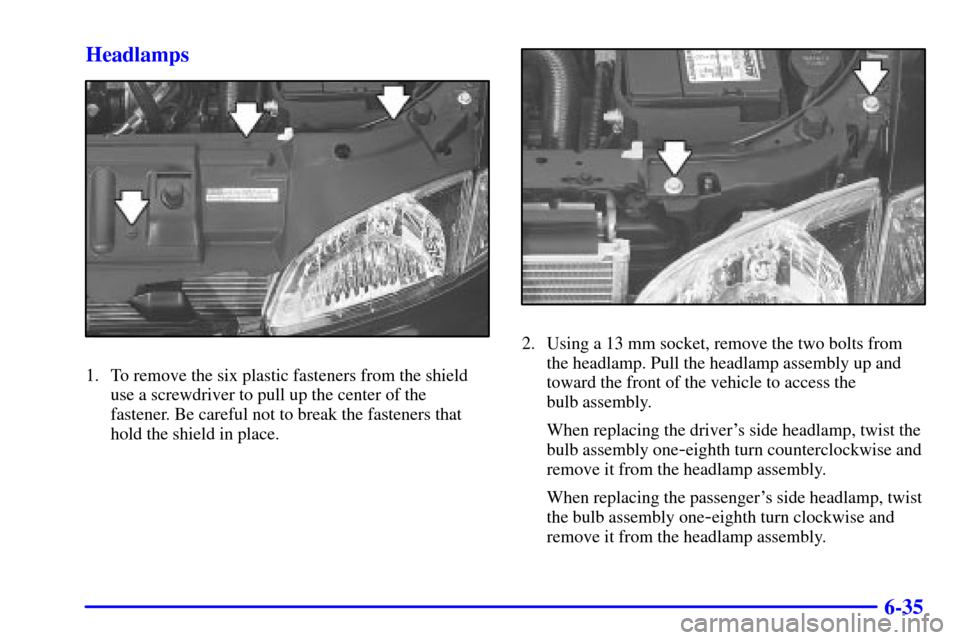
6-35 Headlamps
1. To remove the six plastic fasteners from the shield
use a screwdriver to pull up the center of the
fastener. Be careful not to break the fasteners that
hold the shield in place.
2. Using a 13 mm socket, remove the two bolts from
the headlamp. Pull the headlamp assembly up and
toward the front of the vehicle to access the
bulb assembly.
When replacing the driver's side headlamp, twist the
bulb assembly one
-eighth turn counterclockwise and
remove it from the headlamp assembly.
When replacing the passenger's side headlamp, twist
the bulb assembly one
-eighth turn clockwise and
remove it from the headlamp assembly.
Page 274 of 357
6-36
3. Disconnect the bulb base from the socket by lifting
the plastic locking tab.
4. Remove the black collar by turning it counterclockwise.5. Remove the bulb by pulling the bulb straight out.
6. Snap a new bulb into the socket.
7. Reinstall the bulb assembly by reversing
Steps 1 through 3, making sure the lower leg of
the headlamp bracket is properly seated into the
wedge
-shaped retainer.
Page 275 of 357
6-37 Front Park and Turn Signal Lamps
1. Follow Step 1 under ªHeadlamps.º
2. Place the tip of a screwdriver through the rectangle
hole in the headlamp bracket. Apply pressure to the
snap feature (toward the outboard of the vehicle).
Guide the lamp forward.
3. When the lamp is removed twist the socket to
remove from the lamp. (The bulb is connected to
the wire harness).
4. Replace the bulb and reinstall the socket.
Page 276 of 357
6-38
5. Align the outboard pin to the outboard tab in the
bracket. Align the (two) inboard pins with the hole
in the headlamp bracket.6. Push the front park and turn lamp straight in until
you hear a snap. The snap feature is visible through
the slot in the headlamp bracket.
Page 287 of 357

6-49
Each new wheel should have the same load-carrying
capacity, diameter, width, offset and be mounted the
same way as the one it replaces.
If you need to replace any of your wheels, wheel bolts
or wheel nuts, replace them only with new GM original
equipment parts. This way, you will be sure to have the
right wheel, wheel bolts and wheel nuts for your vehicle.
CAUTION:
Using the wrong replacement wheels, wheel bolts
or wheel nuts on your vehicle can be dangerous.
It could affect the braking and handling of your
vehicle, make your tires lose air and make you
lose control. You could have a collision in which
you or others could be injured. Always use
the correct wheel, wheel bolts and wheel nuts
for replacement.
NOTICE:
The wrong wheel can also cause problems with
bearing life, brake cooling, speedometer or
odometer calibration, headlamp aim, bumper
height, vehicle ground clearance and tire or
tire chain clearance to the body and chassis.
See ªChanging a Flat Tireº in the Index for
more information.
Used Replacement Wheels
CAUTION:
Putting a used wheel on your vehicle is
dangerous. You can't know how it's been used or
how far it's been driven. It could fail suddenly
and cause an accident. If you have to replace a
wheel, use a new GM original equipment wheel.
Page 298 of 357
6-60
Electrical System
Add-On Electrical Equipment
NOTICE:
Don't add anything electrical to your vehicle
unless you check with your dealer first. Some
electrical equipment can damage your vehicle
and the damage wouldn't be covered by your
warranty. Some add
-on electrical equipment
can keep other components from working as
they should.
Your vehicle has an air bag system. Before attempting to
add anything electrical to your vehicle, see ªServicing
Your Air Bag
-Equipped Vehicleº in the Index.
Headlamp Wiring
The headlamp wiring is protected by fuses. Should your
headlamps fail to function, have your headlamp system
checked right away.
Windshield Wiper Fuse
The windshield wiper motor is protected by a circuit
breaker and a fuse. If the motor overheats due to heavy
snow or ice, the wiper will stop until the motor cools.
If the overload is caused by some electrical problem,
have it fixed.
Power Windows and Other Power Options
Circuit breakers in the fuse panel protect the power
windows and other power accessories. When the current
load is too heavy, the circuit breaker opens and closes,
protecting the circuit until the problem is fixed.