Page 75 of 363

2-17 Turning Off the Alarm
If you started the alarm by pressing the panic button on
the remote keyless entry transmitter, you must either
push that button again or turn the ignition to RUN to
stop the alarm.
If the alarm is sounding due to the shock sensor or a
door or hatch opening, it can be turned off by either
turning the ignition to RUN with a proper key or by
pressing any button on the remote keyless entry
transmitter. If you use your remote keyless entry
transmitter to silence the alarm, additional things will
happen depending upon which button you press.
�Pressing the panic button or the UNLOCK button
will turn the alarm off, unlock the driver's door and
disarm the system.
�Pressing the LOCK button will turn the alarm off,
keep the doors locked and keep the system armed.
�Pressing the REAR 2X button will turn the alarm off and
keep the system armed. A second push of the button
(within five seconds, pausing slightly between presses)
will unlock and disarm the hatch only.
If the alarm is sounding because an incorrect ignition
key was used, press any button on the remote keyless
entry transmitter to turn the alarm off.
The alarm will stop by itself after two minutes.
Shock Sensor
Coupe Convertible
The shock sensor is what triggers the alarm when it
detects a blow to your vehicle. It is located over the
wheelhouse near the spare tire in the hatch area, on the
passenger's side of the vehicle. There are two levels of
alarms via the shock sensor. Two horn blasts and
parking lamp flashes for non
-threatening blows to the
vehicle and a full two
-minute alarm for harder blows to
the vehicle. Its sensitivity can be adjusted if more or less
sensitivity is desired. If sensitivity is increased too
much, it may give false alarms caused by gusts of wind
or other natural events that may shake the vehicle.
Page 243 of 363
5-23
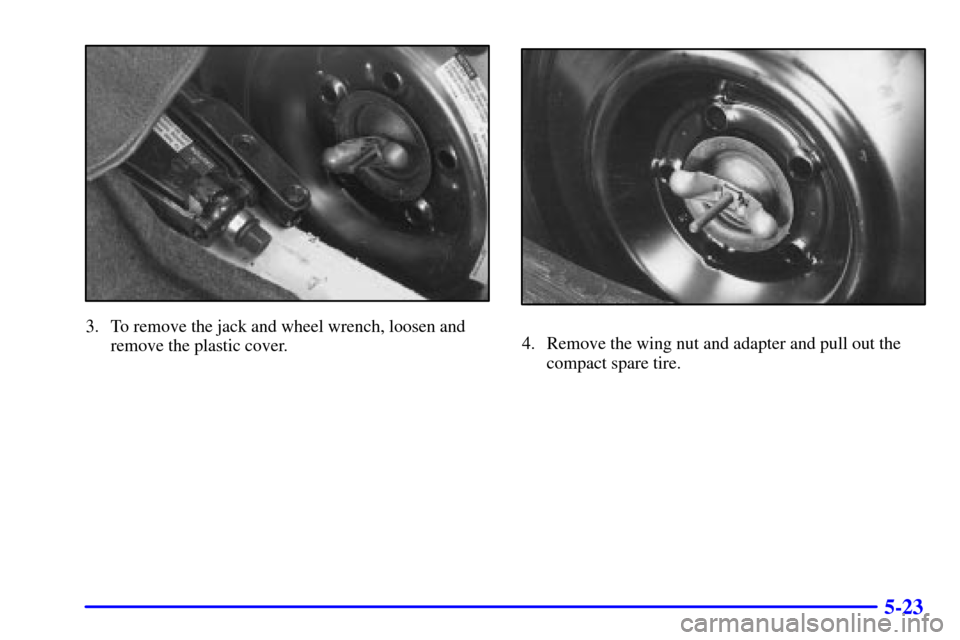
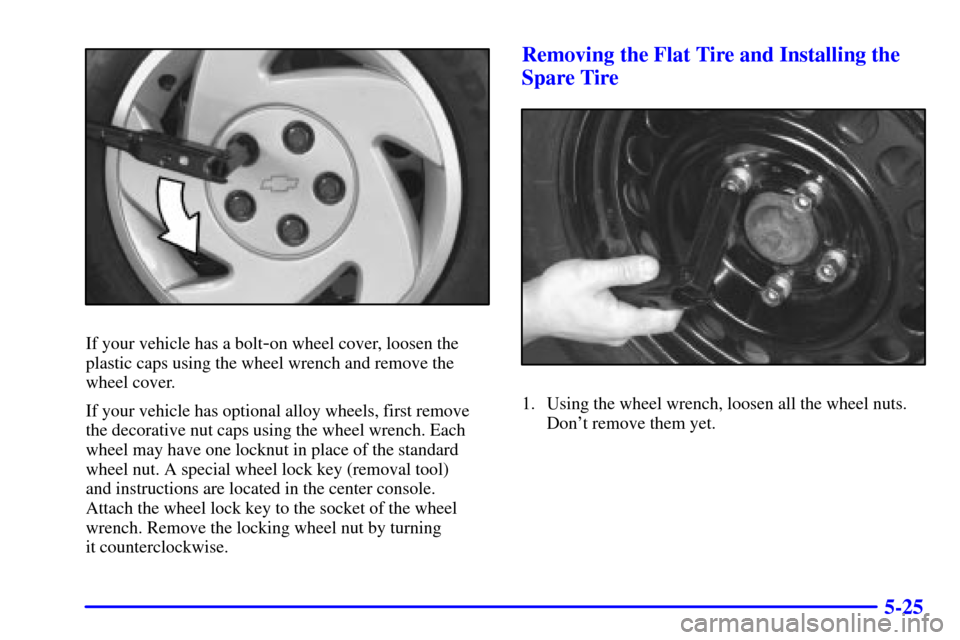
3. To remove the jack and wheel wrench, loosen and
remove the plastic cover.4. Remove the wing nut and adapter and pull out the
compact spare tire.
Page 245 of 363
5-25
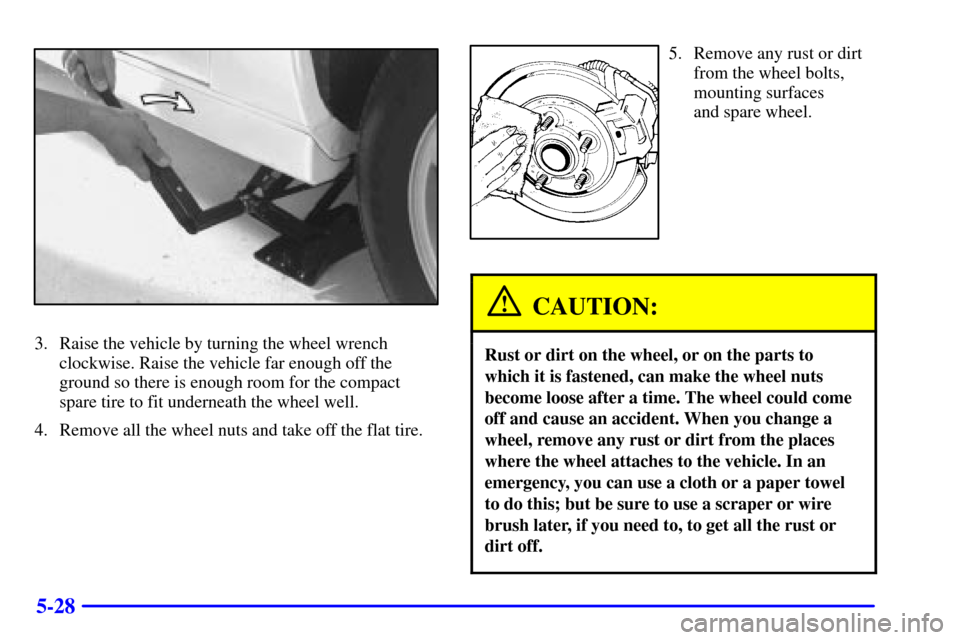
If your vehicle has a bolt-on wheel cover, loosen the
plastic caps using the wheel wrench and remove the
wheel cover.
If your vehicle has optional alloy wheels, first remove
the decorative nut caps using the wheel wrench. Each
wheel may have one locknut in place of the standard
wheel nut. A special wheel lock key (removal tool)
and instructions are located in the center console.
Attach the wheel lock key to the socket of the wheel
wrench. Remove the locking wheel nut by turning
it counterclockwise.
Removing the Flat Tire and Installing the
Spare Tire
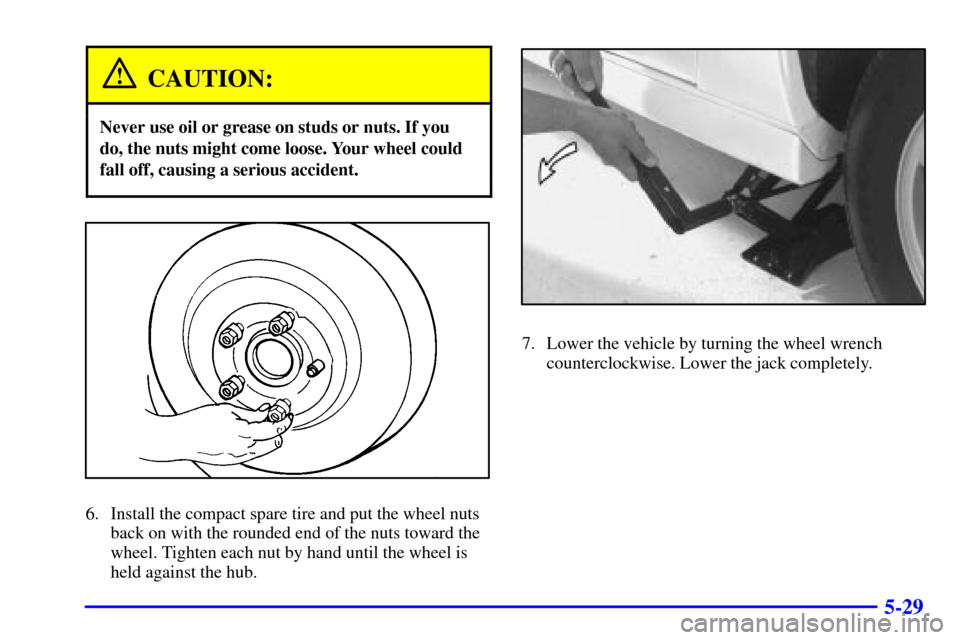
1. Using the wheel wrench, loosen all the wheel nuts.
Don't remove them yet.
Page 248 of 363
5-28
3. Raise the vehicle by turning the wheel wrench
clockwise. Raise the vehicle far enough off the
ground so there is enough room for the compact
spare tire to fit underneath the wheel well.
4. Remove all the wheel nuts and take off the flat tire.
5. Remove any rust or dirt
from the wheel bolts,
mounting surfaces
and spare wheel.
CAUTION:
Rust or dirt on the wheel, or on the parts to
which it is fastened, can make the wheel nuts
become loose after a time. The wheel could come
off and cause an accident. When you change a
wheel, remove any rust or dirt from the places
where the wheel attaches to the vehicle. In an
emergency, you can use a cloth or a paper towel
to do this; but be sure to use a scraper or wire
brush later, if you need to, to get all the rust or
dirt off.
Page 249 of 363
5-29
CAUTION:
Never use oil or grease on studs or nuts. If you
do, the nuts might come loose. Your wheel could
fall off, causing a serious accident.
6. Install the compact spare tire and put the wheel nuts
back on with the rounded end of the nuts toward the
wheel. Tighten each nut by hand until the wheel is
held against the hub.
7. Lower the vehicle by turning the wheel wrench
counterclockwise. Lower the jack completely.
Page 251 of 363
5-31
NOTICE:
Improperly tightened wheel nuts can lead to
brake pulsation and rotor damage. To avoid
expensive brake repairs, evenly tighten the wheel
nuts in the proper sequence and to the proper
torque specification.
NOTICE:
Wheel covers won't fit on your compact spare.
If you try to put a wheel cover on your compact
spare, you could damage the cover or the spare.
Storing a Flat or Spare Tire and Tools
CAUTION:
Storing a jack, a tire or other equipment in the
passenger compartment of the vehicle could
cause injury. In a sudden stop or collision, loose
equipment could strike someone. Store all these
in the proper place.
Put back the jack, wheel wrench and flat tire following
the storage instructions. When you reinstall the trim
panel, be sure to tuck it under the weatherstrip.
Page 253 of 363
5-33
Compact Spare Tire
Although the compact spare tire was fully inflated
when your vehicle was new, it can lose air after a time.
Check the inflation pressure regularly. It should be
60 psi (420 kPa).
After installing the compact spare on your vehicle,
you should stop as soon as possible and make sure
your spare tire is correctly inflated. The compact spare
is made to perform well at speeds up to 65 mph
(105 km/h) for distances up to 3,000 miles (5 000 km),
so you can finish your trip and have your full
-size tire
repaired or replaced where you want. Of course, it's best
to replace your spare with a full
-size tire as soon as you
can. Your spare will last longer and be in good shape in
case you need it again.
NOTICE:
When the compact spare is installed, don't take
your vehicle through an automatic car wash with
guide rails. The compact spare can get caught on
the rails. That can damage the tire and wheel,
and maybe other parts of your vehicle.
Don't use your compact spare on other vehicles.
And don't mix your compact spare tire or wheel with
other wheels or tires. They won't fit. Keep your spare
tire and its wheel together.
NOTICE:
Tire chains won't fit your compact spare.
Using them can damage your vehicle and can
damage the chains too. Don't use tire chains
on your compact spare.
Page 299 of 363

6-45
When to Check
Check your tires once a month or more.
Don't forget your compact spare tire. It should be
at 60 psi (420 kPa).
How to Check
Use a good quality pocket
-type gage to check tire
pressure. You can't tell if your tires are properly inflated
simply by looking at them. Radial tires may look
properly inflated even when they're underinflated.
Be sure to put the valve caps back on the valve stems.
They help prevent leaks by keeping out dirt and moisture.
Tire Inspection and Rotation
Tires should be rotated every 6,000 to 8,000 miles
(10 000 to 13 000 km). Any time you notice unusual
wear, rotate your tires as soon as possible and check
wheel alignment. Also check for damaged tires or
wheels. See ªWhen It's Time for New Tiresº and
ªWheel Replacementº later in this section for
more information.The purpose of regular rotation is to achieve more
uniform wear for all tires on the vehicle. The first
rotation is the most important. See ªScheduled
Maintenance Servicesº in the Index for scheduled
rotation intervals.
If you don't have P245/50ZR16 Goodyear Eagle GS-C
tires or P275/40ZR17 Goodyear Eagle F1
-GS tires, use
the rotation pattern shown above for your tires.