Page 272 of 363
6-18
Engine Air Cleaner/Filter
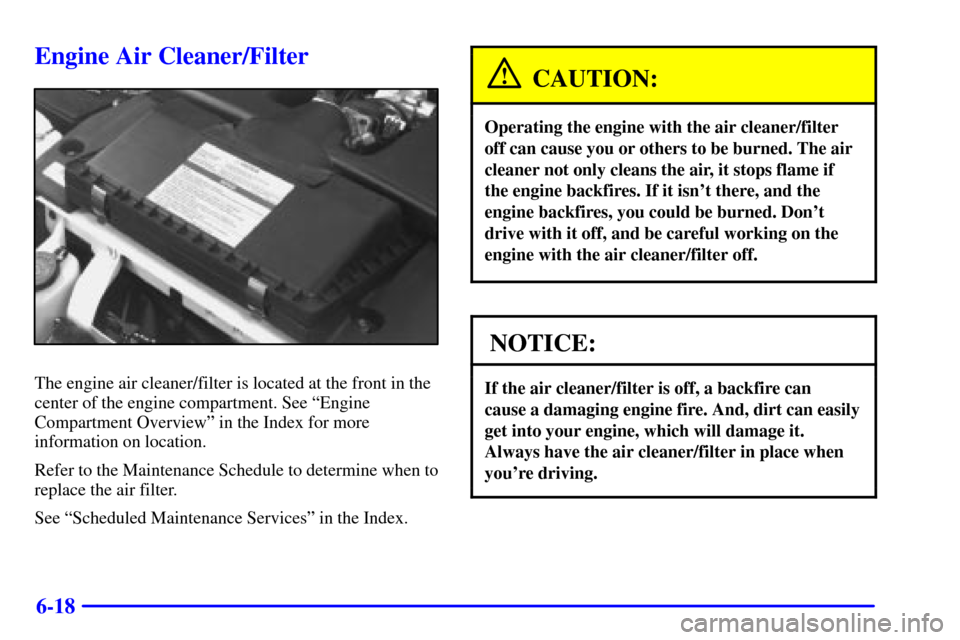
The engine air cleaner/filter is located at the front in the
center of the engine compartment. See ªEngine
Compartment Overviewº in the Index for more
information on location.
Refer to the Maintenance Schedule to determine when to
replace the air filter.
See ªScheduled Maintenance Servicesº in the Index.
CAUTION:
Operating the engine with the air cleaner/filter
off can cause you or others to be burned. The air
cleaner not only cleans the air, it stops flame if
the engine backfires. If it isn't there, and the
engine backfires, you could be burned. Don't
drive with it off, and be careful working on the
engine with the air cleaner/filter off.
NOTICE:
If the air cleaner/filter is off, a backfire can
cause a damaging engine fire. And, dirt can easily
get into your engine, which will damage it.
Always have the air cleaner/filter in place when
you're driving.
Page 274 of 363
6-20
4. Close the cover without an overlap (clamp will not
latch with an overlap) and latch the clamps.
Automatic Transmission Fluid
When to Check and Change
A good time to check your automatic transmission fluid
level is when the engine oil is changed.
Change both the fluid and filter every 15,000 miles
(25 000 km) if the vehicle is mainly driven under one or
more of these conditions:
�In heavy city traffic where the outside temperature
regularly reaches 90�F (32�C) or higher.
�In hilly or mountainous terrain.
�Uses such as high performance operation.
�When doing frequent trailer towing.
�Uses such as found in taxi, police or delivery service.
If you do not use your vehicle under any of
these conditions, change the fluid and filter every
50,000 miles (83 000 km).
See ªScheduled Maintenance Servicesº in the Index.
Page 275 of 363

6-21 How to Check
Because this operation can be a little difficult, you may
choose to have this done at the dealership service department.
If you do it yourself, be sure to follow all the instructions
here, or you could get a false reading on the dipstick.
NOTICE:
Too much or too little fluid can damage your
transmission. Too much can mean that some of
the fluid could come out and fall on hot engine
parts or exhaust system parts, starting a fire. Be
sure to get an accurate reading if you check your
transmission fluid.
Wait at least 30 minutes before checking the
transmission fluid level if you have been driving:
�When outside temperatures are above 90�F (32�C).
�At high speed for quite a while.
�In heavy traffic
-- especially in hot weather.
�While pulling a trailer.To get the right reading, the fluid should be
at normal operating temperature, which is
180�F to 200�F (82�C to 93�C).
Get the vehicle warmed up by driving about
15 miles (24 km) when outside temperatures are above
50�F (10�C). If it's colder than 50�F (10�C), drive
the vehicle in AUTOMATIC OVERDRIVE (�) until
the engine temperature gage moves and then remains
steady for 10 minutes.
A cold fluid check can be made after the vehicle has been
sitting for eight hours or more with the engine off, but
this is used only as a reference. Let the engine run at idle
for five minutes if outside temperatures are 50�F (10�C)
or more. If it's colder than 50�F (10�C), you may have to
idle the engine longer. Should the fluid level be low
during this cold check, you must check the fluid hot
before adding fluid. Checking the fluid hot will give you
a more accurate reading of the fluid level.
Page 278 of 363
6-24
Manual Transmission Fluid
When to Check
A good time to have it checked is when the engine oil is
changed. However, the fluid in your manual
transmission doesn't require changing.
How to Check
Because this operation can be difficult, you may
choose to have this done at your Chevrolet dealership
service department.
If you do it yourself, be sure to follow all the
instructions here, or you could get a false reading.
NOTICE:
Too much or too little fluid can damage your
transmission. Too much can mean that some of
the fluid could come out and fall on hot engine
parts or exhaust system parts, starting a fire.
Be sure to get an accurate reading if you check
your transmission fluid.
Check the fluid level only when your engine is off, the
vehicle is parked on a level place and the transmission is
cool enough for you to rest your fingers on the
transmission case.
Then, follow these steps:
6-Speed Transmission shown
(5
-Speed Transmission similar)
Page 280 of 363

6-26 When to Check and What to Use
See ªEngine Compartment Overviewº in the Index for
information on location.
Refer to the Maintenance Schedule to determine how
often you should check the fluid level in your clutch
master cylinder reservoir and for the proper fluid. See
ªOwner Checks and Servicesº and ªRecommended
Fluids and Lubricantsº in the Index.
How to Check and Add Fluid
The proper fluid should be added if the level is below
the plastic step on the reservoir. See the instructions on
the reservoir cap. See ªEngine Compartment Overviewº
in the Index for more information on location.
Rear Axle
When to Check and Change Lubricant
Refer to the Maintenance Schedule to determine how
often to check the lubricant and when to change it.
See ªScheduled Maintenance Servicesº in the Index.
How to Check Lubricant
If the level is below the bottom of the filler plug hole,
you'll need to add some lubricant. Add enough lubricant
to raise the level to the bottom of the filler plug hole.
What to Use
Standard Differential
Use SAE 75W
-90 Synthetic Gear Lubricant
(GM Part No. 12378261) or equivalent meeting
GM Specification 9986115.
Page 289 of 363
6-35
NOTICE:
�Using the wrong fluid can badly damage
brake system parts. For example, just a few
drops of mineral
-based oil, such as engine
oil, in your brake system can damage brake
system parts so badly that they'll have to be
replaced. Don't let someone put in the
wrong kind of fluid.
�If you spill brake fluid on your vehicle's
painted surfaces, the paint finish can be
damaged. Be careful not to spill brake fluid
on your vehicle. If you do, wash it off
immediately. See ªAppearance Careº in
the Index.
Brake Wear
Your vehicle has four-wheel disc brakes.
Disc brake pads have built
-in wear indicators that make a
high
-pitched warning sound when the brake pads are worn
and new pads are needed. The sound may come and go or
be heard all the time your vehicle is moving (except when
you are pushing on the brake pedal firmly).
CAUTION:
The brake wear warning sound means that soon
your brakes won't work well. That could lead to
an accident. When you hear the brake wear
warning sound, have your vehicle serviced.
NOTICE:
Continuing to drive with worn-out brake pads
could result in costly brake repair.
Some driving conditions or climates may cause a brake
squeal when the brakes are first applied or lightly applied.
This does not mean something is wrong with your brakes.
When you have the front or rear brake pads replaced,
have the other brakes inspected, too.
Brake linings should always be replaced as complete
axle sets.
See ªBrake System Inspectionº in Section 7 of this manual
under Part C ªPeriodic Maintenance Inspections.º
Page 291 of 363
6-37
Battery
Your new vehicle comes with a maintenance free
ACDelco� battery. When it's time for a new battery, get
one that has the replacement number shown on the
original battery's label. We recommend an ACDelco
battery. See ªEngine Compartment Overviewº in the
Index for battery location.
WARNING: Battery posts, terminals and related
accessories contain lead and lead compounds, chemicals
known to the State of California to cause cancer and
reproductive harm. Wash hands after handling.
Vehicle Storage
If you're not going to drive your vehicle for 25 days or more,
remove the black, negative (
-) cable from the battery. This
will help keep your battery from running down.
CAUTION:
Batteries have acid that can burn you and gas that
can explode. You can be badly hurt if you aren't
careful. See ªJump Startingº in the Index for tips
on working around a battery without getting hurt.
Contact your dealer to learn how to prepare your vehicle
for longer storage periods.
Also, for your audio system, see ªTheft
-Deterrent
Featureº in the Index.
Bulb Replacement
For the proper type of replacement bulb, see
ªReplacement Bulbsº in the Index.
For any bulb changing procedure not listed in this
section, contact your dealer's service department.
Halogen Bulbs
CAUTION:
Halogen bulbs have pressurized gas inside and
can burst if you drop or scratch the bulb. You or
others could be injured. Be sure to read and
follow the instructions on the bulb package.
Page 296 of 363

6-42 Wiper Blade Element Replacement
To replace the wiper blade element, follow these steps:
1. Locate the heel end of the wiper blade assembly that
has the two notches held by the wiper blade claw.
2. Hold the wiper blade assembly with one hand and
pull the element gently with the other hand.
(Replacement blade elements have three plastic caps
which retain two metal flexor strips. Do not remove
these caps before the element is installed.)3. At the heel end of the wiper blade assembly, notched
end of blade element last, slide the blade element
into the blade claw sets. The plastic retainer caps
will be forced off as the element is fully inserted.
Make sure that all the claw sets are properly engaged
in the slots of the blade element.
4. Install the wiper blade assembly on the wiper arm.
For information on wiper blade replacement length and
type, see ªNormal Maintenance Replacement Partsº in
the Index.
NOTICE:
Never open your hood with the wiper arms in the
ªService Up Positionº (wiper arms pulled away
from the windshield) because the hood will
deflect the wiper arms into the windshield and
may cause the windshield to crack.