Page 52 of 363
1-40
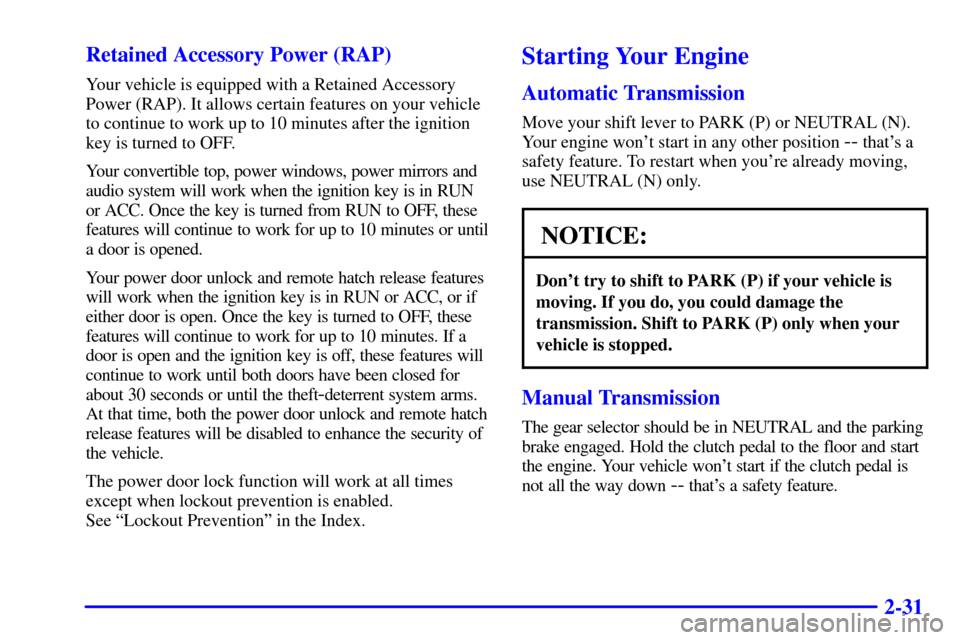
4. To tighten the belt, pull up on the shoulder belt while
you push down on the child restraint. If you're using
a forward
-facing child restraint, you may find it
helpful to use your knee to push down on the child
restraint as you tighten the belt.
5. Push and pull the child restraint in different
directions to be sure it is secure.
To remove the child restraint, just unbuckle the vehicle's
safety belt and let it go back all the way. The safety belt
will move freely again and be ready to work for an adult
or larger child passenger.
Securing a Child Restraint in the Right
Front Seat Position
Your vehicle has a right front passenger air bag. Never
put a rear
-facing child restraint in this seat. Here's why:
CAUTION:
A child in a rear-facing child restraint can be
seriously injured or killed if the right front
passenger's air bag inflates. This is because the
back of the rear
-facing child restraint would be
very close to the inflating air bag. Always secure
a rear
-facing child restraint in the rear seat.
Page 53 of 363
1-41
Although a rear seat is a safer place, you can secure a
forward
-facing child restraint in the right front seat.
You'll be using the lap
-shoulder belt. See the earlier
part about the top strap if the child restraint has one.
Be sure to follow the instructions that came with the
child restraint. Secure the child in the child restraint
when and as the instructions say.
1. Because your vehicle has a right front passenger
air bag, always move the seat as far back as it will
go before securing a forward
-facing child restraint.
See ªSeatsº in the Index.
2. Put the restraint on the seat.
3. Pick up the latch plate, and run the lap and shoulder
portions of the vehicle's safety belt through or
around the restraint. The child restraint instructions
will show you how.
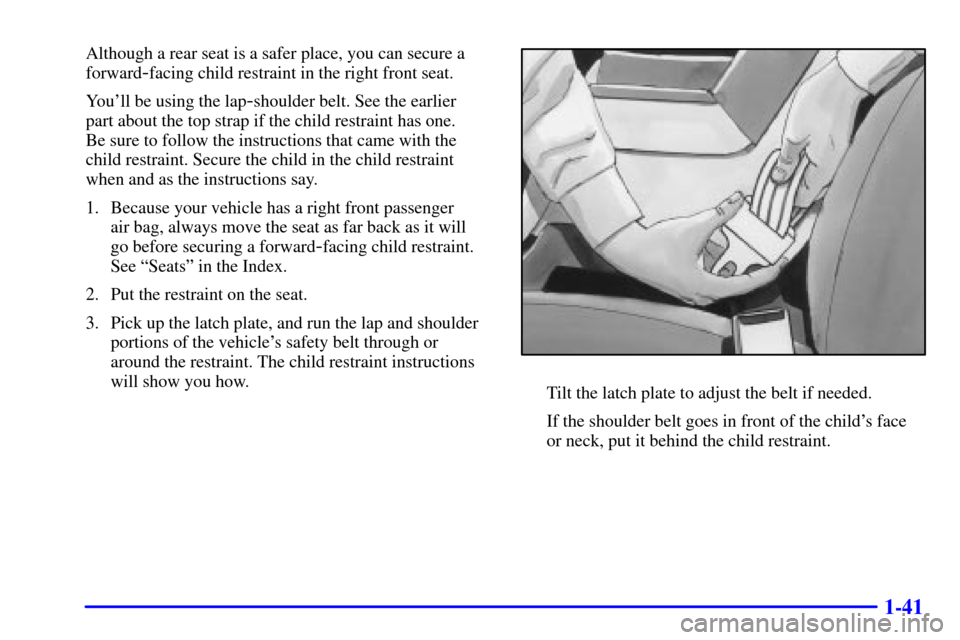
Tilt the latch plate to adjust the belt if needed.
If the shoulder belt goes in front of the child's face
or neck, put it behind the child restraint.
Page 54 of 363
1-42
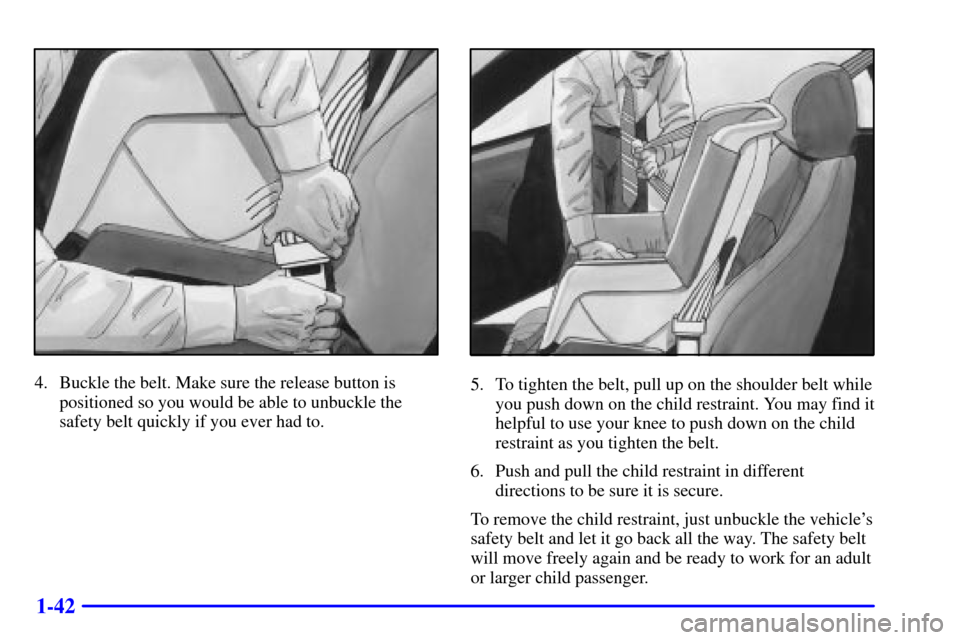
4. Buckle the belt. Make sure the release button is
positioned so you would be able to unbuckle the
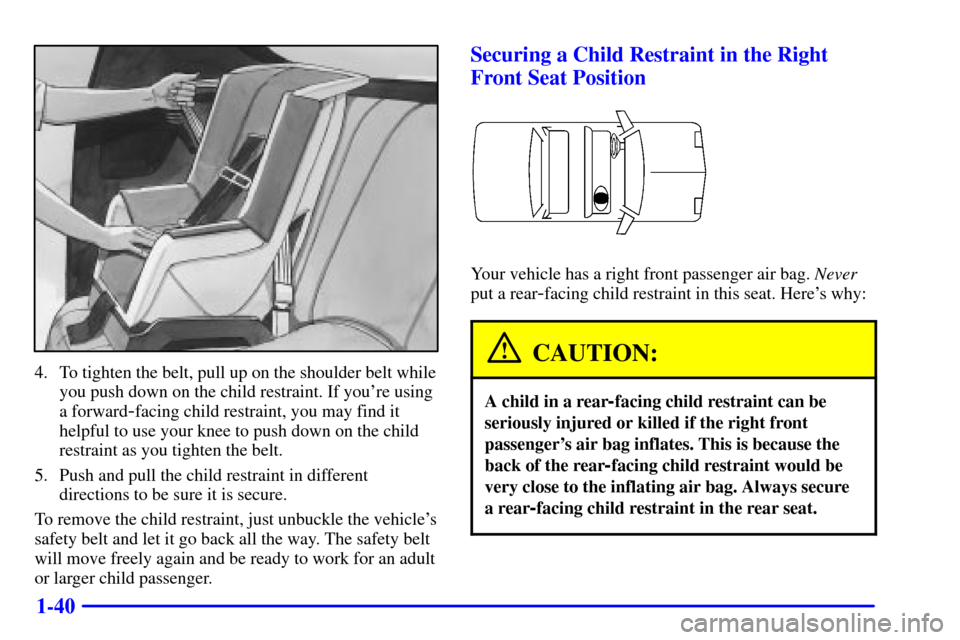
safety belt quickly if you ever had to.5. To tighten the belt, pull up on the shoulder belt while
you push down on the child restraint. You may find it
helpful to use your knee to push down on the child
restraint as you tighten the belt.
6. Push and pull the child restraint in different
directions to be sure it is secure.
To remove the child restraint, just unbuckle the vehicle's
safety belt and let it go back all the way. The safety belt
will move freely again and be ready to work for an adult
or larger child passenger.
Page 71 of 363

2-13 Resynchronization
Resynchronization may be necessary due to the security
method used by the remote keyless entry system. The
transmitter does not send the same signal twice to the
receiver. The receiver will not respond to a signal that has
been sent previously. This prevents anyone from recording
and playing back the signal from the transmitter.
To resynchronize the transmitter with the receiver, do
the following:
1. Stand close to the vehicle.
2. Press and hold the LOCK and UNLOCK buttons
on the transmitter at the same time for about
eight seconds.
The door locks should cycle and the interior lamps
should flash to confirm resynchronization.
If this does not happen, you may need to replace the
battery in your transmitter or match the transmitter
to your vehicle. See ªMatching Transmitter(s) to
Your Vehicleº in the Index.
Hatch
CAUTION:
It can be dangerous to drive with the hatch open
because carbon monoxide (CO) gas can come into
your vehicle. You can't see or smell CO. It can
cause unconsciousness and even death.
If you must drive with the hatch open or if
electrical wiring or other cable connections must
pass through the seal between the body and
the hatch:
�Make sure all other windows are shut.
�Turn the fan on your heating or cooling
system to its highest speed with the setting
on VENT. That will force outside air into
your vehicle. See ªComfort Controlsº in
the Index.
�If you have air outlets on or under the
instrument panel, open them all the way.
See ªEngine Exhaustº in the Index.
Page 73 of 363

2-15 Trunk Release Handle (If Equipped)
NOTICE:
The trunk release handle was not designed to be
used to tie down the trunk lid or as an anchor
point when securing items in the trunk. Improper
use of the trunk release handle could damage it.
There is a glow-in-the-dark trunk release handle located
on the inside wall of the trunk near the floor. The handle
will be on the passenger's side. This handle will glow
following exposure to light. Pull the release handle
down to open the trunk from the inside.
Theft
Vehicle theft is big business, especially in some cities.
Although your vehicle has a number of theft
-deterrent
features, we know that nothing we put on it can make it
impossible to steal. However, there are ways you can help.
Key in the Ignition
If you leave your vehicle with the keys inside, it's an
easy target for joy riders or professional thieves
-- so
don't do it.
When you park your vehicle and open the driver's door,
you'll hear a chime reminding you to remove your key
from the ignition and take it with you. Always do this.
Your steering wheel will be locked, and so will your
ignition. If you take the key with you, and you have an
automatic transmission, it will be locked. And remember
to lock the doors.
Page 77 of 363

2-19 Passive Arming
If the ignition was just turned off and a door was
opened, the system will arm six seconds after both doors
are closed, whether or not you lock them. In all other
cases, the system will wait 30 seconds after both doors
are closed before arming, allowing you time to get into
the vehicle and put the key in the ignition. The parking
lamps will flash when the system arms.
The vehicle is shipped from the factory with this feature
turned off. To turn this feature on, see ªFeature
Customizationº in the Index.
Disarming the System
There are two ways to disarm the system:
�Press the UNLOCK button on the remote keyless entry
transmitter. If the horn chirps two or three times when
you unlock the vehicle, the alarm sounded in your
absence. Two chirps means that the shock sensor was
set off and three chirps means that a door or the hatch
was opened.
�Turn the ignition key to RUN.
For more information on customizing the features
mentioned here, see ªFeature Customizationº in
the Index.
PASS-Key� II
Your vehicle is equipped
with the PASS
-Key II
(Personalized Automotive
Security System)
theft
-deterrent system.
PASS
-Key II is a passive
theft
-deterrent system.
It works when you insert
or remove the key from
the ignition.
PASS
-Key II uses a resistor pellet in the ignition key
that matches a decoder in your vehicle.
When the PASS
-Key II system senses that someone is
using the wrong key, it shuts down the vehicle's starter and
fuel systems. For about three minutes, the starter won't
work and fuel won't go to the engine. If someone tries to
start your vehicle again or uses another key during this
time, the vehicle will not start. This discourages someone
from randomly trying different keys with different resistor
pellets in an attempt to make a match.
The ignition key must be clean and dry before it's
inserted in the ignition or the engine may not start.
Page 78 of 363

2-20
If the engine does not start
and the SECURITY light
stays on when you try to
start the vehicle, the key
may be dirty or wet.
Turn the ignition off.
Clean and dry the key. Wait about three minutes and try
again. The SECURITY light may remain on during this
time. If the starter still won't work, and the key appears
to be clean and dry, wait about three minutes and try
another ignition key. At this time, you may also want to
check the fuses (see ªFuses and Circuit Breakersº in the
Index). If the starter won't work with the other key, your
vehicle needs service. If your vehicle does start, the first
ignition key may be faulty. See your dealer or a
locksmith who can service the PASS
-Key II.If you accidentally use a key that has a damaged or
missing resistor pellet, the starter won't work. The
SECURITY light will flash. But you don't have to wait
three minutes before trying another ignition key.
See your dealer or a locksmith who can service the
PASS
-Key II to have a new key made.
If you're ever driving and the SECURITY light comes on
and stays on, you will be able to restart your engine if you
turn it off. Your PASS
-Key II system, however, is not
working properly and must be serviced by your dealer.
Your vehicle is not protected by the PASS
-Key II system.
If you lose or damage a PASS
-Key II ignition key, see
your dealer or a locksmith who can service PASS
-Key II
to have a new key made. In an emergency, call the
Chevrolet Roadside Assistance Center. See ªRoadside
Assistanceº in the Index for more information.
Page 89 of 363
2-31 Retained Accessory Power (RAP)
Your vehicle is equipped with a Retained Accessory
Power (RAP). It allows certain features on your vehicle
to continue to work up to 10 minutes after the ignition
key is turned to OFF.
Your convertible top, power windows, power mirrors and
audio system will work when the ignition key is in RUN
or ACC. Once the key is turned from RUN to OFF, these
features will continue to work for up to 10 minutes or until
a door is opened.
Your power door unlock and remote hatch release features
will work when the ignition key is in RUN or ACC, or if
either door is open. Once the key is turned to OFF, these
features will continue to work for up to 10 minutes. If a
door is open and the ignition key is off, these features will
continue to work until both doors have been closed for
about 30 seconds or until the theft
-deterrent system arms.
At that time, both the power door unlock and remote hatch
release features will be disabled to enhance the security of
the vehicle.
The power door lock function will work at all times
except when lockout prevention is enabled.
See ªLockout Preventionº in the Index.
Starting Your Engine
Automatic Transmission
Move your shift lever to PARK (P) or NEUTRAL (N).
Your engine won't start in any other position
-- that's a
safety feature. To restart when you're already moving,
use NEUTRAL (N) only.
NOTICE:
Don't try to shift to PARK (P) if your vehicle is
moving. If you do, you could damage the
transmission. Shift to PARK (P) only when your
vehicle is stopped.
Manual Transmission
The gear selector should be in NEUTRAL and the parking
brake engaged. Hold the clutch pedal to the floor and start
the engine. Your vehicle won't start if the clutch pedal is
not all the way down
-- that's a safety feature.