Page 277 of 363
6-23
3. Check both sides of the dipstick, and read the lower
level. The fluid level must be in the COLD area,
below the cross
-hatched area, for a cold check or in
the HOT area or cross
-hatched area for a hot check.
4. If the fluid level is in the acceptable range, push the
dipstick back in all the way; then flip the handle
down to lock the dipstick in place.
How to Add Fluid
Refer to the Maintenance Schedule to determine what
kind of transmission fluid to use. See ªRecommended
Fluids and Lubricantsº in the Index.Add fluid only after checking the transmission fluid while
it is hot. (A cold check is used only as a reference.)
If the fluid level is low, add only enough of the proper
fluid to bring the level up to the HOT area for a hot
check. It doesn't take much fluid, generally less than
one pint (0.5 L). Don't overfill.
NOTICE:
We recommend you use only fluid labeled
DEXRON�-III, because fluid with that label is
made especially for your automatic transmission.
Damage caused by fluid other than DEXRON
�-III
is not covered by your new vehicle warranty.
�After adding fluid, recheck the fluid level as
described under ªHow to Check.º
�When the correct fluid level is obtained, push the
dipstick back in all the way; then flip the handle
down to lock the dipstick in place.
Page 292 of 363
6-38 Headlamps
Before replacing a headlamp bulb that does not light,
check to make sure that the wiring connector is securely
fastened to it.
See ªReplacement Bulbsº in the Index to check the type
of headlamp bulb you need to use before you begin to
replace the headlamp bulb. You must replace a
headlamp bulb with one that is exactly the same.
To replace a headlamp, do the following:
1. Open the hood.
2. Locate the headlamp bulb that needs to be replaced.
3. Press and turn the base of the socket one-quarter turn
counterclockwise. (See arrows).
4. Remove the socket with the burned lamp.
5. Replace the bulb and insert the socket into the headlamp.
Page 293 of 363
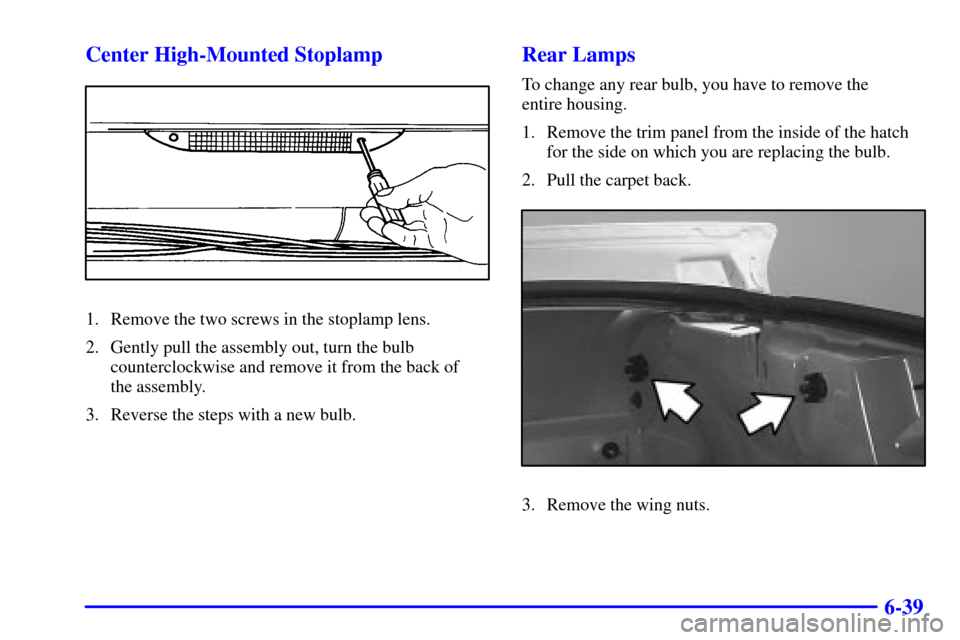
6-39 Center High-Mounted Stoplamp
1. Remove the two screws in the stoplamp lens.
2. Gently pull the assembly out, turn the bulb
counterclockwise and remove it from the back of
the assembly.
3. Reverse the steps with a new bulb.
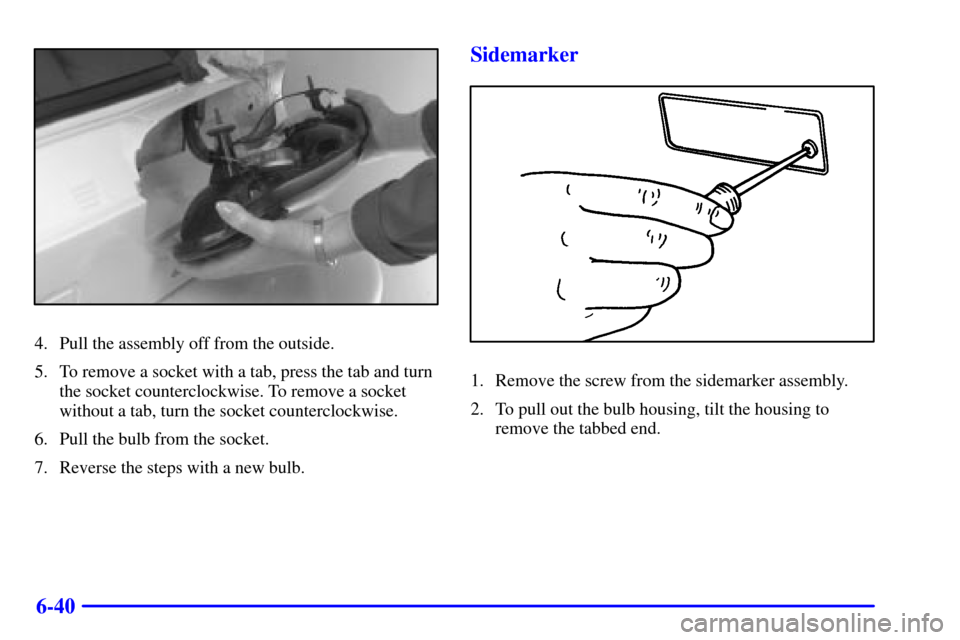
Rear Lamps
To change any rear bulb, you have to remove the
entire housing.
1. Remove the trim panel from the inside of the hatch
for the side on which you are replacing the bulb.
2. Pull the carpet back.
3. Remove the wing nuts.
Page 294 of 363
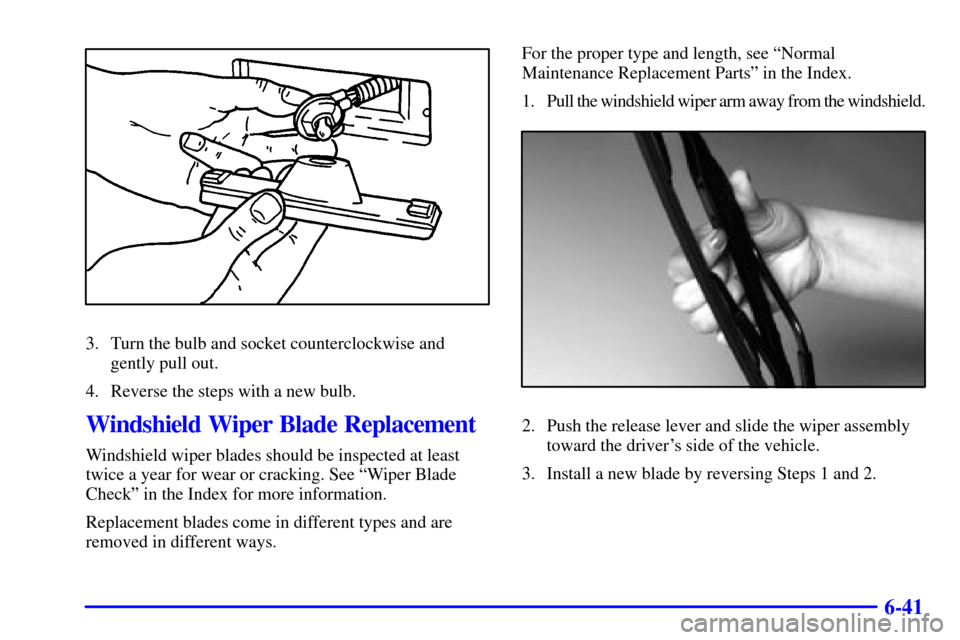
6-40
4. Pull the assembly off from the outside.
5. To remove a socket with a tab, press the tab and turn
the socket counterclockwise. To remove a socket
without a tab, turn the socket counterclockwise.
6. Pull the bulb from the socket.
7. Reverse the steps with a new bulb.
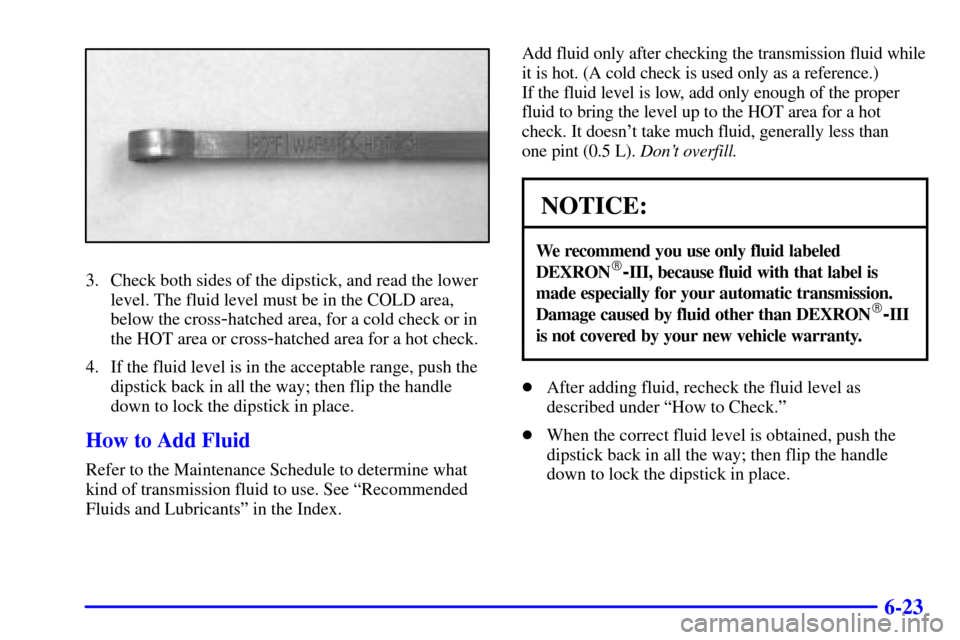
Sidemarker
1. Remove the screw from the sidemarker assembly.
2. To pull out the bulb housing, tilt the housing to
remove the tabbed end.
Page 295 of 363
6-41
3. Turn the bulb and socket counterclockwise and
gently pull out.
4. Reverse the steps with a new bulb.
Windshield Wiper Blade Replacement
Windshield wiper blades should be inspected at least
twice a year for wear or cracking. See ªWiper Blade
Checkº in the Index for more information.
Replacement blades come in different types and are
removed in different ways. For the proper type and length, see ªNormal
Maintenance Replacement Partsº in the Index.
1. Pull the windshield wiper arm away from the windshield.
2. Push the release lever and slide the wiper assembly
toward the driver's side of the vehicle.
3. Install a new blade by reversing Steps 1 and 2.
Page 317 of 363

6-63 Fuses and Circuit Breakers
The wiring circuits in your vehicle are protected from
short circuits by a combination of fuses, circuit breakers,
and fusible thermal links in the wiring itself. This greatly
reduces the chance of fires caused by electrical problems.
There are three fuse centers on your vehicle.
The main fuse block is located behind a cover on the
driver's side of the instrument panel.
The other two are located in the engine compartment on
the driver's side. Open the cover on either of the boxes
to expose the fuses.
Look at the silver
-colored band inside the fuse. If the
band is broken or melted, replace the fuse. Be sure you
replace a bad fuse with a new one of the correct size.
If you ever have a problem on the road and don't have a
spare fuse, you can borrow one of the correct value. Just
pick some feature of your vehicle that you can get along
without
-- like the radio or cigarette lighter -- and use
its fuse, if it is the size you need. Replace it as soon as
you can.
Page 318 of 363
6-64
Main Fuse Block
Fuse Usage
STOP/HAZARD Hazard Flashers, Brake
Switch Assembly
TURN B/U Traction Control/Second
-Gear
Start Switch, Back
-Up Lamp
Switch, Turn Flasher, Daytime
Running Lamps (DRL) ModuleFuse Usage
STG
WHL CNTRLSteering Wheel Controls
RADIO ACCY Delco Monsoon Radio Amplifier,
Remote CD Player (Trunk)
TAIL LPS Daytime Running Lamps (DRL)
Module, Headlamp Switch
HVAC HVAC Selector Switch,
Rear Defogger Switch/Timer
PWR ACCY Parking Lamp Relay, Hatch
Release Relay, Power Mirror
Switch, Radio, Shock Sensor,
Instrument Cluster
COURTESY Body Control Module (BCM)
GAUGES Body Control Module (BCM),
Brake
-Transmission Shift
Interlock (BTSI), Instrument
Cluster, Daytime Running
Lamps (DRL) Module
AIR BAG Air Bag System
Page 320 of 363
6-66
Underhood Electrical Center
Fuse and Relay Center 1
Fuse Usage
ABS BAT SOL Anti
-Lock Brake System
TCS BAT Traction Control System (ASR)
and ETC
COOL FAN Cooling Fan Control
PCM BAT Powertrain Control
Module (PCM)Fuse Usage
FUEL PUMP Fuel Pump
AIR PUMP Air Pump Relay and Bleed Valve
LH HDLP DR Left Headlamp Door and Module
RH HDLP DR Right Headlamp Door and Module
HORN Horn Relay
ABS BAT
-1 Anti-Lock Brake System Module
H/L DR HORN Horn and Headlamp Doors
ABS BAT
-2 Anti-Lock Brake and Traction
Control System (ASR)
COOL FAN Cooling Fan Relays
Relay Description
FOG LAMP Fog Lamps
HORN Horn
FAN #3 Cooling Fans
FAN #2 Cooling Fans
FAN #1 Cooling Fans