Page 242 of 321
6-59
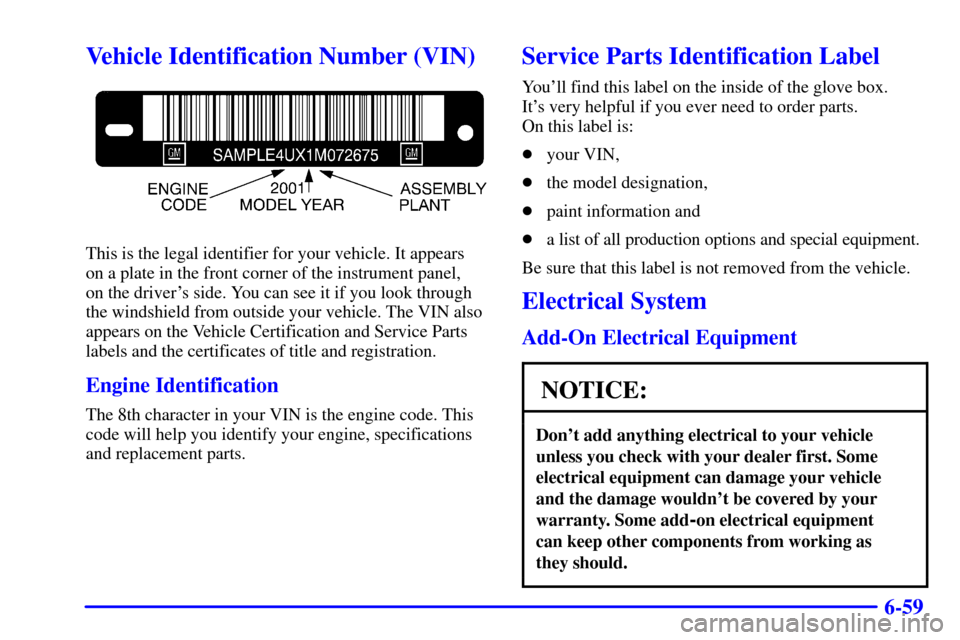
Vehicle Identification Number (VIN)
This is the legal identifier for your vehicle. It appears
on a plate in the front corner of the instrument panel,
on the driver's side. You can see it if you look through
the windshield from outside your vehicle. The VIN also
appears on the Vehicle Certification and Service Parts
labels and the certificates of title and registration.
Engine Identification
The 8th character in your VIN is the engine code. This
code will help you identify your engine, specifications
and replacement parts.
Service Parts Identification Label
You'll find this label on the inside of the glove box.
It's very helpful if you ever need to order parts.
On this label is:
�your VIN,
�the model designation,
�paint information and
�a list of all production options and special equipment.
Be sure that this label is not removed from the vehicle.
Electrical System
Add-On Electrical Equipment
NOTICE:
Don't add anything electrical to your vehicle
unless you check with your dealer first. Some
electrical equipment can damage your vehicle
and the damage wouldn't be covered by your
warranty. Some add
-on electrical equipment
can keep other components from working as
they should.
Page 248 of 321
6-65
Replacement Bulbs
Exterior Lamps Quantity Number
Sealed Beam Headlamps 2 H6054
Composite Low
-Beam
Headlamps2 9006
Composite High
-Beam
Headlamps2 9005
Front Marker Lamp 2 194
Front Parking and Turn Lamp 4 2357NA
Rear Parking Lamp 2 3057
Rear Stop and Turn Lamp 2 3057
Back
-up Lamp2 3156
Roof Marker Lamp 5 194Interior Lamps Quantity Number
Dome Lamps 2
211
-2
Reading Lamps 2
211
-2
Door Courtesy Lamps 2 194
Instrument Panel
Compartment Lamp1 194
For service information on other bulbs, contact your
dealer's service department.
Page 250 of 321

6-67
Normal Maintenance
Replacement Parts
Replacement part numbers listed in this section are
based on the latest information available at the time of
printing, and are subject to change. If a part listed in this
manual is not the same as the part used in your vehicle
when it was built, or if you have any questions, please
contact your GM truck dealer.
These specifications are for information only. If you
have any questions, see the service manual for the
chassis or refer to the body manufacturer's publications.VIN Code G. . . . . . . . . . . . . . . . . . . . . . . . . . . .
Oil Filter* PF454. . . . . . . . . . . . . . . . . . . . . . . .
Air Cleaner Filter* A1300C�� . . . . . . . . . . . . . .
Spark Plugs*** TJ14R
-P15 . . . . . . . . . . . . . . .
Fuel Filter* GF626. . . . . . . . . . . . . . . . . . . . . . .
Wiper Blades** 22154886. . . . . . . . . . . . . . . . .
Wiper Blade Type Trico. . . . . . . . . . . . . . . . . .
Wiper Blade Length 18 inches (45.0 cm). . . . . .
*ACDelco
� part number
**GM part number
***Denso part number
��A1301C high
-capacity air cleaner filter.
Page 251 of 321
7-
7-1
Section 7 Maintenance Schedule
This section covers the maintenance required for your vehicle. Your vehicle needs these services to retain its safety,
dependability and emission control performance.
7
-2 Introduction
7
-4 Part A: Scheduled Maintenance Services
7
-9 Short Trip/City Scheduled Maintenance
7
-31 Long Trip/Highway Scheduled Maintenance7
-45 Part B: Owner Checks and Services
7
-50 Part C: Periodic Maintenance Inspections
7
-52 Part D: Recommended Fluids and Lubricants
7
-55 Part E: Maintenance Record
Page 253 of 321
7-3 How This Section is Organized
This maintenance schedule is divided into five parts:
ªPart A: Scheduled Maintenance Servicesº shows
what to have done and how often. Some of these
services can be complex, so unless you are technically
qualified and have the necessary equipment, you should
let your dealer's service department or another qualified
service center do these jobs.
CAUTION:
Performing maintenance work on a vehicle can
be dangerous. In trying to do some jobs, you can
be seriously injured. Do your own maintenance
work only if you have the required know
-how
and the proper tools and equipment for the job.
If you have any doubt, have a qualified
technician do the work.
If you want to get the service information, see ªService
and Owner Publicationsº in the Index.ªPart B: Owner Checks and Servicesº tells you
what should be checked and when. It also explains
what you can easily do to help keep your vehicle in
good condition.
ªPart C: Periodic Maintenance Inspectionsº explains
important inspections that your dealer's service
department or another qualified service center
should perform.
ªPart D: Recommended Fluids and Lubricantsº lists
some recommended products necessary to help keep
your vehicle properly maintained. These products, or
their equivalents, should be used whether you do the
work yourself or have it done.
ªPart E: Maintenance Recordº is a place for
you to record and keep track of the maintenance
performed on your vehicle. Keep your maintenance
receipts. They may be needed to qualify your vehicle
for warranty repairs.
Page 254 of 321
7-4
Part A: Scheduled
Maintenance Services
Using Your Maintenance Schedule
We at General Motors want to help you keep your
vehicle in good working condition. But we don't know
exactly how you'll drive it. You may drive very short
distances only a few times a week. Or you may drive
long distances all the time in very hot, dusty weather.
You may use your vehicle in making deliveries.
Or you may drive it to work, to do errands or in
many other ways.
Because of all the different ways people use their
vehicles, maintenance needs vary. You may need more
frequent checks and replacements. So please read the
following and note how you drive. If you have any
questions on how to keep your vehicle in good
condition, see your dealer.
This part tells you the maintenance services you should
have done and when you should schedule them. If you
go to your dealer for your service needs, you'll know
that GM
-trained and supported service people will
perform the work using genuine GM parts.The proper fluids and lubricants to use are listed in
Part D. Make sure whoever services your vehicle
uses these. All parts should be replaced and all
necessary repairs done before you or anyone else
drives the vehicle.
These schedules are for vehicles that:
�carry passengers and cargo within recommended
limits. You will find these limits on your vehicle's
Certification/Tire label. See ªLoading Your Vehicleº
in the Index.
�are driven on reasonable road surfaces within legal
driving limits.
�use the recommended fuel. See ªFuelº in the Index.
Selecting the Right Schedule
First you'll need to decide which of the two schedules is
right for your vehicle. Here's how to decide which
schedule to follow:
Page 255 of 321
Scheduled Maintenance
7-5
Short Trip/City Definition
Follow the Short Trip/City Scheduled Maintenance if
any one of these conditions is true for your vehicle:
�Most trips are less than 5 to 10 miles (8 to 16 km).
This is particularly important when outside
temperatures are below freezing.
�Most trips include extensive idling (such as frequent
driving in stop
-and-go traffic).
�You operate your vehicle in dusty areas or
off
-road frequently.
�You frequently tow a trailer.
�If the vehicle is used for delivery service, police, taxi
or other commercial application.
One of the reasons you should follow this schedule
if you operate your vehicle under any of these conditions
is that these conditions cause engine oil to break
down sooner.
Short Trip/City Intervals
Every 3,000 Miles (5 000 km): Engine Oil and Filter
Change (or 3 months, whichever occurs first). Chassis
Lubrication (or 3 months, whichever occurs first).
Rear Axle Fluid Check.
Every 6,000 Miles (10 000 km): Tire Rotation.
Every 15,000 Miles (25 000 km): Shields and
Underhood Insulation Inspection. Diesel Engine
Only: Thermostatically Controlled Engine Cooling
Fan Check (or every 12 months, whichever occurs
first). Diesel Engine Only: Air Intake System
Inspection. Front Wheel Bearing Repack
(or at each brake relining, whichever occurs first).
Every 24,000 Miles (40 000 km): Diesel Engine Only:
Fuel Cap Replacement, if driving in dusty conditions.
(Continued)
Page 256 of 321
Scheduled Maintenance
7-6
Short Trip/City Intervals
Every 30,000 Miles (50 000 km): Rear Axle Fluid
Change with Extreme Overload, Trailer Towing or
High Speed Use. Fuel Filter Replacement.
Every 50,000 Miles (83 000 km): Automatic
Transmission Service.
Every 60,000 Miles (100 000 km): Engine Accessory
Drive Belt Inspection. If Equipped: Exhaust Gas
Recirculation System Inspection. Gasoline Engine
Only: Evaporative Control System Inspection.
Diesel Engine Only: Crankcase Depression Regulator
Valve (CDRV) System Check.
Short Trip/City Intervals
Every 100,000 Miles (166 000 km): Gasoline Engine
Only: Spark Plug Wire Inspection. Gasoline Engine
Only: Spark Plug Replacement. Gasoline Engine
Only: Automatic Transmission Service (normal
conditions). Gasoline Engine Only: Positive
Crankcase Ventilation (PCV) Valve Inspection.
Every 150,000 Miles (240 000 km): Cooling System
Service (or every 60 months, whichever occurs first).
These intervals only summarize maintenance services.
Be sure to follow the complete scheduled maintenance
on the following pages.