Page 210 of 321
6-27
Radiator Pressure Cap
(Gasoline Engine)
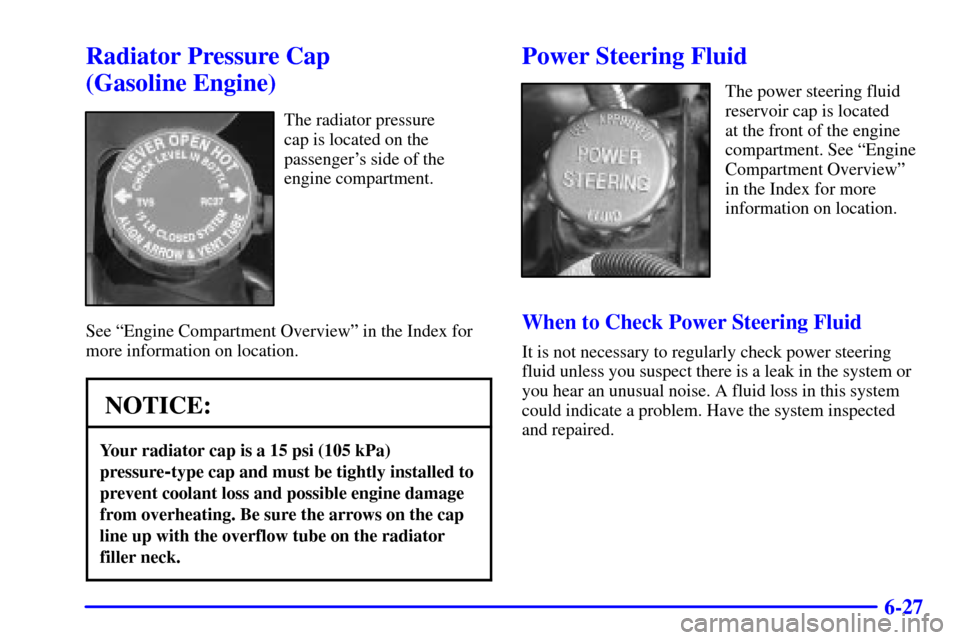
The radiator pressure
cap is located on the
passenger's side of the
engine compartment.
See ªEngine Compartment Overviewº in the Index for
more information on location.
NOTICE:
Your radiator cap is a 15 psi (105 kPa)
pressure
-type cap and must be tightly installed to
prevent coolant loss and possible engine damage
from overheating. Be sure the arrows on the cap
line up with the overflow tube on the radiator
filler neck.
Power Steering Fluid
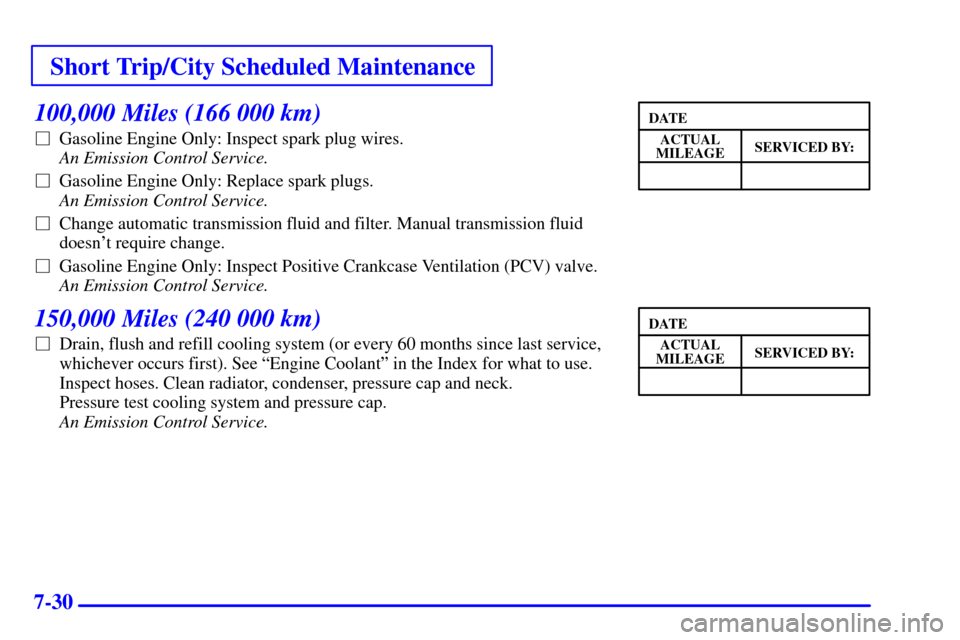
The power steering fluid
reservoir cap is located
at the front of the engine
compartment. See ªEngine
Compartment Overviewº
in the Index for more
information on location.
When to Check Power Steering Fluid
It is not necessary to regularly check power steering
fluid unless you suspect there is a leak in the system or
you hear an unusual noise. A fluid loss in this system
could indicate a problem. Have the system inspected
and repaired.
Page 212 of 321
6-29
Open the cap labeled WASHER FLUID ONLY.
Add washer fluid until the tank is full.
NOTICE:
�When using concentrated washer fluid,
follow the manufacturer's instructions for
adding water.
�Don't mix water with ready
-to-use washer
fluid. Water can cause the solution to freeze
and damage your washer fluid tank and
other parts of the washer system. Also,
water doesn't clean as well as washer fluid.
�Fill your washer fluid tank only
three
-quarters full when it's very cold.
This allows for expansion if freezing
occurs, which could damage the tank
if it is completely full.
�Don't use engine coolant (antifreeze) in
your windshield washer. It can damage
your washer system and paint.
Brakes
Brake Fluid
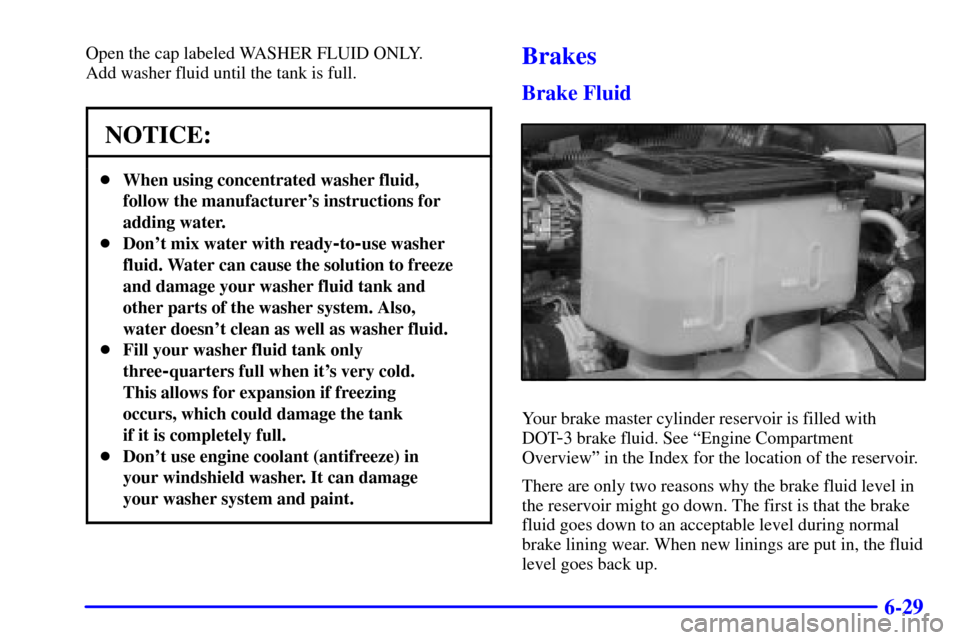
Your brake master cylinder reservoir is filled with
DOT
-3 brake fluid. See ªEngine Compartment
Overviewº in the Index for the location of the reservoir.
There are only two reasons why the brake fluid level in
the reservoir might go down. The first is that the brake
fluid goes down to an acceptable level during normal
brake lining wear. When new linings are put in, the fluid
level goes back up.
Page 245 of 321
6-62
Fuse/Circuit
BreakerUsage
4 Instrument Cluster, DRL Relay,
Lamp Switch, Keyless Entry, Low
Coolant Module, Illuminated Entry
Module, DRAC (Diesel Engine)
5 Not Used
6 Cruise Control
7 Auxiliary Power Outlet
8 Crank
9 License Lamp, Parking Lamps,
Taillamps, Roof Marker
Lamps, Front Sidemarkers,
Door Switch Illumination,
Headlamp Switch Illumination
10 Not Used
11 Wiper Motor, Washer Pump
12 A/C, A/C Blower,
High Blower Relay
13 Power Amp, Cigarette Lighter,
Door Lock RelayFuse/Circuit
BreakerUsage
14 Cluster, Comfort Controls,
Instrument Switches, Radio
Illumination, Chime Module
15 DRL Relay
16 Front and Rear Turn Signals,
Back
-Up Lamps
17 Radio (Ignition)
18 4WAL/VCM, ABS, Cruise Control
19 Radio (Battery)
20 PRNDL, Automatic Transmission,
Speedometer, Check Gages
Warning Light
21 Security/Steering
22 Not Used
23 Not Used
24 TP2 Relay (Gasoline Engine)
A Power Door Lock, Keyless
Entry Module
B Power Windows
Page 280 of 321
Short Trip/City Scheduled Maintenance
7-30
100,000 Miles (166 000 km)
�Gasoline Engine Only: Inspect spark plug wires.
An Emission Control Service.
�Gasoline Engine Only: Replace spark plugs.
An Emission Control Service.
�Change automatic transmission fluid and filter. Manual transmission fluid
doesn't require change.
�Gasoline Engine Only: Inspect Positive Crankcase Ventilation (PCV) valve.
An Emission Control Service.
150,000 Miles (240 000 km)
�Drain, flush and refill cooling system (or every 60 months since last service,
whichever occurs first). See ªEngine Coolantº in the Index for what to use.
Inspect hoses. Clean radiator, condenser, pressure cap and neck.
Pressure test cooling system and pressure cap.
An Emission Control Service.
ACTUAL
SERVICED BY:MILEAGE
DATE
ACTUAL
SERVICED BY:MILEAGE
DATE
Page 294 of 321
Long Trip/Highway Scheduled Maintenance
7-44
100,000 Miles (166 000 km)
�Gasoline Engine Only: Inspect spark plug wires.
An Emission Control Service.
�Gasoline Engine Only: Replace spark plugs.
An Emission Control Service.
�Change automatic transmission fluid and filter. Manual transmission fluid
doesn't require change.
�Gasoline Engine Only: Inspect Positive Crankcase Ventilation (PCV) valve.
An Emission Control Service.
150,000 Miles (240 000 km)
�Drain, flush and refill cooling system (or every 60 months since last service,
whichever occurs first). See ªEngine Coolantº in the Index for what to use.
Inspect hoses. Clean radiator, condenser, pressure cap and neck.
Pressure test the cooling system and pressure cap.
An Emission Control Service.
ACTUAL
SERVICED BY:MILEAGE
DATE
ACTUAL
SERVICED BY:MILEAGE
DATE
Page 295 of 321

7-45
Part B: Owner Checks and Services
Listed in this part are owner checks and services which
should be performed at the intervals specified to help
ensure the safety, dependability and emission control
performance of your vehicle.
Be sure any necessary repairs are completed at once.
Whenever any fluids or lubricants are added to your
vehicle, make sure they are the proper ones, as
shown in Part D.
At the First 100, 1,000 and 6,000 Miles
(160, 1 600 and 10 000 km)
Check dual wheel nut torque. For proper torque, see
ªWheel Nut Torqueº and ªTightening the Wheel Nutsº
in the Index.
At Each Fuel Fill
It is important for you or a service station attendant to
perform these underhood checks at each fuel fill.
Engine Oil Level Check
Check the engine oil level and add the proper oil if
necessary. See ªEngine Oilº in the Index for
further details.Engine Coolant Level Check
Check the engine coolant level and add DEX
-COOL�
coolant mixture if necessary. See ªEngine Coolantº in
the Index for further details.
Windshield Washer Fluid Level Check
Check the windshield washer fluid level in the
windshield washer tank and add the proper fluid if
necessary. See ªWindshield Washer Fluidº in the
Index for further details.
At Least Once a Month
Tire Inflation Check
Make sure tires are inflated to the correct pressures.
Don't forget to check your spare tire. See ªTiresº in
the Index for further details.
Cassette Deck Service
Clean cassette deck. Cleaning should be done every
50 hours of tape play. See ªAudio Systemsº in the
Index for further details.
Page 302 of 321
7-52
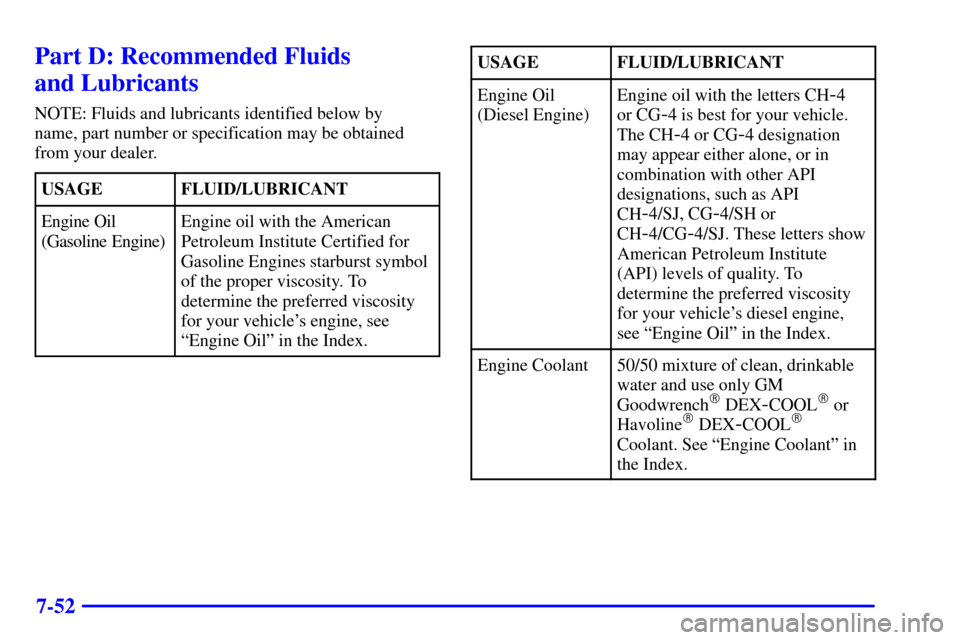
Part D: Recommended Fluids
and Lubricants
NOTE: Fluids and lubricants identified below by
name, part number or specification may be obtained
from your dealer.
USAGE
FLUID/LUBRICANT
Engine Oil
(Gasoline Engine)Engine oil with the American
Petroleum Institute Certified for
Gasoline Engines starburst symbol
of the proper viscosity. To
determine the preferred viscosity
for your vehicle's engine, see
ªEngine Oilº in the Index.
USAGEFLUID/LUBRICANT
Engine Oil
(Diesel Engine)Engine oil with the letters CH-4
or CG
-4 is best for your vehicle.
The CH
-4 or CG-4 designation
may appear either alone, or in
combination with other API
designations, such as API
CH
-4/SJ, CG-4/SH or
CH
-4/CG-4/SJ. These letters show
American Petroleum Institute
(API) levels of quality. To
determine the preferred viscosity
for your vehicle's diesel engine,
see ªEngine Oilº in the Index.
Engine Coolant50/50 mixture of clean, drinkable
water and use only GM
Goodwrench
� DEX-COOL� or
Havoline� DEX-COOL�
Coolant. See ªEngine Coolantº in
the Index.