Page 164 of 321
5-2
Hazard Warning Flashers
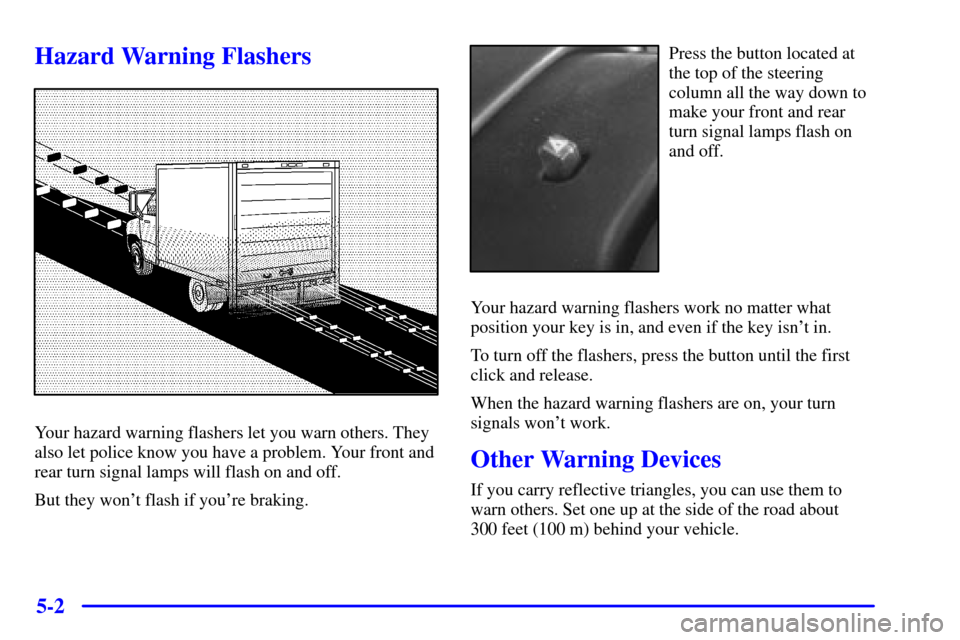
Your hazard warning flashers let you warn others. They
also let police know you have a problem. Your front and
rear turn signal lamps will flash on and off.
But they won't flash if you're braking.
Press the button located at
the top of the steering
column all the way down to
make your front and rear
turn signal lamps flash on
and off.
Your hazard warning flashers work no matter what
position your key is in, and even if the key isn't in.
To turn off the flashers, press the button until the first
click and release.
When the hazard warning flashers are on, your turn
signals won't work.
Other Warning Devices
If you carry reflective triangles, you can use them to
warn others. Set one up at the side of the road about
300 feet (100 m) behind your vehicle.
Page 181 of 321

5-19
Engine Fan Noise
Your vehicle has a clutched engine cooling fan. When
the clutch is engaged, the fan spins faster to provide
more air to cool the engine. In most everyday driving
conditions, the fan is spinning slower and the clutch is
not fully engaged. This improves fuel economy and
reduces fan noise. Under heavy vehicle loading, trailer
towing and/or high outside temperatures, the fan speed
increases as the clutch more fully engages. So you may
hear an increase in fan noise. This is normal and should
not be mistaken as the transmission slipping or making
extra shifts. It is merely the cooling system functioning
properly. The fan will slow down when additional
cooling is not required and the clutch disengages.
You may also hear this fan noise when you start
the engine. It will go away as the fan clutch
partially disengages.
If a Tire Goes Flat
It's unusual for a tire to ªblow outº while you're driving,
especially if you maintain your tires properly. If air goes
out of a tire, it's much more likely to leak out slowly.
But if you should ever have a ªblowout,º here are a few
tips about what to expect and what to do:
If a front tire fails, the flat tire will create a drag that
pulls the vehicle toward that side. Take your foot off
the accelerator pedal and grip the steering wheel firmly.
Steer to maintain lane position, and then gently brake
to a stop well out of the traffic lane.
A rear blowout, particularly on a curve, acts much like
a skid and may require the same correction you'd use
in a skid. In any rear blowout, remove your foot from
the accelerator pedal. Get the vehicle under control by
steering the way you want the vehicle to go. It may be
very bumpy and noisy, but you can still steer. Gently
brake to a stop
-- well off the road if possible.
If a tire goes flat, avoid further tire and wheel damage
by driving slowly to a level place and turn on your
hazard warning flashers. The next part tells you what
to do.
Page 183 of 321
5-21
If You're Stuck: In Sand, Mud,
Ice or Snow
In order to free your vehicle when it is stuck, you will
need to spin the wheels, but you don't want to spin your
wheels too fast. The method known as ªrockingº can
help you get out when you're stuck, but you must
use caution.
CAUTION:
If you let your tires spin at high speed, they can
explode, and you or others could be injured. And,
the transmission or other parts of the vehicle can
overheat. That could cause an engine
compartment fire or other damage. When you're
stuck, spin the wheels as little as possible. Don't
spin the wheels above 35 mph (55 km/h) as shown
on the speedometer.
NOTICE:
Spinning your wheels can destroy parts of your
vehicle as well as the tires. If you spin the wheels
too fast while shifting your transmission back
and forth, you can destroy your transmission.
For information about using tire chains on your vehicle,
see ªTire Chainsº in the Index.
Rocking Your Vehicle To Get It Out
First, turn your steering wheel left and right. That will
clear the area around your front wheels. Then shift back
and forth between REVERSE (R) and a forward gear
(or with a manual transmission, between FIRST (1) or
SECOND (2) and REVERSE (R)), spinning the wheels
as little as possible. Release the accelerator pedal while
you shift, and press lightly on the accelerator pedal
when the transmission is in gear. By slowly spinning
your wheels in the forward and reverse directions, you
will cause a rocking motion that may free your vehicle.
If that doesn't get you out after a few tries, you may
need to be towed out. If you do need to be towed out,
see ªTowing Your Vehicleº in the Index.
Page 184 of 321

6-
6-1
Section 6 Service and Appearance Care
Here you will find information about the care of your vehicle. This section begins with service and fuel information,
and then it shows how to check important fluid and lubricant levels. There is also technical information about your
vehicle, and a part devoted to its appearance care.
6
-2 Service
6
-3 Fuel (Gasoline Engine)
6
-5 Fuels in Foreign Countries (Gasoline Engines)
6
-5 Filling Your Tank (Gasoline Engine)
6
-7 Filling a Portable Fuel Container
6
-7 Checking Things Under the Hood
6
-10 Noise Control System
6
-11 Engine Oil (Gasoline Engine)
6
-15 Engine Air Cleaner/Filter (Gasoline Engines)
6
-17 Automatic Transmission Fluid
6
-20 Manual Transmission Fluid
6
-21 Hydraulic Clutch
6
-22 Rear Axle
6
-23 Engine Coolant
6
-27 Radiator Pressure Cap (Gasoline Engine)
6
-27 Power Steering Fluid6
-28 Windshield Washer Fluid
6
-29 Brakes
6
-33 Battery
6
-33 Bulb Replacement
6
-40 Windshield Wiper Blade Replacement
6
-41 Tires
6
-51 Appearance Care
6
-52 Cleaning the Inside of Your Vehicle
6
-55 Cleaning the Outside of Your Vehicle
6
-58 GM Vehicle Care/Appearance Materials
6
-59 Vehicle Identification Number (VIN)
6
-59 Electrical System
6
-65 Replacement Bulbs
6
-66 Capacities and Specifications
6
-67 Normal Maintenance Replacement Parts
Page 192 of 321
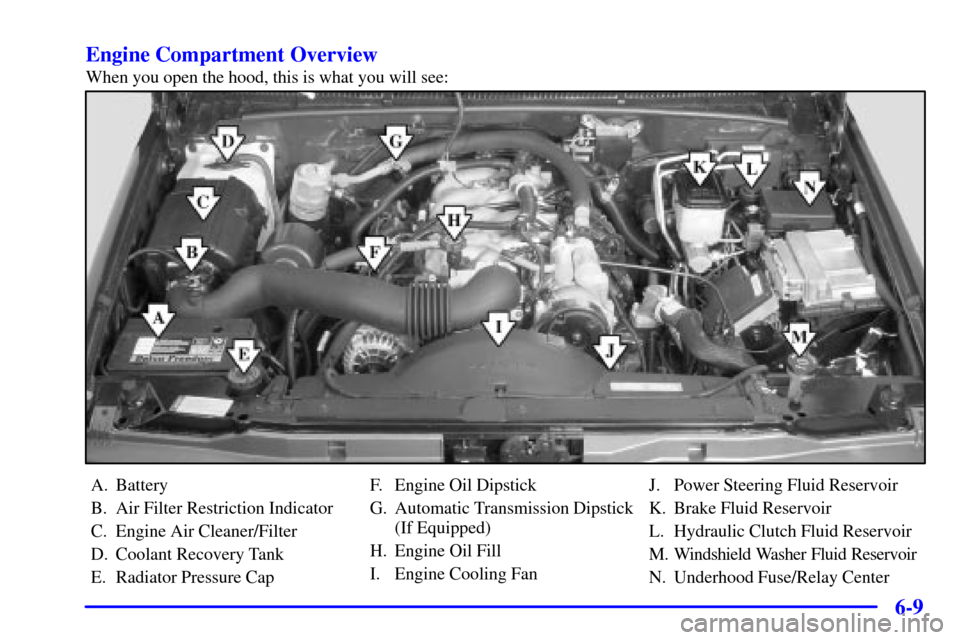
6-9 Engine Compartment Overview
When you open the hood, this is what you will see:
A. Battery
B. Air Filter Restriction Indicator
C. Engine Air Cleaner/Filter
D. Coolant Recovery Tank
E. Radiator Pressure CapF. Engine Oil Dipstick
G. Automatic Transmission Dipstick
(If Equipped)
H. Engine Oil Fill
I. Engine Cooling FanJ. Power Steering Fluid Reservoir
K. Brake Fluid Reservoir
L. Hydraulic Clutch Fluid Reservoir
M. Windshield Washer Fluid Reservoir
N. Underhood Fuse/Relay Center
Page 210 of 321
6-27
Radiator Pressure Cap
(Gasoline Engine)
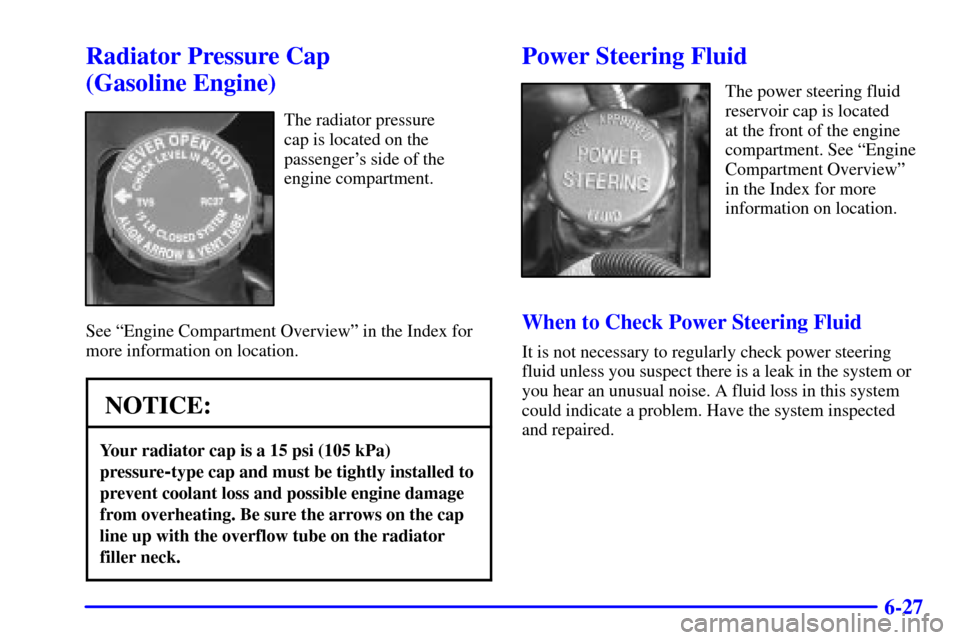
The radiator pressure
cap is located on the
passenger's side of the
engine compartment.
See ªEngine Compartment Overviewº in the Index for
more information on location.
NOTICE:
Your radiator cap is a 15 psi (105 kPa)
pressure
-type cap and must be tightly installed to
prevent coolant loss and possible engine damage
from overheating. Be sure the arrows on the cap
line up with the overflow tube on the radiator
filler neck.
Power Steering Fluid
The power steering fluid
reservoir cap is located
at the front of the engine
compartment. See ªEngine
Compartment Overviewº
in the Index for more
information on location.
When to Check Power Steering Fluid
It is not necessary to regularly check power steering
fluid unless you suspect there is a leak in the system or
you hear an unusual noise. A fluid loss in this system
could indicate a problem. Have the system inspected
and repaired.
Page 211 of 321
6-28 How to Check Power Steering Fluid
Turn the key off, let the engine compartment cool down,
wipe the cap and the top of the reservoir clean, then
unscrew the cap and wipe the dipstick with a clean rag.
Replace the cap and completely tighten it. Then remove
the cap again and look at the fluid level on the dipstick.
The level should be at the FULL COLD mark.
If necessary, add only enough fluid to bring the
level up to the mark.
What to Use
To determine what kind of fluid to use, see
ªRecommended Fluids and Lubricantsº in the Index.
Always use the proper fluid. Failure to use the proper
fluid can cause leaks and damage hoses and seals.
Windshield Washer Fluid
What to Use
When you need windshield washer fluid, be sure to read
the manufacturer's instructions before use. If you will be
operating your vehicle in an area where the temperature
may fall below freezing, use a fluid that has sufficient
protection against freezing.
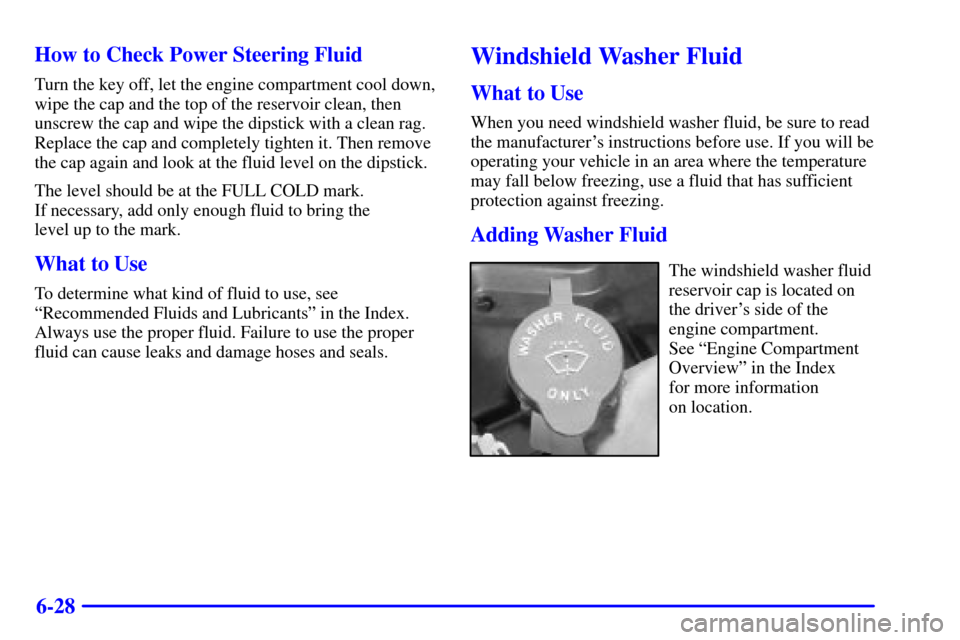
Adding Washer Fluid
The windshield washer fluid
reservoir cap is located on
the driver's side of the
engine compartment.
See ªEngine Compartment
Overviewº in the Index
for more information
on location.
Page 245 of 321
6-62
Fuse/Circuit
BreakerUsage
4 Instrument Cluster, DRL Relay,
Lamp Switch, Keyless Entry, Low
Coolant Module, Illuminated Entry
Module, DRAC (Diesel Engine)
5 Not Used
6 Cruise Control
7 Auxiliary Power Outlet
8 Crank
9 License Lamp, Parking Lamps,
Taillamps, Roof Marker
Lamps, Front Sidemarkers,
Door Switch Illumination,
Headlamp Switch Illumination
10 Not Used
11 Wiper Motor, Washer Pump
12 A/C, A/C Blower,
High Blower Relay
13 Power Amp, Cigarette Lighter,
Door Lock RelayFuse/Circuit
BreakerUsage
14 Cluster, Comfort Controls,
Instrument Switches, Radio
Illumination, Chime Module
15 DRL Relay
16 Front and Rear Turn Signals,
Back
-Up Lamps
17 Radio (Ignition)
18 4WAL/VCM, ABS, Cruise Control
19 Radio (Battery)
20 PRNDL, Automatic Transmission,
Speedometer, Check Gages
Warning Light
21 Security/Steering
22 Not Used
23 Not Used
24 TP2 Relay (Gasoline Engine)
A Power Door Lock, Keyless
Entry Module
B Power Windows